Archive for the ‘environment’ Category

STRESS !!!

August 11, 2018

I have been absent from writing for a couple months while negotiating a combination of work and health changes that, out this other side, I now see were causing me far more stress than I had recognized. I know that stress is insidious, subtle and pervasive. I know and employ a variety of stress management techniques as well as stress reduction practices. I thought I was dealing fairly well with the pressures, and feedback from others close to me suggests they also thought I was coping well.

The difference in my body, my energy, my viewpoint this morning when I woke from sleeping the clock round reveal just how much more severe and draining the stress was than I had realized. The physical health matter was the not uncommon need to undergo cataract surgery. In late May I determined that, although my vision was not yet seriously impaired, this summer would be a good time to get through the process. My eye doctor recommended completing the procedures before I became adapted to the grey and fuzzy results of thickening cataracts, and upcoming changes in my living conditions also suggested now would be a good time to get done with the necessary surgeries. I was able to schedule the two operations just two weeks apart, minimizing the time when I was faced with mismatched eyes that nonetheless had to function for daily reading and computer work in order for me to carry on with my employment.

As of today, both eyes are “set” for distance vision, with close to equal need for magnification for reading and to see the computer screen. Interestingly, my old trifocal prescription lenses are still serviceable at least temporarily. What was the distance adaptation works for the computer, what was the middle computer adjustment works for up close reading, and I look over the tops of the lenses for distance. I am told I must wait a month, until after I’m done with the complete and somewhat tedious regimen of drops, before being assessed for what should be the final prescription I will ever need. Or perhaps I won’t need one at all, and can simply use two strengths of readers, one for close and one for the computer screen.

My work during this period included not just my regular care coordination support for my caseload members, but also being trained on the new data management system that is being introduced this fall. Lots of learning and significant extra computer “face time” during the period when my vision was least reliable. In retrospect ,I see that I was struggling for a sense of control during a period of constant change in multiple areas of my life. And I see that I was less patient, more judgmental, and significantly more exhausted than I recognized at the time.

It bears repeating. Stress is subtle, insidious, draining and far more damaging than most of us credit. Managing stress is not the best answer, as my relatively successful effort to do so proves. Eliminating stresses is virtually impossible. Which leaves learning to minimize stress responses, the stated goal of a mindfulness training approach introduced during a recent gathering of my coworkers for our quarterly training at headquarters.

I did make an effort to take mindfulness breaks in my days. I know I kept away from worrying over possible problems and negative outcomes, focusing instead on what I could learn that would be of use to my clients (or helpful for mentoring my coworkers) as I adapted to the changes in vision and mastering the new and different data management system being implemented at work. While I believe I was moderately successful in this effort, I know I have a ways to go yet toward reducing (as opposed to managing) my stress levels.

I offer a general apology to those with whom I interacted over the past month when I was impatient and intolerant – particularly people in my employer’s IT department. Someone up their chain of command implemented a switch from software to cloud based email for all of us, without warning, without training, and without any allowance for the lack of adequate internet infrastructure in rural parts of the state such as where I live. Systems crashed, work could not be done to the tight required deadlines, and I had no leftover reserves to handle the additional stress. I especially want to – anonymously but in a most heartfelt way – acknowledge the IT tech I most recently dealt with, who showed me how to red flag an email as urgent and made me laugh at my own frustrations as he did so. Bless the man!

I don’t have anything substantive to add to the reams of online material (can a term for paper quantity be correctly applied to internet content?) on stress. Rather I feel impelled to document my renewed awareness of how deeply one can be affected by anything that brings one’s sense of identity, or one’s feeling of control over basics of daily life, into question. I did not consciously think about the changes I was going through. I coped with them and kept moving forward but that did not negate their manifestation as subtle stress that seriously drained my energy and sent my attitude “south” (Why south? What did south ever do to deserve so negative an association, other than be traditionally located downward on a map?)

Being present – with one’s Creator, Master, Higher Power, the Sound – being focused for however long or short a time on the immediate present and one’s vital essence and its supports, doesn’t just manage but eliminates stress for those moments. The more frequently one can remember the practice, and exercise it for even just  few moments, the less stress accumulates. The less accumulates, the less requires management, and the more one’s thoughts and energies can be directed to other more important endeavors. I know “these Truths to be self evident.” I apparently needed a reminder to put them more consistently into practice.

I have been reminded.

Baraka Bashad and Thanks Be.

Revisioning

May 29, 2016

A much needed break from my day job has just come to an end. Returning to work, I could feel the familiar skin of tension wrap itself around me, its confining pressure made up of having to be “on” at all times, a plethora of deadlines, and the need to adapt to constantly changing requirements. Knowing that the work is stressful and trying the usual tricks to reduce the impact of that stress – the vacation trip being one – still didn’t prepare me for the visceral reaction I experienced when I returned to work a few days ago.

Knowing about the stress, and intimately experiencing its descent upon me, are very different levels of awareness. The latter has motivated me to rededicate myself to living by my spiritual Master’s will, leaving control of how each day unfolds to wiser guidance than that of my own mind.

In practice this means I’m coming back to work intent on “redoing” my approach to my responsibilities so that I can use the awareness of the tense extra skin as a red flag – when I sense it, I know to stop, release the mental straightjacket into which I’ve wedged myself, and give control of my Self back to the Master. I already know that when I function from no-mind, all goes well, the work gets done, and I have energy left for the rest of my life interests.

As with any habit, I will need to implement this release repeatedly, until I no longer wear the tension sheath at all. My health will, I know, immediately improve, as it did during the short vacation break.

The second half of my vacation trip was also a redoing – or perhaps more correctly an undoing of a previous negative experience, replacing it with a positive one.

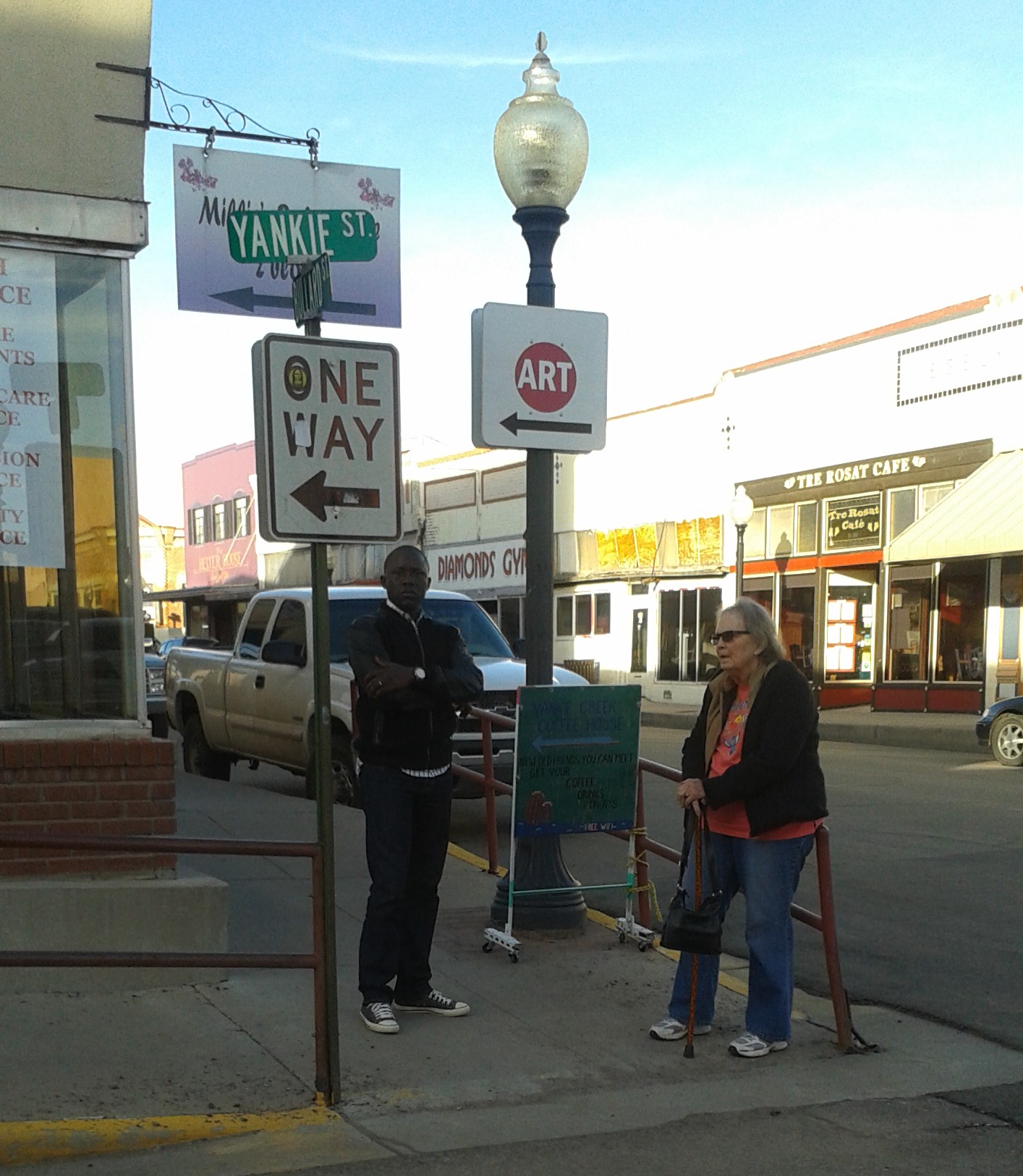
Some 15 years ago I made a similar trip across the Midwest to see a former getaway student – to Fargo rather than Rochester, my UWC student/temporary daughter then a Senegalese rather than an Asian. In the first instance my companion was, unknown to me, strung out on heroin and pretending not to be. As a result, when we were supposed to be enjoying a sightseeing return trip, he was too sick to do anything but insist we make it home as fast as possible. It was summer, so hot my Subaru’s AC couldn’t keep us any cooler than 90 and all I wanted was out of the heat and away from the anger and harsh attitude in my passenger seat. We drove within sight of the Crazy Horse monument, but did not see Mt. Rushmore, nor any of the other attractions of the Black Hills area.

This trip has been so different – relaxed conversation, enjoyment of the densely varied shades of green in Nebraska, Minnesota, and South Dakota with subtle differences between the three states noticeable to eyes attuned to grabbing whatever green can be found in New Mexico’s desert tans. We passed through areas of rolling hills which my husband said look like the area around Bamenda in his native Cameroon. We also passed a number of windfarms in Minnesota, the clean white towers with their sedately turning blades overlapping into the distance like a giant mobile decorating the sky. Farming continued between and below the strong white pillars, corn for biofuels being produced on the same lands as electricity from wind.

Following a warm family-feeling graduation/anniversary/birthday event in Minnesota, we drove back through South Dakota and down through the Black Hills, snapping pictures of the Mt. Rushmore faces and spending time in the museum at the Crazy Horse monument. The museum’s assembled collection of native crafts from all across the country provides visitors with an opportunity to appreciate differences in design, perhaps reflective of differences in perception and world view, between tribes. I particularly noticed a 150 year old beaded pouch from the Winnebago tribe with a floral design that put me immediately in mind of Georgia O’Keefe’s flower paintings. Distinctively different from the straight lined geometry I previously have associated with Native beadwork.

Recent astrology patterns suggest this spring to have been a period of review, with the opportunity to renew and revise one’s goals, as well as to set new patterns of social interaction. Eric Francis of PlanetWaves pointed out that each time of reconsideration (planets in retrograde) appears as an upheaval on the larger social scene, as we are collectively subjected to pressure to make changes. No surprise then, that we are looking at a political scene which has totally confounded the pollsters. And no surprise that I’ve been given the opportunity to make changes also, creating new memories and finding new and healthier ways to carry on with daily obligations.

Model of what is to be

Model of what is to be


The familiar that is

The familiar that is


En Famille

En Famille

Theme and Variations

November 22, 2015

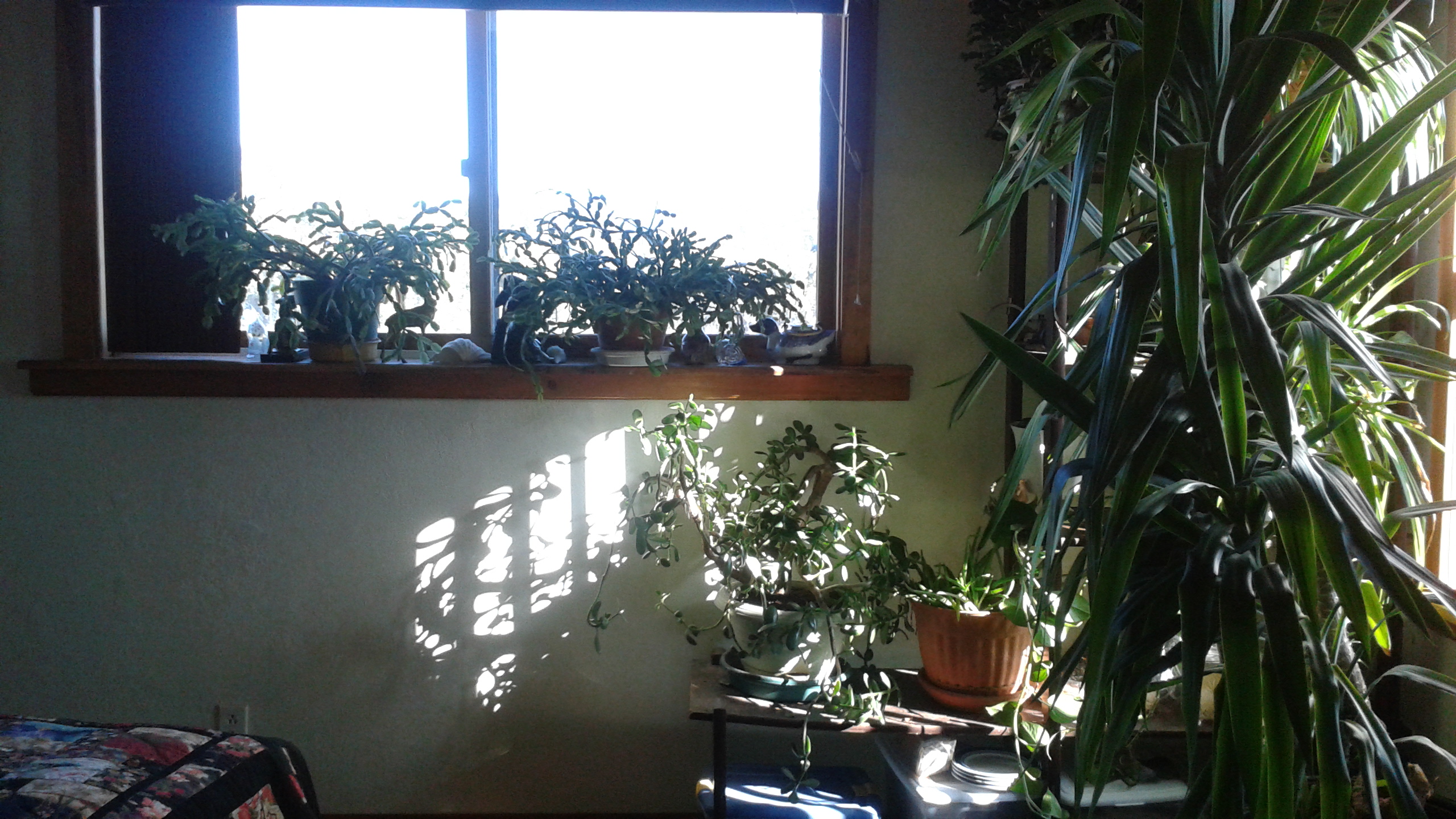
After several days of wood-stove heated cold weather, the temperature has soared to cotton shirtsleeve comfort, and an afternoon originally intended for housekeeping has turned into one spent on whatever could be completed outside in the sunlight. For my husband, that has meant washing cars. I, meanwhile, cooked some of his habanero pepper sauce on the outdoor grill (its bite sets everyone sneezing and crying if prepared inside) and re-potted houseplants. Or rather, transferred cuttings that had taken root in water into new pots, and repositioned one jade plant that, for reasons of its own, has chosen to grow so lopsidedly that its pot is highly prone to tip over. Reoriented, the main stem now angles sharply to one side, but seen from a distance the whole plant looks much more balanced.

straighter now beneath the window

straighter now
beneath the window

Why do some natures veer off crookedly? How do several children raised in the same supportive environment take such different attitudes forward into their adult life? Why are some people seemingly constitutionally unable to appreciate what is offered and available to them, while others build wondrous achievements out of little more than scraps and string?

My household greenery includes five different Christmas cactus plants, one of which has begun to bloom in anticipation of Advent. If previous years are any indicator, one or two more will flower before the holiday for which they are named, and one – the largest and oldest – will only flower around Easter time. Each is a different color, one white, one pink, and three distinct shades of red. They all get similar light, water and food, and are exposed to the same temperature variations, yet each takes its own turn to blossom.

If it’s true that no two snowflakes are alike (is it so?) then my examples of variation, where similarity might be expected, become rather insignificant and small. But more people seem to be affected by personality differences among siblings than are concerned with verifying the uniqueness of snowflakes or the reasons for oddities in the flowering cycle of plants.

Discussing one of my husband’s English writing assignments brought me up against the debate about how to treat addiction – as a disease that was not chosen any more than one chooses to have cancer, or as an intentional act with moral consequences. The former position is supported by medical evidence showing that when alcohol or drugs cause the release of endorphins in stressed individuals, their brains process this chemical change as life-saving. Future use/misuse of substances becomes, at a purely neurological level, a matter of survival. There is no longer any choice involved, just as a cancer patient does not have a choice about whether his untreated, abnormal cells replicate. Addicts need to seek treatment to recover from their addictions just as cancer patients need to seek treatment to (hopefully) recover from their malignancies.

Choice – and judgement – enter this scenario when the alcoholic refuses to admit he has a problem, or fails to seek treatment. Choice – and judgement – also enter the scenario when a person chooses not to undergo chemotherapy and/or radiation to treat cancer. The same variability that leads us to ask why two siblings should turn out so differently from one another can then lead us to wonder why two similarly situated alcoholics (married, with children, good jobs and reasonably effective support systems) should follow very different paths. Where one recognizes the harm being caused to family, and seeks treatment, the other dives into denial and eventually loses spouse, family and job without ever accepting the many offers of help being extended.

Is it that we need to believe we have free choice, no matter what? Is that why we insist there is a moral standard that is appropriately applied in all life situations? Two children have the benefit of the same loving parenting. One thrives and succeeds and gains our respect. The other struggles and turns to drink and becomes an object of scorn.

We do not scorn the cactus that fails to flower at Christmas. We are happy to welcome its flowering whenever it chooses to show its colors. I do not blame my goat Storm for persistently worming her way between the bars of the pasture gate; it is just her nature to want to get to that greener grass on the other side of the fence. I can’t imagine anyone blaming a snowflake for not looking identical to its neighbors on the patio. Why, then, are we so hard on ourselves and our fellow humans? Why can’t we simply accept that there is a wide range of individual variation in how people grow and respond and live, that our natures are as different, one from another, as are the many snowflakes that covered my yard four days ago? Then it was icy, snowy and cold while today it’s balmy and delightful outdoors. I don’t hear anyone saying “that’s wrong, that’s bad, Nature shouldn’t be so variable and inconsistent.”

Am I asking too much to wish that people could be as accepting of one another’s variability as we are of flowers, snowflakes, weather and stubbornly determined animals? To do so doesn’t mean abandoning standards of conduct, or being obliged to accept anything and everything as “cool, man” or “whatever.” If I meet someone who doesn’t seem to share my values, I am free to choose not to pursue the relationship. I don’t need to judge them, try to change them, or moralize about how and why they are as they are. And I can hope that they would, reciprocally, let me pass on without being subjected to attempts to change my vibrant red colors to muted pink ones.

Aspiration Accomplished

Downside, Upside

June 21, 2015


Nearly fifteen years of drought in my northeastern corner of NM have not come to an end – but this spring into summer we have had rain, almost daily, steady and hard at times, short and sharp at others. More days have been cloudy, foggy and cool than the dry, windy and sunny we’ve become accustomed to enduring since 2000. Forestry signs indicating level of fire danger are in the lower yellow – moderate – range instead of the screaming fire engine red of extreme.

Ranchers are running larger numbers of cattle, and those herds are lazing about in lush greenery up to their bellies. Horses are grazing fat, and antelope scattered among the domestic herds are too somnolent to come check out, as in their more normally inquisitive fashion, the curiosity of a person walking nearby and waving a hat. I give up waving, and continue my way, remembering the morning I woke from a sleep-out under the stars, a ring of antelope surrounding me. Not this bunch – too lazy.

The rainy dampness and chill have greatly delayed me in initiating my outdoor walking routine. A rural dirt lane a few miles from my house has become my normal exercise site – a mile and a half round trip the standard, easily extended to two miles or executed in every shorter times, according to my increasing stamina. By this time last year I was already well seasoned and doing two miles in half an hour. Today, it took me the half hour to just go a mile and a half.

The delay in getting up to speed is partly due to rain, and partly due to my own reluctance to switch to early morning walking. It’s been my habit to finish my work day and then walk – and that habit had years to become set, as the drought mandated waiting until the cooler temperatures of evening made walking a pleasure. I’ve become accustomed to the evening walk as a way to wind down from work, to quiet my mind and prepare for evening chores and rest.

Back in the 1990s, when last we had wet summers, I practiced a different routine. Then my exercise was riding my horses and I knew the activity had to be completed before midday, if at all. Our then typical summer pattern was bright sun and light breeze until about noon, when huge white cumulus clouds would build up and move in from the west, to collect and darken and dump rain in the afternoon, often lasting into the night.

That pattern has, this year, established itself once more. For several months now, by the time my work day is done, the sky is totally overcast, the air is thick and wet, the ground is sodden and more rain threatens/promises to fill the night. No way to walk outside and unwind from the stresses of the day.

Ronni Bennett, who blogs on elder issues at Time Goes By, Time Goes By recently posted about habits – in her case the habit of ordering her coffee from New York because that is easier than going through the process of trial and error to find a blend, where she now lives in Seattle, that satisfies her as much as her long-enjoyed standard.Ronni makes the important distinction between habit and addiction and reminds readers that, while addiction is a serious problem, habit most certainly is not. Indeed, we cannot survive without habits. How exhausting to have to go through a day thinking out each step of all the cleanliness routines, the household chores, the mechanical skills on which we rely! Habit only becomes a problem (still not as serious as addiction) when we become locked into patterns and resist change.

Like my recognized delay in adapting to the changed weather by switching my walks from evening to morning. I’ve started the process (today was my second morning outing) and expect that by week’s end I will have a new habit pattern in place. I will not, however, have made up for the month’s delay in building my endurance and speed over my usual trekking path.

Even in drought, walking in the evening meant wearing long sleeves and lots of bug repellant. Now, in the wet, walking at night is truly not safe (West Nile Virus is here). Fortunately, I do not seem to need excessive protection in the early morning. Perhaps the mosquitos, so very much more prevalent at night than they were last year, have also not made a change of habit to morning activity?

Walking in the early morning feels self-indulgent, like I’m doing something purely pleasurable BEFORE meeting my obligations to my family or to my employer. Why is it that I feel I’m only entitled to do something for myself after other responsibilities have been met? I work from home, am supposed to put in a “normal” work day/week but the demands of the job do not allow me to take lunch hours, the day never ends before 6 or 7 P.M. and only rarely do I have an entire weekend off. Why, then, am I still pushing myself to start promptly at 8 A.M., as though I were clocking into an office assignment?

Tomorrow, a Monday, I intend to walk as the start to my day. Probably that means I won’t turn on my work computer until 8:30. Almost certainly I’ll feel a bit guilty, but I’m counting on that habit, also, being changed by the end of the week. Morning walks, better energy and also, almost certainly, better concentration are my new habit priorities. This older dog IS learning new tricks.

Small Packages

February 3, 2015

Good things come in small packages could be the motto for the meals at Curious Kumquat restaurant in Silver City. Good things in small packages may also be the motto for my week of vacation, of which a meal at the Curious Kumquat was one experience.

Two J’s in Silver City

My friend and shared-birthday mate Jane treated us to the tasting menu at the small restaurant our first night out, at the start of our trek to California. The menu bade us choose our entree; the chef then served six various delights in small “taste” portions, all freshly made with local ingredients and served as beautiful works of art. We had a pumpkin-based soup, and my main course was rabbit, with dessert a chocolate flan bottom with white chocolate whip on top. I can’t repeat all the appetizers and side dishes; I should have written them down. There was a grain-based pudding-textured treat, with both berries and glazed vegetables as garnish. The service was flawless, elegant and yet comfortable. An absolutely perfect first night of vacation.

Sentinel in the Sun

Sentinel in the Sun

Good things in small packages continued, as we drove the long hours and miles across Arizona and California to San Diego. Saguaro let themselves be photographed. A rest stop at Gila Bend included colorful critters made of painted pottery from Mexico. The wind farms on the CA-AZ border are, to my mind, beautiful. Tall white towers stand out against their dull brown mountain background, sentinels of a future, protectors of the clear blue sky in that area. Quite a contrast to the layer of yellowish smog to be seen once we crossed over the mountains and began the descent back down to sea level.

Passing By

Passing By

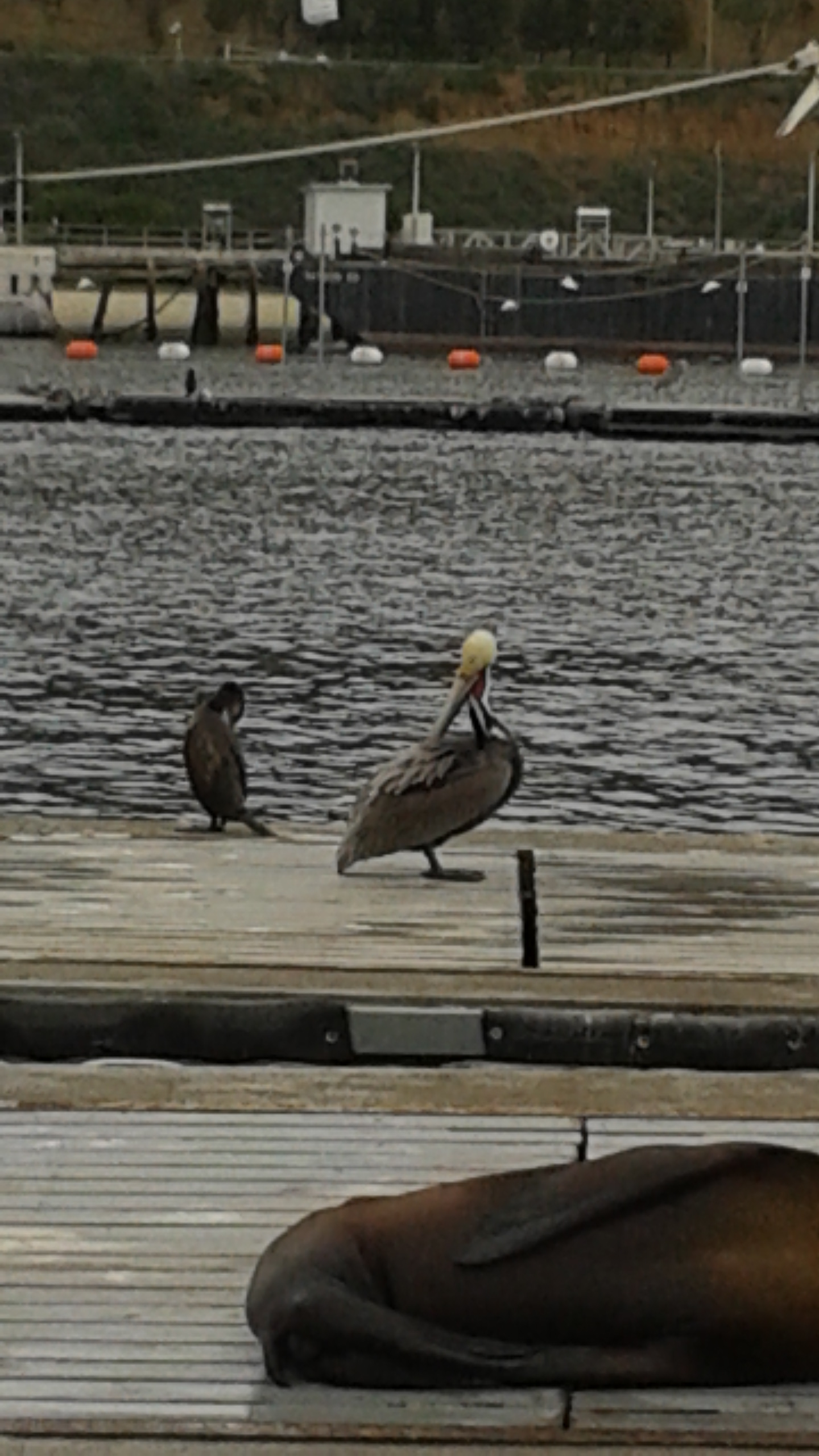
With only one day to sight see, we mostly walked – through the old Chinese area and a museum recording the history of Chinese settlement in San Diego. Around the harbor and downtown area, enjoying views of boats and waves and gulls. We did also ride – on a combination open bus that becomes a flat-bottomed boat, to view the harbor from the water. Sea lions and a variety of birds made the whole trip memorable.

Standing Proudly

Standing Proudly

Aah, a Good Stretch

Aah, a Good Stretch

Keeping Company

Keeping Company


The primary purpose of the trip was to attend MasterPath seminar… a wonderful thing in a not-so-little package, if one counts the number of participants (well over 1000) in the room. The Path being a singularly individual experience, however, a better perspective is of a room full of one thousand small packages, each one specially tailored to the person receiving it.

A Petite Beauty

A Petite Beauty

As we do with our unique meal in Silver City, the recipient of each MasterPath package will savor and remember it, and re-experience it afresh with each remembering.

Two to Enjoy

Two to Enjoy

No two alike, each a gift from the Divine. We are blessed.

Lifting a Veil of Ice

January 25, 2015

Driving toward Taos to see clients living high in the hills, in tiny villages tucked against mountain sides, I am mindful of the curious contrasts around me. I pass Sipapu Ski Resort, packed with families enjoying a weekend outing together, an influx of people to a sparsely populated valley that, if there is no snow, remains virtually deserted for weeks at a time. We had a substantial snow a few days ago, although nothing like the severe ones pummeling the East Coast. Immediately after the snow stopped our sunny days resumed, so that much of the moisture has turned from lovely white fluff to sticky, gooey mud.

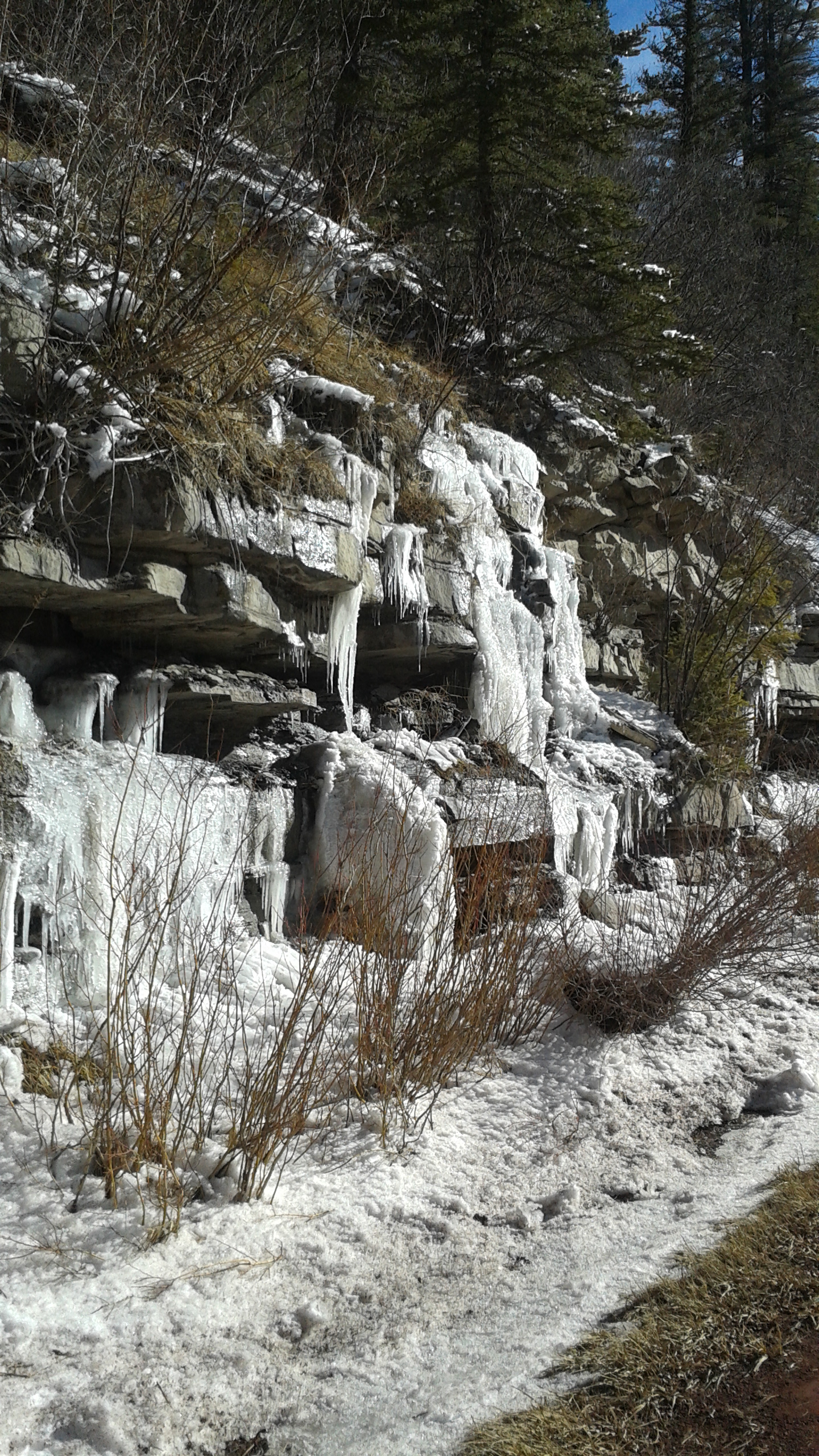
Along the route I drive regularly to Taos, I pass through a valley with steep rocky walls crowding one side of the road, a grassy verge and a stream skirting the other. In a few places the grassy area widens out sufficiently to provide pasture for cows and horses. In others, it narrows to a cascade rushing along beside the road, daring drivers to race it to the next corner. In a few places, the remnants of a small spring trickle down the rock face if we have a moist winter season, or some summer rains. At most times, of late, there is no sign of wetness on the rocks – our long years of drought have virtually exterminated the spring.

Caught in Time

Caught in Time

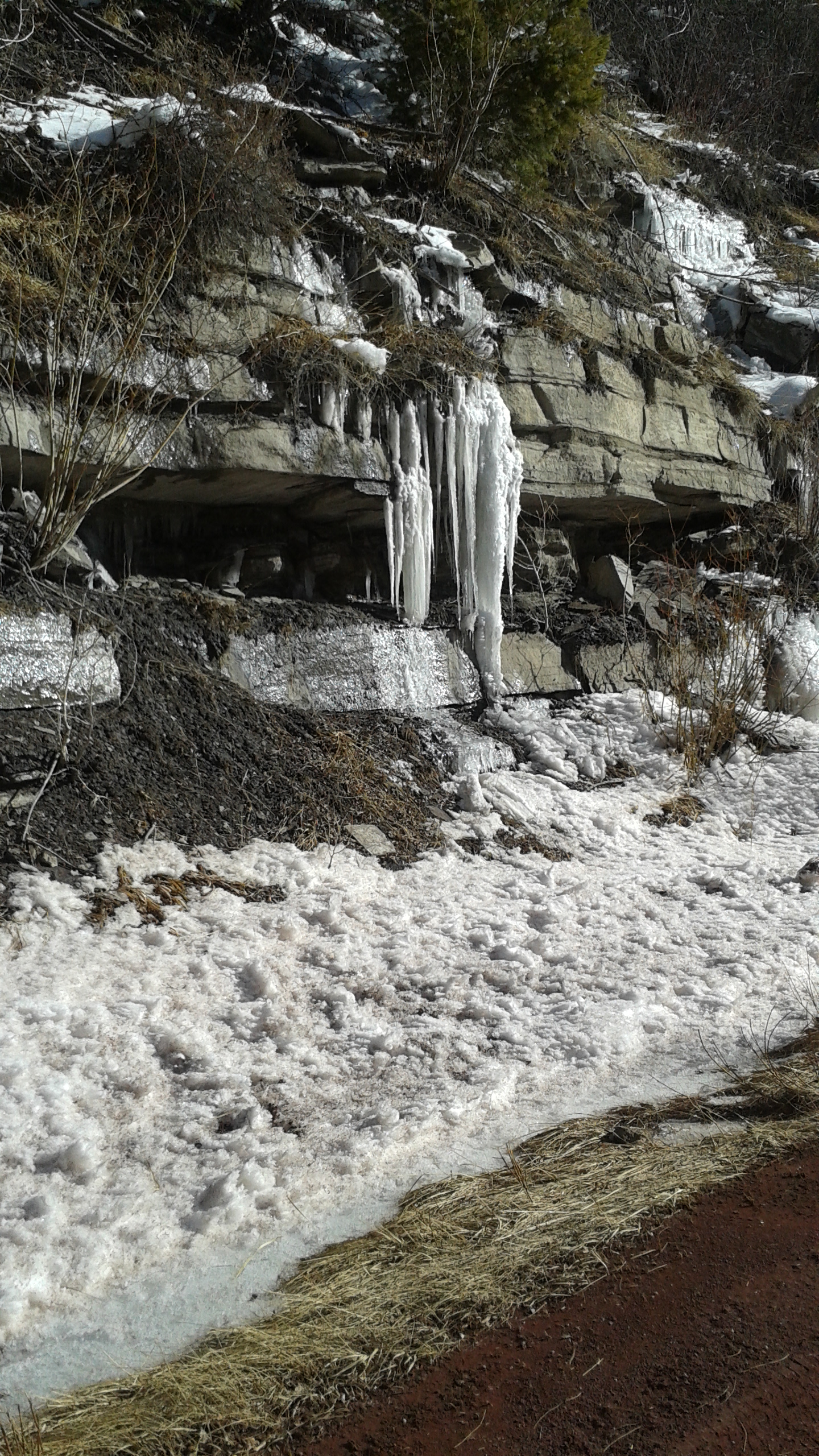
This trip, as I round a corner near the ski resort, I am greeted with a glorious white flow of ice rippling down the rocks. An earlier snow has obviously fed the spring, which put forth its lovely flow just in time to be captured and held by the deep cold of our latest storm. It got down to something like 12 degrees below zero (Farenheit) last night and now it is more than 60 degrees warm, and sunny. The ice curtain will not last long. I am most fortunate to have come along while it is still showing itself so beautifully. What a pleasant reward for my diligence in working on a Saturday!

The rocks, adorned

The rocks, adorned

After fifteen months of working mostly 50-60 hour weeks, I am taking a week of vacation, to drive to California for a MasterPath seminar. As much as I’m looking forward to the change, and to showing my husband parts of the U.S. quite different from where we live, I have had to pass through a period of regretting arranging for the time off, because of how much additional work I must cram into the days before and the month after, if I am to meet expected deadlines. Ergo, I work on the weekend.

I vividly recall one of my teachers on the Path suggesting to us that work should not be allowed to overwhelm our lives to the detriment of other aspects, such as maintaining a daily spiritual practice. Given that the present demands of my work take as many hours as they do, I have been trying to integrate the spiritual into the practical, as a means of accomplishing what otherwise would require the impossible task of stretching my effective-functioning hours in a day to something more than fifteen.

What I’m finding is that, to the extent I can truly follow the dictum of living fully in the moment, time ceases to be a rigid restricter. It becomes elastic, and somehow everything gets done. Indeed, I can judge the extent to which I am fully present in each moment by my simultaneous experience of time as flexible and malleable.

Icefall and Snow

Icefall and Snow

The frozen waterfall symbolizes, for me, a successful blending of opposites, such as I also achieve when I know time to be elastic. My Teacher encourages us to seek for what opposites have in common, for therein one will find Truth. Freed from the constraints of time, the Truth of the now becomes known. Captured within my photo of a frozen moment of time, waters flow from a renewed spring.

During Saturday busyness I found an image of beauty and peace. On vacation, what will I learn about busyness and work? Something of value, I’m certain. I’ll know when the time comes.

Now is not yet that time.

Now it is time to fix supper. Practical end to a reflective period.

All is in balance, and as it should be.

Breadth or Depth?

January 17, 2015

Saturday mornings are the only day in the week that I can be a bit lazy, get up an hour or more later, and not have to rush into preparation for activities. I’ve begun to guard this quiet A.M. time carefully, assuring myself of a few hours with no “have to” obligations. I’m learning that without at least some part of each week available as unscheduled “down time” I get out of balance.

My week used to include two hour Interstate drives and that time served me well for mental rest, but now my 250 or so miles per week of driving is over mountain roads and between client visits, with a cell phone that often rings with work demands. It definitely does not support a meditative state.

I do see lovely scenery. Just Wednesday, coming back from Taos, I came around a bend and was presented with three small frozen waterfalls glimmering in the darkness of early evening. The moon was up and reflecting off the rippling ice curtains, reminding me vividly of stalactite formations I first saw in Lurray Caverns when I was eight years old. Trekking through Carlsbad Caverns many years later, knowing that what was on public display is only a tiny part of the glories existing there, I reflected on how much that is wondrous we live in ignorance of.

(Yes, I hear the editor in my head reminding me not to end a sentence with a preposition. That is a dictum up with which I will not put.)

“You’ve only scratched the surface” is a phrase one of my teachers used often, in a survey course of world literature. He meant us to be challenged to read more widely than even the syllabus demanded. Archeologists genuinely do get to dig ever deeper, quite literally, into their subject matter. My acres, when I lived in Galisteo NM, were littered with pot shards and arrow head flakes. Digging out a pit for a septic tank, I came across layers of ancient litter, several different styles of painting on pottery and even one hand coiled pot, still intact. What might I have found if I’d been able to go down twenty feet, instead of only ten?

Layers of History

Layers of History

I’ve been complimented on the breadth of my knowledge – “Is there anything you don’t know something about?” I feel like a dilettante, knowing a little about many subjects, but without much depth in most of them. I greatly admire people whose careers enable them to master much, if not most, of a field – for example, musicians who know the work of centuries of obscure as well as famous composers, or the full range of indigenous songs in multiple cultures.

A mystery series I’m reading now (the Dr. Ruth Galloway novels by Elly Griffiths) feature a forensic anthropologist who knows everything there is to know about the dating of bones. Ruth admits to being narrowly focused, and to finding it a drawback not to have depth of knowledge outside her field. She admires people who are at ease at parties, able to make small talk because they know, as I seemingly do, a little about many different topics.

So why, then, am I just like Ruth and not at all comfortable at parties? I’ve always preferred conversation in small groups, like over dinner with a few friends. When I get to a larger gathering, I become tongue-tied, stand on the side lines and mostly just watch, quickly becoming bored. I want to connect meaningfully with other attendees, but seem unable to find the way to do so.

Oh, you’re telling me the problem is that I want some meaning from connections at an event where people are focused on the superficial. They come to cocktail parties to see and be seen, not to talk philosophy. I should lighten up, learn to relax and just float along at these events. Maybe that’s what’s needed, but no can do.

I’ve had friends who readily find solitude living in crowded cities. “It’s easy to be anonymous” in the heart of Boston, they tell me. I, on the other hand, feel invaded, overwhelmed and lost in busy and noisy environments.

To find solitude, I need silence. That has translated to needing a great deal more income to sustain me, living in a city. I can be poorer living where I do now, in rural northern New Mexico. Money can buy thick walls and enough surrounding land to provide me some sense of peace in an urban space. In sparsely populated areas, I am at ease in a small space, even a thinly-walled one.

On a Recent Misty Morning

On a Recent Misty Morning

Looking up from my writing just now, I see nine deer crossing my pasture, evergreen trees waving in a strong breeze, the sun reflecting brightly off a few remaining patches of snow. A scene of energetic tranquility, perfectly suited to my cherished morning of contemplation and reflection. I suspect that, over a lifetime, I’ve given up hundreds of thousands of dollars in income, by living “in the boonies.” But as was said to me just this morning, life isn’t about money. It’s about what you learn, and what you are inside.

From My Window

From My Window

I’ve learned many things. Perhaps the most important is that what I am inside is Soul. All the rest is just accreted layers obscuring my core. My most important skill is that of an archeologist, carefully scooping away mental and emotional grit, to reveal the core gifted to me by my Divine Master. If my breadth of experience and smattering of wide knowledge serves any purpose, it may be that I have thereby acquired a means to connect with diverse people and perhaps assist them with their own excavations. To the extent this is so, I am extremely blessed.

To Heal a Tummy

January 11, 2015

The weather has been on a crazy whirl this past week – sunny and a spring-like sixty-five one day, icy twelve degree fog the next coating everything in sheaths of white rime. Then another warm day melting it all, to be followed once more by ice rime and black-ice accidents on the highways. We’re projected to have several more of these mood swings in the next week, around which I am trying to plan my work-related travel.

I regularly go up over the mountain (part of the Rockies) from my home to Taos. I have to accommodate my planning not only to the fluctuations of weather as I experience them where I live, but also as they manifest quite differently on “the other side.” Just last week, I spent a warm and lovely day seeing clients in Taos, and did not know it had been a fogged-in and icy day at home until I came back over the ridge in the late afternoon, and looked down onto clouds.

Above the fog

Above the fog

Bodies react to these unpredictable changes in climate. Old injuries begin to ache, remnants of bronchitis flare, sinuses swell and congest, even tummies become sensitive and refuse to function properly. There is a very direct cause and effect for the bone and joint aches – heat soothes and cold aggravates these types of reminders of past incidents. To the extent that the warmth releases pollens, chest and sinus irritations can also be understood as directly related to weather. But tummies?

I’m one of those who are most sensitive to what affects tummies. Mine has been – my husband sweetly calls it fragile – since infancy. I’m more inclined to use harsher words, like irritable, aggravating, infuriating. It’s definitely where any and every stress lands. My mother complained to all who might sympathize, that the only formula I could tolerate as a baby was one which required a great deal of work – a complicated process involving twenty-four hours of advance preparation and multiple periods of cooking. I also had many food allergies, and did not outgrow them until I was well into my teens. Some I have retained all my life, in the form of sensitivities I’ve learned to recognize.

Some days I can eat eggs, other days they make me very sick. And I react horribly to the ‘flu vaccine, incubated in eggs. I love fresh tomatoes, but have to moderate my consumption, and must avoid most cooked tomato products, like spaghetti sauce. Thankfully, I can usually enjoy strawberries, and most thankfully I’ve never, as an adult, re-experienced hives from eating hard-shell seafood. I am gluten intolerant, have probably been so all my life but have only accepted and adjusted to that limitation in more recent years… hmm… nearly ten years now.

I’ve repeatedly questioned why, when I mind my diet and adhere to its restrictions, I can still suffer from severe and usually totally unanticipated abdominal distress. It’s too easy to blame the weather, claiming some as yet unrecognized link between storms and digestive upsets. My latest bout was with an actual bug that is going around.

Identified cause, commonly experienced effect.

I treated the episode partially with a special form of deep breathing I’ve learned in Ba Gua, something called empty breathing. The unpleasant symptoms of stomach ‘flu remained present. Empty breathing did not eliminate them, but it did seem to reduce the pain and cramping side effects. And I recovered quickly, for me. Instead of a week of subsequent hypersensitivity, I was able to eat my normal diet by the third day.

Which set me to reflecting further on breathing as a relaxation technique, and breathing helping my tummy recover, relaxation being related to quick recovery… maybe relaxation being related to not being so fragile, going forward?

I’ve begun 2015 focused on doing what arises for me, to the best of my ability, in a flexible way that does not allow for me to berate myself for what is not done – or what is not done as thoroughly as I might like. I’ve even incorporated that goal into the “work-related achievement objective” that I must create as part of my employee evaluation criteria for this new calendar year. My personal achievement objective (another requirement) dovetails, in that I’m committing to a certain number of blog posts, which means committing to a consistent pattern of taking time for myself in quiet reflection.

I’ve learned that if I don’t write, I don’t reflect – and conversely if I don’t take time to reflect, I can’t write. And I’ve also learned that my tummy is less fragile if I’ve reflected more. Because I breathe differently when I reflect? Maybe. Because I release tension when I reflect? Certainly.

Which brings me inexorably to the conclusion that my childhood must have been filled with tensions (gee, I had no idea) and was consequently one of frequent sickness. I learned a pattern then, related to my mother’s fierce dislike of “the sick room”, which was that if I was sick, I was left alone (not harassed, nor subjected to demands). No wonder, for years, when I began to feel overwhelmed, I’d fall ill. Even after I was on my own, and being ill only added to the pressures I was experiencing, rather than providing relief from them.

Then, finally, I recognized that pattern and the need to release it. I came to the realization that if I didn’t take time to care for my spiritual self, I’d get sick several times a year – brought to a halt, confined to bed, enabled to contemplate what had brought me there.

Lesson learned.

As noted above, now I mind my diet, I exercise, I pursue my daily spiritual practice, and I treat myself as respectfully as I treat others. But still there remains that fragile tummy, that I’d like to see be more durable and tolerant, especially when it comes time to travel with my husband to Cameroon.

So it seems I’m being asked to take a next step, to actively and consciously come to recognize the tensions I habitually tuck into my gut, and to stop doing this basically harmful practice.

We all store tension somewhere. If I see my husband stretching his neck, rolling and flexing his shoulders, or holding his head somewhat rigidly when turning to look to the side, I know to ask what family matters are bothering his mind. He quite literally “carries the weight of the world on his shoulders.” I, on the other hand, apparently absorb and “swallow” the cares of others.

People – especially my clients – are inclined to say that they feel better after talking to me. I’m very glad for that ability to help them, and do not want in any way to diminish that form of service to those in need of a listening ear. However, I do want to learn to recognize when I am taking their cares into my body and Being, and to stop doing so, on however subtle a level I internalize their issues.

My Master teaches us about the goal of being “a pure and open channel” for the Shabda, or Divine Soul Current, or Sound, or – to Christians – the Holy Spirit. When one is such a channel, others are enabled to clear their own karmic issues, while the channel remains free of the shadow of those issues. Putting the abstract into a very mundane image, one becomes able to clear the soot from a wood stove without getting that soot on one’s hands and clothes.

I obviously have a way to go, down this new path of understanding. I’m still at a point equivalent to getting soot on my hands when I load wood into the stove for burning. But each time I load that stove, less soot transfers. Each time I notice my tummy being “unhappy with me” I can stop, breathe deeply, and tell it lovingly to release whatever emotional tension I’ve unthinkingly crammed into it. And above all, I can remind myself daily that my job, my busy days, my world are all too big for my puny mind to encompass, let alone control. As soon as I no longer try to control my days, they sort themselves out far more perfectly than I could ever have imagined.

Ice Dance at Sunrise

Ice Dance at Sunrise

THAT is the blessing of not being a human being, but rather “being a Spiritual Being, having a human experience.” (T. de Chardin).

Visitors

May 25, 2014

Why is human nature so perverse?

Praying for rain, hoping for rain, wishing for rain, deploring the drought, finally it rains.

Now on the third successive day of grey skies and autumn chilliness, instead of continued joy at the moisture, there’s a sliver of … what is it exactly?
Resentment?
Regret?
For the absence of sun, or for coolness when I’m ready to wear my light summer clothes?

I’m remembering the first summer I lived in Sapello, an historically wet period that hasn’t been matched in the quarter century since. I never did get into my light clothing that year. I wore long sleeves and often a cotton sweater the entire summer season. I have pictures – old fashioned print ones, not digital to be shared here – of the flooding sheets of water carving gullies in my driveway and turning the lower pasture into a lake.

It’s unlikely that this summer will prove to be anything like that one in 1990, which followed the coldest winter in decades and completed a most memorable weather year. My rational mind knows that several weeks of continued rainy weather will only just barely put a dent in our parched conditions. My spirit is delighted to see a return of the long-missing summer pattern of overcast nights, clearing mornings and afternoon thunderheads spilling precious rain. The little, irrational corner of being that feels chilly will just have to suck it up and put on a sweater.

I used to know that outdoor activities like riding my horse needed to be completed in the morning.
I used to ensure that rain boots rode in the trunk of my car (boots in the boot), and that I had an umbrella always on hand, from May to September.

Those days and those habits are long gone. Is it time to bring them out of the closet of memory, press them into freshness, and begin wearing them once more?

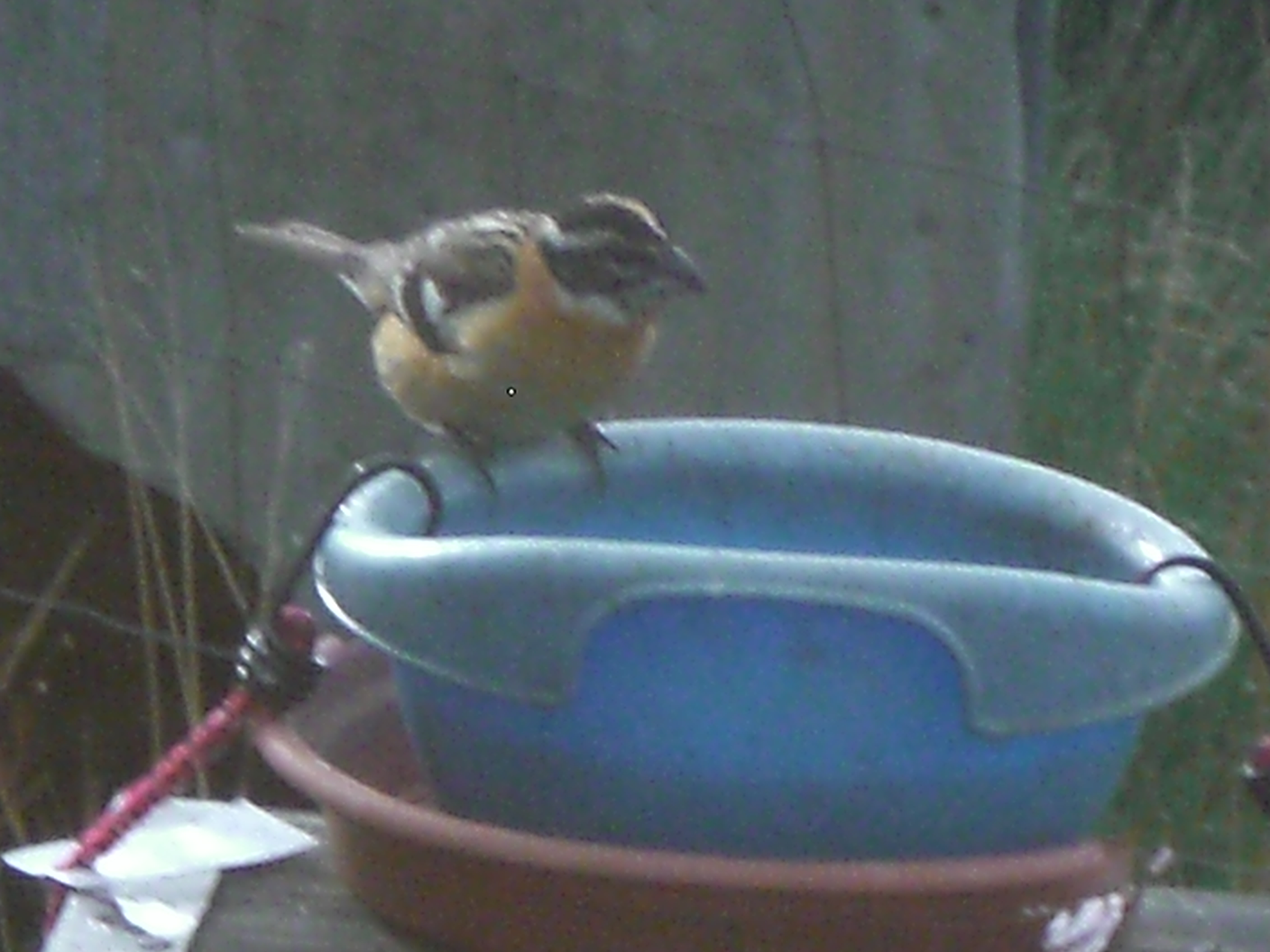
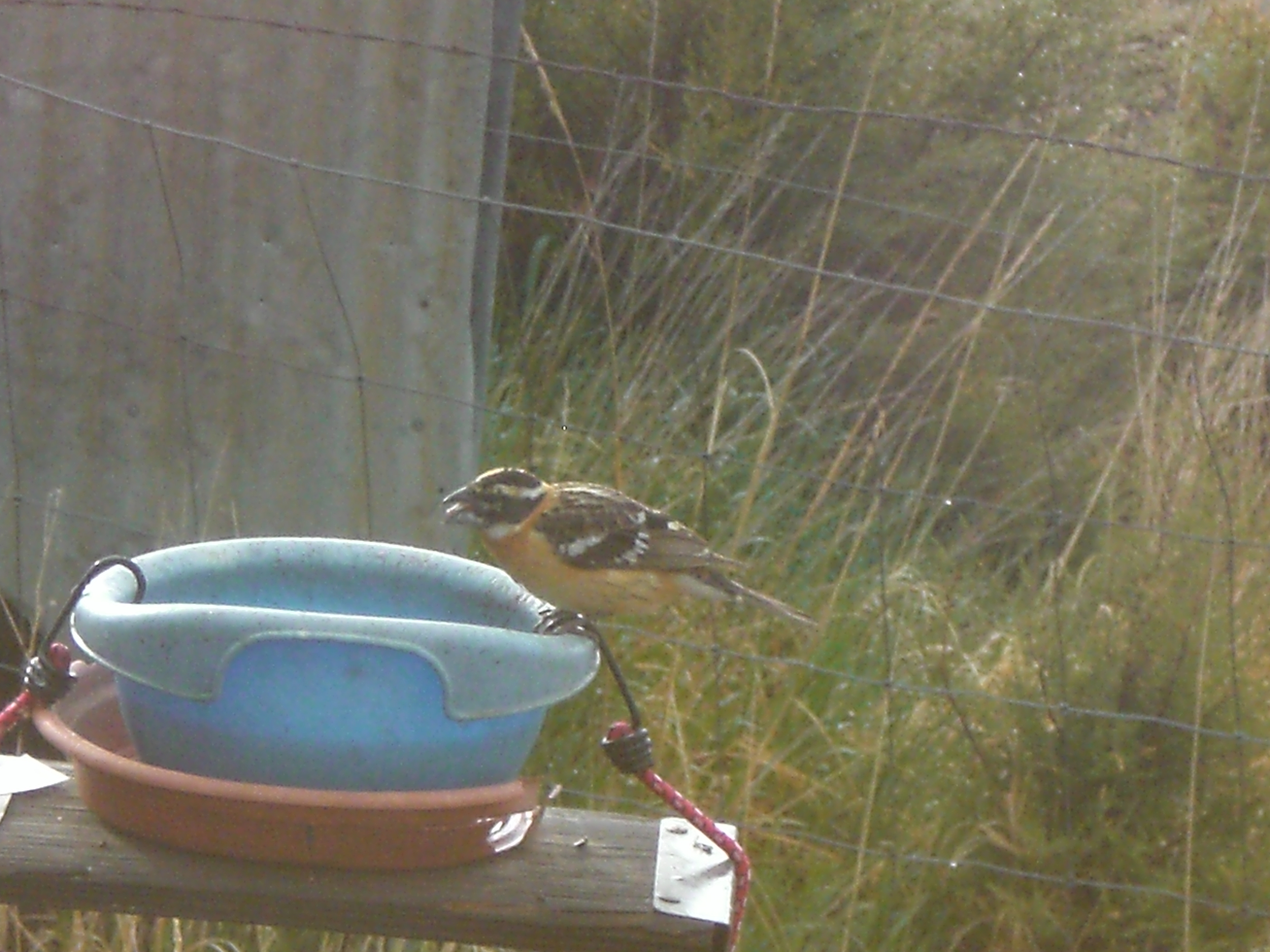
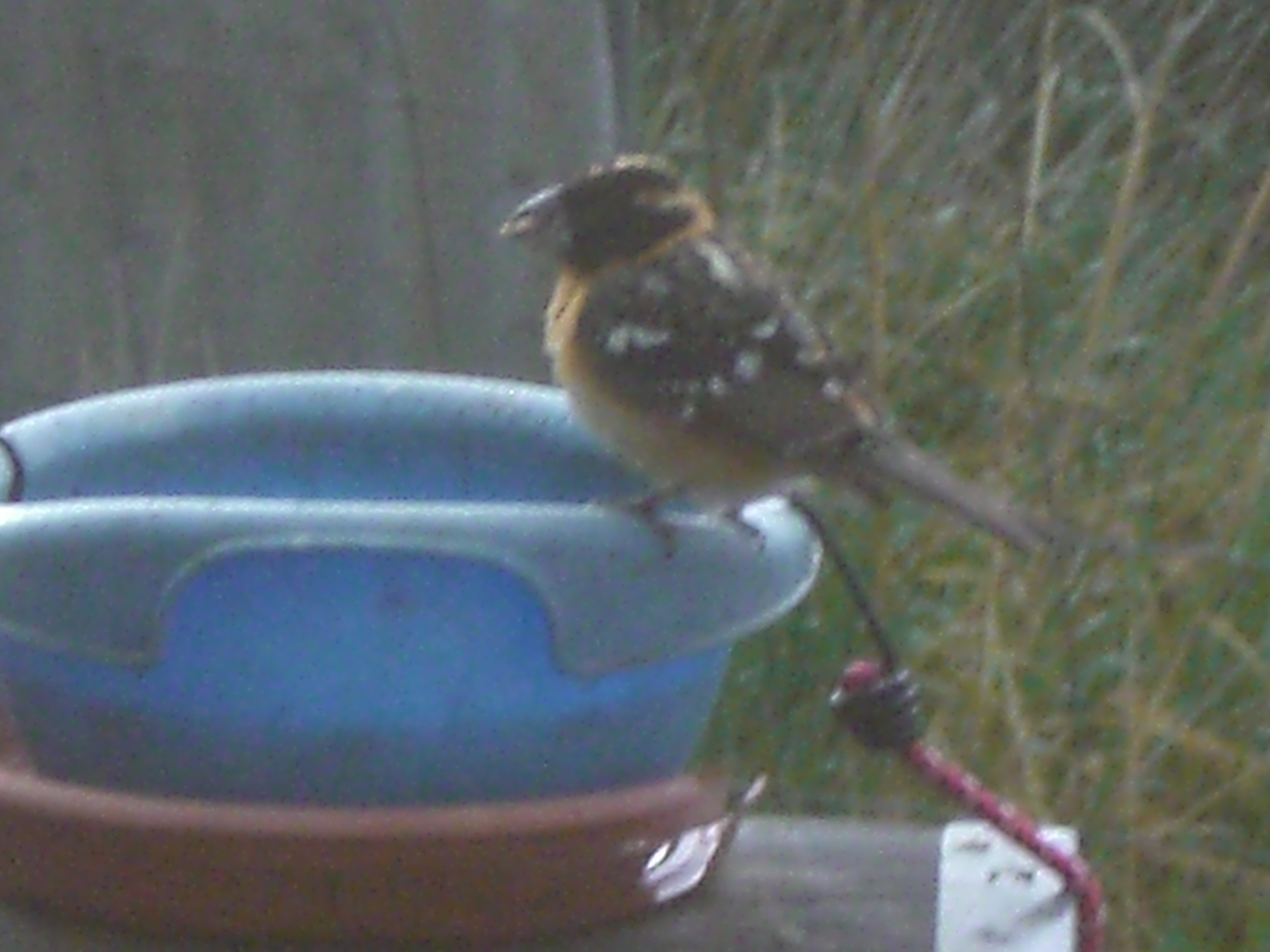
I’ve been seeing a different mid-sized bird at the feeder the past few weeks. Orange chest, tan belly, orange spot on the top of a head striped with deep brown and a bit of white, patterns of brown and white running head to tail on the back.

I am a ?

I am a ?

Can you tell I’m not a birder? I seem to remember having lent my bird identification book out and apparently not gotten it back. At least, it’s not on the shelf where I expected to find it.

Another view

Another view

I do wonder if these new visitors are indicative of a shift in weather (and wind) patterns that has broader meaning, perhaps an alert that we’re resuming the nearly forgotten routine of summer afternoon rains?

Cute, n'est-ce pas?

Cute, n’est-ce pas?

For now, I can only note that my day unfolded with repeated short downpours across a wide swath of northern and central New Mexico, perfectly timed. When I needed to load the car, it was clear. While I ate lunch in my favorite Chinese restaurant, it rained. Shopping in the big indoor mall in Albuquerque, it rained. During the two hour drive home, it drizzled, but when I needed to bring my purchases into the house, it was clear.
Who could ask for more?

Let It Rain

April 19, 2014

It’s the end of a long, productive but tiring day and I had no idea what to write about for this week’s post.
I opened email from a dear friend, to find a single word – “rain”.

Perhaps because my last email to him announced happily that it was raining outside? For all of five minutes, it actually did rain, hard enough to be heard from inside the house.

Rain – its long absence from our lives, the urgent need for it – is on many minds. An elderly client stated that damp weather – like cold – makes her bones ache but she’d welcome the ache if it brought water for our thirsty earth.

Driving into town (I live about 15 miles out) earlier this evening, I remarked on the dusty, silted, sadly brown fields and talked about the Depression Era dust bowl with my companion. In that area of our community, on a windy day, the air is almost unbreathable, thick with topsoil being scoured from the land. Ninety plus years along, and it seems we haven’t made any progress at all toward preventing another dust bowl.

Hmm… the saying is that you attract what you give your attention to. Perhaps the problem is that too many of us have been giving attention to the drought, when what we should be doing is meditating on rain, snow, lakes, springs, moisture in all its myriad and lively forms.

Like the pond I discovered beside the road back into the mountains, en route to do an assessment with a client who lives in a tiny camper trailer on a twelve acre parcel of wooded mountain land. Several ducks floated on its surface, undisturbed by a chorus of frogs loud enough to be heard over my car’s engine. More than twenty years of living not far away from the area, and I’d never heard that the pond existed. My client informed me that it’s not a year around water, that by June it will be dry.

So think about rain. Think about all the different types of rain I’ve experienced.

The first that comes to mind is in Saigon. My usual form of transport was a cyclo-pousse (French for the combination of bicycle and push, describing a bike with a seat in front, sitting on two wheels).

Cyclo Drivers, Saigon 1957

Cyclo Drivers, Saigon 1957

The faster, noisier variety were called cyclomoto, did not have a carriage cover, and so could not enclose the rider. They were better adapted to carrying large loads.

Motocyclo - Saigon 1957

Motocyclo – Saigon 1957

During the rainy season, the cyclo driver would deploy, from behind the seat, a sort of umbrella cover to which tarps could be attached, ostensibly to keep the rider dry. You can see the cover, minus its surrounding tarp, on the central cyclo. Being enclosed did help a bit, but one still got soaked from below, as furiously fast rains pounded the pavement and rebounded up to a height of two feet or more. There was really no way to be dry if one went outdoors during the downpour. Fortunately, the rains came on a predictable cycle, gradually working their way around the twenty-four hour clock as the season progressed. One could even safely plan to hold an outdoor party at night, during the part of the season when it rained in the morning.

Any wonder that I questioned a local station’s weatherman about his use of the term monsoon for the nearly non-existent rains of the  summer season in New Mexico? Turns out the term describes patterns of air movement which, in wet countries, produce rain and which – rarely – do the same here.

Think about rain.

The British have a wonderful word – mizzle – for the thick, misty, almost-rain conditions associated with foggy London nights. I remember walking across my college campus (Swarthmore, in Eastern Pennsylvania) in a mizzle, bundled against a wet that somehow penetrated all my layers and left me dampened and chilled. There was a beauty to the campus on those wet nights, lamplight haloed by mist showing my way through the rose garden and along winding, tree lined paths. It took several cups of hot cocoa to thaw me, when I reached the warmth of the student center.

The first summer – 1990 – that I lived in my present home in Sapello, I wondered what I had done, buying a home in what felt like a flood zone. My previous residence, on eleven acres southeast of Santa Fe in the Galisteo basin, was almost 1000 feet lower in altitude, and definitely in a more desert-appearing landscape. We received the blessing of summer thunder storms during the years I lived in Galisteo. Great arcs of lightening would leap across the sky, crash into the Ortiz Mountains, and unleash water onto the prairie at a rate that could be absorbed. An occasional gully washer would plow a furrow down my drive, but was always sufficiently short-lived not to do damage.

The summer of 1990 in Sapello was different. It started raining in May and seemed not to stop, not to show the sun, not to warm enough to wear lightweight summer clothing. It rained and rained and rained. My uphill neighbor’s catch pond overflowed and sheets of water poured down across my property, overflowing the culvert and – twice – washing out my driveway completely. I had to have another neighbor come in with his backhoe to rebuild the drive, installing a larger culvert in the process. My horses’ hooves softened and began to rot, as they were unable to escape standing in sopping mud. I scrambled to create a cement pad and shelter for them, before they suffered serious harm. Try laying concrete in a persistent downpour!

Meteorologists tell us that the 90’s were an exceptionally wet period for this area, not a standard against which to rate our current situation. There certainly has not been a summer like 1990 in the past 15 years. I’m gently teased by a friend (native of a tropically wet climate) about my attention to our weather, to the condition of the prairie, to what I see on the distant skyline. He has yet to live through a wildfire summer. He tells me that a member of his church regularly petitions the congregation to pray for rain.

Please join me in a collective focus on wetness falling from the sky onto the lands of the Southwest.

In reciprocation, I will join you – if you live in the Midwest – in a collective focus on calm air and balmy days of recovery from the storms and ice of this past winter.

Together, may we find a better balance and harmony in all aspects of our lives.

**************

PS: Between writing yesterday and posting tonight it rained, intermittently, for several twenty minute periods. The air is cool and damp, the ground moist and there are a few puddles glistening on the highway. I see no stars nor moon tonight – rain clouds hover overhead.

Dieu nous benisse. 🙂


Only Fragments

Love Letters to the Tar Pit

KarusaaVerse

Words that Sparkle, Thoughts that Ignite: Fueling Your Imagination

Leaf And Twig

Where observation and imagination meet nature in poetry.

Millarson Diaries

Personal Musings and Thought Experiments

The Beauty Along the Road

Discovering Beauty in the small details of our lives

Flowerwatch Journal

Notes on Traveling with Flowers

1eclecticwriter

Wide-Ranging Commentary

Spirituality Exploration Today

Delving into the cross roads of rationality and intuition

smilecalm

Life through Mindful Media

A Good Blog is Hard to Find

I will shatter a word and scatter the contents into the wind to share it with the world.

Ray Ferrer - Emotion on Canvas

** OFFICIAL Site of Artist Ray Ferrer **

AKA The Versatile

Fashion | Lifestyle | Food & Travel | Beauty | Fitness | Education | Product Reviews | Movies | Doodling | Poetess

Aging Abundantly | Women Over Fifty | Empty Nesters | Caregivers | Aging Gracefully

Finding Joy at Every Age with writer/philosopher Dorothy Sander

ARTZZLE

Helping with the Pieces in Life's Puzzle of Art and Design

Project Light to Life

A bucket list blog: exploring happiness, growth, and the world.

The Daily Post

The Art and Craft of Blogging

Any Shiny Thing

MIDLIFE MAGIC

allmostrelevant

@allmostrelevant

The Irrefutable Opinion

Assaults on the Casually Mundane by K. Jean King