Archive for the ‘life wisdom’ Category

Memory Lane

September 8, 2013

Told that you will be spending two days with a former partner – lover, ex, intimate friend – from whom you parted on amicable terms but have not seen in 45 years, what would you expect to experience? Assuming, of course, that you are old enough to have so much time elapse between encounters. If you’re younger, compress the time appropriately, and include an awareness that you and the former partner knew you had different goals and would be traveling different paths. You parted amicably.

So here you are at the other end of a long separation, having pursued your divergent aims. You are going to meet not just your ex-partner, but that person’s current mate about whom you know absolutely nothing. Would you, like me, wonder if you’d find anything familiar in your former partner? Would you ask yourself questions about “the road not taken” and be curious to learn if you’d been correct to leave it? Would you – unlike me – obsess about your looks and how you’d aged and whether you’d still be found attractive?

Turns out, I had the interesting and enlightening experience of both appreciating the qualities that originally drew me to this particular former partner (FP), and recognizing how our differences had deepened into a rift which would inevitably have pulled us asunder. We were indeed lucky – or perceptive – enough to have realized that we should separate “before any harm was done.”

What I didn’t anticipate was the extent to which the visit brought back other memories from my earlier life – memories not necessarily connected to the relationship, including memories of events from my early childhood. It was as though, once broached, the closet where I’d shoved recollection of much of my early life behaved as any physical closet stuffed to overflowing – it spewed out random items when the door cracked open.
Going for a Walk

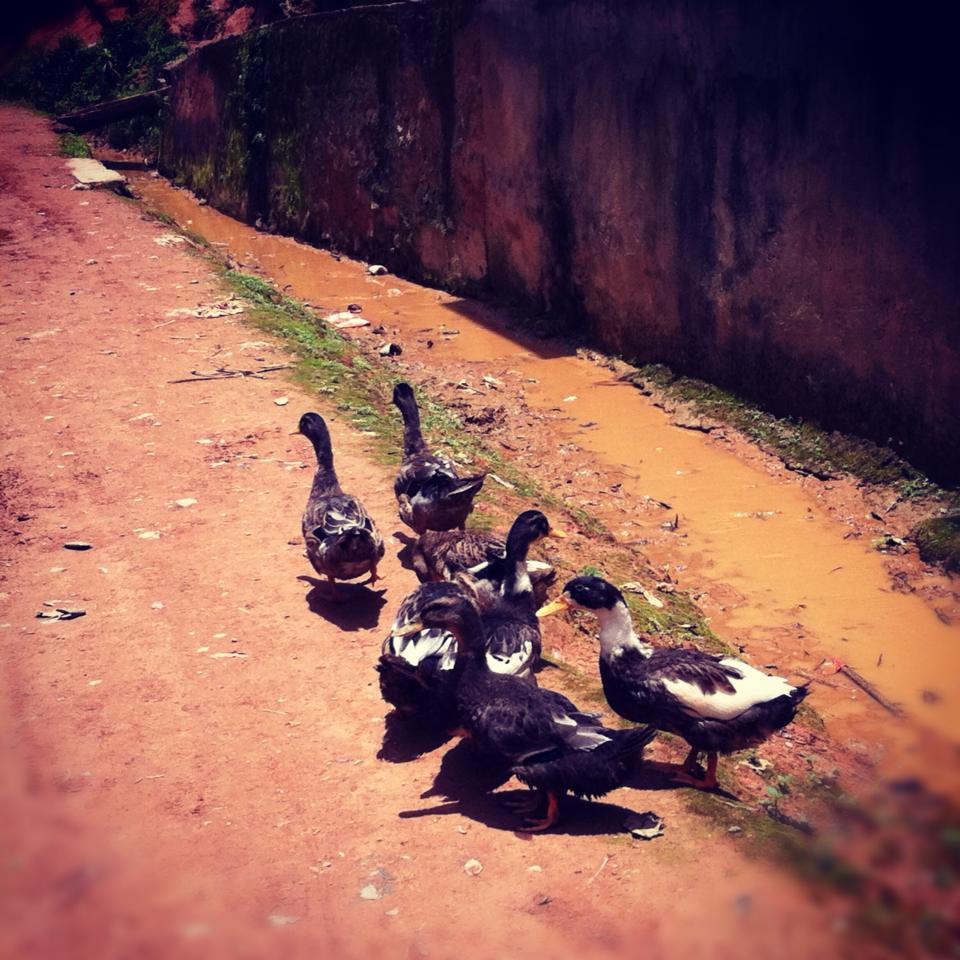
Going for a Walk

Visits to the zoo with my grandfather, during which he talked about life, and values, and the challenge of finding just the right word for his latest poem. He queried my week and my interests and what I was reading. I was vividly reminded of those Sunday conversations when FP gently probed how I live and who I am now, in much the same way as my grandfather had sought to know me.

Memories of intensely difficult times with my mother, who had serious psychiatric problems. It took me quite a few years to overcome the effects of her paranoia, explosive anger, and abuse. FP perceptively commented on his recollection that my mother also had an abusive mother, in the context of mentioning that he and his present wife were lucky to have grown up amid very positive family lives. I know now what it’s like to feel supported and encouraged by a set of caring supporters. And I also appreciate to what extent my adventurousness and my inability to fit neatly into the socially defined role FP offered, arise from the instability and emotionally volatile nature of my childhood. I’ve not had an easy life, but I’ve certainly had a varied, challenging and infinitely rewarding one.

Also tumbling out of the closet were memories of other relationships, rather a lot of them, mostly all pleasant. Such a range of different types of people I’ve come to know and value as friends! People who are very far removed from the European immigrant, advanced-degree-educated, middle class traditionalist pattern of my parents and of FP. Motor cycle riders, cowboys, ex-cons, and prisoners still serving time who participate in the Alternatives to Violence Program workshops I facilitate in the New Mexico prison system. Sixth generation descendants of Spanish families who migrated into the New Mexico territories from Mexico, and who still speak English only as a second language. Some of them are conversos (crypto-Jews) rediscovering their family origins. FP and his wife, conservative Jews, were deeply interested to learn about this link to an area they now plan to revisit.

I’ve known mechanics whose crossword puzzle skills rival my own. Believers and practitioners of a host of religions, and of no religion at all. Providing home health care throughout a large rural section of the state, I’ve been welcomed into ancient adobe homes with sod roofs, ranch headquarters in the midst of thousands of acres of range land, luxury second homes for people who spend half their year in Texas, and the truly mobile homes of a couple living permanently in their Winnebago.

Amidst the tumble of memories spilling forth, I find and grab onto a gem of an idea. I ended the relationship with FP because I knew I did not fit within what felt to me like a confining, prescribed role. I was not at home within a “family” structure. It turns out I’m not at home within any other established structure I’ve encountered in my life journey. I’ve fit myself into them (work, a variety of different cultural norms) to get along, but none have felt like ‘home’. I belong nowhere. Ergo, I belong everywhere!

Perhaps that’s why I’m planning to start a new career within weeks of turning seventy, and then, four or five years from now, I’d like to take off to live once more in a different country. Somewhere with a comfortable climate for older bones, where I can teach, and learn, and continue my life adventure. I’ve been dipping into memories from the past. I’ve defined a possible future to hold in intent. Meanwhile, it’s time to resume the most important aspect of Being – living in, and appreciating, each moment of the present.
Older… and Wiser?

August 30, 2013

Have you noticed that the ‘older’ part of ‘older but wiser’ is singularly obvious in wrinkles, aches, and the need for Post-It notes littered over every surface – but the wiser part is much harder to recognize? Especially when the dog mouths one of those Post-It notes, and you have to make an extra trip back to town for the three forgotten items of the six that you need to make supper.

How delightful, how ego-boosting it is, then, when circumstances allow you to recognize that the ‘wiser’ at least occasionally manifests. A recent experience allowed me to feel grateful for whatever passes for wisdom in my brain. I had thought to pursue a course of study which would require me to hold in equal respect two conflicting paths to spiritual understanding. My training directed me along one path, my mental inclination tempted me onto the other. The studies would have meant constantly balancing two goals, two world views, two concepts of self. The outcome of the program would have enabled me to practice in a field I’d like to enter, for which I do not – at least at this point – see another means of qualifying.

So I did all the paperwork, wrote the essays, completed the application – and then was denied acceptance. What to do now???

Here’s where the wiser comes in. I did nothing, just let the fact of the denial settle into my awareness. Within a few days, I had one of those blessed “aha” experiences, a flash of insight that allows me to lay at least passing claim to wisdom. Recognition is enough! Seeing the differences between the two paths, understanding how different aspects of myself are drawn to each of them, and knowing that I am capable of continuing to follow one while learning the other – that is the recognition. And it is enough. I don’t have to also undergo the stress of carrying awareness of the paths and their differences through a two year course of study.

Wiser seems to be at work in my growing ability to move through a mine field of life choices while maintaining a ‘neither for nor against’ mentality.

Older is definitely a handicap in my search for paid employment. I cannot help but believe that the on-line application and screening systems which substitute for preliminary job interviews include an edit that discards all applications with college graduation dates before 1990 (the application isn’t accepted if a graduation date is left blank). No other explanation accounts for a year of denials of my applications for positions for which I meet every criterion, which mirror work I have already done successfully, and which are written using all the key words of the job description included in my work summary. Wiser allows me to keep the constant rejection at arm’s length, not translating it into a feeling of personal inadequacy. The right income opportunity will come my way, so long as I keep an open, explore-everything approach to the search – and all this rejection is good practice for the inevitable “send out twenty stories to get one accepted” that mark a writing life.

+++++++++++++++

Older is what I will be – starting another decade – on my next birthday in the autumn. Wiser is what I hope also to be by then, having learned the parameters of a new job which I’ve been offered, and having experienced yet again the virtues of patience. I’ve been hired into a position which exceeds every criterion I had set – flexible hours, service to others, supportive and enjoyable coworkers. And I have almost two months to discern how to maintain my established writing pace while fulfilling the job’s requirements. I’m old enough to know that won’t be easy. Hopefully I’m wise enough to know both how important the writing is to my sense of well-being, and how possible it is to “have it all.” With patience, I will see the way.

A Good Day

August 23, 2013

It seems to be perversely part of human nature to never be satisfied.

Through months becoming years of drought, we in the northeastern New Mexico high-mountain desert worried about the lack of rain. Our brown grasslands, swirling dust devils, raging fires and smoke-poisoned air were prominent in every conversation.

Until just a month ago, when suddenly, for some of us, things changed.

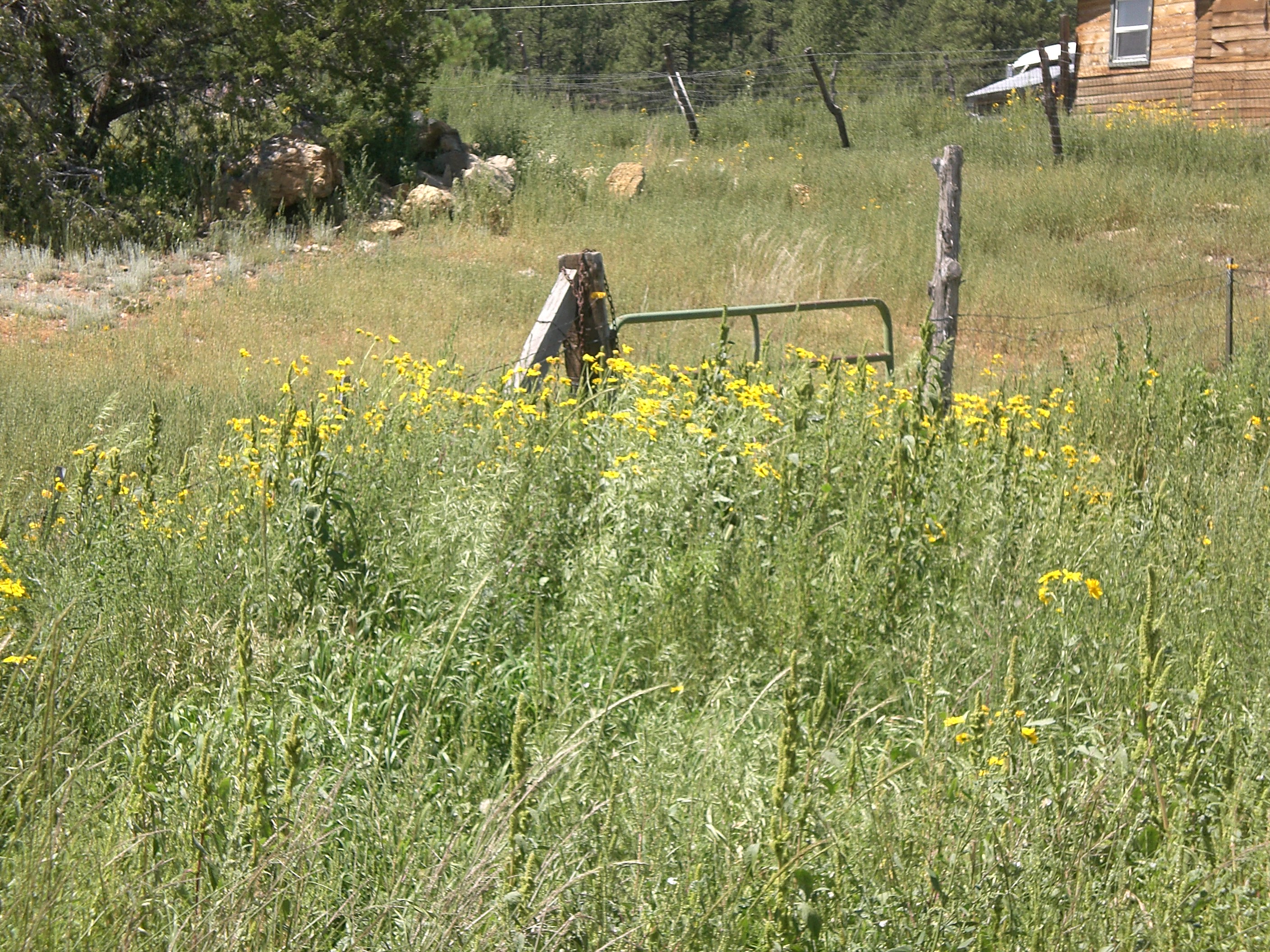
Water began to come out of the sky, in thick sheets, on almost a daily basis. Not everywhere, not for long periods of time, but enough where it did appear – including where I live – to turn the prairie green and yellow – green weeds shooting to chest height, yellow wildflowers making wide swaths of color especially where run-off water has pooled.

Rain Gate

Now I hear complaints of pollen-allergies, and worries about the burrs and needle-like seeds that will permeate everything – especially the fur of four-legged pets – as soon as the short-lived grasses and flowers dry out this autumn. People hustle to find mowers and weed eaters, to chop down the lush growth, the absence of which was so recently bewailed.

Today, the sun is shining, there’s a cooling breeze, hummingbirds are hovering over the purple thistle flowers, and a dove is pecking seed from beneath my bird feeder. A few puffs of cloud float in a dust-free postcard blue sky. I’ve had to use the snips designed for nipping small limbs from trees, to cut down the largest red-root weeds blocking the steps to my home. A friend has promised to come mow, before I have company over Labor Day weekend. Not all my acres, just the area immediately around the house, so I can get to the bird feeder and the outside water hydrant without wading through chest-high weeds. So my guests can get into the cottage door without scratches to their legs and prickers in their clothes.

Nothing I can do will prevent the forthcoming torment to dogs and cat. Daily brushing, sessions of picking out burrs, even a close shearing of coats (canine at least) can reduce but not eliminate the pending assault by things that stick and sting and burrow into skin and paws. It’s been so long since we’ve had rain, and weeds, in summer that none of the current crew of pets has experienced what is in store for them. They are all too young.

Green Pastures

I am not too young. I remember, ten years ago, the last time we had summer rains and weeds and wildflowers and enough grass for horse hay to be a reasonable price. I remember the quill-like needles that result from those pretty yellow wildflowers dropping their petals, drying and disseminating their seed. I remember the cockleburs, brown and clawing, so sharp they pierce the leather of my shoes as I walk by them; so sharp they even caused my horses to limp until the spines were picked out of their hooves.

I remember, but today I will not complain. Today I enjoy the sun and the cool breeze and the green vistas and the dancing yellow flowers. Today I am grateful that we have had rain, and a respite from dust and fire and smoke. Today is a good day to Be.

Choices

August 18, 2013

For the past year I’ve been living in a way most of us are taught not to… day to day, with no ‘life goals’ and few plans that reach more than a week or two into the future. It’s a natural way to be; children wake each morning to a truly new day, one full of possibilities. They have to be trained to ignore distractions and to stay focused on mandates – good grades, keeping a room picked up, personal cleanliness, helping with household chores, thinking ahead.

Oh yes, thinking ahead. You didn’t make your bed when you should have done, so now you have to do it instead of watching your favorite TV show. You should have thought ahead! You’ve been skimping on your homework, now you’re failing 5th grade, though you’ve been warned over and over. You only have one six week grading period left to bring your work up to acceptable level. You’ll be doing nothing but school work from now until the term ends. No trips, no play, no time for fun… you should have thought ahead!

Sorry, Mom and Dad, but I’ve been determinedly not thinking ahead. There is a point, ahead out there somewhere, when I will run out of savings and, without income, be destitute. I’m not ignoring that fact, but I’m not focused on it. My wise teacher instructs that attention is food – what one attends to grows in one’s life.

Conversely: ”If you want something to leave your life, take your attention off of it.”

I see no benefit from worrying about a maybe some three years off into the future, so I am attending to what is here with me in the present. I have been searching job boards, applying for everything that seems a possibility. Like many older people in the job market, I get few responses. Experience seems not to be valued any longer. Employers want new young minds to train to their special priorities. They want to mimic parents, who know instinctively that training children to think ahead, plan for the future, and learn habits of daily living is easier when the children are young and haven’t yet had enough experience to question the parental dictates.

So how do I communicate, in a standard application and resume submission, that part of my experience has been learning to be open to new ways of doing things, new goals and new achievements? Do I say that I have been living day to day for a year now, proof of my ability to be flexible and adaptable? Do I use, in a cover letter, another image from my spiritual teacher, of riding a horse up a creek and, at a moment’s notice and for no conscious reason, jumping the horse up onto the bank? Knowing when to listen to one’s inner voice (intuition, or spiritual knowing) can indeed be the skill that saves one, in what turns out to be the nick of time, from a tumultuous flash flood gushing down the creek bed.

Asked what I’m looking for in new employment, I could perhaps best answer by saying I seek the employer who will appreciate the depth of meaning in my teacher’s story. Or one who could read Lesley S. King’s recent post entitled Face Your Inner Mischief, about her yapping mind, and understand it for the beautiful parable it is. I seek an employer who has the ability to appreciate the innovative, the creative, the self-directed in others because that is what he/she is also. Someone not threatened by new ideas, not hearing questions as challenges to authority but rather as the positive contributions of an assistant engaged in the process of achieving goals which, themselves, may shift with time and experience.

Living each day for what it offers, as I have done of late, could be considered a rejection of the values my parents, particularly my father, taught – to plan, to delay immediate gratification for a larger achievement; to save and be mindful of expenses, so as to have financial resources when they are needed; to be cautious and consider all possible consequences before acting. Indeed, much of my life could be seen as a rejection of those values; I’ve left higher paying jobs for lower paying ones on a matter of principle; I’ve spoken out about fundamental rights and been blacklisted; I’ve challenged the status quo in large and also in small ways, living as my friend Jane said recently, when she wrote, “I did what the Holy Spirit led me to do, and I can do no other.”

Nonetheless, there is a way in which I still embody the underlying lesson my father – and most parents – try to teach their children. That silent message is about acquiring the ability to choose – i.e. to have an understanding of cause and effect, an ability to be patient long enough to experience outcomes, and a sense of what information comes from within one’s being and what is imposed from ‘outside’. With these three skills, one can choose – to follow outside dictates or respond in opposition to them; to stick with an unsatisfactory job or to leave it without another already in place to go to; to value integrity more than security, or patience more than impulsiveness.

Ultimately, it is our choices – or lack of them – that define our lives. Lucky is the child of a parent who knows to teach how, but not what, to choose. Blessed is the individual who learns from a spiritual teacher that worlds exist beyond the mundane, and that we all have within us the capacity to manifest Truth, to Hear the Word, to be led by the Holy Spirit, in whatever language or manner of Knowing we choose to embrace.

As I continue to practice not knowing, living open to whatever turns out to be my ‘next step’, I am content. I have made my choices and, again like my friend Jane, I have paid a price, but “I would do it all over again.”

It’s good to know that I’m fulfilling my promise to myself, made shortly before my grandfather’s passing, to live my life so that whenever my time of transition arrives, I will have as few regrets as he did on his deathbed. His nearly final words to me were, “I possibly should have remarried – it would have been better for your mother, but I never found a woman I wanted to marry… and I wish I’d learned to play the mandolin.”

May we all make our choices such that we can sum up our lives as contentedly and succinctly!

Plenty of Nothin’ is Plenty

August 4, 2013

I wonder if the hardest part of getting older is not the challenges of coping with a failing body and mind, nor the inevitable sorrow of losing friends and peers, but the gradual – or sometimes very sudden – loss of illusions, loss of aspirations, loss of hope. At some point we all face the recognition that a cherished desire or goal is not going to be fulfilled. What then?

Psychologists have given labels to the behavior engendered by some of these confrontations – empty nest syndrome and male menopause being the most prominent. Those two experiences are primarily about accepting transitions in one’s life path rather than about loss of a way forward. It may be hard for a mother to accept that her children are grown and must be allowed to live their own lives while she redefines herself – she will still be a mother, but engaged differently in the lives of her family. And just as business managers must adapt their style when a company transitions from growth to maintenance mode, so some men must accept – at some point in their careers – that they have reached a plateau where they may expect to be for the rest of their working lives.

(Yes I’m aware of the sexist, stereotypical nature of the two above examples. Men may indeed have troubled letting go of a familiar pattern of fathering, and career women also have to recognize the point at which their professional lives plateau.)

Except, of course, that creative men and women reinvent themselves, begin new careers, take up new interests and continue to make contributions to their community, their families and themselves, often to the end of their days. Of what is that creativity made? Is it something more than a stark refusal to concede to lost illusions, lost aspirations, lost hope?

Consider a particular expectation – that of finding someone with whom one can walk life’s path, a partner to share the joys and sorrows, someone to ‘be there’ when support is needed. Some of us are lucky enough to find such a mate. Almost all of us are given the expectation that we will be in that lucky group. We read novels about these ‘good’ marriages and we see – or think we see – examples around us. We may or may not also learn that romantic love doesn’t hold up well to the stresses of married life, but that if again we are lucky, we discover a more stable, enduring form of love that does survive the inevitable losses life brings. Above all, if we are lucky, we find someone with whom we can share (and thereby halve) the pain, and share (and thereby double) the pleasures life brings our way.

But what of those who do not find such a partner? Or who find a partner incapable of sharing in a way meaningful to us? There are many such people, their stories recorded over and over again in country western songs. How do we move past the realization that we have come to a point in life where it is clear there will not ever “be someone to hold me while I cry?”

Those of us who are fortunate enough, wise enough to let go of the demand for a single person to fulfill the human need for companionship often find ourselves with support in unexpected but very meaningful ways. When I cracked my spine in a horseback riding accident, a neighbor showed up daily to do my chores and another took off from her work whenever needed, to drive me to my own work and appointments. And years ago, after the love in my life was yanked away, an acquaintance from the Quakers volunteered herself into my new home to help me unpack and settle, and to hold me while I cried.

My spiritual teacher instructs that attention is food. What we give attention to multiplies. Inversely, the way to remove something unwanted from one’s life is to simply take one’s attention off it. Focusing on what is missing from life (a forever mate for example) will only push the possibility of finding one farther away. Psychologists have used transactional analysis to spell out the emotional dynamics of this truth, and shown how unhealthy, unequal relationships are formed from neediness. Most are unfulfilling and unsustainable. In the end, they rupture and dump the needy person right back where he/she began, in the classic cycle of repetitively marrying an abuser, an alcoholic, a philanderer, et cetera. I love the accuracy of the title of the landmark book in this field, Games People Play.

We have the option not to play games. Creatively fulfilling our needs for companionship, for attention, for support by drawing on a variety of resources – including ourselves – shifts attention away from lack and loss and toward plenty. With attention on plenty, it multiplies in a happy way. Porgy, in the operetta Porgy and Bess, expresses giving attention to sufficiency so well:
I got plenty of nothing,
And nothing’s plenty for me.
I got no car – got no mule,
I got no misery.
Folks with plenty of plenty,
They’ve got a lock on the door,
Afraid somebody’s gonna rob ’em
While they’re out (a) making more – what for?
I got no lock on the door – that’s no way to be.
They can steal the rug from the floor – that’s OK with me.
‘Cause the things that I prize – like the stars in the skies – are all free.

I have so much more than nothing. Most of us do. Whether or not all our dreams are fulfilled, are we not plenty-full?

Plenty

Plenty

Solitude

July 28, 2013

Keeping on, keeping on

I’ve just finished reading Sara Donati’s Fire in the Sky, committing to myself to find the next book in her series about the Bonner family, and life in upstate New York in America’s early years. In an afterward, Donati states that she hopes she has done her work well enough for readers to seek out histories of the period, the War of 1812, which she feels is given short shrift in school history lessons. If my own experience is any indicator, she’s correct. My recollection of what I learned in elementary school about that war is limited to the battle at Fort McHenry and its role in the origin of our national anthem. High school American history class gave me even less about the War of 1812 – undoubtedly because the lesson was taught in a school in Paris, by a British woman who dismissed the entire affair as a “skirmish on the edge” of the important war happening at that time – Britain versus Napoleonic France.

My take-away from Donati’s writing is not, however, an interest in researching the complexities of what U.S. history books also refer to as the ”period between the French and Indian Wars and the settling of the West” (i.e. all the anguish and horror of the Amerindian experience with European intolerance). My take-away from Donati’s well written, engrossing series is far more personal – a profound feeling of loss, and a bone-deep sense of aloneness. Unlike the characters in this novel, who are an extended family with deep interconnections and emotional commitments to one another – unlike these people written into vivid life – I am alone. Profoundly alone. Only child of older parents long deceased, no first cousins, formerly married to a loner whose own small family (one brother and his children) made me welcome but with whom I have too little in common to connect. I have no children of my own, and never had the occasion to adopt any.

Mind you, I am not lonely. I like my own company, indeed find that I need solitude and tire quickly of constant interaction on those occasions when I am in extended social situations. When, with my husband, we went to visit his brother for a weekend, my sister-in-law was first puzzled, then amused to know that if I went missing, she could usually find me settled in the back seat of our car, with a book. Never happy unless surrounded by the noise and chatter of her children, nephews, cousins and visitors, my sister-in-law struggled to understand how overwhelming so many people could be to a person like me. I was raised in a home dominated by the quiet of parents who, because they did not like each other much, spoke little and went their own ways – until my mother would explode in rage. Noisy interaction, to me, means anger, shouting, ugly accusations, slaps, and being punished for non-existent infractions of unstated rules.

I am well aware of other types of noisy, social family dynamics. Adults happy to be together, chattering about their shared past and planned future, children busy with invented games that send them chasing among the adults, teens congregated on the porch giggling and talking (now also texting) their secrets to one another… I see all this around me as a positive experience, but know myself unable, now, to become part of it. Know that I was set onto my solitary path as early as kindergarten, where my tentative efforts to join the other children and make friends were undermined by my mother’s belief that it wasn’t safe for me to visit in any of their homes, or get to know them outside of the classroom. I know, as an adult, that it was her own self-doubt, her own fears that she was projecting outward, creating an environment around me that forbade socializing in groups.

I’m grateful that I’ve learned to enjoy people, and have been blessed over the years with companions and close friends. I’m also blessed with the ability to enjoy life as a single person, not needing to be part of a couple or in anyone’s company to eat at a restaurant, go to a concert or play, take a road trip, or vacation abroad. I have seen how family dynamics can become warped, twisted into lifelong animosities and unforgiven grudges. I know that much of the appeal in Donati’s stories (beyond the fact that she is an excellent writer) lies in becoming engaged with an ideal of family caring. The members support each other through their various trials, remaining in the end united despite distance or even death. The appeal of romances is that they portray an ideal, of love overcoming obstacles, achieved in the end. The appeal of traditional westerns is of clear cut right and wrong, an ideal justice achieved in the end.

The appeal of an ideal… Is there an ideal of solitude?

Not noticeably in fiction, but perhaps in religion or spiritual pursuits. The Buddha, sitting alone in contemplation. The Benedictine brothers at Christ in the Desert, living a vow of silence in their isolated monastery. The occasional lone backwoodsman – Robbie, in Donati’s Lake in the Clouds – an exemplar of a character choosing to live alone. Spiritual practitioners of solitude do carry the qualities of an ideal. The fictional characters do not. They are portrayed, even the most positive of them, as missing some important element of life. They are portrayed as strong enough to live alone, but nonetheless in some way damaged and unable to connect appropriately with society.

Why this disconnect between the positive image of spiritual solitude and the flawed one of social solitude? I am happy to have ample alone time for my spiritual practice, during which I feel embraced and held close in the joy of the Divine’s presence. I only question my aloneness when I encounter – usually in fiction, but occasionally in daily life experiences – the ideal of family, and then my emotional self begins to wonder if I’ve missed something important. A co-worker has been diagnosed with cancer. His family – sister and two adult daughters – have come from across the country to visit with him, provide support, and enjoy his company. Who would come if the same challenge were to arise for me?

I am looked after and cared for most completely by my spiritual Beloved. I know in my bones, in my gut, in my Soul, the certainty that I am not alone, not forgotten, not adrift in a life without purpose or meaning. As life challenges arise, the tools to meet them will be provided to me, in ways and forms I cannot invent nor imagine, as has already been proven true when I review my Path thus far. Indeed, my current querying of my state of aloneness, my curiosity as to whether I’ve missed out in some way by not experiencing the ties of family, my observation of the ideal of those ties as presented in fiction – all this reflection is an example of the process by which I am gifted to acquire whatever tools I will need going forward. It is just my mind, like a little child, tugging at my spiritual skirts and whining, “I want a sister, I want a brother, to talk to, to play and share with.”

Maybe next lifetime?
Careful, there. Remember the adage about being selective in what you ask for!

. . . Was the Word

July 20, 2013

 valley viewI wrote my first poem, in my teens, after standing up to a howling wind blowing across the rim of Les Baux, in southern France. Below me was the Val d’Enfer (Valley of Hell), so named, I was told, because it was the site of attacks on merchant caravans whose masters tried to avoid paying tithe to the lords of Les Baux. My poem sought to express a sense of standing up to challenge.

Now, in my so-called golden years, I live in one of the windiest areas of the USA, the foothills of the Rockies in northeastern New Mexico. As I write, the wind swirls around my home, slamming against the house before fading to a conifer-leached sigh. With my eyes closed, the sounds could be those of the ocean, hitting the Maine coast and splashing me with spray or, from even earlier in my life, the rolling tumult of storm-roiled combers crashing onto Rehoboth Beach, Delaware, below where I stand hanging onto the railing of the boardwalk.

Just last month, the wind lifted tin off the roof of my loafing shed (fortunately no horses were around to be frightened into bolting). I arranged to re-roof the cottage to which the shed is attached, so tonight there is no clatter and rattle, only the almost intelligible language of an ocean of wind, once again attempting to tell me all the truths of the world.

Heavenly Wind

Heavenly Wind

The wind, no matter in what spot in the world I experience it, brings change. Sometimes merely a change in the weather, other times a practical change like the needed, but previously postponed, new roof. The wind, no matter in what spot in the world I experience it, always brings me to inner change.

Awareness of a power beyond my small self, clinging to the boardwalk rail.
Awareness of good and evil across the ages of man’s time on earth as I looked into hell’s valley from the heights where I was sheltered and protected.
Awareness of the power in wind-driven, fragile drops which shattered to spray against mica-rich Maine rocks, before falling back into the sea and rising again to the work of eroding those rocks over eons of time.
Awareness tonight that, living amidst frequent winds, I have placed myself in the perfect outer environment to match the pace of my inner spiritual evolution. Washed by waves of wind-sound, like the Maine rocks, I am inexorably cleansed, my ego eroded to allow the bright mica reflections of Soul to shine forth.

Cleansing started, and will end, with the Word, spoken by the lips of the wind, into the ears of those who wish to hear.

Whoooo Are Youoooo?

July 13, 2013
I Dare You...

I Dare You…

The neurology course I finished last month on line, through Coursera – and the Cardiac Resuscitation Science one I just finished – both touched briefly on brain phenomena which have been observed to accompany what people describe as near death experiences. By wiring up Hospice patients to study brain patterns as life ends, or monitoring brain activity in the emergency room during CPR and defibrillation, scientists have observed bursts of brain activity which accompany the last moments of life – and which also occur in those who are “brought back”.

I’m not sure where I stand with regard to the effort to explain all cognitive experiences in terms of brain physiology. On one hand, the brain is fascinating in its complexity, flexibility, capability – and in the fact that there is so much we still don’t know about how it functions. On the other hand, I am strongly drawn to a spiritual life that knows phenomena by direct, non-mental, experience. It’s an easy out to say that when we fully understand the brain, we will fully understand transcendental experiences. I am more inclined to maintain that when we fully understand the brain we will fully understand that not all phenomena of experience can be explained by physiology.

How I wish that I could inquire of my three year old Shih Tzu what his experience was when he recently flat-lined and was resuscitated with extended CPR at the vet’s during what should have been a routine, minor surgery. When I picked him up he showed only the usual post-anesthesia grogginess – and his recovery was reasonably normal for what he’d experienced. It took him a few days to regain easy movement after the bruising and soreness from chest compressions, and he slept more than usual for about a week. He now seems his normal self in most activities, but there is a slight yet noticeable change in his personality (okay, his behavior, if you prefer a more rigorous, scientific terminology).

From puppyhood a rousing, adventurous and typical “boy”, Shian Shung would tussle with all comers, chase after rabbits, try to dominate larger dogs at the food bowl and to herd the neighbor’s horses if they came too close to ‘his’ property He manifested an assertive command of his life. He accepted human affection and tolerated my ministrations to his infected eye, but would generally leave people with the impression that, catlike, he was gracing us with only a portion of his attention and that only for a limited amount of time before more pressing demands took him off into the fields or to a game with his peers. (I have four dogs and a cat, while neighbor dogs and cats – including the striped and stinky variety – regularly visit our acreage).

Since his resuscitation, Shian Shung has been seeking out human contact, wanting to spend time on laps or in the house around people. Just today, he tried to climb into the car of a new person coming to our home, rather than standing to one side as he used to do, barking to let her know she was on his turf. He is as energetic as usual, but milder and less dominating of the other dogs. And he has stopped chasing the cat. Because he has “seen the Light?” He was intubated during the CPR and did not suffer oxygen loss to the brain, so cell death in motor or instinctive behavior areas did not occur and thus cannot be invoked as a cause of his behavior change.

Personality is the subtlest of the selves by which we are known and recognized. One might say it is the aspect of oneself closest to one’s real essence, or core reality. Changes in personality do occur with changes in brain function, as often happens with the onset of Alzheimer’s Disease. But that does not obviate the possibility that a personality change can occur without any apparent change in brain function. The sense of self we all recognize as part of our being and project through our personality has, as it were, a life of its own. If we suffer brain damage from accident or chemical changes, we may behave differently but we retain – in almost all cases – our ‘selfness’ unaltered.

How I wish I could inquire of Shian Shung whether he recognizes his changed behavior (personality)!

I think I’m on solid ground when I project that he would not be aware that he has changed, just as we humans are rarely aware, until circumstances or another person force the point, that we have begun to respond differently than we did in the past. We think of ourselves as impatient people striving to improve until one or more situations arise which we handle with a consummate patience for which we are praised. “Oh,” we say. And look back at our behavior with some surprise, recognizing that we have indeed been patient, not only in the most recent encounter but also, upon reflection, in those of the past several months as well. The interesting question is whether we then alter our self-concept to include being patient, or continue to cling to the idea that we are impatient but ‘doing better on occasion.’

There so often is a disconnect between so-called reality, and our perceptions of it, especially when the subject of the perception is some aspect of ourselves. Humans are famous for perceiving themselves as fatter or thinner or older or uglier than reality – the consensus of others – dictates. Some of us can feel fat one minute and not-so-fat a few minutes later (when trying on new clothes for example) despite there being no change whatsoever in our actual size. How much more flexible, and divorced from reality, are our perceptions of our personalities.
So who are we, really? A body commanded by a brain to move through time and space? A mind inhabiting and directing a body to move through time and space? A Soul or Spirit temporarily linked to a mind and body and animating it within time and space? Something else altogether?

If Shian Shung could communicate with me about his death and resurrection, would he express it in terms similar to those used by people to describe their own near death experiences? Or would the fact that the canine brain differs significantly from a human brain mandate that the experience be perceived differently? I wish I knew – or do I?

Each advance in science, seeking answers to these ancient questions, seems over the course of recorded history to have only raised new versions of the same questions. Quantum physicists posit abstract entities, the descriptions of which sound a great deal like the energies that mystics have attempted to describe with terms like Soul or spirit. Neurologists use the laws of physics to describe brain function at the level of the neuron. Neuroscientists have completed experiments which purport to show that neurons are activated in support of one option in an either/or choice milliseconds before the subject becomes conscious of deciding to act. From these results, they propose that free will, like the concept of a self which is separate from brain function, is an illusion – a byproduct of brain functioning.

A contrarian argument arises – that the need to believe brain function can explain all aspects of human experience, is itself a brain-generated belief and not the ‘choice’ of a rational, scientific mind. I need to stop at this point. Taking the iterations any farther will land me in the far reaches of hypothetical thinking, and I will have come full circle once more from science to philosophy, from the brain to the Self or Soul – without knowing anything more about the inner experiences of my dog.

For now, I am content that he survived, that he is healthy, and that he enjoys time on my lap.

Life Patterns

July 7, 2013
At UWC-USA Graduation 2013

At UWC-USA Graduation 2013

Marker events in our lives – weddings, baptisms, graduations, funerals – don’t just bring us together in community. These rites of passage often also occasion a life review, or at least a review of that part of one’s life affected by the event being marked. Is my child growing in the way I would hope? Has my marriage turned out as I anticipated? Do I need to make changes to my diet, to live longer than friend John there in the casket? It is a natural human behavior, to make comparisons and to consider not just where one stands in relation to others, but where one stands in relation to one’s own life goals.

There is another type of life review, however, that does not arise so easily, nor so obviously. I’m referring to a bout of unsettledness that descends (or creeps up) seemingly out of nowhere. For me, a recent one definitely came as a sneak attack, catching me in the gut, triggering an upset digestive system not related to diet, illness or any other identifiable external cause. Only stress has, in the past, caused me this sort of physical response. There are no apparent stresses in my life just now, at least not recognizable ones off the widely distributed list of events (including happy ones) known for causing this pernicious dis-ease.

Perhaps that’s why it took me awhile to recognize that what was troubling my tummy lay deeper than a ‘bug’, or too much green chili on my tostada.

For much of the past year I have not known in what direction my life would turn. I left a position I’d held for twenty years, and experienced a huge easing of stress. I’ve gone forward with an open mind, following no pre-chosen path, but rather exploring each option that has presented itself, to see where it would lead. All of the possibilities fizzled out, until I came to writing, which is not a new interest but one that I have pursued in fits and starts over the past twenty years, too frequently allowing it to fall to the wayside as paying work and family demands took precedence. Now, however, I find myself able to give the writing precedence – and am very happy to do so.

I have recently recognized that my life pattern has been one of compromise – and of finding validity for my existence in activities that are of service to others. Teaching college in a prison, working for defense attorneys, running a home health agency and providing case management services to clients – worthwhile pursuits from which I gained as much in learning as I offered in care. The compromises lay in choices made regarding how and where I served – in the U.S. rather than in other countries, as I would have wished to do had I been single and free to go where I pleased. The compromises also lay, unrecognized until just recently, in the subtler realm of belief that I had to justify my existence by some form of service. How many of us are driven by an unstated, perhaps unrecognized, belief that we have no worth until we have somehow ‘earned’ our right to existence? I was startled to realize that until very recently, I did not feel entitled to choose a career on the sole basis that it is something I want very much to do!

I was still a young child when I first came across Robert Frost’s “Death of a Hired Man”, and the concept therein (stated by the wife, mind you) that home is “something you somehow haven’t to deserve.” By that criterion, I have been searching for a home most of my life, and am only just beginning to understand to what extent I have carried within me parental strictures about having to measure up, to prove myself, to earn the right to be thought ‘good enough.’ Finding home, and happiness, as I seem to have managed over this past year, means I have – finally – extricated myself from the tentacles of ‘deserving.’

In my former conditioned way of thinking, I could say that I have worked hard, done what was expected and required of me, for enough years that I now deserve to devote myself to the new career I choose – writing. But I recognize with some considerable surprise that the happiness I am feeling arises not from the doing of the writing, but from my freedom from the need to justify the doing of it. I think I have finally found ‘home’ – a state of being which is independent of the concept of deserving, within which whatever I choose to do with my time and energy will prove to be the right thing for me to be doing.

It isn’t surprising that a major shift in how I approach current activities could cause subconscious stress, and hence digestive upset. I do want to be careful that I don’t use my physical state of well-being (or lack thereof) as a measure of my success in making this transition, since I know that the physical takes much longer to change than does the emotional, which in turn takes much longer than the spiritual. What can be grasped in a moment of enlightenment can take years to fully manifest on the physical.

What matters is that first willingness to recognize that a shift is not only necessary but has in fact occurred. And to allow an unexpected welling of emotion, as well as the uncomfortable gripping of pain, to mark a happy transition from a limited state of (earned or deserved) being, to simply Being.

Unlearning

June 30, 2013

For the last twelve months I’ve been taking a Ba Gua class from the wonderfully skilled man who also gives me acupuncture treatments. I’ve used acupuncture as my primary form of medical care for more than 40 years, and have been cared for by a number of able practitioners over that time. Without question, John Mince-Ennis is the best of them all. He’s a gentle and effective teacher as well.

I began my physical-activity life as a dancer, studying both modern and Thai classical styles, with an occasional ballet technique class thrown in for its discipline. I’ve also been a horseback rider, European rather that western-style, and a hiker. In later years, I’ve learned a 27 form Tai Chi pattern, taken a couple years of Tae Kwan Do, and finally found Ba Gua. Also a ‘soft’ martial art, like Tai Chi, Ba Gua works on realigning the fascia, resulting in a suppler yet strengthened body, improved balance, and overall improved health. Used as a fighting form of active martial art, it is both beautiful and effective, with a distinctive circular, coiling and uncoiling movement.
The challenge for me in learning Ba Gua is in fact not learning something new, but unlearning something old. My body has had many decades to practice moving in ways instilled from as long ago as those first dance classes at age 8. Legs turned out from the hips, knees over toes, balance maintained by tight control from the core (abdomen) which is pulled in and up. All movement (including the graceful lifting of an arm) originates from that same central place.

An overlay of how to swing through with a tennis racket, was added during my sojourn in Saigon. I had no language in common with the pro, so he placed himself behind me, reached around and grasped the racket with me, then moved my body through the correct motions. An amazingly effective and enduring type of instruction. I don’t run to meet a ball any longer, but placed where it will bounce, my body still knows the right way to connect with a solid swing.
None of which is of use – indeed all of which must be refuted – as I learn Ba Gua. Instead of pulling my core in and up, I must “hang from the one point” at the crown of my head, sink my lower body into a semi-seated stance and relax the middle, “rotating waist inside of hips”. Toes are slightly pointed inward (a similar slightly pigeon-toed walk is understood to be natural to some Amerindian tribes) in direct contradiction to my ingrained habit of toeing out. A set of twenty-four “gao” – exercises – seem to begin with arm movements, but have the effect of teaching the inner core new ways to move. In other words, where my dance training initiated movement in the belly, from where it moved outward, the beginner’s instruction in Ba Gua initiates movement in the limbs, from where it works inward to retrain the fascia.

My teacher on the MasterPath speaks of a similar, necessary unlearning of all our habits of mind and unconscious ways of believing, thinking, behaving – in order to uncover the truth of Being. Neither process of unlearning the old, to acquire the new, is easy. Both take years of instruction, diligent practice and, above all, the willingness to change. Odd, how persistently we cling to old ways of doing and being, even in the face of ample evidence that our circumstances have changed, and we should change also.

Staying at an acquaintance’s home recently, I looked for silverware in the drawer closest to the sink. Instead I found storage containers. My hostess directed me to a different drawer to find a spoon to stir my tea.
“Why did you look in the drawer by the sink?”
“Because that’s where the silverware would be in my own kitchen.”
After a pause to reflect, I had to add, “That’s where my mother stored the silverware.”
Decades later, I felt disoriented because something as mundane as the location of a silverware drawer was not in accord with my conditioning!

Beliefs about ourselves, about how to relate to others, about what aspects of ourselves we should identify with – these concepts are so ingrained that few of us are required to examine them unless we experience a traumatic shattering of our sense of self from which we must work to find our way back to wholeness. Or perhaps if we start on a path of spiritual exploration.

The challenge, the excitement, the work and the reward of MasterPath lies – for me – in being asked to examine every single assumption, expectation, concept and belief in my life. Most especially, it challenges patterns of being which are buried so far down in the unconscious that I have no recognition of their existence, until some circumstance or life event pushes me to bring the assumption into awareness, to be contemplated and understood for what it is (or is not).

Just as my body is being renewed by the process of unlearning/relearning that is Ba Gua, my essence is being redefined by the unlearning/relearning of what I Am – of what it means to Be, to Know, to See.

On all levels, the unlearning/relearning is hard work, but amazingly rewarding!


Only Fragments

Love Letters to the Tar Pit

KarusaaVerse

Words that Sparkle, Thoughts that Ignite: Fueling Your Imagination

Leaf And Twig

Where observation and imagination meet nature in poetry.

Millarson Diaries

Personal Musings and Thought Experiments

The Beauty Along the Road

Discovering Beauty in the small details of our lives

Flowerwatch Journal

Notes on Traveling with Flowers

1eclecticwriter

Wide-Ranging Commentary

Spirituality Exploration Today

Delving into the cross roads of rationality and intuition

smilecalm

Life through Mindful Media

A Good Blog is Hard to Find

I will shatter a word and scatter the contents into the wind to share it with the world.

Ray Ferrer - Emotion on Canvas

** OFFICIAL Site of Artist Ray Ferrer **

AKA The Versatile

Fashion | Lifestyle | Food & Travel | Beauty | Fitness | Education | Product Reviews | Movies | Doodling | Poetess

Aging Abundantly | Women Over Fifty | Empty Nesters | Caregivers | Aging Gracefully

Finding Joy at Every Age with writer/philosopher Dorothy Sander

ARTZZLE

Helping with the Pieces in Life's Puzzle of Art and Design

Project Light to Life

A bucket list blog: exploring happiness, growth, and the world.

The Daily Post

The Art and Craft of Blogging

Any Shiny Thing

MIDLIFE MAGIC

allmostrelevant

@allmostrelevant

The Irrefutable Opinion

Assaults on the Casually Mundane by K. Jean King