Archive for the ‘Living and Learning’ Category

A Piece of a Past

March 2, 2014

Dear Much Appreciated Readers:

I have driven something over 600 miles between Wednesday morning and Saturday afternoon of this past week, reflecting a busy-ness that has left me no time to write. Please accept as this week’s post, a short essay I wrote last year and stored as a back-up piece, to be used in just this sort of situation.

A Memory of Tea

The first English tea I remember having was on the lawn of an elegant house in Victoria, British Columbia. My mother and I were on our zigzag way from Washington DC to join my father at his post as an economic officer at the U.S. embassy in Saigon, Vietnam. Back before anyone in the U.S had even heard of Vietnam. Just after that country’s successful fight for independence from France. I was twelve.

We children had just finished up a game of croquet. Tea included jam tarts and my first encounter with scones and cream. I remember the tea cups had roses on them, and were of such delicately thin china that the late afternoon sun shone through them. My mother gloried in experiencing a scene that could have come from her favorite Jane Austen novel. I gloried in the fact that she was, temporarily, enjoying herself, with her attention distracted from its usual petulant unhappiness with everything, including me.

My next English afternoon tea was in steamy Saigon, at the home of the British ambassador. His wife had taught her Vietnamese cook to make the pastries and scones, but there was no cream available. Tinned milk did not substitute. We ate the scones with a thick, rich marmalade instead.

I don’t recall having a proper tea again until some five years later. A friend of my father’s (both left Germany as young men, my father to settle in the U.S. but Eric to establish himself in England) had become a successful surgeon heading a hospital outside Sheffield. My parents were taking a driving vacation through southern England, from my father’s posting in Paris. I needed an operation on my wrist. “Uncle” Eric and his wife Hilda came down to collect me, welcoming me to their home with a full high tea served in their lovely back garden. How quickly did I learn not to insult the flower-filled space by calling it a yard (as it would be in the U.S.) And how quickly I also learned not to insult “Aunt” Hilda’s special face flannels by calling them by the American term wash cloths! I remember the Sheffield tea was served in pottery mugs, and the meal which accompanied them had a meat and cheese pie and salad, in addition to its pastries and scones with jam and cream.

Returned to the U.S. for college (university, to a Brit) and graduate school, I eventually settled in northeastern New Mexico, over 7000 feet high up in the foot hills of the Rocky Mountains. High plains desert landscapes, mostly brown – especially in the past ten years of drought – fit better with rodeo cookouts than English tea. Until my friend Anne Bradford arrived in town, to open The Carriage House Bed and Breakfast and offer afternoon tea. She made them fancy, a multi-tiered sandwich and pastry tower for each table, choice of at least three different types of tea, sausage rolls and cucumber sandwiches, scones with cream or jam, and strawberries. Her collection of teacups decorated the public rooms of the huge Victorian house, when they weren’t part of the meal service.

Anne grew up in Ardingly, in Sussex, and managed an elegant hotel in San Diego, California, before moving to Las Vegas, New Mexico (the original Las Vegas, the old one dating back to the 1600s, not the new gambling center in Nevada). Obviously adaptable herself, Anne succeeded in making traditional English teas seem perfectly appropriate to the old Southwest. They became a popular way to celebrate a birthday, graduation, or other special event. And they became a taste of home for the students from Great Britain who attended the United World College (UWC) located in nearby Montezuma.

After Anne closed the B and B, and went to work for the Plaza Hotel, she continued making teas available. For the birthday of one of my staff, we all dressed and celebrated in the hotel’s Victorian elegance.

Tea at the Plaza Hotel

Tea at the Plaza Hotel

We were among the last groups to enjoy the event before Anne left the hotel – which subsequently changed ownership.

Now, when I welcome UWC students, I fix tea in my own home. The atmosphere is far more casual, and the meal is possibly less authentic. But we do have pretty china cups, sandwiches, and plates of scones and cream. And we share my memories of a tradition that continues to span the world, linking anglophiles in jungles, in deserts, in vintage homes and in commercial hotels. Linking Sapello, New Mexico with Sheffield, England and all the far flung places where afternoon tea has been – and often still is – enjoyed.
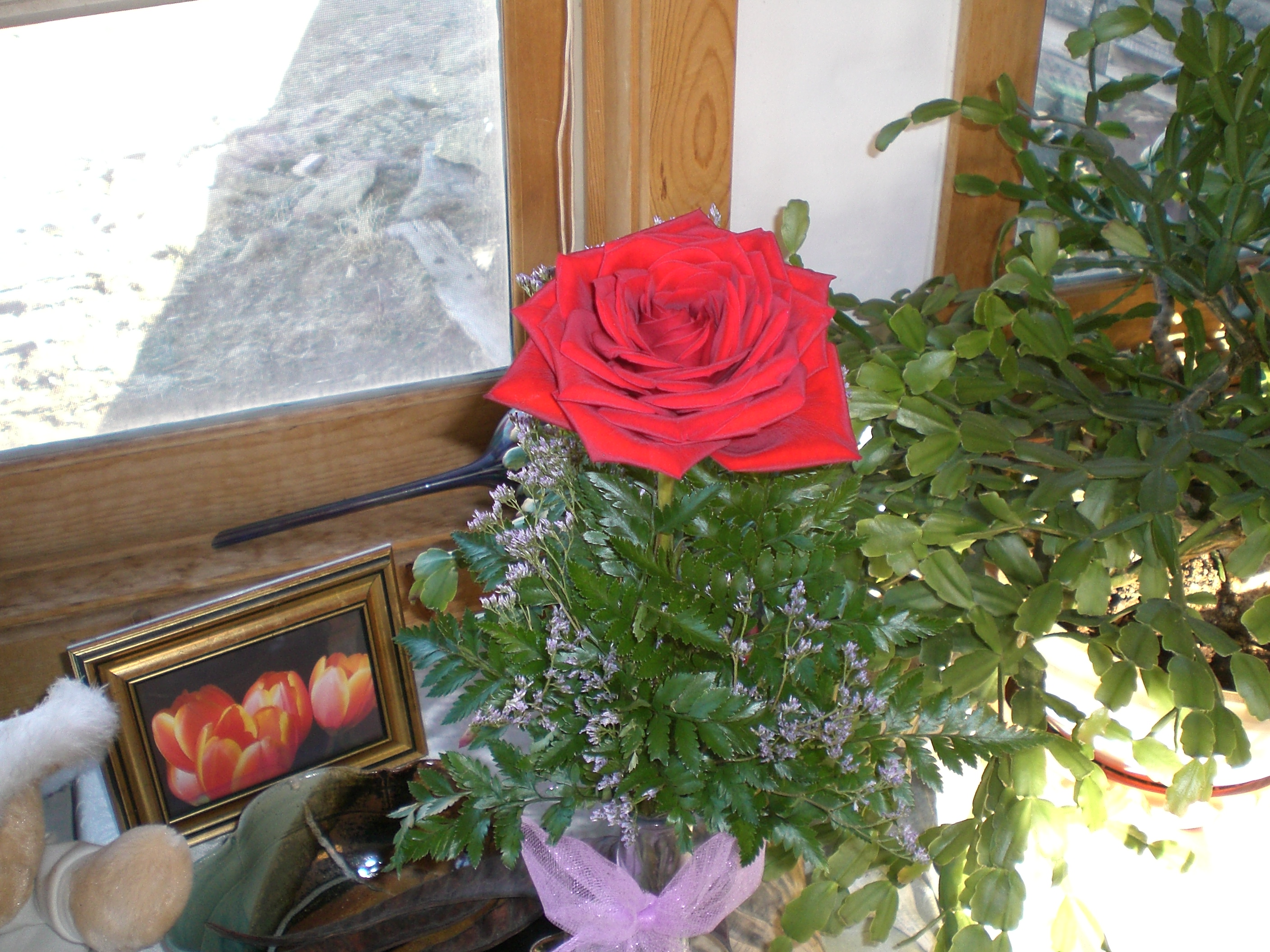
Being Present

February 23, 2014

As I woke this morning, three little puffs of cloud – the only ones in the sky – were framed in the window at the foot of my bed. I lay watching them through the leaves of a night-blooming cereus plant, waiting for the sun to come up above the eastern hill and finish lighting the sky. The clouds seemed immovable, virtually unchanging in what is obviously a windless day. Then, just as the sun began to shine directly into the east window, the puffs merged into one larger pillow, rising up and out of my sight. When I got up to look for what remained of them, the white fluff had thinned and was disappearing against the lighted blue background of a clear morning sky.

I’ve reflected on snow, and last week on the howling wind. This morning of remarkable stillness seems to be a special invitation to stop and consider the hectic pace of my recent weeks, not only of work but in my private and inner life as well. Never one to rush into new situations, new relationships, I have been meeting three to five people (clients) a week, and getting to know them and their family members quite intimately. Drawn into helping them access services which will resolve serious problems they are facing, I am exposed to the challenges and rewards of life in a very personal way that reveals how nothing stands still, even when we feel as though nothing is changing.

First gifts

First gifts

Several small birds have appeared in my long picture widow, flitting around one juniper tree, and two neighbor dogs have just trotted into the pasture, sure to initiate a barking greeting from my ever-vigilant min-pin Doodles and his woolly poodle companion, Warrior. The sun now slants directly into the window at my side, forcing me to lower the shade in order not to be blinded. Small changes – an inch of rise of the sun, a flutter of birds – and the day has shifted. A contrast to the experience of focusing on a single issue – such as finding a job, or getting a driving license – when it can seem as though nothing changes day after day because the single object of focus and desire is not obtained.

One of the greatest gifts from my MasterPath instruction has been an increasing ability to notice the small differences and changes occurring during periods of waiting for some larger event. My Teacher speaks of the need for certain karmas (external situations) to exhaust themselves in our lives, stressing that spiritual growth need not be delayed until after XXX (I get sober, I am able to retire, I find a job). How one views one’s days and the way one approaches the occurrences of each day are both the means and the opportunity for growth. In that light, the AA injunction of “one day at a time” is an important reminder that life is lived, and changes evolve, not in some distant future, but here and now, day by day.

Wisdom of my Teacher

Wisdom of my Teacher

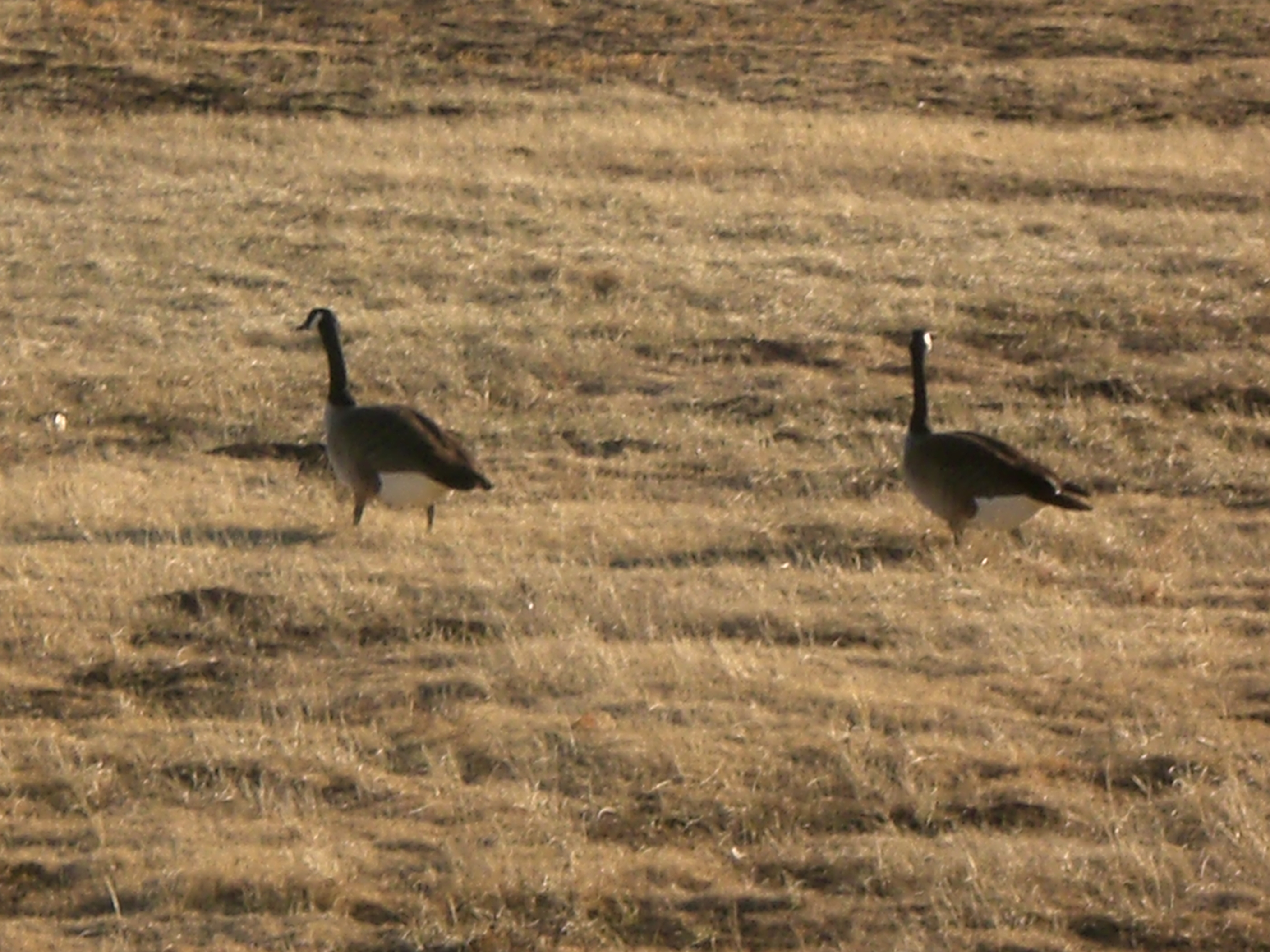
It seems as though my recent spiritual lessons have emphasized not just one day at a time, but one hour, sometimes one minute – bringing out how malleable time, or one’s perception of time – can be. I began with a comment about the hectic pace of my recent weeks, yet that pace only seems hectic when I look at how few days I’ve spent entirely at home, compared to pre-job weeks of days when I didn’t leave the house. If I count how many trips I’ve taken to different communities, how many new clients I’ve met, how much driving around the countryside has filled my recent weeks, I can feel as though there has been no time for me, no time to reflect, to write, to evolve. On the other hand, I remember that I noticed snow geese amongst the Canadians by the pond near town; watched a hawk catch a rabbit on the prairie outside Roy; learned more about Cameroon from stories shared during some of the longer drives; observed the relaxation of a tense body as a harried son who gave up his job last fall, to care full-time for his disabled mother, learned from me that he could have income within a month, being paid to provide that care. I remember these small moments, and time stretches.

Hectic, for me, is when I feel as though events have been rushing at me with no time to consider them, to notice details, to organize and structure experiences or – related to my new work – to prioritize what must be done. From that perspective, my commitment to myself to continue to post weekly is a commitment to limit the hectic pace the job could demand. At least once a week I must stop and reflect, and in this moment’s case, realize that I also stop and reflect frequently throughout each busy day. Noticing the geese, the hawk, the easing of tension are moments of reflection, of being present rather than reaching forward to an as yet non-existent future.

Only Canadians, no Snows

Only Canadians, no Snows

My mind has challenged the idea of being present with the moment when that moment is perceived as difficult, painful, scary or otherwise negative.

Why would one want to be fully present in a recent day of flu-induced aching and nausea? The lesson mind needed to learn was that during that day, other things were also occurring worth noticing, worth being present with. During that day, my one large dog, a retriever-cross named Blackjack, stayed on the porch and insistently close to me rather than spending his time as he usually does, out in the pastures. During that day, cotton tails appeared three separate times in the pasture. During that day one Christmas cactus put forth a single white flower, though the plant had never bloomed before.

On a recent day when I was physically exhausted but nonetheless had to drive 80 miles of winding roads on an urgent visit to a client, I was gifted to have a companion for the drive, and to receive the encouragement of expressed appreciation for my effort, from both the companion and from the client. I also saw multiple frozen waterfalls glued to rocks in the canyon through which I drove, and remembered and shared the story of a triple rainbow that had filled one field when I traveled that road in the past.

Little things to be present with. Little things which, accumulated, become large, become the frame and the tone and the import of each day. Again, my Teacher instructs that we are always free to choose what we give our attention to. Attention is food – what is fed grows. I choose to feed appreciation, present moments, what is. In such small steps, with present moments of attention, what can be is also fed, given form, and enabled to appear.

Baraka bashad.
Amen.
May the Blessings Be.

Letting the Wind Blow Through

February 15, 2014

A friend just mentioned he’d enjoyed my reflection on snow, bringing to mind the gorgeous silence of that recent morning, a stillness in dire contrast with the roaring, shaking, blustering, hollering wind blasting my home tonight. Gusts over sixty miles an hour have been hammering at us for five hours now; fortunately the general temperatures were warm enough today that the blasts are not unduly chilling. At least not chilling in temperature. But those who are made uncomfortable by wind can find our New Mexico spring weather intimidating. Tonight’s blasts are not unusual. A little early in the year perhaps, and lasting later into the night than normal, but very familiar nonetheless.

When I was fifteen I wrote a poem about standing up to wind, not a very good poem though the underlying thought was worth the effort. It had been triggered by standing on the edge of a precipice, at Les Baux in southern France. The town sits atop what here in the southwest we’d call a mesa, overlooking a broad plain called the Val D’Enfer. Reputedly the Dark Ages lords of Le Baux forced trader traveling through the valley to pay tribute – often exorbitant tribute – for safe passage, making the traversing of the plain a veritable descent into hell. My poetic effort attempted to recognize the strength it takes to stand up against a powerful wind, and the strength it took for travelers to risk passing near Les Baux.

I’d prefer more quiet tonight, to assure a better night’s sleep. It’s been a very long, productive but tiring day. If wishes were horses, beggars would ride… so says the adage that echoes in my mind wherever I let myself dwell on what isn’t. So instead, I’m using the blasting wind as a motivator to write this week’s post. We’ll have to see how the essay turns out! Smooth and slick, or choppy and irritating? The wind is both at once – will my essay mimic the wind, or express its essence?

“Love me, love me, say you do.
“Let me fly away with you.
“For our love is like the wind,
“And wild is the wind, the wind,
“Wild is my love for you.”

The most recent theory, from a study in Germany, of why older people take longer to respond to memory tasks, is not that ability fades with age but rather that there is so much more stored in an older person’s brain, it takes longer to sort through everything to find the relevant bit of information. I like that explanation, not just because it is more flattering. I like that explanation because it takes into account all the bits and pieces of song lyrics, like the one above, that pop out of the storage cabinet at mostly – but not always – appropriate times.

Say the word English, and I’m apt to begin quoting, “Her English is too good,” he said, “which clearly indicates that she is foreign. Whereas other people are instructed in their native language, English people aren’t.” And on and on, in Rex Harrison’s voice. I learned the entire performance of My Fair Lady when I was eight. Don’t ask me why, and don’t ask me why it’s still all there in the lumber yard storage of my brain.

That’s the term that was used, disparagingly, by the wave of neurologists who discarded “old” brain storage theories in favor of computer-link images that propose an entirely different set of rules for how our brains perform our thinking and memory functions. That new set of rules is the one that posited an eroding of capacity with age. One more reason I stand in opposition to all the supposedly “better” connectivity and computer-based emphasis of our “modern” world.

Inventors create a new toy and suddenly scientists see everything through the lens of that new technology. Wisdom of centuries is derided, practiced ways of relating to the world and to one another are treated as out-of-date. All theories, all explanations must fit the new paradigm.

Until a brave soul stands up and says “no” to forced conformity to what is new. Until a study from Germany says older brains are just as efficient as younger ones, but they have more data to process, more varied possibilities to consider, and so take longer to come up with answers. Until I suggest to a friend, who has been angered by a phone call wakening him at 3AM, that he can, in fact, turn his cell phone off when he wants to sleep.

What a novel idea to the ethos of today – to be disconnected!

In the midst of the wind storm, I am barraged with sound. Fortunately, I know the storm will pass and it will become quiet again. I really can’t conceive of living in the middle of a non-stop gale, any more than I can relate to those people who live constantly connected – mobile phone always on, always at hand, computer permanently turned on with multiple pages open, Youtube, Facebook, LinkedIn and Skype all demanding attention.

There are reasons to be available to others. If one is living far from home and family, computer connections bridge time zones and allow relatively inexpensive contact. The nature of my present job is such that I must be reachable in emergencies. That doesn’t mean all clients can call me twenty-four hours a day, however. They call a central, toll free number for triage. Only the true emergencies are put through to me in the late, or early, hours of a day.

Connectivity, like the wind, has its season. I do hope that before the passing of all those of us who have lived when (or where) there was not a phone in every home, those born to the age of connectivity will have tired of disrupted sleep and life in a fishbowl. I do hope for an opportunity to teach the continuing values of concentration, of solitude, of silence, of windless days and of attention to one thought, one person, one experience at a time.

*****

Awakening this morning, I first register the silence. The storm has passed, the wind abated. A new day, and new environment surround me. I appreciate the renewed quiet, the ability to focus inward before joining the network of souls who will make up my work day. And I’m happy to think that, now that a research study has been published which respects older brains, perhaps some of the thoughts and beliefs dwelling in those older brains will also be given new respect.

Wouldn’t that be a novel and pleasant experience!

A Snowy Contemplation

February 9, 2014

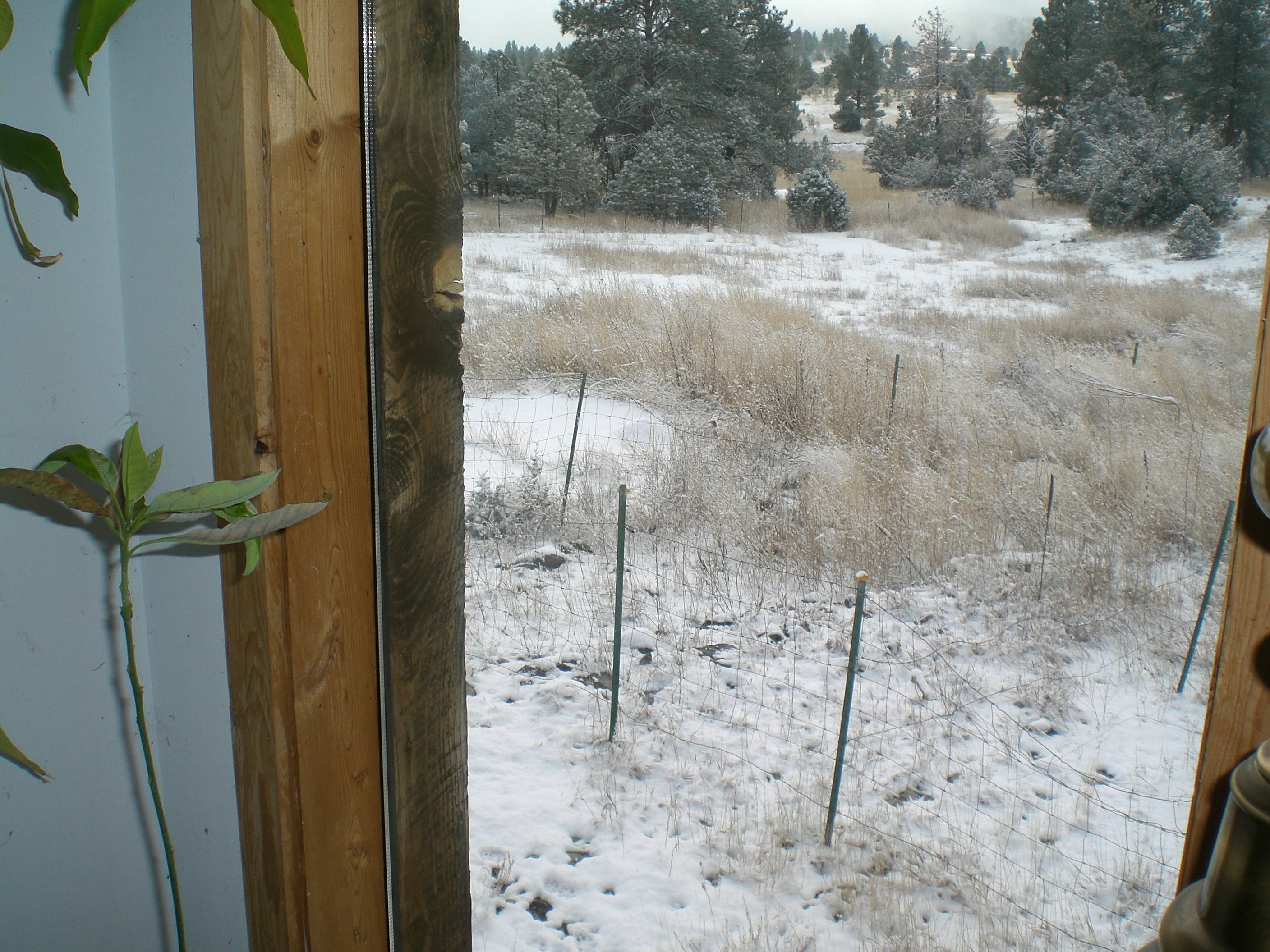
Have you noticed the unique silence that accompanies a fall of snow? The white blanket covering the ground somehow muffles ordinary noises of a country stillness, so that the world is – for a short time – truly quiet. I see birds at the feeder, fluffing themselves to shake dampness off their feathers, but they are not noisily jostling as they were yesterday. Even my dogs lie in, enjoying their heated porch rather than running barking at the rising sun.

From my Window

From my Window

Not much snow fell, not much more than a promise of wetness to our parched land. But the sky is still grey, except where the rising sun has broken through a cloud bank to paint a few slashes of peach and gold. Perhaps a few more drops will bless the earth from the clouds in the west. That is the direction our winter wetness comes in from. In summer it is often the reverse – systems stretch up from the gulf off Texas to give us summer rains. This past year, Texas did not share, and after a good start in late fall, the weather gods have chosen to send all the moisture either north of us into Colorado, or farther east where the blizzards and cold have caused major havoc.

Have you noticed how people’s temperaments are affected by the climates in which they dwell? It is an almost universal truth that cultures in hot, wet environments become gregariously noisy, even in Asian regions that one tends to think of as possessing a pattern of restraint. The silence of traditional Japanese people passing each other in public (it snows in Japan you know) is vastly different from the voluble street harangues of Vietnamese pedestrians in a country where the difference between hottest and coldest weather is less one of temperature than of moisture – monsoon season, or “dry” season when the humidity is perhaps 60% rather than 85%.

I knitted my first sweater in Saigon, when I was fourteen, and wore it twice on “cold” dry season days. Not days really suited to wearing a sweater, but I did so want to show it off. By the time I arrived in a cold enough climate to need a sweater, I’d outgrown it. A pretty dark cherry red pullover, with cap sleeves and a mini-turtleneck, the sweater went with me on to college and to Boston and eventually here to the desert, where I finally gave it to the daughter of a friend to be worn during what used to be our very coldest weeks of January. Used to be – it got down to 30 below at night and not much more than 5 for a daily high over at least a couple of weeks each January, even as recently as 20 years ago when I moved to my present home. For the past ten years, the night time temperature here has not dropped below minus 10, and the sun has warmed us comfortably every day. Pleasanter living than the mid-west’s polar experiences, but dire for our drought.

A snowplow has been by, and the school bus’ flashing lights indicate it has picked up my neighbor’s boys. I see cars making their way down the road that curves toward town, heading into the start of another workday. But still it is silent here around me, in a way only snow produces. It won’t last, neither the silence nor the snow, so I cherish it.

Have you noticed how people’s expressions of temperament change with their circumstances? A man courting a woman asks cautiously will she do this, would she help him to do that. Having won her, he issues orders – we will do this now, you must do that. The woman still has choices. She can simply agree, or she can learn in what way to express her own preferences so that she is heard. It is not significantly different in non-traditional relationships – we learn each other’s ways of being and how to express ourselves to influence the nature of the relationship. We learn how to help one another grow, and sadly, we also often learn how to block or stifle one another in an expression of frustrated, never-outgrown teenage envy.

Have you noticed how, entering a new relationship, there is a tendency to ask oneself, “Should I trust this person? How far? With how much of the truth about myself?” Past personal history of support or betrayal, extent of confidence in one’s self, willingness to risk, curiosity about different life styles, what a friend of mine simply calls open-mindedness, can all blend together into a force that shapes how a relationship develops. That is the common way.

How differently the issues of trust, of exploration and communication and growth of understanding unfold, if one considers a new relationship from the perspective of why the Divine ( God, or Fate, one’s Master, one’s karma, one’s wise inner self, or a Higher Power) “has brought this person and this experience to me at this time.” All the ambiguities of trusting in another person are released to the trust that we are alive for a reason, and that we can understand that reason, learning and thriving in our understanding.

Like the rare silence of a snow-covered early morning landscape, achieving an understanding of ourselves in relationship is a blessing. The moments of silence are brief; I woke early to enjoy them. The opportunities to intuit “what we’re here for” are also brief. I wake early to contemplate them.

The line of cars I see driving to work has warmed the thin snow covering on the road, and it is already turning to splashing slush. My big dog is out and barking to let the world know he has started his new day alertly. His two little companions romp patterns into the snow of my long, curving driveway. Outside, and in, the world is no longer silent. A new day of life has begun. What will I learn? What will I hear? What will I come to understand? What will I teach? What will I give, and what will I receive? Soon enough, I’ll have answers. Soon enough, too, I’ll have another opportunity to practice trusting that what is, is so, for a reason I may or may not be able to fathom. In trusting, I live. To cease trusting would be death – and I’m a long way from ready to die!

Across the Pasture Gate

Across the Pasture Gate

Another wave of snow clouds is sweeping in, flecks of white are drifting across the window. I will delay, just briefly, starting my own work day. Because I can do so, I choose to savor for a few moments more the regained silence (dogs still, birds quiet, no cars passing on the road), the blessing of extra drops of precious water, and another opportunity to consider why I am where I am, and for what inner purpose my outer life has taken on its latest form. Thank Thee, Master, for these gifts!

Friends

February 2, 2014

There is nothing intrinsic to my speaking French that excludes women.

There is something significant to the pattern of my friendships, which were primarily with males until I was well into my adult and professional life.

I had one close girlfriend as a small child – Sara Harwood – whose family moved away from Washington DC when I was about nine. I ran away ten blocks to her house after one particularly horrible encounter with my mother. Her mother sat me down with milk and cookies, listened to me, then called my home to say I was invited to spend the night with my playmate. The next day Sara’s mother drove me home. I have no idea what she said to my mother – but nothing changed in how I was treated.

I also played with a neighbor – Keith Fleming – until my family moved away from Washington DC when I was twelve. Keith had a wonderful playhouse her father had built in their back yard. We were both only children; neither of our families was comfortable with the other, limiting our interaction to the hours we spent building fantasy lives in the playhouse.

From the time we moved to Vietnam, as I turned thirteen, I was a loner – or had friends who were boys and, as I grew older, a sequence of boyfriends. I missed out on slumber parties. Not allowed to attend, and my mother steadfastly refused to take on responsibility for anyone else’s children so I never had friends over to visit in my home. Without the opportunity to reciprocate, I became uncomfortable spending time in other homes, reinforcing my loner path through my teens.

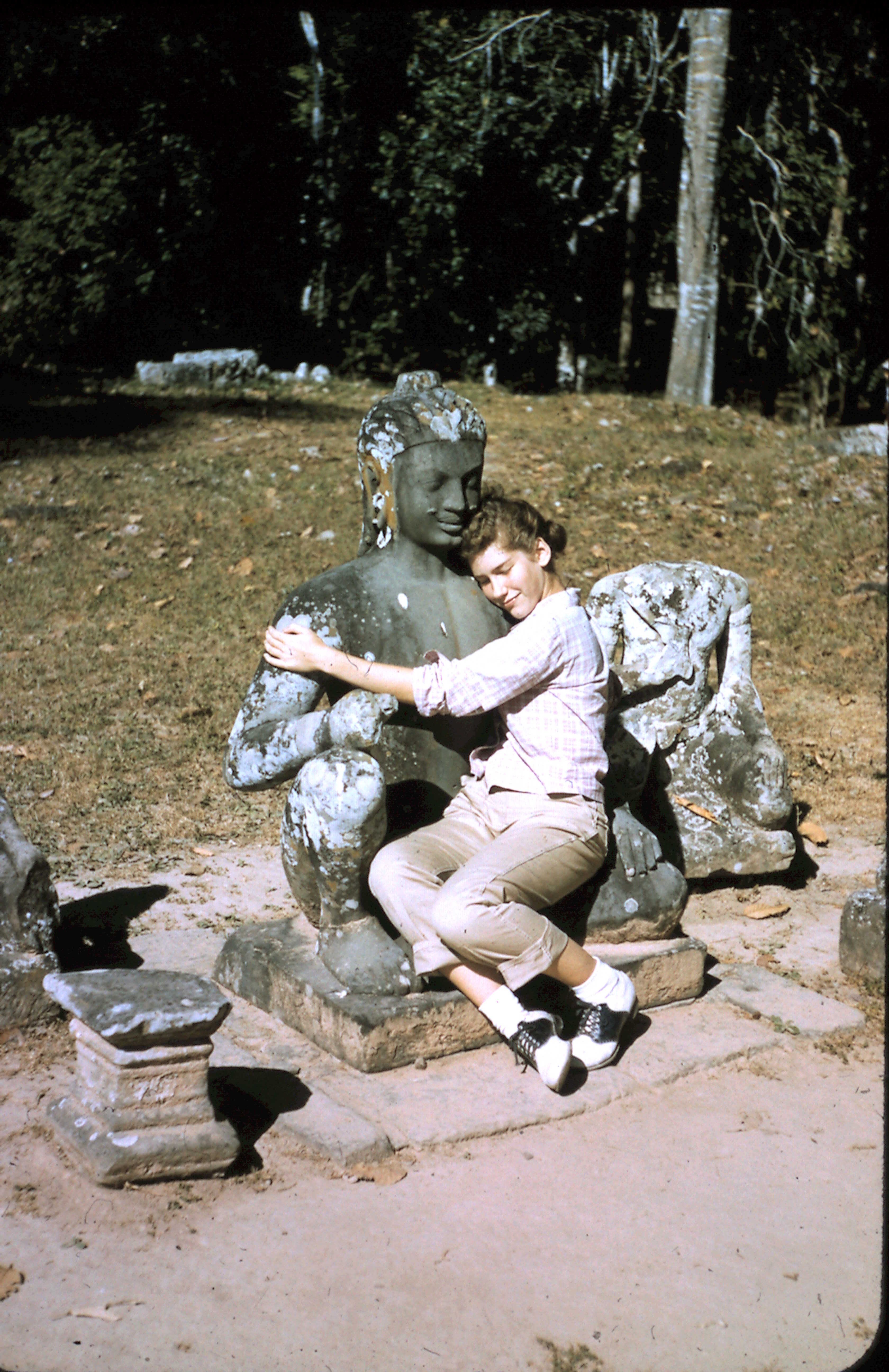
In the arms of the Leper King - Angkhor Wat

In the arms of the Leper King – Angkhor Wat

Undoubtedly the difficulties of life with my severely emotionally disturbed mother produced subtle bias against forming relationships with women. By contrast, I received affection from the one grandparent in my life – my Grampa – and at least intermittently from my father. Not surprising, therefore, that I was more comfortable with boys than with girls – and consequently not surprising that my memories from my French-speaking life are of interactions with males.

Overlooking Athens

Overlooking Athens

Not surprising either – perhaps – that for much of my early career I worked in male-dominated areas, encountering relatively few women from amongst whom to find friends. Clinical research in Boston, employment testing and then wildlife management planning in Santa Fe, then teaching in the New Mexico penitentiary… surrounded by men, in some cases the only female professional in the group. It wasn’t until I reached my mid-thirties that I developed close friendships with several women. Interestingly, they remain my friends today – thirty some years later. So once the barrier came down, friendships with both sexes became my norm.

Sivan at Mesa Verde

Sivan at Mesa Verde

Come to think of it, those first friendships with women had a common thread – all of us had had difficult relationships with our mothers. We were mature enough to not feel the need to vie, as teens so often do, for “who had it worst” (or best, or easiest). Absent that competitive tone, we could learn from each other and bond over our shared solutions to the psychological slings and arrows we had endured. Just a week ago, one of those friends commented to me that she’s always thought of me as sexy although she’d never mentioned the trait to me. I am surprised – it’s not at all how I think of myself, although I do enjoy and embrace that aspect of life. Reflecting on her remark, I realize that there is still a corner of my psyche that accepts my mother’s strictures against behaving improperly – i.e. in a sexual manner. And believe me, she saw sexual innuendo everywhere!

A meal with Leon at San Felipe

A meal with Leon at San Felipe

I don’t. And where I do see it, I am not offended nor embarrassed, nor do I think of myself as improper because I enjoy all aspects of my being. My female friends, I suspect, do the same, though that is not a subject we’ve found it necessary to discuss. Instead we talk about our careers, balancing personal with professional life. We share excitement over new endeavors, and commiseration over frustrated aspirations. And, with those who are, like me, followers of MasterPath, we share the outward manifestation of our inner spiritual discoveries.

It no longer seems to matter to me if a friend is male or female – the nature of the bonding remains the same. Shared values, interest in new aspects of life, finding ways to be useful and to be appreciated, these are my building blocks for any constructive relationship. I’m pleased to know that my early misdirection away from females has been overcome; now I just need to encounter some French-speaking women to bring full balance to my language-dictated relationships.

A happy Khin

A happy Khin

Courage

January 25, 2014

For all the twenty plus years that I’ve been a “getaway” parent to students at the United World College of the American West – a two year international school drawing 16-19 year old students from nearly 80 countries to live and learn together – I’ve admired the courage of these young people. As much as many teens want to escape from parental supervision, it is still a major step to travel half way around the world, to live and study in a very different cultural environment.

I’m reminded of my own small venture into a similar unknown. I was sixteen, and had succeeded in finding and being accepted into an international summer work camp organized by the Mennonites. At the time I was living in Paris. The work camp was located in Vienna. My parents decided to make a vacation of driving me to the reunion point. They did not calculate travel time very well – or rather, they did not allow for my father’s insistence on frequent photography stops, as we made our way across France and into Switzerland.

When it became clear there was no way we could arrive in Vienna on time, my mother reluctantly agreed that I should take a train the rest of the way. My father coached me most thoroughly on how to say “I do not speak German, but I understand a little. Speak slowly please.” Trouble is, he taught me so well that my flawless pronunciation contradicted my statement, and the people I encountered generally responded with a flood of information, of which I was only able to glean that they thought I expressed myself very well indeed.

Despite the communication challenges, I made it from the railway station across Vienna to the church our group was to restore. In the end, we were moved out to the country to work on a farm/guest retreat – eighteen of us living over a chicken coup, cutting hay with hand scythes, bringing in firewood, installing a septic system, working very hard but also having a great time. We were from eight different countries, as disparate as Sweden and Turkey. I was the only American. Over the course of the summer we created evenings with a meal – improvised from our very limited diet of potatoes and tinned meat – and entertainment typical of our homes. I made sloppy joes from the tinned meat, and taught square dancing. Oh, and I appalled the Germans and the French by serving a desert of apple pie a la mode. Pie, yes OK. Ice cream, yes OK. But together? AAARRRRGGGGHHH.

For twenty years I’ve observed how variously the United World College (UWC) students do or do not adapt to the adventure they have undertaken. Most do surprisingly well. The most common pattern has been two students per year from a nation, so that there are four “country mates” at a time. Occasionally there will be a single student and not one every year. One of my early getaways was from Korea, the first to come here from that nation, and the only one for several years. She found it hard to adjust until she met a local family who had adopted a Korean baby. Spending time with them helped her feel more comfortable.

An Ethiopian getaway I had several years ago admitted that she was very nervous coming to the USA. She had heard enough stories about prejudice against blacks to fear for her safety off campus. It is my habit to research the food of the countries from which my getaways come. I’ve learned to cook Burmese, Senegalese, Korean, and Malay in addition to the more common Chinese, Japanese, French, Spanish, Indian and Thai with which I’ve long been familiar. I was able to find teff flour in Albuquerque at an international food market, and the first time Bereket came to the house I tried my hand at making a traditional bread for her. It was less than a smashing success, but she later shared with the general college population that my effort stood out in her mind as a sign of welcome and an indication that her fears were unfounded.

Lately the number of Chinese students has risen substantially – there is a contingent from the mainland as well as from Hong Kong. They are even offering classes in Chinese to the local community this spring. The dynamics on campus are changing, as the size of different cultural groups shifts – but that is a topic for a different essay.

The students at UWC do have a framework of support, not just from country mates, but from the fact of being in a school program. How much more courage it takes to come to the US to escape intolerable living conditions in one’s home country. How much courage it takes to put oneself into a position of dependence on the kindness and support of strangers. How much courage it takes to not only travel half way around the world for one’s one survival, but to bring along the aspirations and dependency of one’s entire family. To live each day with the knowledge that the future of the next generation in one’s family depends on one’s effective exercise of wit and charm, to create a life in a land far from home.

My father was an immigrant to the US 85 years ago, as was my mother’s father twenty years before that. From the stories I heard as a child, I know it was not easy for either of them, but it seems that the environment into which they came was more hospitable than the one new arrivals and asylum seekers face now. At the turn of the 20th century, the US was truly a nation of immigrants, of refugees from famine, from pogroms, from oppressive regimes. I may be wrong, but I think our immigration laws were less punitive then – and the communities of immigrants created more of a home away from home for subsequent arrivals. My grandfather talked about families who knew of and expected his arrival. My father had a harder time – he developed spinal meningitis on the trip over, and was taken off the boat into hospital, not expected to live. He did survive, eventually found his way to upstate New York to work on a dairy farm, became an agricultural expert, and finally an employee of the government, and an economic officer in the diplomatic corps.

Now the process of making one’s way through the complexities of immigration status seems dependent on a good attorney – and the money to pay for one. Without papers one cannot easily work and earn money. Without money one cannot easily obtain papers. To knowingly put oneself in this Catch-22 situation, with the hope that a way can be found through the maze, takes an awesome amount of determination and courage. I am privileged to know several people who are finding their way through the thickets – a young woman from Burma, my former getaways from Senegal and Nigeria, my new friend from Cameroon. Their lives and their challenges remind me to be grateful for what my grandfather and my father achieved – and I am encouraged, as well, to do my part to “pay it forward” as a way of expressing my admiration for their courage. They believe their lives will be better as they become able to live and work here legally. I know this country will be better for their presence and participation among us.

Energized for the Best

January 18, 2014

I’ve never engaged in the forced gaiety others seem to think necessary for New Years – have instead always enjoyed a few simple, symbolic activities like having pickled herring and some sort of sweet pastry to give zest and pleasure to the upcoming year. Whether alone at midnight, or with company on New Year’s Day, I’ve kept that tradition – inherited from my maternal grandfather – going for a very long time. Sometimes I’ve lit sparklers at midnight – but not this year, since I was tired and went to sleep early.

What seems to be already markedly different for me in this new year is its energy level – both demanded and being met. I seem to be coming out of a longish period of – not retirement, but a withdrawing from interpersonal engagement, a period of living in a somewhat more distant and reflective way. Friends say that I have been so busy and active that no one would perceive me as withdrawing, but to me it has felt that way. Especially as I contrast the past eighteen months with both my new job, which is pushing me into a great deal of one-to-one interaction, and with being drawn into a more active socializing via two Cameroonians, newly made friends.

I’m fixing a west African dish for supper for them/us tonight. It’s one I learned years ago when two freshly graduated students from the United World College, one Senegalese, the other Nigerian, lived with me for a summer. There are of course regional and tribal differences across the very large continent of Africa, but overall, my experience of Africans is of a warmly engaged, very active presence – two days without a phone call is rare. It can feel intrusive when one is accustomed to a more formal and distanced way of being, but it is also energizing. Radically opposite to the reserve of most Asian cultural norms, with which I am more familiar.

The UWC girls were challenged, adjusting to living in my rural home. I feel as though I have close neighbors – I can see houses in several directions out my windows. They felt as though they were in the middle of nowhere, because for them a neighbor is someone living so close by that you hear their voices throughout the day – almost as though they are part of your immediate family. To compensate for the quiet I so enjoy, they played music – loudly – until they saw my car coming up the drive. I would hear the music suddenly turned off and smile to myself. Different strokes for different folks, indeed.

+++++++

It’s several days since I began this essay. The dinner on New Year’s Day was full of lively talk, appreciation for a meal “from home” with every bit of the food scarfed down. The energy level in my small house rose dramatically, seeming to be almost too charged to be contained. Such a change from its usual status as a quiet retreat.

And that has been my experience each time, since, that one of the men has been out for a visit. I’m learning (in French) about a lifestyle very different from my own, about the way old cultural customs (reading the color of the kidneys of a freshly killed rooster to determine the chances for success of a marriage) are blended with modern life. Before you question the role of the rooster in planning a relationship, consider what outside omens you look to, for guidance in decisions. Astrology? The I Ching? What page your Bible happens to fall open to?

We all seek reassurance that actions we are taking are “for the best.” We enjoy reminders of the familiar when we are surrounded by what is strange and new. As I am adventuring into new territory with my job, I see myself mentally tying aspects back to prior experiences. Coming away from my first home interview with a cliet I was happy, relaxed, feeling I had made a difference – yes, this is what I used to value when I worked as a case manager in the past, this is the reward for dealing with the excruciating, dictatorial, last minute and excessively thoughtless mandates of the State. Working with people, connecting with people, helping people is the thanks for coping with a computer data system designed by urban techies with no regard to efficiency, the limits of Internet connectivity in rural “frontier” areas, or the limits of patience of “normal” human beings.

So far, it is for the best that I continue to work long and demanding days, and late into the night hours. It is for the best, I trust, that I am simultaneously using French daily and regaining my ability to speak it without thinking, and to catch myself thinking in French as I drive through miles of open grasslands, seeing an occasional herd of antelope, and many hawks, but nary a truck or car.

Out on the Plains of new Mexico

Out on the Plains of new Mexico

And it is apparently also for the best that I am being swept up into the energetic and warmly embracing family of Cameroonians I’ve so recently met.

Accustomed to considering why things happen the way they do, questioning what I should learn from various events, I am instead, in this new year, being rushed along on a tide of activity with only the ability to hang on for the ride. I will see what it is all for, when I find out where it is that I am destined to fetch up. A new year, a new job, a renewed language, all combine to present me with a new way of experiencing my life.

It just occurred to me that there is a belief – Asian I think or perhaps New Age – in the relevance of seven year cycles in our lives. No wonder mine has taken such a different and interesting turn, at ten times seven!

In Another Language

January 12, 2014

Do you speak more than one language fluently?

How are you different to yourself or to others, according to the language you are using? How does the difference in world view embodied in a language reveal a difference in its speakers? What depth of knowledge, of concept and perception of the world is lost when a language dies for want of speakers?

Once upon a time, when I was much younger, I was fully bilingual, speaking, thinking, dreaming in French as readily as I do in English. After forty years of living in the Southwest, with rare occasion to use French, and then only for a few hours at a time, I felt that I was losing more than the ability to speak French. I was losing aspects of my identity, personality, self.

Some traits are obvious – I use my hands much more when I speak French. These past thirty years have steadily diminished both my gestures and the mobility of my face (as evidenced by videos), with my communication limited to English. What else about myself is disappearing? Am I less flirtatious? More reserved? Living more through my mind and less through my emotions?

Or are those changes the result of growing older, of my life experiences, of my spiritual practice – and would exist irrespective of the language I speak?

In the way of events in my life now, once I’d framed up an inquiry, the means to explore the answer presented itself. I’ve been introduced to a Cameroonian who has been pursuing graduate studies at a nearby university. He is fluently bilingual, and offers me the opportunity to resurrect my French. I’ve been pleased to discover that my language skill still exists, relatively intact, beneath the surface of my daily life and that, as I use it regularly, my fluency is returning. My pronunciation, however, definitely needs practice.

What else is or needs changing as a result of using a second language? Can I separate shifts in attitude or emotion that originate within me based on language, from those resulting from the topics of discussion?  What is the effect of conversing with an African, rather than a Frenchman, or a bilingual American?

A good friend with whom I discussed the effects of language on perception, told me of how his relationship with an acquaintance changed as a result of a change in use of language. The interaction of the two men had been conducted in a mixture of fractured Thai and equally limited English. Despite the limitations, they had begun to build a friendship. Then the American was observed by the Thai, chatting easily with a group of other English speakers – and “the friendship was not the same afterwards. He saw me differently, and seemed not to be able to be comfortable with me in the same way as before.”

Do I see myself differently, when I speak French? I’ve been remembering events from my earlier life that I’ve not thought of in a long time. An evening at a club on the Left Bank in Paris, during my junior year of high school (American School of Paris) to which I was invited by the son of a friend of my mother’s. Hugh had just returned from a semester in the US, and ostensibly was introduced to me by our mothers, so that he could practice his English. He already had plans for the evening, and agreed to include me. On the way to the Sorbonne, by metro, he suddenly asked what part of the US I was from. When I said Washington DC his next question was, “Is that considered the South?”

He was subtly trying to determine if I’d have a problem spending the evening with his friends – African students at the Sorbonne. I did not. We collected his two French-speaking friends from Dahomey (now Benin), and went on to visit a Nigerian who has in hospital. There we acquired a fifth member of the group, a visitor who spoke virtually no French. As the only person fluent in both languages, I became the interpreter for the evening, which meant that I danced with one or the other of the men from Dahomey who argued for each African nation developing itself economically, then with the Nigerian visitor whose view was that a Pan African approach to growth was essential to the emergence of the continent as a presence in the world. About every third or fourth dance, Hugh would escort me and – in English – check to see if I was enjoying myself, and if I minded talking so much politics.

I mostly remember the oddity of being – with Hugh – virtually the only white face in the club, which was a hangout for all the Africans living in Paris. I remember enjoying the dancing, and the adventure associated with being out with “older” guys (they were in their mid-twenties) and experiencing an evening so distinctly different from the norm of my life.

My first “true love” happened in French. I dated Patrick throughout my senior year, left him behind when I graduated and returned to the US to attend college, but never really left him behind. He visited me in Boston seven years later – and fifteen years after that came with his family to the US, and a visit at my home near Santa Fe. We still exchange greetings although we haven’t written letters or talked in a long time, partially because I “lost” my French, partially because I’ve found it challenging to translate some of my US, and particularly my rural Southwest, experiences into a language I know primarily as a fast-paced, urban expression.

In college, for about a year, I dated an African Olympic soccer star, coincidentally also from Dahomey. We spoke French when alone, but English in company. He led the college team to the championships, and would usually make one goal that was spectacularly “pour toi” – a solo, elaborate-footwork trip down the field showing off his skills. The rest of the game he was the consummate team player. He was also sadly troubled and displaced, enough to not return from a summer visit home between our sophomore and junior years. In this instance also, French was associated with experiences out of the norm of my life – even though I was minoring in the subject. Studying French literature and practicing translation of texts felt like part of my general academic life. Dancing the High Life, cheering at a soccer match off campus, trying to help my friend overcome the culture shock that was dampening his spirit – those were new and different challenges.

So am I finding that I’m more adventurous in French? Perhaps…

I certainly seem to be more frank. Because I do not have the fluency to mask my thoughts and feelings? Perhaps…

I notice, in the recounting, that the significant experiences being brought to mind by my use of French are all about interactions with the opposite sex! Hmmmm…..

To be continued.

Instead…

January 5, 2014

The adage that misery loves company bothers me. I’m all too aware of its accuracy, seeing it manifest in my recent work days as an easing of tension when I discovered that others are having the same problems with computer malfunctions that I have been experiencing. I’m glad for the reduced anxiety that accompanies not being the only one facing this problem, but embarrassed, nay ashamed of feeling relief that the problem is widespread. There is nothing appealing to me about knowing other people are facing challenges!

In my defense, I can also attest to feeling elated when a co-worker “got” a concept she’d been struggling with, thereby joining the company of those of us who were trying to help her understand and apply it. She was happy with her success, but she admitted some of her happiness was relief at no longer being alone in her lack of understanding.

One of the pleasures of my new employment is that the company ethos is very positive and supportive, the antithesis of “misery loves company.” Carping, impatience, brusqueness are not acceptable despite highly stressful work circumstances that have had some of my managers putting in 65 hour weeks for the past six months. The consequence is that all of us slightly befuddled, confused, easily overwhelmed “newbies” are quickly learning to express our uncertainties in the form of positive questions. By seeking guidance it turns out that we have also been identifying glitches in the data systems with which we are expected to work, becoming part of the solution and, in the process, feeling better about ourselves.

I come from a prior work environment which was very different. Above me (fortunately in another office in another city) the ethos was one of jealous attention to any perk awarded to someone else; a pervasive fear of being randomly called on the carpet for perceived faults never previously identified; a daily manifestation of what I recall being told is a military belief that the way to deal with recruits is to keep them complaining. “If they’re distracted with complaints, they won’t notice how miserable they are.”

Within my own domain, I tried to set a different tone, one of teamwork and all of us pulling together to meet the expectations of my out-of-town supervisors. For the most part I was successful, less so in my last few years when tensions associated with the many changes in health care translated to increasingly frequent “audit” visits by staff from the main office. They rarely found problems. They did leave behind the unpleasant taste of their “gotcha” approach to our work.

Sadly, when a serious problem was uncovered and I took responsibility for not having detected it myself, those who initiated it chose to deny culpability and were resentful of being expected to pitch in and make the necessary corrections. Our office did get things put right, but the atmosphere had become one of misery, loving company, dragging everyone down to the lowest unhappy level. Finding myself not strong enough to boost the prevailing mood up again, I resigned.

My new employer is advertising supervisory vacancies, and several people have encouraged me to apply. I have no intention of doing so. If possible, I never again want to be responsible for anyone’s work product other than my own. Twenty years of ‘growing’ employees, helping workers uncover and develop their potential, seeing them move out and up to better paying positions – I’ve served my time as an administrator. I do not believe, now, that just because I have a skill I must use it. Instead, I think I’ve earned the right to only do work I enjoy, which translates to only being responsible for my own work outcomes.

Yes, I mentioned helping teach a co-worker; I’m still oriented to bringing everyone’s skill and success levels up and doing all that I can to reverse misery loving company. I choose to do so voluntarily, not as part of the responsibilities of a defined supervisory position.

What is it about having a responsibility that converts a satisfying “want to” into a burdensome “have to” activity? Is the mechanism the same, when an acquaintance expects you to provide a form of support that you might willingly offer, but which you mind – maybe even resent – having to provide in response to the imposed expectation? What causes the same action to be, in one case a gift, in another an onerous duty?

Perception, a label, a naming of the action, an attachment to the idea of freedom of choice – any or all of these can and do change how we feel about what we are doing. Seeing others “similarly situated” changes an experience of vulnerability to one of “I’m not alone” and we feel better.

The challenge, as I see it, is to shift one’s perception away from “alone with this problem” without needing to find others who are similarly unhappy. I expect of myself that I will minimize occasions where I am manifesting the true – but very negative – “misery loves company” adage. I expect, instead, that I will remain sufficiently focused on the inner spiritual joy I know to be my true Self, that I will not feel alone with any problem. I expect to practice my daily contemplation, to stop and “check in” many times during the demanding and busy days ahead, so that I function in a space of shared pleasure, shared accomplishment, shared cooperation, banishing misery not just from my own space, but from the space and lives of those around me.

Joy loves company. Joy expands. The Soul is a joyful entity. I am Soul. Therefore I AM – joy.

I am the Cat

December 27, 2013

How is it that, as a self-identified cat person, I write so much more often about dogs? True, over the years I’ve shared my home with more dogs than cats, undoubtedly because dogs more easily work out a pack status and accommodate to numbers. For every three dogs, I’ve offered food and shelter to at most one cat. The only time I can recall offering housing to two cats at once, the dominant cat (Natasha) had recently been a mother, her kittens just weaned and off to new homes.

Shifting possessions in a rented storage unit, I heard a frantic mewling coming from behind the building. Huddled under an accumulation of dead leaves blown against the metal siding, was a tiny black handful of fur with a wide open mouth, loudly proclaiming its presence. Chantilly Lace quieted as soon as I picked her up. She dug around against my chest until she found my generously-sized inside jacket pocket, then nestled her way into it and went to sleep.

My chores completed, I returned home uncertain how to introduce Chantilly to Natasha and to the dogs living with me. Isha, a lanky Lab cross, had recently finished her stint as a kitten sitter. She amazed me with her willingness to let Natasha’s brood line up and nurse on her dry tits. Once the last kitten began eating solid food, Isha resumed her role as junior dog in the pack that went daily into nearby fields, to chase rabbits and warn off coyotes. She did not seem disposed to play mother substitute once more. Driftwood (Golden/Collie cross) and Khan (another black Lab cross) showed the normal doggy disdain for felines. No help there.

Not knowing the outcome, I set Chantilly down on the couch between me and Natasha, and waited. My timing must have been perfect; post natal hormones pushed Natasha to wash Chantilly, whose grateful purring response reinforced a bond. The two cats became familiars. I never afterwards saw one without the other. Their preferred sleeping positions were snuggled head to tail (69 position) and belly to belly, Natasha’s grey tiger stripes accented by Chantilly’s glossy black tail, a fur boa draped across Natasha’s neck.

In more recent times, I’ve watched my horses tend to each other’s needs by standing side by side, head to tail, nibbling bugs off hind quarters and those hard-to-reach places that need a scratch or – in the case of the cats – a good wash. Natasha, several years older, nonetheless outlived Chantilly. Alone after years of partnership, Natasha became noticeably more affectionate with me. She would fall asleep against my thigh when I sat reading. Gradually waking from a nap, she was apt to begin licking my leg, her left over habit of grooming Chantilly before and after sleep.

Natasha’s long life ended with a tumor on her jaw that eventually precluded eating. She survived on determination and wet food thinned to drinkable consistency, until the day she climbed onto my lap, looked me over thoroughly, licked my hand and meowed an unmistakable request to be eased on to her next incarnation.

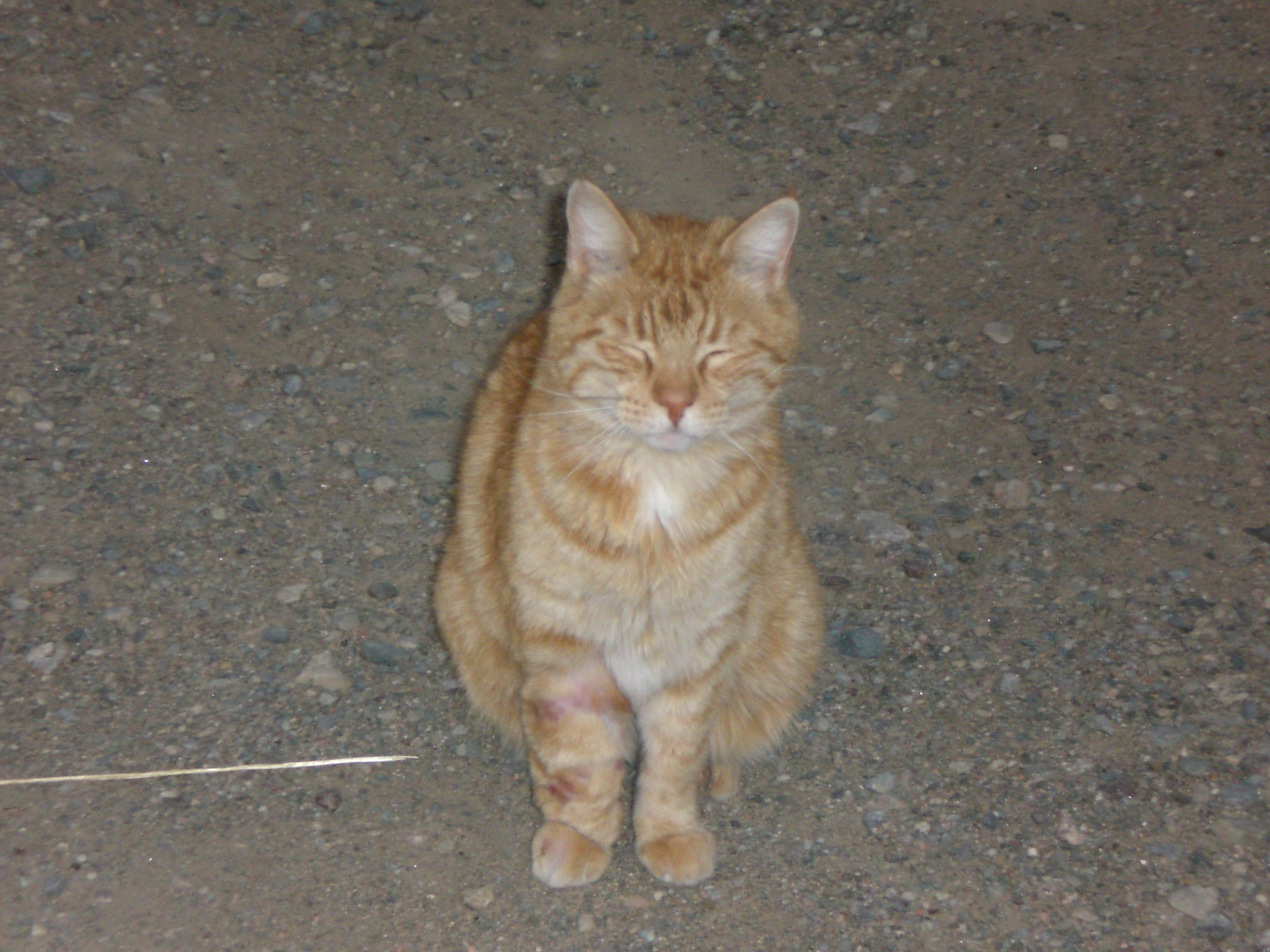
A goodly number of years – and quite a few short-lived cat visitors – later, I was gifted to share space with Haiku, a ginger tom whose disposition was a charming balance of feistiness and affection. He enjoyed the several dogs (a Bouvier, another Lab, a Scottie and my first Shih Tzu) and was not averse to sleeping beside one, or tussling for a bone with another. Indeed, his personality was so like that of Daisy, my departed beagle, that I sometimes wondered if he wasn’t her reincarnated essence.

Handsome Haiku

Handsome Haiku

Haiku was a hunter – solo but also in company with whichever dog felt like going after a rabbit or dove. He would stalk prey, flushing it toward the waiting dog, then join whichever canine (usually the Lab) in pouncing on the heedless rabbit, or jumping into the air to snap at the dove. Together the pair were successful a surprising number of times. Haiku usually left the carcass to his canine teammate – his was indeed the thrill of the chase, more than the achievement of a goal.

Late in his life, Haiku became a test subject for an anti-cancer treatment being developed by a chemist friend of mine, in partnership with a research biologist from Arizona. Haiku grew a tumor on his foreleg which resisted surgical removal, growing back quickly and so deeply that the only further surgery possible would have been an amputation. The anti-cancer medication had, at that point, primarily been tested on mice. Calculating an equivalent dosage for a cat, my friend and I started Haiku on a weekly series of injections to which the tumor responded by softening and growing at a markedly slower rate. My vet followed the experiment with interest – and helped me ease Haiku onward when his system began to shut down as a result of the combined stress of the cancer and older age. He made his mark, not just in my life, but via his test data which went into the pool of information being used in further development of the anti-cancer treatment. A noble contribution from a noble creature.

Miss Socks

Miss Socks

The three most recent cats in my household have been Socks, Limerick and Noelle, all rescues, the first two of whom lived with us for relatively short periods of time. Socks took up with my Bouvier, both of them older and sedate, enjoying sleeping together in the sun. Like a long-married couple, they died only a short time apart. Limerick arrived – and left – by moonlight, spending only a few months with us.

Limerick in the Light

Limerick in the Light

Noelle, now five years old, was a Christmas gift, rescued as a kitten by a neighbor and presented to me “as holiday company.” For an animal born wild, she took to indoor life with alacrity, claiming the utility room as her home and only going out if I carry her to a perch high up under the carport. She hangs out in the rafters, fussing at the dogs and demanding to be transported back to her indoor residence, yet requiring persistent persuasion to come down within my reach. Once back indoors, she hides from just about everyone who has reason to enter the room (she dislikes the noise of the washing machine but hums along with the dryer). Her favorite places to perch are wrapped around the vent pipe for the hot water heater, or atop a box in the room’s south facing window. She has also made herself a hidey hole under a low shelf and it is there she retreats with a flash of tail, if a stranger enters the room.

Noelle

Noelle

Noelle is a talker – but only to me and one aide, who works with my housemate on Sundays. She is affectionate with the two of us, but avoids other people, even those who would lavish affection on her. I don’t know why – she’s not had any negative experience of people in all the years she’s lived with me. Her inscrutable cat reasoning, I guess.

I recently received a cute, animated set of pictures from a friend, illustrating the stereotypical difference between dogs and cats – the dogs generally bouncing in excited response, the cats indifferent to whatever is offered them by their people. What my several cats have taught me is that differences between and within species are more nuanced, closely mirroring the differences between humans.

Or perhaps, what I observe is merely the truism that our pets become mirrors of ourselves? In which case, I guess I defy classification, being sometimes aloof, sometimes affectionate, generally independent, usually friendly, occasionally on guard, rarely wary, never mean, often changeable, my bad moods short-lived. I like to play, love to cuddle, enjoy affection but still, when all is said and done and now that I am in the latter years of my life, I am Kipling’s “cat, who walks by himself.” So be it. Amen.


Only Fragments

Love Letters to the Tar Pit

KarusaaVerse

Words that Sparkle, Thoughts that Ignite: Fueling Your Imagination

Leaf And Twig

Where observation and imagination meet nature in poetry.

Millarson Diaries

Personal Musings and Thought Experiments

The Beauty Along the Road

Discovering Beauty in the small details of our lives

Flowerwatch Journal

Notes on Traveling with Flowers

1eclecticwriter

Wide-Ranging Commentary

Spirituality Exploration Today

Delving into the cross roads of rationality and intuition

smilecalm

Life through Mindful Media

A Good Blog is Hard to Find

I will shatter a word and scatter the contents into the wind to share it with the world.

Ray Ferrer - Emotion on Canvas

** OFFICIAL Site of Artist Ray Ferrer **

AKA The Versatile

Fashion | Lifestyle | Food & Travel | Beauty | Fitness | Education | Product Reviews | Movies | Doodling | Poetess

Aging Abundantly | Women Over Fifty | Empty Nesters | Caregivers | Aging Gracefully

Finding Joy at Every Age with writer/philosopher Dorothy Sander

ARTZZLE

Helping with the Pieces in Life's Puzzle of Art and Design

Project Light to Life

A bucket list blog: exploring happiness, growth, and the world.

The Daily Post

The Art and Craft of Blogging

Any Shiny Thing

MIDLIFE MAGIC

allmostrelevant

@allmostrelevant

The Irrefutable Opinion

Assaults on the Casually Mundane by K. Jean King