Archive for the ‘Living and Learning’ Category

Tea-tinted Memories

August 29, 2016

Filling time between a dermatology appointment (Neosporin aggravates rather than helps to heal wounds!) and a dharma talk at Upaya, the Zen center in Santa Fe, I took a walk up Canyon Road, famous for art galleries, a history of being the path to the source of water and wood for city residents, and site also of the Santa Fe Friend’s Meeting with which I have a long and pleasant history. Most of the galleries I knew from years past have gone; so too a few favorite restaurants.

Living 80 miles away for the past 25 years, I’ve obviously not kept up with the street’s evolution. I did walk past the house where longtime friends lived when I first visited Santa Fe, in the early spring of 1972. And the gallery where, during that visit, I purchased a small bear fetish made from serpentine is, amazingly, still in business. The Glory Hole is gone. I miss its lively presence, the roar of the furnace and the crowd of onlookers enjoying the vivid, skilled and energetic process of creating blown glass objects.

In that space there are now several galleries – and a tea shop. Very ready for some cool refreshment, I went into the store to order a freshly brewed glass of Assam, and looked around at the walls of tins of different types of tea for sale. Many familiar labels stood among the black, green, white and herbal teas offered. Old friends from Ceylon, Darjeeling, Kenya, and Russian, English, and Scottish blends. Smoky Lapsang Souchong, various Greys (all with the bergamot that I have an allergic reaction to and therefore do not ever consume) and also a variety of jasmine blends. Last in a row on the top shelf, with a plain white label, one canister caught my eye. Vietnam OP.

In a flash, I was thirteen, touring a tea plantation with my father, in the Vietnamese highlands. Seeing how the leaves were graded according to which plants they had been picked from, told that those plants higher on the sunny slope produced a better quality of tea. We walked through the drying sheds, saw the different ways leaves were handled, to make green versus black versus smoked final products. My father’s role was to verify that the packaged tea was totally produced in the “free” south of Vietnam, not in the Communist controlled north. His certification made it possible for the tea to be marketed in the United States (this was in 1957, when the U.S. was determinedly not dealing with any countries with socialistic or communist-style governments.) My presence was the result of my father arranging a treat for me, compensation for a missed birthday party that had to be cancelled due to a government imposed ban on gatherings of all sorts, after a series of bombings had occurred in Saigon. (No terrorism, bombing of innocent civilians is NOT new).

We had journeyed up the coast and first visited a salt producer – beds of ocean water walled off and allowed to evaporate, with the resultant salt raked up, rinsed, dried once more, and bagged for market. Then we traveled up into the hills to the tea plantation. Both business operations were being managed jointly by a French and a Vietnamese proprietor. Both had been solely French until 1954 and the ouster of France from Indochina. Many of the French living in Vietnam had gone “home” to France initially, but many had then returned to take up their former occupations, more at ease in the tropics than their native land in which they had not lived for as much as 20 years. These returnees negotiated with the Vietnamese government, trading their expertise for acceptance back into their former occupations and lifestyles, now with Vietnamese “partners” to participate in the production and profits of salt, tea, cinnamon, rice and other agricultural products.

After the tour of the tea plantation was complete, we were treated to a “tasting”. Tiny cups – one sip worth – of each of the teas produced on the plantation were offered for sampling, freshly brewed with bites of plain local rice taken between sips, so that the palate would be clear and ready to appreciate the new and different tea sample.

Much has been written, and incorporated into literature, about the rituals associated with wine tasting. I learned then that there is as elaborate a process in savoring tea, though it is much less well known in the West. I did know even then, from my father, how to make a “proper” cup of tea. He followed the Russian process of brewing a very strong essence, then serving a small portion of it into a cup and adding freshly boiled water to bring it to the proper strength for drinking. Although I admit to using tea bags (or make my own with bulk tea), I still follow my father’s process for special occasions.

I’ve made a series of such special occasions this past week, each time I brew myself a cup of the Vietnam OP which I purchased in Santa Fe.

Half a world and most of a lifetime separate my two experiences of tea from Vietnam.

Probably not coincidentally, the message in the sermon my husband heard in church this morning was about the importance of making memories – and of sharing them.

So won’t you join me for a rich, energizing yet soothing cup of tea?

Tea for Two
Tea for Two


I Went for a Walk

August 14, 2016

Cleaning out unneeded documents in my computer files, I came across an essay I wrote for myself about eight years ago. I don’t recall writing it. Rereading it now, I recognize that I’ve integrated the essence of it into my self, my life, my philosophy of living, my spiritual path. I choose now to share it with others, offering a bit of my beloved grandfather’s wisdom to those who honor us both by reading my words.

A Walk with My Grampa

I Went For a Walk in the Forest was the book title and first phrase I learned to read, precociously at age three, sitting on my Grampa’s lap as he read the story over and over to me. The book was paper bound, about 6 inches high and 10 inches long, with a black and white cover sketch of the forest surrounded by a pumpkin-orange border. If you opened the book out flat, so that the back and front covers made one whole picture, all the animals met on that forest walk could be seen hidden among the trees. In the delightful manner of children’s fantasy, the animals collected in that forest ignored the habitat restrictions which would normally prevent them meeting, except perhaps in a zoo.

From the safety of Grampa’s lap I learned about lions and horses, a giraffe, an elephant, deer and antelope, and a monkey. When the reading walk was done we rested. He smoked, and I trapped the smoke rings he blew into a wide mouth bottle, where they magically retained shape until the genie who also lived in the bottle stirred them into a fog to give himself shelter.

I went for a walk at the zoo, with my Grampa, most Sundays from when I was seven until I was twelve. He would come down on the train from Baltimore to spend the day with us, and would take me for ‘our’ time. Not always to the zoo, sometimes to the park or just for a walk around the neighborhood. He would ask me about my week in school, what I had learned and what I was reading, and he would tell me about the poem he was working on, or the article he was writing (in Hebrew, or Yiddish) for The Forward (which he pronounced as though a “v” began the second syllable). It was important to him to pick just the right Hebrew word from among several choices for his poems, to convey mood and spirit, as well as meaning.

I went for a walk on the beach – alone now, a world away from my Grampa, he still in Baltimore and I on the sand at Nha Trang, picking up tiny pink and black and pearl-colored shells which elderly Vietnamese refugees from the north collected to string into elaborate necklaces. I wore a small gold pendant my Grampa gave me, with the Tree of Life etched into it. A link, he said, that would stretch from Vietnam back to Maryland, to keep us sharing our walks. Those were harder years, without his immediate presence and gentle wisdom to balance the emotional stresses of my early teens.

I missed him still, when I went for a walk in the Bois de Boulogne during my high school years. I wrote to him, sitting on a sarcophagus in Pierre La Chaise cemetery, one of the few places in bustling Paris that I could find solitude and quiet. Those were very hard years, for both of us. He was no longer working in his dental practice and had fewer places to publish his essays and poems. He was no longer as able to care for himself, and not very aware of time, so his replies to me were intermittent, and rarely responsive to the questions I asked.

I went for a walk in the Crum Woods on Swarthmore’s campus, during my college years, and felt his presence through the guitar in my room, a fine instrument I’d found in a pawn shop, which he gave me the seventy-five dollars to purchase. I’d asked my parents for the money, but my mother had responded in her usual fashion. “Why don’t you prove your interest in playing guitar by learning on a borrowed one before you ask me to spend my money on something you may not pursue?” Fifty years later, that guitar stays easily in tune and its tone is admired by everyone who plays it.

I went for walks by the Chicago shore of Lake Michigan, and along the Charles River in Boston, after helping my mother to settle Grampa in Miami, where the better weather and the presence of a few close friends made it easier for him to manage. We talked on the phone since his eyes had failed to the point that he could not write, nor easily read. With a metal-bound, rectangular, hand-held magnifying glass left from his collection of dental tools, he would slowly read the daily Yiddish press, sharing his opinions with me on the events which he didn’t trust TV news to present fairly. He worried, after the Six Days War, that while its outcome improved Israel’s security at the time, there would come from it a negative turn in world opinion toward the Jewish state. He would, I know, be distraught over the actions and decisions taken recently – the wall, and the West Bank settlements which have become symbols of oppression rather than statements of freedom.

I went for one last walk with my Grampa, along the path beside the railroad tracks in Lamy, here in New Mexico, after he could no longer live on his own. My mother and I moved him into a nursing home outside Santa Fe, where I visited with him several times a month, and brought him to my little converted boxcar house for an outing, the one weekend he was strong enough to come. I told him the story of looking out the train window, age twelve and on my way to Vietnam, seeing Lamy as a strange, wild and western place – missing him desperately and never imagining that we two would walk together there. He answered that it was good to walk with me, though he didn’t really grasp where we were, and complained to me that there were people in his nursing home whom he could hear speaking Yiddish from a distance but who, when he came close and spoke to them, would not answer. I tried to explain that they were speaking Spanish, not Yiddish. He was by then seriously deafened, hearing just enough scraps of language to know when it wasn’t English being spoken. Like most speakers of more than one tongue, with advanced age Grampa’s communication abilities lasted longest in his first language, or in his case his first two, Yiddish for everyday and his beloved Hebrew for poetry and praise.

My grampa died within days of his official 91st birthday. Official, rather than real, because he had to transfer a birthdate from the Jewish (lunar) calendar used in what he called the “dot on the map village outside the dot on a map town” where he was born in Russia, to the western calendar he encountered when he entered the US as a twenty year old man in 1907. Knowing Shvat to be a spring month, he arbitrarily called it March. He equally firmly rejected the proposed Americanizing of his name to Hill, insisting that “no, my name is Domnitz, Aaron Domnitz.”

I go for walks now, often a brisk measured mile by Storrie Lake, or a leisurely stroll along Bridge Street, and realize I am just the age my Grampa was as my parents prepared to take us (his only close family) across the world to Vietnam. After 14 or more years of weekly trips from Baltimore to DC (he began them when my mother became pregnant with me), how great a change – and loss – that must have been for him!

I wonder – but obviously have no one to ask – why my parents didn’t bring him with us? Perhaps it was discussed and he refused? More likely, I’m afraid, my mother determined that she ‘didn’t want the responsibility’. That was her standard reply with which to block everything from my having friends for a sleep over, to helping host visiting dignitaries whom it was my father’s job to entertain. Blessedly it was also her response when Grampa needed nursing home care, so that I got to have him close to me for those precious last 18 months of his life. We went for so many lovely walks, in our talks, during my on-my-way-home-from-work visits with him!

Because life in his natal village had gone virtually unchanged for centuries before he left it, his awareness bridged nearly 300 years. Thus, we talk-walked streets of the 1700s in Russia as readily as those of Santa Fe in 1975. He shared the concern of many, that our technological skills so far exceed our ethical advances. “Will we now bring war to the moon?” was his question after that ‘one giant step’ for mankind.

Grampa’s dental cabinet, filled with a fragile, gaily decorated porcelain tea service from Vietnam, sits in my dining room. I use his magnifying glass when I need stronger eyes. The guitar provides music from many cultures, when I entertain students from the United World College. I pick my written words with care, respecting the importance he gave to nuances of meaning.

My Grampa started me reading about a walk through a forest to meet different animals. He continues to guide me on my walk through life, meeting its varied challenges. Some of that guidance arises from one of the last things Grampa said to me, shortly before he died. I’d asked if he had his life to live over, what he might have done differently. His answer was that he had only two regrets. The first was that he thought perhaps my mother might have been a happier person if he had remarried (he raised her on his own), but he’d never found the right woman. The second was that he wished he’d learned to play the mandolin. No wonder he supported my learning the guitar!

However long my own life walk turns out to be, I hope that when it ends, I will have as few regrets as my Grampa did. With his gifts surrounding me, and his ethics a part of me, I have every reason to succeed.

Rooster Knows

June 12, 2016

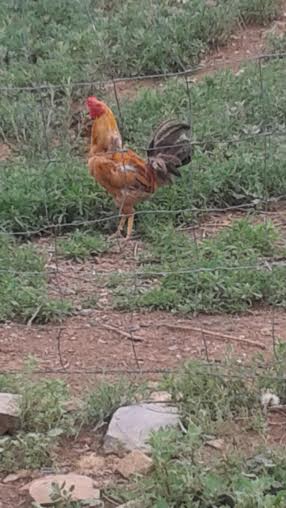
You know you’re in the country when… your rooster lets you know not just when it’s morning, but when the hens are wandering farther afield then he thinks right, or the goats are butting each other away from their food, or the dark clouds of summer afternoon rain are looming and the flock should take cover. I’m told that chickens in Cameroon only get under cover when a serious rain is impending. For a few drops they will continue their foraging undeterred. I’m waiting to see if the same applies here in high desert northern NM.

Being able to differentiate mild from major disruptions may be an inherent skill for Cameroonian chickens. It does not seem to be so for humans. Rather, we can spend a lifetime learning to “not sweat the small stuff”. Finding one’s way to feeling happy with oneself and one’s life – a goal most of us strive toward – requires not only relaxing about those small irritants, but also accepting that it’s okay to be happy.

From several sources recently, I’ve been reminded of how much more readily we identify with loss, pain, difficulties and challenges then we do with being “temples of God”, the home of Soul, or inherently divine beings entitled to feel happy and fulfilled. Many years of spiritual practice can increase the ease and frequency of identifying with one’s highest Soul essence, but still we can (or at least I find that I can) be tripped into the pit of unworthiness by surprisingly small stuff.

Why is it so easy to identify with negatives, to point always to what’s missing, and so hard to embrace being loved, appreciated, fulfilled, happy?

Believers of some religions would say it’s because we are born in sin. I think rather that the concept of being born in sin originates in a mind’s effort to explain our propensity to see imperfection rather than perfection. Yes, this is a cart and horse debate, one that cannot be decisively resolved. But in my experience, looking for what’s right rather than poking around in what’s wrong makes for a much happier and more satisfying life. It does take persistent attention and regular refocusing, to not let past experience of lack distort present enjoyment of wealth. I’m including within wealth all the tangible and intangible benefits one can enjoy – supportive relationships, worthwhile employment, a sense of purpose, relaxed ease of emotions, meaningful spiritual practice… a comprehensive list would run many pages.

Research study after research study reveals that negative behaviors of adulthood originate in childhood – abusers were bullied and abused as children, jealous spouses never learned to feel worthy of love, rage-aholics had explosively angry parents, etc. We hear much less about how good childhood experiences with positive role models produce happy and successful adults. Just as news of disasters sells papers, it seems explanations of negative behavior result in academic publication. Would that it were otherwise!

My favorite feature in The Week is entitled “It Wasn’t All Bad” and cites (usually) three stories of generosity, (a fire fighter who bought a month’s groceries for a citizen whose kitchen fire he had been called to help extinguish); achievement (a 101 year old great-grandmother getting her high school diploma alongside her great-granddaughter); or heart-warming connection (a dog lost for over a year being found and returned to the developmentally disabled child who was its original owner). I wish that fully half the weekly magazine’s content could be similarly summarizing positive stories – but it’s a magazine devoted to reviewing the “top” stories in the world press, and most of those are less than heart-warming.

About our bodies, it is said that we are what we eat. About our minds and emotions, it is also true that we become what we give our attention to. Looking always to the negative, we cannot help but feel unworthy. I prefer to “count my blessings instead of sheep, and fall asleep counting my blessings” – at least until the rooster thinks I should be aware and alert to one of his small concerns.

Cock Calls

Cock Calls

Revisioning

May 29, 2016

A much needed break from my day job has just come to an end. Returning to work, I could feel the familiar skin of tension wrap itself around me, its confining pressure made up of having to be “on” at all times, a plethora of deadlines, and the need to adapt to constantly changing requirements. Knowing that the work is stressful and trying the usual tricks to reduce the impact of that stress – the vacation trip being one – still didn’t prepare me for the visceral reaction I experienced when I returned to work a few days ago.

Knowing about the stress, and intimately experiencing its descent upon me, are very different levels of awareness. The latter has motivated me to rededicate myself to living by my spiritual Master’s will, leaving control of how each day unfolds to wiser guidance than that of my own mind.

In practice this means I’m coming back to work intent on “redoing” my approach to my responsibilities so that I can use the awareness of the tense extra skin as a red flag – when I sense it, I know to stop, release the mental straightjacket into which I’ve wedged myself, and give control of my Self back to the Master. I already know that when I function from no-mind, all goes well, the work gets done, and I have energy left for the rest of my life interests.

As with any habit, I will need to implement this release repeatedly, until I no longer wear the tension sheath at all. My health will, I know, immediately improve, as it did during the short vacation break.

The second half of my vacation trip was also a redoing – or perhaps more correctly an undoing of a previous negative experience, replacing it with a positive one.

Some 15 years ago I made a similar trip across the Midwest to see a former getaway student – to Fargo rather than Rochester, my UWC student/temporary daughter then a Senegalese rather than an Asian. In the first instance my companion was, unknown to me, strung out on heroin and pretending not to be. As a result, when we were supposed to be enjoying a sightseeing return trip, he was too sick to do anything but insist we make it home as fast as possible. It was summer, so hot my Subaru’s AC couldn’t keep us any cooler than 90 and all I wanted was out of the heat and away from the anger and harsh attitude in my passenger seat. We drove within sight of the Crazy Horse monument, but did not see Mt. Rushmore, nor any of the other attractions of the Black Hills area.

This trip has been so different – relaxed conversation, enjoyment of the densely varied shades of green in Nebraska, Minnesota, and South Dakota with subtle differences between the three states noticeable to eyes attuned to grabbing whatever green can be found in New Mexico’s desert tans. We passed through areas of rolling hills which my husband said look like the area around Bamenda in his native Cameroon. We also passed a number of windfarms in Minnesota, the clean white towers with their sedately turning blades overlapping into the distance like a giant mobile decorating the sky. Farming continued between and below the strong white pillars, corn for biofuels being produced on the same lands as electricity from wind.

Following a warm family-feeling graduation/anniversary/birthday event in Minnesota, we drove back through South Dakota and down through the Black Hills, snapping pictures of the Mt. Rushmore faces and spending time in the museum at the Crazy Horse monument. The museum’s assembled collection of native crafts from all across the country provides visitors with an opportunity to appreciate differences in design, perhaps reflective of differences in perception and world view, between tribes. I particularly noticed a 150 year old beaded pouch from the Winnebago tribe with a floral design that put me immediately in mind of Georgia O’Keefe’s flower paintings. Distinctively different from the straight lined geometry I previously have associated with Native beadwork.

Recent astrology patterns suggest this spring to have been a period of review, with the opportunity to renew and revise one’s goals, as well as to set new patterns of social interaction. Eric Francis of PlanetWaves pointed out that each time of reconsideration (planets in retrograde) appears as an upheaval on the larger social scene, as we are collectively subjected to pressure to make changes. No surprise then, that we are looking at a political scene which has totally confounded the pollsters. And no surprise that I’ve been given the opportunity to make changes also, creating new memories and finding new and healthier ways to carry on with daily obligations.

Model of what is to be

Model of what is to be


The familiar that is

The familiar that is


En Famille

En Famille

Time to Look Back

May 15, 2016

“Work should not be given priority over relationships.”

Quite a challenge for perfectionist, Type A workaholics but a very pertinent statement made by Pastor Katie at Las Vegas’ First Presbyterian Church in the course of her first sermon as the new leader of this congregation. She spoke movingly about the spiritual lessons that come through mundane daily events, such as those surrounding her recent transplant from Colorado to New Mexico.

One of these lessons was about the need we all have, to have persons to whom we can vent our toxic thoughts, persons who will listen and help us clear our spirits without judgement. I recognize this to be my primary role with some of my clients at work. Not as part of my formal job description, which only talks about assisting them to access the services and supports necessary for them to achieve and maintain the maximum of health and quality of life. We include mental health in the range of services we Care Coordinators support, and many of my clients do have counseling or psychotropic medications included in their service plans. They manage the scheduling of their services and their overall health maintenance with little input from me beyond completion of the mandatory assessments which enable them to become eligible for those services.

Some clients, however, cannot accomplish this self-management without an outsider to their daily lives to whom they can express their frustrations, fears, angers or constraints – and they have elected me to be the receptor of these toxic thoughts and feelings. I’m glad when I can provide this service, sometimes also having a suggestion or insight to offer that helps the client move past the blockage. In rare instances, I’ve been used as the means for two people, each with a need, to connect and jointly resolve their separate concerns. I know, when that happens, that I’ve been what I aspire always to be, a “clear channel” for the Divine to work through.

Why is it so much harder to be a similarly clear channel when the issues are not someone else’s but my own?

Why can I “speak truth to power” on behalf of a client but find it so difficult to speak up for myself appropriately in my own relationships and my daily interactions with the various manifestations of power, such as erroneous charges on a bill, or petty tyrants who take pleasure in making me wait unnecessarily before fulfilling their job duties providing service to me?

Is it because I’m female, of “a certain age” and therefore raised before feminism brought out the extent to which women have historically been taught to accept the denial of their right to dignity and respect?
Or is it just my own personality, resultant from an upbringing in a less-than-positive or supportive family?

Does the reason even matter?

I would like to be able to maintain a clarity and simplicity of day-to-day existence such that I can be aware of the spirit flowing through me in service of my own needs, in the same way that I’m able to let it flow through me to serve others. Instead, it seems that ego, or the rough edges of my personality, or both or neither but something else altogether, create blockages and I end up feeling drained and exhausted.

“Too much outflow without enough inflow” my MasterPath teacher would say. Or, as Pastor Katie also shared, not enough quiet time taken to process what is being left behind before new experiences are presented to be taken in. She recognized the need to grieve leaving behind a home where she’d raised her family, and planted iris given her by her mother-in-law.

We have in common that we have both worked in Hospice care, and understand the need to grieve losses, including ones less dire than loss of a loved one to death. A training program I attended for grief counselors emphasized that seemingly small losses can become the triggering event for previously unexpressed pain over the loss of a family member – the man who seems to handle the death of his wife but collapses a year later when the family pet dies, for example. One of the exercises in the workshop required that we attempt to catalogue all the losses we have experienced in our lifetime, to help us recognize things we should give ourselves permission to grieve. Also to help us hear what is implied but not clearly stated when a family member of a deceased client expresses extreme anger at a factually minor loss of respect or status on their job, six months after the death.

Moving from one community to another is a clear transition that will bring up for any sensitive soul – as it did for the pastor – the need to grieve what is being left behind. Other life changes should also be accompanied by time to grieve, but are less likely to be recognized as such. My own fairly extreme change in life pattern is one such, that I did not see as needing to include time for grief, until the pastor’s sermon brought it to my attention. I do appreciate that I am able to hear the suggestion and receive the input just when I need it. I think I’m not being unduly self-congratulatory when I accept that I must be in a fairly “clear” state to be gifted with just the right input at just the right time, even though I felt anything but clear. Indeed, before hearing the sermon, I was angry, feeling disrespected and as though there was no longer room for “me” in my daily life.

All because, as Pastor Katie instructed in her list of lessons learned during her move, work should not be given undue priority over relationships. Including one’s relationship with oneself. I have been so busy trying to meet, to a perfectionist’s standard, the many demands of my job, my clients, my marriage and my daily existence, that I’ve neglected my relationship with me and, more importantly, my relationship with the Divine.

I have been so engaged with my exciting, rewarding but very busy new life that I’ve also not left myself space to process the loss of the old (semi-retired, leisurely and thoughtful) life left behind two years ago. Nor have I been able to properly grieve the termination or the transformation of some relationships from that old life. Pastor Katie will always have the memory of her yard full of blooming iris, but she is no longer able to walk out of her house into that yard. I will always have my memories of frequent and satisfying visits with distant friends, but I can now see those friends only rarely and under different circumstances. The pastor and I each carry an aspect of the past with us into our new lives, but we each also know a sense of loss that deserves attention and time to be grieved.

So much emphasis is placed on the window that opens when a door closes, that people seem to feel guilty paying attention to what’s behind that closed door. We are urged to move on, look forward, appreciate what is being offered and let go of what is being left behind. Good advice, overall, but sometimes too hastily offered.

Moving forward without reviewing and properly saying goodbye to what is past can have the feeling of devaluing that past, and the consequence of leaving us feeling devalued ourselves.

Taking time to dig up a few flowers and bring them along to a new home helps assure that we give ourselves time to say good bye to the life behind that closing door. It is thus that we increase our ability to be clear, and present, with the new experiences coming in through the window, and – for me – it seems that taking time to properly grieve what has been lost is essential to clearing out the toxins that prevent me from achieving a level of clarity of spirit for myself that at least approaches the level which I try to offer to others.

Added benefits – improved health and easier maintenance of desired weight. But that’s a topic for another day.

Autumn Color

Autumn Color

Bipolar World

April 30, 2016

For more than two years I have been working at my day job (and weekend and night job) at a demanding pace more suited to a much younger person who is still trying to build a career. Partly because my employer was not adequately staffed for the number of clients who chose our organization, partly because I’m enough of a perfectionist about work that I am not easily able to leave things half done.

Since November, the workload has begun to come down, and I realize that I have mastered enough of the quirks of our horribly user-hostile data base to be moderately efficient in how I enter my case documentation. My client load, as of today, is only modestly above the target set by the State agency that contracts with my employer – a state of affairs I find curiously unsettling. Used as I am to a pressured work week, I’m not sure what to do with myself when I encounter a few days at a time with relatively little scheduled.

Today was such a day – the visits I thought I would be making were postponed by the clients, leaving me with a few calls, some extended “verbal hand-holding” of highly anxious individuals, the organization of my visits and calls due to be made in May – and quite a lot of “down” time.

The change has been recent enough that I haven’t identified the “next less urgent” level of work to which I can actually now turn. Whatever those projects prove to be, they must be of the sort that can be initiated and then set aside, to be picked up again as and when I find myself without client contacts to be made. It’s the nature of my work that new tasks can be assigned at any time, and also that clients may call at any time with new needs.

Being always available is one of the job descriptors. As is being flexibly ready to rearrange one’s planned day at a moment’s notice. Also patience with people who don’t return calls, don’t keep scheduled appointments, don’t notify of changes in contact numbers, and the myriad other small annoyances that come with working on behalf of somewhat irresponsible individuals, or those with mental/emotional problems that interfere with focus and communication.

Like the client who described our recent weather as “even more bipolar than I am”. Which indeed it has been, warm into the high 70s one day, below freezing, snowy and windy by the following night.

I begin to sense in myself an analogy to bipolar behavior, in that I feel as though I’ve been dropped flat in a trough of non-doing after the high of constant pressure to meet deadlines and to get to all the clients on my (formerly excessive) caseload as often as mandated. I’ve functioned without spinning out of control in the manic phase, but I feel less sure of my ability to maintain an appropriate energy and pace now, fearing that I may lose myself in a lightening of the load that feels too much like depression.

There would be no risk, if I could divert the “free” work time to other uses. There are more than enough activities and projects I’d love to resume, that I’ve set aside for lack of time, during these past two years of intense work. But I can’t become unavailable for those empty periods; I have to be reachable by both phone and email, if I’m not out of my office at a client visit.

Not doing, because one is waiting for the phone to ring, is a guaranteed means to bring oneself down. It is strongly discouraged in dating and other social environments, and I know it is not healthy for me during my work day either. Determining what one can accomplish, beyond housework, while being simultaneously “on call” is an interesting challenge. Suggestions, anyone?

++++++++

I needn’t have become concerned. A recent hire, completing the roster of my coworkers, has already given notice, there’s an uncovered caseload to be parceled out once more, and I’ve had a new member assigned to me as well. That State mandated target caseload is once more fading into an unreachable goal, and my risk of falling into the depressive side of this bipolar world is gone.

Making Friends

April 17, 2016

My husband’s current work schedule is such that I am alone on Friday evenings. I’ve been scheduling late client visits for my own work, or a massage or other self-care activity into those evenings, but this past week my appointment was cancelled at the last minute. I found myself, after shutting down work at 7 PM, in that odd state referred to as being at loose ends. Sort of wanting to get together with someone for conversation and perhaps a drink, sort of not wanting to be put to the effort of driving to town (twenty minutes). And I was made aware that I do not have much of a list of people to call to meet with at short notice. In the end I settled on the couch with a small drink and a good book and read the evening away. Enjoyable, relaxing – but not sociable.

Between chapters I guess I also thought about the nature of friendships, and socializing, and the fact that I’m one of those who has a few close friends (not necessarily close in proximity), and so many personally engaging work interactions that I usually want quiet and silence and solitude at the end of my work day/week. Spending long working hours helping people with their health needs seems to use up my quota of “people contact” tolerance, leaving little to devote to building friendships of the sort that can provide either planned or spontaneously arranged relaxation.

Or maybe it’s just my personal makeup?

Being an only child, raised by parents who preferred not to “be responsible for other people’s children” as my mother expressed it, and consequently not free to invite playmates to my home, I think I lost out on learning how to relate easily, happily, casually with others. I don’t “do” party chitchat, and never know the latest gossip.

It occurs to me that my strong preference for writing – as emails, letters or this blog – rather than talking on the phone comes from the same lack of learning to connect in that way as a young person. It must seem strange to those fully comfortable in the current “connected” environment, that I was in my early twenties before I lived in easy proximity to a telephone. There weren’t home phones in Saigon, and only very few in Paris where my father did have a phone in his study, but it was paid by and used only for his work.

To this day, I very rarely spend more than a few minutes on the phone in conversation. The exceptions are those special times when I talk with a dear friend who lives at some distance from me, Washington (the state, not D.C.), Minnesota, or Singapore for example. Our close personal connection is already established, I can “see” the person I’m speaking with, and am able to make myself ignore the discomfort of hanging onto a phone. (Don’t say to put the phone on speaker – my conversation is not for all to hear).

A preference for writing over talking should not be taken to mean I do not enjoy dialog. On the contrary, my close friends know that I take great delight in a lively discussion. One of my clients, an elderly gentleman living in a tiny hamlet in the rural “frontier” of New Mexico, saves up news tidbits from his TV watching, that he hopes will “get me going” on a social or political topic. He’s been known to be intentionally provoking, most often when he has also been shorted on good conversation. We agree more often than not, but both enjoy dissecting the broader implications of some current event. He is fighting cancer now – seemingly successfully – and during a recent celebration of a “cancer undetectable” medical report, he humbled me with his comment that he wasn’t ready yet to leave our debate dates.

One of the measures of self-acceptance is purported to be the ability to be comfortable with one’s one company.  Achieving that status does not, apparently, confer freedom from self-questioning, at least at the “I wonder what/why/if” level. I’ve not just spent time alone, but have traveled, eaten in restaurants, gone to night clubs, to the theater, and camping with only myself for company, enjoying all those activities as readily as I have savored them while sharing them with others. My evening with a glass and a book was no less satisfying than it would have been in the company of a friend. I do wonder what would have to change, for me to have a circle of people whom I could have called to share the evening with me?

I’m not one to say it’s too late to change – especially not with the huge alterations to my personal life that have occurred in the past few years. I do question, in the specific case of my social interaction patterns, whether I’m sufficiently motivated to change. I’ve tried, at times in the past, to participate more readily in casual social events and achieved some modest success, measured not just by people coming out at my invitation but by receiving invitations to join them on short notice for coffee, or lunch, or to go to a party. Those periods didn’t last, largely I must admit, because I don’t fundamentally enjoy what feels to me to be superficial chitchat. And yes, I am aware that my lack of enjoyment is recognized.

“You’re too intense (substitute intelligent, intimidating, independent) for most people” is the feedback I get.

With Popeye, “I yam what I yam”, and it’s okay.

Which doesn’t prevent me from wondering at times what it would be like to be someone different, at least in the area of socializing. Perhaps I’ll find that out in my next lifetime? Meanwhile, I have a good book to get back to reading, a stack piled on the shelf waiting for me when this one is done, and an amazingly compatible partner due home in just a few minutes.

IMG-20160306-WA0007

What Am I?

April 10, 2016

Once one has lived a moderate number of years, a large variety of situations can lead to reflection on the nature of self, what it means to be K, or N, or Mrs. M. Retirement planning seminars stress the importance of developing a set of interests outside of one’s profession, to ease the transition to a new concept of self. Being abruptly laid off due to down-sizing prevents this sort of planning. So does the onset of physical illness, or an accident which seriously alters ones capabilities. Even a slowly progressing illness can reach a turning point, where activities previously manageable suddenly become impossible.


A common expression of the challenge faced in such a transition is who am I if I’m not … working as a plumber, teaching classes, acting in plays? At a still more sensitive level, who am I if I can no longer button my shirt, use the bathroom without assistance, or sit outside in the sun when I wish to do so?


In an ongoing conversation with a dear friend of long standing, this transition has been jokingly referred to as the Do Be Do Be Do discussion. My friend recently referred to an unnamed source whose contribution to the topic was the statement “God is a verb”. I took that into contemplation today, during our monthly Quaker Meeting for Worship, and found myself reflecting that both doing and being are verbs, i.e. action words. Shouting, dancing, running, doing are perhaps more noisy than sitting, dreaming, accepting, thinking, being – but all are verbs, all are forms of action.


So standing and waiting is being active, albeit in a passive-feeling way.


My friend’s dilemma arises partially from his career as an actor, radio personality, radio program director – highly satisfying activities which involve exchange with an audience, a cyclical/reciprocal engagement with contributing to the lives of others that has been a primary value throughout his life. Now that he can no longer participate in those roles, and must often measure achievement in successfully moving himself from point A to point B (because Parkinson has control of his body) he questions what he is contributing to the well-being of people around him. Is it sufficient, to accept gracefully the offers of help which others do feel good about extending? That is only half the cycle. What is traveling outward, to be received by the other, processed and returned?


If God is a verb, and Being is a verb, then in simply being, we are godly. If also God is Love – loving is a verb – then in loving we are being godly. Loving travels outward, to be received by others, processed and used – and hopefully also returned. Reciprocation need not be tangible to be complete.


Another participant in today’s Quaker Meeting contemplation shared her morning’s experience of “shedding” – elk on her property shedding antlers, a friend shedding light on a problem, and the value of shedding outdated concepts of oneself. Shedding is a verb. Perhaps the key to a smooth transition from active verbs like doing, to quieter ones like being, is to be ready to shed constricting definitions – of self, of what constitutes contributing, of what it means to love.


The challenge – in a positive, active sense – becomes one of accepting a new and refined sense of manifesting that of God within. Aging with grace, letting one’s love shine out in a smile, holding a state of being such that others walk away from one’s presence feeling enriched and glad to have been there… these are valuable contributions. In the noise and busy-ness of daily life, such sweet giving is too rare. We need more of such Being, more of God manifesting through us, to both strengthen and soften our human interactions. I can’t think of a more important purpose to incorporate into daily life.

Returned

April 3, 2016

I’ve done the one thing I’ve been told is lethal to a blogger’s career – abandoned posting without an explanation. Do I have any followers left? I guess I’ll find out now – or maybe not, since I rarely received comments even when I was posting reliably, although Cheryl at Artzzle always responded and I greatly appreciate her for that.

When I started this blog, I thought I was embarking on a new phase of a sporadic writing career that has spanned decades. I finished a novel and was starting to look seriously at marketing it; a blog with followers was a step toward finding an avenue to get my novel published and read. Then I got a job – a really good job with most of the characteristics I desired: working with people, working from home, good pay and a modestly flexible schedule. The volume of work has, however, been rather overwhelming, stretching to 55 or more hours a week. My limited “free” time has been devoted to a new marriage and other changes in my personal life. As I said in one of the few posts to go out in the past year, I’ve been too busy living to reflect on or write about my experiences.

The demands of my job are finally reducing a bit, to something closer to 40-45 hours a week and the schedule within my personal life has settled as well, giving me two evenings a week, alone, which I can use for interests that have been shorted of late.

One of those interests is reading. Most of my life I’ve buried myself in a book whenever I had an unoccupied moment – even standing in the grocery checkout line, or on occasion when stuck in a traffic jam. I was fortunate to be encouraged to learn to read very young, sitting in my grandfather’s lap and following along as he read me “I Went for a Walk in the Forest”. Fictional worlds soon became my escape from an unpleasant family life. Long before the household was transferred to Asia and then Europe, for my father’s work, I had visited many countries – both real and imaginary – and had great adventures solving crime with Nancy Drew, or uncovering ancient tombs on archeological digs on the plains of Argolis.

What better indicator of just how demanding my job has been, than the realization that over a period of 18 months I read at most 6 books – the number I normally devour in a month. In the past half year, I’m pleased to see, by the size of the pile of books ready to go to the exchange, that I’ve been able to resume reading at something closer to my habitual rate.

And with reading comes reflection, ideas, and the urge to resume writing.

So here I am, probably not with any consistency yet, but back from the deep silence of the past … oh my goodness, nearly a year!

My apologies for the abandonment.

Paying It Forward

December 19, 2015

The following is a true account of recent events. Initials are used instead of names, to respect the privacy of those involved.

S had been living with her service dog in her SUV for 8 months, in an effort to save money and pay off the loans that had allowed her to travel several states away, to spend time with her grandchildren. She used the resources in her Taos area effectively, staying at camp grounds, bathing every few days at the homes of friends, and using a small propane heater, arctic rated sleeping bag, and propane camp stove to manage her meals and sleep. As autumn approached she became concerned to find something more secure against high mountain winter cold.

V a friend and neighbor of this writer, called one morning to offer purchase of a Winnebago in excellent shape for use as a guest home, just in need of motor repair. The price was minimal – but I had no need for the extra sleeping space. I asked if the generous offer might be extended to S and was told “give her my number.” By the time S called V, the offer of the Winnebago had become “haul it away and it’s yours.”

S was overwhelmed. She had recently joined AAA and was able to arrange a tow. She and V met when the tow truck was scheduled, sharing their interest in dogs and dog training. S, who had trained her own service dog, guided V to web sites where she could connect to programs that need volunteers for this type of training. A positive exchange ensued. “I haven’t forgotten when I didn’t have a pot to piss in, and slept on people’s floors” V said by way of background. “We all need a hand up on occasion.”

At the grocery store a few weeks later, S and her dog noticed an older woman, also with a dog, who was struggling to load groceries in her truck. Despite a bad back and lifting limits, S followed her dog to the truck. While the canines made friends, the two women loaded groceries and started to talk. S had been seeking a place where she could safely park the Winnebago long term. She was already occupying it, but the tow had deposited it in a temporary location. The older woman, L – a former army nurse who served in Vietnam – offered a parking site and subsequently offered occupancy of a comfortable home on the same properly. S and L became friends, as well as tenant and landlord. S expressed the feeling that she’d found not one but three fairy godmothers, and felt incredibly blessed.

About a month later, a coworker of mine posted a request for information/resources for D, a homeless person in the Taos area who uses a wheel chair and has a service dog. I called S to ask her if she’d share her knowledge of supports with D. She immediately said she could check with L about possibly letting D use the Winnebago. Before a week had passed, S and L were on their way to meet D, who was living in a camper in an area that becomes impassable in rain or snow. The upshot of the visit was that D’s camper was winterized for her, and she was stocked with groceries and dog food so that she could shelter in place in bad weather, and drive out to town for supplies between winter storms. “I’ve always tried to help others, and pay my own way,” S said when she reported the outcome of her visit to D. “With all the help I’ve received from my three guardian angels (you, V and L) the least I can do is my part to pay it forward.”

Have you noticed that, often, it is the people who have the least who are the most open-hearted and open handed with that least – which somehow seems always to be not just enough but to multiply like the loaves and fishes?

I am so grateful that my work engages me almost daily with this sort of sharing, caring, generosity and warm-heartedness. Peace and joy to all in this reflective season.


Only Fragments

Love Letters to the Tar Pit

KarusaaVerse

Words that Sparkle, Thoughts that Ignite: Fueling Your Imagination

Leaf And Twig

Where observation and imagination meet nature in poetry.

Millarson Diaries

Personal Musings and Thought Experiments

The Beauty Along the Road

Discovering Beauty in the small details of our lives

Flowerwatch Journal

Notes on Traveling with Flowers

1eclecticwriter

Wide-Ranging Commentary

Spirituality Exploration Today

Delving into the cross roads of rationality and intuition

smilecalm

Life through Mindful Media

A Good Blog is Hard to Find

I will shatter a word and scatter the contents into the wind to share it with the world.

Ray Ferrer - Emotion on Canvas

** OFFICIAL Site of Artist Ray Ferrer **

AKA The Versatile

Fashion | Lifestyle | Food & Travel | Beauty | Fitness | Education | Product Reviews | Movies | Doodling | Poetess

Aging Abundantly | Women Over Fifty | Empty Nesters | Caregivers | Aging Gracefully

Finding Joy at Every Age with writer/philosopher Dorothy Sander

ARTZZLE

Helping with the Pieces in Life's Puzzle of Art and Design

Project Light to Life

A bucket list blog: exploring happiness, growth, and the world.

The Daily Post

The Art and Craft of Blogging

Any Shiny Thing

MIDLIFE MAGIC

allmostrelevant

@allmostrelevant

The Irrefutable Opinion

Assaults on the Casually Mundane by K. Jean King