Quiet Blessings

February 25, 2018

Exhausted, coming home from several hours spent on a family intervention, being a mediator for parents, their older-teen daughter, and the couple who have taken the daughter in since she ran away from home and reported her parents to youth services. So much anger, so much pain, so much misunderstanding, a microcosm of the macrocosm of mistrust, fear and hatred reflected in the barrage of daily news thrown at us.

I couldn’t decide what would best restore me. Were my husband at home, talking with him would rapidly help re regain balance. But he is not only not at home, he is not in the country and not in a place where the “wonders of modern technology” are sufficient to ensure communication. Had I an “inside dog” companion, I know from past experience a Scottie or Shih Tzu cuddle would also restore me. But I only have an assertive excellent outside guard Akita who does not do cuddle. Jump up on me, demand treats, fiercely protect me and our herd from predators, horses, neighbors working in their fields – all those she barks away with determination. I appreciate her for her skills. They do not easily restore me to a place of rightness in my world.

It as become apparent that one of the best benefits I derive from my marriage is the easy, quiet togetherness of evenings spent with my husband, he studying and me reading or writing. Not many words exchanged, just a restful companionship. With most everyone else in my vicinity, whether clients or acquaintances, I have to be “on” in some fashion, engaged, accommodating to their level of energy, finding topics of conversation when I would prefer to not have to think.

Why do we make it so hard on each other, to just “be”?

What finally brought me ease was an Andrew Wyeth painting posted on Facebook by Leslie Mason. Copied from I Require Art, the picture entitled Off at Sea is of an empty bench before a window with a view of distant clouds, mostly shades of white. I saw in it the welcoming silence of a Quaker Meeting about to begin, and immediately settled into an inner contemplation focused on all the quiet blessings in my personal life.

No, I’m not going to enumerate them here. Instead I encourage you to seek out your own. They are often tucked into corners, small and easily overlooked. Many different prescriptions have been offered in recent days for the ugly violence that permeates not just our culture in the US, but too many others in the world. My background is Jewish and members of my extended family perished in the Holocaust. I do not think it right to criticize an Olympic  skater for using the Schindler’s List score to perform to, just because she is German. Did anyone inquire if perhaps she is also Jewish? Or wanted to honor those who did what they could to oppose the horror unleashed by Nazism? Have we become so conditioned to intolerance and rejection that we are unable to allow a dancer to interpret a beautiful piece of music, only because of her nationality?

None of the prescriptions for preventing recurrence of types of violence featured idaily n the headlines seem to me to be directed toward reducing tensions. Instead they fall  mostly in the “meet violence with violence” category, or they cast blame on all adherents of a differing viewpoint regardless of the moderated, mediated, seeking to meet in the middle tone with which those viewpoints are offered.

Which brings me back to the unhappy family mediation effort I engaged in today. No one wanted to, seemed willing to, consider finding common ground. Each participant was totally vested in being right, and justifying their every outrageous action by some equally outrageous behavior on “the other side.” I was only able to suggest a mild disengagement, a cooling off period, with severely limited interaction, in hopes that the high emotion level could thus be brought down to a more manageable level.

Scientists are discovering that our brains are permanently altered by extensive amounts of “screen time”, most of that spent on social media. I haven’t yet read through the details of the studies, but I will not be surprised to learn that the alteration pushes us toward requiring ever greater levels of drama and stimulation, in order to feel engaged. The unavoidable result is that what was once outrageous is now commonplace, catching our attention for a few days, at most a week, and then fading away, needing to be replaced by something yet more fear or anger inducing. We seem to have forgotten, as a species, how to value calmness, serenity, satisfaction, balance, centeredness, peace.

I am very aware that, were I younger, living in only slightly different circumstances, more engaged with social media, I might well have gone from the mediation to a bar, seeking noise and loud music, alcohol and high energy to replenish the depletion I felt. I can envision how that sort of ‘cranking it up’ could seem appealing. But I do not see how that response can be beneficial in a larger sense, since it seems only to tilt the emotional turmoil meter ever farther to an extreme.

I know I am not the only one to feel that pushing to the extreme in so many dimensions of life is dangerous, threatening an entire spectrum from individual well-being to the functioning of our national democracy. I am also not the only voice speaking out for moderation, balance, a cooling off period, some healthy silence. A recent post by Neodivergent Rebel discusses several aspects of modern office space/work conditions that are difficult for those with unique neurological functioning to manage. All these “innovations” strike me as quite intolerable. Open office space – i.e. cubbies in a huge tank of a room – super bright neons instead of natural light, frequent reassignment of desk space, pop meetings rather than scheduled ones… A la Snoopy, my response is Arrrrrgh!

Just as generations of younger people require ever louder volume at the movies to compensate for their hearing lost to blasting music, apparently generations of over-stimulated brains require more and more arousal to  feel at ease, and hyper-emotionalism is the new norm.

World wide? Or just in the West, and in those countries (so many of them now) subjected to the constant stress of warring factions, religious persecution, ethnic cleansing? Why is the trend toward agitation, unrest, dis-ease, noise and disruption spreading so widely?

What will it take for Bhutan to lead the way to more places monitoring gross national happiness?

I have no answers for anyone but myself. For me, now, it is to sit in contemplation of Off at Sea, while I review the quiet blessings of my life.

(I tried to get a copy of the picture uploaded here but can’t seem to manage it, due to my unfamiliarity with the functioning of the Chromebook I’m still learning to use. You’ll have to Google it. Sorry!)

 

In the Small Hours

February 18, 2018

What is it about the small hours of the night (somewhere between 2:30 and 4:30) that allows our deepest fears to surface and torment us? My acupuncturist has spoken of how energy patterns shift through the various body meridians at different times in the 24 hour cycle, identifying for me which pathways are activated around 3 AM. Certain emotions are associated with each of the organs for which these meridians are named, including the emotion of fear. I will not be surprised to learn that the meridian and organ linked to fear is energized in the wee small hours. A healing system that has been effective for many more centuries than Western medicine has existed is certain to continue to give good answers to silly but nonetheless life altering questions.

( A check after I wrote the bulk of this essay confirmed that the meridians engaged at that time are lungs, associated with grief and loss, and kidneys which are indeed associated with fear.)

Life altering, because the course of a life can be determined by the way in which one handles the sleeplessness, the stark terror, or the merely nagging discomfort of the fears that arise. Tough it out until it passes? Make Plans C through F for how to deal with what one fears may happen? Pray for escape from the threat? Or for understanding of how to transform the fear into acceptance? Look for the spiritual lesson hidden in the fear? Identify the origins of the fear and how one’s circumstances have changed such that the fear is no longer relevant?

Intellect can interpret, redirect, calm, reason away irrational emotions. It is not very effective at reasoning away rational feelings, like the fear experienced by a military spouse left behind when the partner goes into a war zone. It is eminently rational to fear the loved one will come to harm in a dangerous environment. No matter how well armed, trained, clever the spouse may be, there is always the chance of the proverbial “being in the wrong place at the wrong time.”

Reason also does not seem to work well, for me, against fears that are ultimately rooted in inner experiences, whether or not they express themselves as projections into our common outer reality. I have come to understand that my early conditioning by a mentally ill and abusive mother set me up to expect that good things would not be granted to me, and that happiness is not a state of being that I would be allowed to enjoy for more than snatched and brief moments in a life otherwise fated to be a harsh struggle against negative forces determined to block and overwhelm me.

Writing that last thought out, I recognize it as exactly what my mother believed and felt, and made into the truth of her own life. Sometime after she died, when I was already approaching my own middle age, I read a diary my mother had written at the age of fourteen, as she traveled to a boarding school in what was then Palestine, now Israel. It showed me a girl already lost to reality, living in a fantasy world filled with both a gallant Prince Charming and horrific ogres doing battle for her attention. She appeared to have been more convinced of the reality of the ogres than of the existence of the princes in those writings. She certainly manifested that orientation to the negative as I knew her. And she apparently instilled that expectation of the negative more deeply into me than I had realized until a very recent 4 AM awakening.

I have been reasoning away the discomfort of not receiving an expected call over the past 46 hours, with sufficient success that I was able to complete a productive day of work, relax and go to sleep at the usual time – but not to stay asleep through the meridian shift that occurred about 3:30. Awake in the dark, I allowed myself to feel the despair of loss in order to trace back its cause, and then started writing to externalize the feelings, a technique I’ve found most helpful in the past. And there, on the page, is the statement about my mother and the realization – not just an intellectual knowing but a deep-seated understanding – of how I have been affected/infected by that same expectation that the ogres will win.

Scant minutes after writing the lines about ogres and princes, the awaited phone call came in. And I learned that the sequence of events I had rationalized to explain its delay had indeed taken place. More importantly, I was shown yet again that realizing the truth of a situation is transformative. My spiritual Teacher frequently reminds us that we do not have to “fix” what we perceive to be out of balance. “Recognition is enough” he tells us. Once the elements of an issue have been recognized (re-cognized, seen from a different point of view) we are directed to take our attention off the subject matter and place it back where it belongs, on our spiritual purpose in this life. “Attention is food, what you give attention to grows, what you deprive of attention withers and vanishes.”

I was initially distraught at least partially because I couldn’t tell if my fear arose from a prescient foreboding of an impending calamity, or instead from a deeply ingrained and unconscious pattern of expectation (what on the MasterPath is called a sanskara). As indicated above, my experience of the emotions and subsequent contemplation of the experience put it squarely into the sanskara category. Releasing the sanskara’s hold on my attention and imagination came (is still coming) next. New insights arise daily, as I do my normal chores and also those that have fallen to me during my husband’s unexpected absence. I see that I am being gifted with opportunities to completely reassess my experience of being unsupported and, of necessity, totally self-reliant throughout virtually all of my life, until four years ago.

Knowing now what it feels like to be in a loving, mutually supportive and caring relationship, I begin to realize that – should my worst fear be realized – I would not be cast back into the unfulfilled void of my earlier years. I am not that same person, or perhaps more accurately I do not see that person through the same eyes as before.

For that change, as for so many other new insights connected to my initial 3 AM panic, I am most deeply grateful.

A Solitary Cat

January 24, 2018

In the small hours of the morning I lie awake, thoughts and feelings flooding through me in delayed response to the previous day’s news, which brought about a shift in my daily life patterns. A death, unexpected, the necessary response to which has once again made salient a frequent awareness that I have, in the past, repeatedly sought to ignore or overturn.

If required to pick a single word to describe my life experience, I would unquestioningly choose “solitary”. Seemingly odd, for someone who has spent nearly 40 years in the married state, but nonetheless accurate. With a few more words I would say my life experience has been that of an outsider, looking at others, families and couples, living normal lives of mutual engagement. Not necessarily happy engagement, because I clearly see the tensions, the jealousies that make relationships – especially sibling ones – difficult.

Difficult or easy, the relationship ties are strong, and the interactions engaging. And I am on the outside, looking on.

I was the only child of an only child mother, and a father who was so estranged from his two siblings that I did not know they were still alive until I was in my mid-teens. So no siblings, no cousins, virtually no family at all except my maternal grandfather. My mother was mentally ill, my father shy, distant, emotionally withdrawn. I vividly remember nights (rather like this one) when I would waken from a few hours sleep, and lie in bed feeling deep solitude. Then, my cry expressed itself as “why can’t we be a family like other families are?”. I would imagine that I had been adopted, and somewhere – out there – were sisters and a brother I could belong to, if only I could find out how to identify them.

But I was not adopted, I was born into a loveless marriage that had been founded on illusion and was sustained by obligation. I benefited from the circumstances in that I was made to learn quickly how to be flexible and self reliant. I set myself a goal in those early years, to make for myself a home, which I then defined from a poem studied in school as “the place, where when you come there, they have to take you in, a place you don’t have to deserve.”

I achieved that goal in the early 1970s when I bought my first “house” – a 150 year old railroad boxcar, on property rented from the railroad, with only cold running water, and two out houses in lieu of a bathroom. An adobe addition had been added to the boxcar in the past, but the roof had fallen in and the walls partially eroded. I paid $500 for the place, then invested a few thousand more, and a lot of hard labor, to install a toilet, hot water heater and tub, run propane in for the water heater and a cook stove, clean out the debris and re-roof the addition, and lay down a flagstone floor in what became the living room, with a sleeping loft above part of it. I had my home.

Over the years, I moved on – started afresh with 11 acres and a mobile home onto which I added rooms and a workshop, then sold that to move to my present, smaller but more efficient home on four acres, with solar heating supplemented by wood and propane, relatively easy to maintain and to keep me comfortable in both heat and cold.

I’ve shared these homes with others – obviously, since I’ve been married much of the time. But the marriages were not “traditional” and included 8 years of being alone while my then husband was imprisoned. More years were functionally alone, for various reasons – ill health, poor choices, incompatibility. The reasons don’t matter, the effect is what I now recognize as my life’s path, to be consistently and solely responsible for all that occurs in my life without recourse to anyone to depend on, no partner or – I love the old fashioned word – helpmate.

Until about four years ago, that is.

Whether from the lessons of early childhood, from innate nature, or from Divine intent, I am in essence “the cat who walks by itself.” I have long recognized that I am uncomfortable in larger social groups, unless I have a role to fulfill – teacher or hostess being the two most frequent. In small dinner parties of 3-4 people, I can relax and talk, enjoying an exchange of ideas with my companions. As soon as the group gets larger, I am inclined to stay quiet, sit slightly apart, observe and rarely speak – once again taking on the position of an outsider looking in to family/group life going on beside me, including when my husband’s country-mates gather for a meal, discussion of soccer, and of the troublesome politics at home.

I am comfortable with silence. Living alone I may talk to my pets, and put on the radio to listen to the news (though rarely these days, there being nothing I care to hear). I equally rarely play music, or feel any need for sound to fill a void I do not experience. It has, you may conclude, therefore been an interesting adaptation to live with my current husband, who grew amidst the constant uproar of a large family in a culture that non-Africans perceive as “noisy”. He plays music even when studying. I’ve learned to enjoy most of his selections, only occasionally asking him to turn the sound down so I can think.

For the four years now that we have been together, I have experienced more of the meaning of family life than in all my years before. I thought I might get to enjoy having a sister but that has not proven true. I have come to deeply appreciate my husband’s unique character, his depth of understanding of his siblings, his learned skill at managing his responsibilities as designated successor to his father and head of the family. I am offering what I can by way of experience and supervision to his/our children with whom we are able to talk daily, thanks to the wonders of a technology that did not exist when I was, at age 12, taken halfway around the world and away from the emotional anchor of weekly visits with my grandfather. Blessings be for What’sApp.

Now, suddenly, I am faced with renewed solitude. Not for long, only about six weeks, but sufficient to make me vividly aware of the way in which I have, over so many years, persistently sought and not found a permanent sense of belonging. What first came to mind, at 3:30 AM, was a story told by my spiritual teacher, of the wealthy ruler who had all the riches of a full and engaged life, but instructed that when he died he should be buried with one open hand left extended above the earth, to show to his people that no matter how much we have in life, no matter how close we are with family and friends, we leave this world empty-handed. Elsewhere, we are reminded that we come into life alone, and leave it alone. Not exactly ashes to ashes and dust to dust, but echoed in the song refrain “all we are is dust in the wind”.

I have no doubt that I will manage my work, my health, my home responsibilities alone while my husband is in his home country attending to the family needs which have just arisen. Political unrest there precludes me accompanying him, as I might otherwise have done. “You will be a target, it is too unsafe.” The U.S, and British embassies have already instructed their citizens in the country not to venture outside the capital city, and we would be traveling to a small village in the heart of the “rebel” region. I am aware that managing life here on my own is not the challenge facing me. I can do that easily enough. Instead, my basic concern is for my husband’s safety and the stress of living day to day with an underlying current of uneasiness, waiting for the next phone call to update me on how he is managing, and to reassure me that he is safe and not, as a recent returnee from the West, targeted to be a hostage in the political upheaval.

I did not find it easy, four years ago, to learn to accept help, a partner, support, suggestions, redirection. But I realize now that I have done that adapting, have relaxed into it, and deeply enjoy it. In consequence, returning to self-reliance, while quite doable is not particularly desirable. I find myself wondering, in the small hours of the night, whether this experience is meant to remind me not to become too dependent on another person? Or simply to give me the opportunity to reflect back on my life overall? Or perhaps both of these, plus the most important reason which is to reinforce the teachings of my Master that the first and only place to look for guidance and support is “in and up” to one’s own Divine essence , as revealed through the grace and the training of the Master. With my attention where it needs to be placed, all else will be as it should be.

Baraka bashad.

Practicing Patience

January 13, 2018

The winter storms keep missing us. We get the wind and the cold but not the moisture that is being dumped so plentifully to our north and across the midwest. I remember reading a projection that north would be exceptionally cold and we in the southwest would be noticeably warm across this winter. So far it’s been an accurate forecast.

In some previous similar years, the consequence of this weather pattern has been particularly heavy spring snows, the kind that leave us without power and snowed in for several days, but which then also melt off quickly so that once we can get out, we can drive without the hassles of icy roads. For now, it’s wait and see.

I wouldn’t be concerned at all one way or the other, but my job has me on the road for 50-90 mile one way trips with sufficient frequency that I have to be aware of weather risks – especially in February when the combination of an exceptionally short work month and a markedly heavy workload intersect and make scheduling my travel a critical component of meeting all the deadlines. A day or two unable to get out to my appointments may well mean I don’t get the month’s work completed. Reminding myself I’ll just have to wait and see.

In the meantime, it’s cold enough (or the daylight hours are reduced enough, I’m not sure which is the determinant) that the hens have stopped laying, but not so cold that I have to wear my heavy winter coat. Concerns about renewed drought do not prevent me from enjoying the mild and sunny afternoons that entice me to go walking. For how much longer? Yes, you know the refrain now – we’ll have to wait and see.

Mini-mind

January 6, 2018

It’s another one of those evenings when I find myself playing solitaire, alternating with reading. One of those evenings I have identified as better spent writing (and reading) so that when I look back I will feel I’ve been productive rather than mind-numbed, zoned out, and wasting time.

When the book is particularly engaging, I just read. If I’m not reading steadily, why don’t I just put the book away and find another? Old habit, I suspect, and that internal voice lecturing about finishing what has been started. You’d think I’m old enough to disregard the habit and the voice, but apparently not. Hmm, another pattern to review and see why I am still controlled by it.

That is, in fact, what most of my reflection periods seem to be about these days – reviewing the whys and wherefores of any number of habits of behavior or thought, to consciously decide if they are worth maintaining or if it is time to be freed from them. In many cases, the final outcome is not really either option, but rather a choice to maintain the behavior or way of thinking as a tool to be used at times and ignored at others. In essence I transform the unconscious habit into a chosen action for those situations where it will be truly beneficial.

Follow this lovely road to freedom from the tyranny of mental constructs.

This way to freedom from the tyranny of mental constructs.

No Drama Please

December 28, 2017

Of the many adjustments required as we age, one I did not anticipate has emerged as a result of coworkers taking time off for the seasonal holidays. In particular, a behavioral health care coordinator (BHCC) with whom I work closely has been on vacation since before Christmas, and won’t return until after New Year’s Day. Meanwhile, one of the clients we coordinate to assist has been in crisis, suicidal and starting to misuse drugs. I have done what I can to support his immediate family members who are the ones actively intervening to divert his self harm. He seems to be headed for inpatient assistance, and I did find another contact person for his family to call if they need further help while I in my turn take the next few days off.

In years past I have had a counseling license, and supported myself at times with a private clientele about evenly divided between couples unable to communicate about their incompatibilities, and men with anger issues. From the feedback I received, I was an effective practitioner, and I found the work rewarding. I learned much that has been useful to me in my subsequent years working in home health, and now as a care coordinator for a managed care organization. I even thought about applying to work for the behavioral health component of the organization. Something held me back – and now I think I know what that something is.

Age.

Not that I’m too old to do the job, which is no more demanding than my own. In fact the  BHCCs have smaller caseloads, more paid vacation, and the same working hours as I do, so the capacity of my older body to see the work week through might well be less stressed by a BH caseload. That’s not the issue.

While I don’t agree that getting older means getting more conservative, I do see in myself a subtle shift in values that can perhaps best be described as less engaged with the drama of others’ lives. For those who seek help, I am ready to provide supports, encouragement, instruction, empowerment and accompaniment if that is needed. I don’t expect immediate success nor do I limit the number of repeats necessary or the amount of time allowed to achieve progress, however minimal, toward the client’s stated goals. What I used to also offer was intervention when misunderstandings escalated into high drama, persistent redirection when drug use became a burden, and a generally more receptive involvement with the ups and downs of my clients.

No more.

In one of several descriptions of the stages of life, the later years are said to be dominated by contemplation. Whether reviewing one’s own life, or reflecting on the state of society, older people are perceived to be thinkers more than doers. Pragmatically, we’ve learned the often negative consequences of impulsive, reactive behavior. We see benefit in giving reasoned responses and we know that few important decisions need to be made “right here, right now.” Which is not to say that we procrastinate (though some of us may do so), nor that we resist acting promptly, in a timely manner, to take advantage of unexpected opportunities. But we do so with forethought, and at least in my case, with a degree of detachment from the decision.

Perhaps what I’m trying to express is simply that few things that arise strike me as dire and in need of immediate action. Few things, equally, are apt to cause my world to collapse around me, if my decision turns out to be faulty. As a consequence, I apparently also prefer not to be unduly engaged , at this point in my life, with people for whom every decision is fraught with high drama. I care about, but do not fear, outcomes. I am confident that if things don’t work out as I hoped, I will not only survive but appreciate the different direction my life goes as a result of the unexpected outcome.

This preference definitely carries over into my work; I don’t wish to engage much with people in the midst of high drama, panicking over decisions that may seem, but seldom are, life threatening. Ergo, I would not do well with a caseload of clients with such mental instability that they need care coordination to get through the basics of their daily lives. My own clients need care coordination as well, but primarily to help them access supports for their physical shortcomings. I am occasionally called on for counseling on how to accept new physical limitations, plan for end of life, or adapt to new and frightening diagnoses. That is a type of mental/emotional support I still feel easily able to provide.

Without this past week’s experience, I might not have recognized my shift in perspective. I do know that I don’t want emotional tension in my life now. I used to live with a degree of dramatic stress which I would now find totally exhausting. Loss of energy with age? Loss of patience with false intensity of feeling? Or gain in understanding and perspective, with an accompanying gain in ability to express and manifest my preferences?

Whatever the underlying reason for my shift in preferences, I’m glad to recognize them and know that I have the capacity to implement them in both my personal and my work life.

Now, I wonder what previously unconscious inclinations, habits, tendencies and preferences will be revealed to me in the new year? I look forward to finding out.

big-billed-bird.jpg

Standing Proudly

Giving Oneself Permission

December 23, 2017

Today was nothing out of the ordinary by way of work demands, but somehow the juxtaposition of those demands and the expectation of three days off for the Christmas holiday made the emotional drain of the day salient in a way I have not previously recognized. Yes I know that my work pulls hard on my energy. It also gives energy rewards in the form of appreciation and thanks for the help I am at least occasionally able to offer. I’ve not sat down to try to put the outflow and the inflow onto any sort of balance scale. I rather doubt I am capable of such an assessment, and not sure that there is any real benefit to be had from the effort. I won’t be changing my employment any time soon and I have no control over, and no way to predict the arrival of, expressions of appreciation for what I do. Those are simply givens of my daily life.

What I do have some control over is my ability to recognize when an energy drain is more severe than usual. I can also, usually, identify what makes the drain more severe or more noticeable. And I can, if I practice what I know to be effective, consistently make an effort to re-balance myself. The “catch” lies in those seemingly simple few words, “consistently making the effort.”

Nothing seems harder, when I feel drained, than making an effort of any sort. Sporadic, halfhearted, minimal are as much a challenge as consistent or purposeful.

Moment of clarity! This problem needs redefinition. Activities to recharge my energies must not be categorized as achieved through effort, but rather as the result of desire. I must not be telling myself I should do what I know I will find refreshing. Instead I wish to hear the voice in my head saying “go on and enjoy … “ (whatever the activity may be), “you need and deserve this time for yourself.”

How is it that we so easily slip into making have to’s of what began as want to’s? I enjoy stringing beads into jewelry, yet I seem to only sit down to create when I have a gift to give someone, and a limited timeline for completion of the project. I equally rather enjoy writing these blog essays, but rarely do so simply to relax and focus my attention. For awhile now, I’ve thought that I’d like to return to piano lessons, and see how much I’ve retained from my childhood instruction. What stops me is the voice in my head saying that I will then “have to” make time to practice, and I already drown in too many have to’s. Why isn’t that voice saying “If you think you’ll enjoy the activity, try it” since, if it doesn’t provide me a pleasurable relaxation, I can always stop?

Some twenty years ago I wrote a long letter to my spiritual teacher that included a discussion of my understanding of responsibility and how that quality developed in me, as well as how deeply embedded it had become. I identified how limited, by contrast, was my experience with spontaneity, with love and with simple pleasure. Over the decades since I have learned to be much more present in the moment, and to enjoy many of those moments purely for what they are: this morning’s colorful sunrise, for example. I’ve been blessed with opportunities to love and be loved, and have become overall a much happier person. I apparently have not, however, yet freed myself from that deeply ingrained orientation of being responsible, as though to do so would turn me into someone less worthy.

The most loving people I know are also the most responsible to others in their lives. The most responsible people I know are (were) among the most difficult to live with, for others in their lives. As frequently as we are exhorted to think more of others than of ourselves, one could believe that selfishness rules the world and sadly, seeing the actions of government in the U.S of late, one would be correct. But I do not think the appropriate response to the sort of greed dominating political life is to be angrily, stridently demanding change. Yes I am concerned for the loss of integrity being manifested, for the furtherance of what to me are ugly values best buried in history. And yes I will do my part in speaking up in protest, but mostly I need to do my part by living my day to day life as best I can from an expansive place of happiness rather than from within the restrictive atmosphere of responsibility and “must do” that drains energy and leaves me snappish and deeply dissatisfied.

In the language of my Teacher, I am saying simply that I will continue to move toward living my life as pure Soul, unclouded by dualist mental considerations of right/wrong, selfish/generous, open/closed, responsible/careless, etc. Since Soul is a happy entity and happiness spreads naturally and effortlessly from one to another, there is no more effective way to re-balance both my own energy and that of everyone/thing in quite a wide sphere, than for me to keep my attention firmly focused on Being. That focus is both necessary and sufficient for responsibilities to be met, energy to be in balance, joy to replace exhaustion, and all that is meant to occur taking place as it is meant to do.

Baraka Bashad – May these Blessings Be.


Looking Ahead to Blessings

December 17, 2017

Having stressed repeatedly to different clients the importance of a personal goal, apart from improved health which most of them seek, and having heard my husband reiterate this same objective to his parents as an key contributor to continued energy and engagement despite the various pains and slowly of age, I am guilty of failing to keep my own personal goals updated. The result is that lately I’ve been feeling weighed down by all the “have to’s” of my daily life, and also as though so much of my core energy is being expended on those requirements that I am simply depleted and have “nothing left” to expend on enjoyment.

To some extent, the energy drain is unavoidable – there’s only so much reserve left in this aging body, and so very much that it is being required to get through by way of work, housekeeping, support of mate and extended family, and the myriad chores of daily living. But what I recognize I’ve shorted myself on – and also recognize as a frequently encountered shortcoming in all those people whose work or life roles fall under the heading of care-giving – is making sure our activities that refill the reserves get as much priority as do our daily duties.

So my personal goal that is being re-established as I write, is to assure that I do refill the cup with activities that give me pleasure in and of themselves. My daily spiritual practice is one of those that has not been neglected; it is absolutely necessary (but apparently not sufficient yet) for me to maintain at least a semblance of balance, and a comfortable engagement with my outer life. I’ve cut way back on attention to the broader political and social scene, the hysterical reactivity of which is totally exhausting and debilitating. I continue to distance myself from whatever will trigger the “been there, done that, didn’t think I’d have to do it again in my lifetime” discouragement of seeing so much hard work, and advances toward a kinder and more caring society, erased and replaced with unfettered greed.

My work as a Medicaid-program Care Coordinator is rewarding, and as jobs go, just about ideal. I get to work from home (no daily commute), see my clients in their homes, support people toward improved health and management of their lives, experience directly their appreciation and pleasure as their circumstances improve, and know that I am functioning as part of the solution rather than being part of the problem. My home life is all that anyone could ask for, and more sustaining than I ever imagined I would enjoy. Overall, my health is apparently still fine, with only this irritating decline in energy and will that I need to sort out.

I don’t have the answer(s) yet. Only some hints as to where to look. For the physical depletion, I’ve resumed taking an adrenal supplement recommended to me some years ago, and it does seem to be helping. For the psychological, I’m looking to specific activities that I’ve enjoyed in the past and have not been participating in lately, notable among those being more regular blog posts.

I’m also taking seriously the increasing evidence that substantive ‘screen time’ alters mental functioning. My work requires a good deal of computer data input. Keeping up with news summaries on my phone (we don’t have TV) adds to the screen time. Writing will do so also, but more productively than the hours I have lately been spending in somewhat mindless Solitaire or Scrabble. I am undefeated in Free Cell and win better than 97% of hard level games against the computer in Scrabble. So what. Neither accomplishment is nourishing me. At best they have provided a sort of ‘zone out’ from thought, akin to ‘stopping the mind’ in meditation. I can do better, focusing my attention where the inflow of energy will be beneficial, not merely neutral.

I have yet to understand what those targets of focus will be, other than a continued extending of my attention to spirit. But now, the goats have escaped their fence and need to be corralled, and dinner needs to be put into the oven. I am reassured by the knowledge that when I  pose a question in my daily spiritual practice, I will receive needed answers, including on how to refresh my psychological energy.  I am so very grateful to have that guarantee in hand!

May these blessings be, for all who seek them.

Odd One Out

November 19, 2017

I’m vacillating between two topics, Michelle Obama’s recent concise advice to “focus on what you can control”, and a rather more controversial reflection on color discrimination across species. I sense there’s a linkage underlying the two subjects which may emerge as I write. We’ll see.

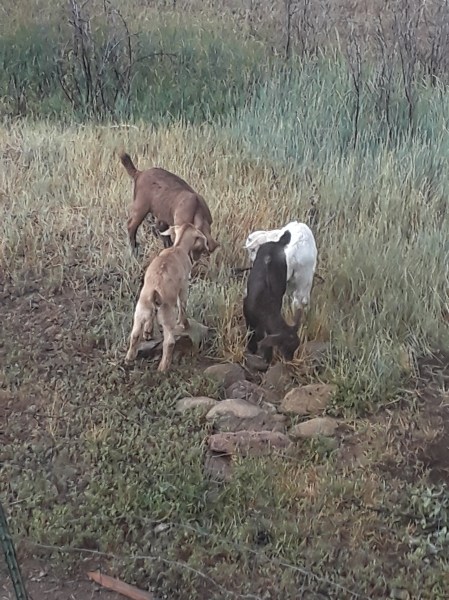
We have two mother goats of the Boer breed (white with brown and black markings around the head and neck) who were each impregnated by a handsome white billy and each produced twins. One set of a male and a female are shades of brown, the other of two males are opposites, one all white like his daddy, the other all black like none of the rest.

Knowing nothing more, if you were required to bet on which kid is the odd one out, how would you place your money?

Years ago when there was only one main prison facility in the state and I was teaching psychology in the New Mexico Penitentiary, an albino Black man in my classes wrote a paper about the unique discrimination of being an “oddity” within his culture. I’ve read that in some African cultures, albinos are considered to be evil, and are persecuted and driven out, if not killed shortly after birth. Albino individuals in Caucasian society are also at risk of suffering from humanity’s’ general intolerance for differences.

Have you now concluded that, as is the case, the pure white kid is the one who is pushed away from food, isolated and scorned, and the only one whom our dog actively harasses? Was the white one also your first bet?

I can discipline my dog to refrain from attacking and harming the white goat. I can do little about its isolation by the rest of the herd, beyond assuring that it gets enough food which, given the large pasture they all inhabit, is fairly well guaranteed.

By extension, does that mean I am right to focus my energies these days within my own world where I can have some influence, perhaps make small changes for the better without wasting energy on much of the larger political scene? I sign the petitions to those I think will listen, or who may be influenced by sheer numbers; I don’t bother with the ones I am certain will fall on deaf ears.

And I continue to wonder about the evident cross-species tendency to exclude, ostracize, put down and otherwise do harm to those perceived as “different”. Have we any hope, as thoughtful human beings, of altering on a large scale what appears to be a fundamental biological motivation? Is the current atmosphere of intolerance and defensive anger perceived in many countries around the world, simply a resurgence of basic human nature rather than a “swing to the right” or some other philosophical trend?

I have no answers. I do take comfort from following Mrs. Obama’s advice to “focus on what you can control”. Anything else is just a waste of energy.

The challenge, of course, is discerning what one can – and one one can never – succeed in controlling!20170727_092225

Hope Less, Be More

November 12, 2017

I’ve been trying to decide if I can write this reflection meaningfully, without first including the whole of Leslie S. King’s latest post, “Give up Hope” on The Inner Adventure. Finally I’m just going to start writing, refer to the lines that are most relevant to me at the moment, and encourage you to read her poem/post in its entirety for the images that may be more salient for you.

I have felt, of late, like the proverbial round peg in a square hole. Inundated with unpleasant, incessant, noisy and noisome news, arrogant attitudes, and pestering financial demands to support every cause that is under attack, every candidate promising to make things different/better for someone, somewhere. Trying vainly to balance quiet reflection and inward focus with the persistent shaming of “we have to resist”, “we have to fight back”, “we cannot afford to be cynical, or tired, or detached” from what is happening in politics and society, on TV and in sports, in all the venues that take place out there in time and space.  

How does one not react to outrageous public events? How achieve living fully in the present, when that present is perceived to be so ugly that one’s only wish is to escape it, shut it out, be other-where?

Enter Leslie’s poem, and the line that has echoed in my mind as the key to reestablishing balance, “When you quit hoping the rain will stop, you pull out your umbrella.” 

Hope entraps the attention into the time track, pushing us into living for a future that, one hopes, will be different and better than the present one is experiencing. Hope immobilizes. When I hope the weather will be fine tomorrow so I can exercise outdoors, I do not seek means to exercise on this damp and windy day, indoors.

Sitting and reading, instead of exercising, I come across another line, this one in the novel The Brutal Telling by Louise Penny, an extraordinarily skilled writer I’ve only recently discovered. “I just sit where I’m put, composed of stone, and wishful thinking.” Two very different sources giving me the same message – wishing and hoping are not the positives they are so often presented as being.

A pessimist, expecting the worst, does not escape the immobilizing effect of seeming to live in an as yet unrealized future. An optimist can appear by contrast to be in a better space – but that is an illusion. Our minds may expect the best, or the worst, but in either case they are ignoring the present, the only moment where Being exists. In Being is freedom, wisdom, love, infinite capacity for anything and everything to manifest, and also an open umbrella, sheltering and protecting from adversity.

Knowing this Truth does not mean I am able to make it my everyday reality. I get caught, distracted, tugged into the noisy flow of mental concepts, wound tight and held fast by hope, anticipation, expectation – choose a word, they all essentially mean being dissatisfied with the present moment. Moment after moment of dissatisfaction turns into a life of regret, broken only rarely by flashes of contentment. Not how I want to perceive my life, whenever the end of it looms imminent and it becomes time to make final assessments.

The standard advice for countering discontent it to count blessings. Quite a fine thing to do, certainly, but still a mental exercise often accompanied by trips into the past and renewed hopes for the future. Back on the time track, no longer present with the moment that is here, now, pure essence without any overlay of mental constructs.

And they are so subtle, those mental constructs! What can be wrong with aspiring to______? (Fill in the blank with any achievement you choose). How conditioned we are, from earliest childhood, to think in future tense. “What do you want to be when you grow up?” we ask of even the smallest of nursery schoolers. Rarely do we say to them, “Are you enjoying what you are doing in this moment, right now, right here?”

The Brutal Telling also quotes Pascal, “Most unhappiness comes from not being able to sit quietly in a room.” Sitting quietly, mind still or focused closely on what is immediately present, is a surprisingly rare skill, at least in the busy West where “doing” is given so much more respect than “being” (Yes, I hear you singing dear friend, doo be doo be doo). Despite the spread of various forms of meditation and Buddhist practice, despite the growing number of participants practicing contemplation on my spiritual program MasterPath, despite the Quakers who do sit silently in a room seeking “that of God within”, the predominant direction of attention in our culture is outward, looking back to learn lessons, forward to aspire for a better life.

I can’t help but feel that we are, collectively, rushing directly toward unhappiness and away from the only place where lasting joy can be found – right here, right now, in this moment. I know what it is to feel the joy of now, I have learned to expand now into what the clock measures as periods of time, but I recognize how limited my skills are, how much I still have to learn if I wish – and I do wish it – to remain permanently in that joy, permanently in now.

The first new skill clearly involves learning to revel in, instead of fear, the instruction to “abandon hope all ye who enter here”. Abandon hope, not because I am doomed but for the positive goal of knowing my Self as divine in this moment, complete and splendid right here, right now. Safe and sheltered whether I am in glowing sun, or serenely under an open, shining, divine umbrella.


Only Fragments

Love Letters to the Tar Pit

KarusaaVerse

Words that Sparkle, Thoughts that Ignite: Fueling Your Imagination

Leaf And Twig

Where observation and imagination meet nature in poetry.

Millarson Diaries

Personal Musings and Thought Experiments

The Beauty Along the Road

Discovering Beauty in the small details of our lives

Flowerwatch Journal

Notes on Traveling with Flowers

1eclecticwriter

Wide-Ranging Commentary

Spirituality Exploration Today

Delving into the cross roads of rationality and intuition

smilecalm

Life through Mindful Media

A Good Blog is Hard to Find

I will shatter a word and scatter the contents into the wind to share it with the world.

Ray Ferrer - Emotion on Canvas

** OFFICIAL Site of Artist Ray Ferrer **

AKA The Versatile

Fashion | Lifestyle | Food & Travel | Beauty | Fitness | Education | Product Reviews | Movies | Doodling | Poetess

Aging Abundantly | Women Over Fifty | Empty Nesters | Caregivers | Aging Gracefully

Finding Joy at Every Age with writer/philosopher Dorothy Sander

ARTZZLE

Helping with the Pieces in Life's Puzzle of Art and Design

Project Light to Life

A bucket list blog: exploring happiness, growth, and the world.

The Daily Post

The Art and Craft of Blogging

Any Shiny Thing

MIDLIFE MAGIC

allmostrelevant

@allmostrelevant

The Irrefutable Opinion

Assaults on the Casually Mundane by K. Jean King