Posts Tagged ‘adages’

Instead…

January 5, 2014

The adage that misery loves company bothers me. I’m all too aware of its accuracy, seeing it manifest in my recent work days as an easing of tension when I discovered that others are having the same problems with computer malfunctions that I have been experiencing. I’m glad for the reduced anxiety that accompanies not being the only one facing this problem, but embarrassed, nay ashamed of feeling relief that the problem is widespread. There is nothing appealing to me about knowing other people are facing challenges!

In my defense, I can also attest to feeling elated when a co-worker “got” a concept she’d been struggling with, thereby joining the company of those of us who were trying to help her understand and apply it. She was happy with her success, but she admitted some of her happiness was relief at no longer being alone in her lack of understanding.

One of the pleasures of my new employment is that the company ethos is very positive and supportive, the antithesis of “misery loves company.” Carping, impatience, brusqueness are not acceptable despite highly stressful work circumstances that have had some of my managers putting in 65 hour weeks for the past six months. The consequence is that all of us slightly befuddled, confused, easily overwhelmed “newbies” are quickly learning to express our uncertainties in the form of positive questions. By seeking guidance it turns out that we have also been identifying glitches in the data systems with which we are expected to work, becoming part of the solution and, in the process, feeling better about ourselves.

I come from a prior work environment which was very different. Above me (fortunately in another office in another city) the ethos was one of jealous attention to any perk awarded to someone else; a pervasive fear of being randomly called on the carpet for perceived faults never previously identified; a daily manifestation of what I recall being told is a military belief that the way to deal with recruits is to keep them complaining. “If they’re distracted with complaints, they won’t notice how miserable they are.”

Within my own domain, I tried to set a different tone, one of teamwork and all of us pulling together to meet the expectations of my out-of-town supervisors. For the most part I was successful, less so in my last few years when tensions associated with the many changes in health care translated to increasingly frequent “audit” visits by staff from the main office. They rarely found problems. They did leave behind the unpleasant taste of their “gotcha” approach to our work.

Sadly, when a serious problem was uncovered and I took responsibility for not having detected it myself, those who initiated it chose to deny culpability and were resentful of being expected to pitch in and make the necessary corrections. Our office did get things put right, but the atmosphere had become one of misery, loving company, dragging everyone down to the lowest unhappy level. Finding myself not strong enough to boost the prevailing mood up again, I resigned.

My new employer is advertising supervisory vacancies, and several people have encouraged me to apply. I have no intention of doing so. If possible, I never again want to be responsible for anyone’s work product other than my own. Twenty years of ‘growing’ employees, helping workers uncover and develop their potential, seeing them move out and up to better paying positions – I’ve served my time as an administrator. I do not believe, now, that just because I have a skill I must use it. Instead, I think I’ve earned the right to only do work I enjoy, which translates to only being responsible for my own work outcomes.

Yes, I mentioned helping teach a co-worker; I’m still oriented to bringing everyone’s skill and success levels up and doing all that I can to reverse misery loving company. I choose to do so voluntarily, not as part of the responsibilities of a defined supervisory position.

What is it about having a responsibility that converts a satisfying “want to” into a burdensome “have to” activity? Is the mechanism the same, when an acquaintance expects you to provide a form of support that you might willingly offer, but which you mind – maybe even resent – having to provide in response to the imposed expectation? What causes the same action to be, in one case a gift, in another an onerous duty?

Perception, a label, a naming of the action, an attachment to the idea of freedom of choice – any or all of these can and do change how we feel about what we are doing. Seeing others “similarly situated” changes an experience of vulnerability to one of “I’m not alone” and we feel better.

The challenge, as I see it, is to shift one’s perception away from “alone with this problem” without needing to find others who are similarly unhappy. I expect of myself that I will minimize occasions where I am manifesting the true – but very negative – “misery loves company” adage. I expect, instead, that I will remain sufficiently focused on the inner spiritual joy I know to be my true Self, that I will not feel alone with any problem. I expect to practice my daily contemplation, to stop and “check in” many times during the demanding and busy days ahead, so that I function in a space of shared pleasure, shared accomplishment, shared cooperation, banishing misery not just from my own space, but from the space and lives of those around me.

Joy loves company. Joy expands. The Soul is a joyful entity. I am Soul. Therefore I AM – joy.

Not a Christian

December 21, 2013

“I am not a Christian.” A simple, declarative sentence.
My housemate’s aide asked why we do not yet have a tree up, and I answered, “I am not a Christian.”

Why is this the first time I’ve made that statement so openly? In the past, I’ve evaded. “We don’t make a fuss over the holiday, since it’s just the two of us.” Or, “I wasn’t raised to celebrate Christmas.”

It’s true, I wasn’t. My culturally but not religiously Jewish upbringing included commemoration of holidays as a remembrance of history rather than as spiritual practice. I’m old enough to have attended public schools that started the day with both the Pledge of Allegiance and a prayer. For all of my first 6 years in school, I would silently add “Cross that last line out, God” when the teacher ended the prayer “In Jesus name.” Later, at convocations, graduations, other public events in pre-politically-correct times, I didn’t bother with the amendment. Other people could pray as they wished, and assume what they wished about me.

While I lived in Vietnam, in order to participate in a choir, I practiced with the group at a non-denominational Protestant church. My mother did not let me perform with them on Sundays, however. I lit incense at a temple with our Chinese housekeeper, and watched the elaborate funeral parades of some of Saigon’s wealthiest families. The first time I encountered the concept of reincarnation, I knew it to be truth, resolving as it did so many of my questions and doubts.

One of Many

One of Many

In college I took several courses in comparative religion, and sat in silence with the Quakers, drawn both by their lack of ritual and their commitment to social action. The practice of seeing “that of God in every man” enabled me to feel part of a larger whole, in contrast to my life’s lessons of being an outsider. I diligently sought, in the silence, to discern “God’s will for me” and to listen to the “still small voice” giving direction to my life.

I’ve rarely had – or perhaps only rarely remembered having – dreams. The few vivid ones that have occurred have always been crystal clear as to their meaning, and prophetic. My access to inner answers has been simpler, more direct than dream interpretation. If I frame a question before going to sleep, I awake with the answer. If I frame a question before participating in Quaker Meeting, I leave the meditation having received – either from within myself or from a spoken message – a sense of direction. I never conceive of this instruction as God speaking directly to me. Rather, I remember my grandfather’s answer to a question about why one should do right. “Because you know it is the right thing to do.”

I have followed my inner instruction because I know it to be right for me. Living and working these past twenty years amid practicing Christians, primarily Catholics, I’ve kept my views to myself in order not to offend, in order not to disturb their settled beliefs. I’ve been respectful of our differences, not feeling any need to explicate those differences.

For more than twenty years I have been student of MasterPath – a spiritual teaching, an instruction in how to find “one’s way back home” to realization of one’s true nature as Soul. Practitioners number now in the tens of thousands, come from many countries and a wide variety of faith – or no faith – backgrounds. What we have in common is the desire to know our Divine purpose – to know and be our true selves, to manifest wisdom unadulterated by considerations of body, emotions and mind.

Different religions use terms like man’s purest essence, Buddha nature, the Soul self, Christ consciousness to describe the state of pure consciousness to which my Path leads me. Many religions ascribe the capacity to manifest that pure consciousness only to the founder(s) of the religion, as something outside oneself, to be worshiped and admired, but not to be attained.

Regrettably many religions are now adulterated by ego interpretations of what it means to act “as a ______” (fill in the blank with Christian, Muslim, Hindu, Sikh, Jew, Buddhist, Taoist, etc.) so that instead of manifesting the beauty and truth of their faith, they demonstrate violence, intolerance, exclusion and dominance all in the name of religious purity. It should not surprise anyone that atheists point to the history of war waged in the name of religion as proof that belief in God has a negative influence on humanity.

Religious history has little to do with why I reached my seventh decade before stating plainly, “I am not a Christian.” Or maybe it does? Maybe the intolerance of differences reflected in all those wars waged in the name of religion has seeped into my being, quietly persuading me to not make an issue of my difference from my neighbors?

No, I think it has taken me this long to be truly comfortable with who I am and what I know to be Truth; to achieve a genuine indifference to reputation and how others perceive me; to feel certain in my knowledge of my Inner Being. In other words it has taken me this long simply to Be, and hence to be free to speak my own truth. I need not weight myself down with a responsibility not to offend others. If they are discomforted by me, so be it. In a far from cartoonish and Popeye’d way, I am what I am.

In the words of a blessing spoken at the start of a lovely Ba Gua exercise called Swimming Dragon, “I am health, I am beauty, I have enough.” It is enough, that I AM.

One of a Kind

November 2, 2013

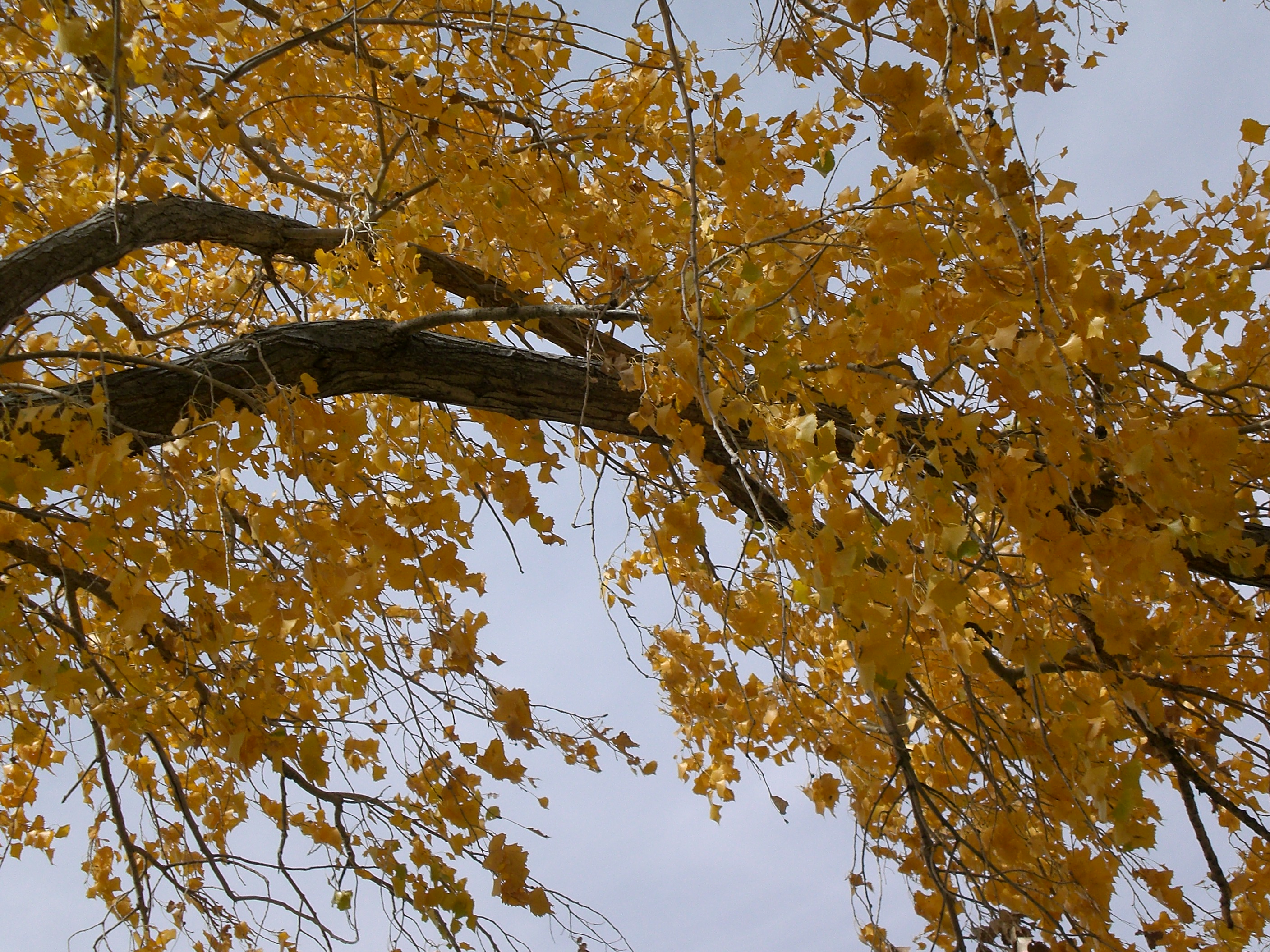
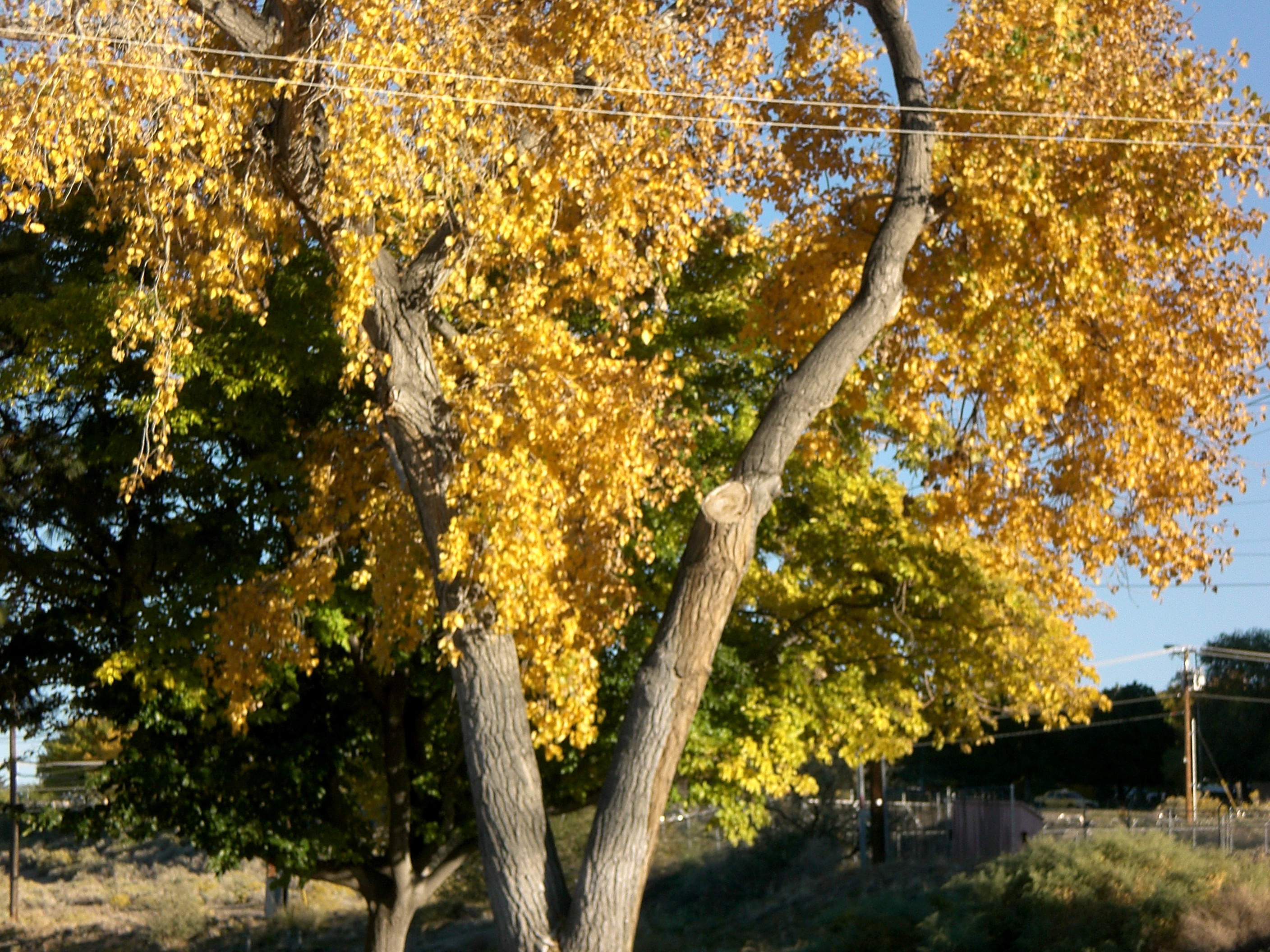
It’s a gorgeous, sunny, crisp yet warm autumn afternoon. I’m driving down from my home at 7500 feet towards Albuquerque. Down as in south, down as in descending to the city’s 5000 foot altitude. I pass from full-color glory of cottonwoods in deep gold, dotted here and there along arroyos which occasionally run but are now dry, to clusters of trees beside small streams which show a mixed blend of yellow tones. Here and there on hillsides I see an occasional, rare in the desert, sprinkling of red leaves where scrub oak is doing its part to show off. Wishing I had time to stop and take pictures at each of the scattered sites, I slow down and drink in the brilliant color enhanced as it is by a bright sun and a postcard-perfect clear blue sky.

An Arc of Gold

An Arc of Gold

Much of the land is once again brown, grasses dried and earth showing little sign of the week of heavy rain that caused flooding in New Mexico as well as Colorado. Oh, you didn’t know that we had floods? Not surprising. When it comes to national reporting, New Mexico doesn’t exist. Our flooding was not mentioned; our drought is equally overlooked, although we have officially been the driest state in the nation. Only when Los Alamos lay in the path of wildfire, and last year when the biggest wildfire raging in the country ate tens of thousands of acres southwest of Santa Fe, did New Mexico make the news. “Listen my children, and you will hear…” stories like those handed out to tourists in a booklet entitled “One of Our Fifty is Missing”  –  but that is the subject of another posting.

On the Prairie

On the Prairie

The rain is gone. One week in August, then a torrential week in September that dumped more than the land could absorb – now we’re once again living with drought, seeing long stretches of dun and tan prairie grasses, and encountering bears on the edges of our communities, some even making their way into the center of large cities in search of food. Acres of monochrome are suddenly interrupted by a line of golden cottonwoods. Looking out across the prairie, those trees beckon with the promise of a water course. Many of these small rivulets are dry, their banks eroded by the flash floods which accompanied that week of September rain, sometimes to the point that tree roots are exposed. Tree roots reaching down deeply, to what little is left of moisture; tree roots anchored in brown to give life to riotous gold.

A Survivor

A Survivor

I pass yet another cluster of trees about ten miles south of Santa Fe, and see cars pulled off the side of the road. Looking more closely, I spy a group of artists, easels lined up, some standing, others on camp stools, each of them trying to capture autumn glory. I wish I could stop and join them! Instead I continue down the highway, across dry flat lands, then down one last hill. Spread out before me is the bosque of the Rio Grande, a wide and many-miles-long swath of cottonwoods, in every possible shade of yellow. It is almost too much to take in – acres of dancing golden tones sating the eye to the point that I must look away, watch the highway and the traffic, overfull.

As I enter Albuquerque, I find myself searching out the occasional red of an intentionally-planted maple (they are not native here) and wonder if the householder responsible for the tree is, like me, originally from the East Coast. I delight in the rare splashes of red in equal measure as I responded to the occasional golden cottonwoods earlier in my trip.

Rosy red

Rosy red

I remember autumn in New England, red upon orange upon grape upon wine, each color seeming to stand out and be enhanced by its subtle differences from its neighbors. I never tired of those shades of red in the way that today I ceased to be drawn to the yellows in the bosque.

Neighbors

Neighbors

I perceive that, because there were so many different types of trees producing multi-hued woodlands, autumn in the East, with its continuous experience of changing colors, did not become “too much” in the way that miles of yellow upon yellow have exhausted my ability to be inspired. I ask myself how much variety is enough to keep me from becoming sated? Is it actually variety that is important, or uniqueness? A clump of cottonwoods in a landscape of tan grasses is unique. A brilliant red maple stands out against an orange-toned oak whereas, in an acre of similarly colored trees, each cottonwood loses its distinction.

Do we not all strive to find our own unique color, to stand out from those around us?

Some of us are more strident, others quite subtle, but all of us seem internally driven to find a way to express individuality. Undoubtedly one of you readers will have objected that the acres of yellow in the bosque, the totality of which I found to be ‘too much’, would have delighted you with its abundance. The open, empty plains that I find soothing were frightening to my mother. On her one visit to New Mexico she felt unpleasantly vulnerable, as though naked and exposed. I, by contrast, feel invaded, almost assaulted, by the intensity of human activity in urban areas.

Standing Out

Standing Out

Going out for a walk after orientation class has ended, I find a patch of grass littered with slim, deep red leaves. I don’t know what sort of tree they have dropped from – I’m not an educated botanist. I do know that I’ll keep the handful I collected on my desk in the training room, until they turn brown and brittle. And to have them longer, I’ll photograph them to upload to my screen saver, along with pictures of cottonwood and of maple branches lit by late afternoon sun.

Red Delight

Red Delight

I may feel sated in the bosque; I will delight in retaining reminders of this colorful day, replete with images that speak to my soul while teaching lessons about the value of individual differences.

Words of Communication

October 26, 2013

Driving down I-25 toward I-40 in Albuquerque, I passed through more than one weaving section – those complicated stretches of road where it seems everyone is trying to get into a different lane, coming up from an on-ramp or trying to reach the off-ramp or to position themselves for the upcoming interchange where two major roads meet or diverge. I know the term weaving section courtesy of a transportation planner with whom I had a relationship a very long time ago. He also taught me to drive competently and safely. Thank you, Ray.

Once through the series of weaving sections, I traveled from southbound I-25 to eastbound 1-40 via a flyover – or that’s what my British friends would call it (I know the term courtesy of all the British authors I’ve read over the years). A flyover is the part of the interchange that takes you up and over other lanes of traffic, what we in America call an overpass. As I passed over (flew through at high speed) the interchange, I remembered a number of other lessons in American versus British English, these taught me by my Uncle Eric and Aunt Hilda in Sheffield when I was still a teenager. In (I hope) mock horror Hilda scolded my use of wash cloth (only for cleaning dishes) when what I wanted was to clean my skin (using a face flannel). She was also upset that I called her garden (grassy with flowers) a yard (bare dirt or pavement). And she made it clear that the soil in her garden was earth, not dirt!

My venture into reflection on terminological differences arose following my attendance at an emergency planning conference – more properly the New Mexico Local Emergency Planning Committee Annual Conference – at which a number of intelligent, engaged, caring and thoughtful people tried to convey their knowledge and expertise to a largely receptive audience. My problem with the conference was not in participation, nor content, but in the strange transmogrification which occurred in the speakers – from competent communicators to committed users of stilted government-speak. Several of the presenters tried to include humor in their talks; all had the ubiquitous power point at hand for support; some also added pictures and graphics to illustrate key points. But the bottom – common – line amongst almost all of them was their use of that strange obfuscation which passes for communication within bureaucracies.

Ah, you’ve noticed my inclusion in these paragraphs of big words. It’s fun, sort of, to fall victim to that of which I am complaining. Here, I’m changing my usual form of communication for fun, and with intent. The presenters did not alter their delivery for fun. They seemed, rather, to feel the need to assume a formal persona because they were presenting a talk. As though who they are/how they speak normally was not good enough or important enough to give a conference presentation. One exception was the only attorney to make a presentation – he is so at home in his public delivery that there was no discernible change in him (except voice projection) when he stopped chatting over lunch and stood to give the luncheon address.

I’ve coached students learning to write essays for school, and encountered a similar perceived need to drastically alter their manner of communicating. One teen with an engaging ability to tell stories, when asked to turn the story he’d just told into an assignment for English class, became the written equivalent of tongue-tied (pen-tied, computer-tied?).

“How do I begin?”
“Just start telling your story.”
“I don’t get it. How do I begin?”
“Pretend you’re talking to me and just put the words on paper instead of speaking them.”
“But how do I start? Where do I start? How far back should I go, to get the reader to understand what the story is all about?”
“How far back did you go when you told me the story just now?”
“I didn’t have to go back because you know me.”
“So pretend the reader knows you and start the way you started with me.”
“But the reader doesn’t know me and might misunderstand.”
“Write it like you’re writing a letter to me, then. You know I won’t misunderstand.”
“So do I start with “Dear Ms. Sebastian”?”
“If that lets you get into your story, go for it.”

It would seem that wanting to communicate, for many people, contains within itself the root of lost ability to do so! It is a painful truth for stutterers, that the more urgently they desire to speak, the more inhibited that speech is likely to become. Some stutterers overcome the problem by taking singing lessons. Next, they think of singing their daily speech, and the words come out fluently. I aimed for a similar transfer of skills with my encouragement of my writing student to tell me the story on paper just as he’d told it aloud. He did write me a letter, then transferred the body of the story to essay format, and got a good grade on the paper.

I’m convinced that effective communication – whether in a formal presentation or a chat over tea in a garden – is not about the words one uses, not about the style, but about having a comfortable sense of oneself, and an intent to communicate. The presenters at the conference became ensnared by their efforts to appear as some formalized image of themselves, perhaps labeled “the professional”. The student, a natural story teller, was blocked by replacing his intent to communicate with an intent to “be a writer”. Many people, convinced that they won’t be understood, don’t try to express themselves at all, and become the fulfillment of their perception, going sadly misunderstood through life.

The simplest injunction to give to someone undertaking a new communication task is “be yourself” – yet it is also, often, the hardest one to manifest. How many of us really have “a comfortable sense of ourselves” that we are willing to expose through our written or spoken words? To become a good communicator then, there are in fact four necessary steps:
1) Know yourself
2) Be yourself
3) Trust yourself
4) Express yourself

Just four steps – but ones it often takes a lifetime to learn.

Older… and Wiser?

August 30, 2013

Have you noticed that the ‘older’ part of ‘older but wiser’ is singularly obvious in wrinkles, aches, and the need for Post-It notes littered over every surface – but the wiser part is much harder to recognize? Especially when the dog mouths one of those Post-It notes, and you have to make an extra trip back to town for the three forgotten items of the six that you need to make supper.

How delightful, how ego-boosting it is, then, when circumstances allow you to recognize that the ‘wiser’ at least occasionally manifests. A recent experience allowed me to feel grateful for whatever passes for wisdom in my brain. I had thought to pursue a course of study which would require me to hold in equal respect two conflicting paths to spiritual understanding. My training directed me along one path, my mental inclination tempted me onto the other. The studies would have meant constantly balancing two goals, two world views, two concepts of self. The outcome of the program would have enabled me to practice in a field I’d like to enter, for which I do not – at least at this point – see another means of qualifying.

So I did all the paperwork, wrote the essays, completed the application – and then was denied acceptance. What to do now???

Here’s where the wiser comes in. I did nothing, just let the fact of the denial settle into my awareness. Within a few days, I had one of those blessed “aha” experiences, a flash of insight that allows me to lay at least passing claim to wisdom. Recognition is enough! Seeing the differences between the two paths, understanding how different aspects of myself are drawn to each of them, and knowing that I am capable of continuing to follow one while learning the other – that is the recognition. And it is enough. I don’t have to also undergo the stress of carrying awareness of the paths and their differences through a two year course of study.

Wiser seems to be at work in my growing ability to move through a mine field of life choices while maintaining a ‘neither for nor against’ mentality.

Older is definitely a handicap in my search for paid employment. I cannot help but believe that the on-line application and screening systems which substitute for preliminary job interviews include an edit that discards all applications with college graduation dates before 1990 (the application isn’t accepted if a graduation date is left blank). No other explanation accounts for a year of denials of my applications for positions for which I meet every criterion, which mirror work I have already done successfully, and which are written using all the key words of the job description included in my work summary. Wiser allows me to keep the constant rejection at arm’s length, not translating it into a feeling of personal inadequacy. The right income opportunity will come my way, so long as I keep an open, explore-everything approach to the search – and all this rejection is good practice for the inevitable “send out twenty stories to get one accepted” that mark a writing life.

+++++++++++++++

Older is what I will be – starting another decade – on my next birthday in the autumn. Wiser is what I hope also to be by then, having learned the parameters of a new job which I’ve been offered, and having experienced yet again the virtues of patience. I’ve been hired into a position which exceeds every criterion I had set – flexible hours, service to others, supportive and enjoyable coworkers. And I have almost two months to discern how to maintain my established writing pace while fulfilling the job’s requirements. I’m old enough to know that won’t be easy. Hopefully I’m wise enough to know both how important the writing is to my sense of well-being, and how possible it is to “have it all.” With patience, I will see the way.

Choices

August 18, 2013

For the past year I’ve been living in a way most of us are taught not to… day to day, with no ‘life goals’ and few plans that reach more than a week or two into the future. It’s a natural way to be; children wake each morning to a truly new day, one full of possibilities. They have to be trained to ignore distractions and to stay focused on mandates – good grades, keeping a room picked up, personal cleanliness, helping with household chores, thinking ahead.

Oh yes, thinking ahead. You didn’t make your bed when you should have done, so now you have to do it instead of watching your favorite TV show. You should have thought ahead! You’ve been skimping on your homework, now you’re failing 5th grade, though you’ve been warned over and over. You only have one six week grading period left to bring your work up to acceptable level. You’ll be doing nothing but school work from now until the term ends. No trips, no play, no time for fun… you should have thought ahead!

Sorry, Mom and Dad, but I’ve been determinedly not thinking ahead. There is a point, ahead out there somewhere, when I will run out of savings and, without income, be destitute. I’m not ignoring that fact, but I’m not focused on it. My wise teacher instructs that attention is food – what one attends to grows in one’s life.

Conversely: ”If you want something to leave your life, take your attention off of it.”

I see no benefit from worrying about a maybe some three years off into the future, so I am attending to what is here with me in the present. I have been searching job boards, applying for everything that seems a possibility. Like many older people in the job market, I get few responses. Experience seems not to be valued any longer. Employers want new young minds to train to their special priorities. They want to mimic parents, who know instinctively that training children to think ahead, plan for the future, and learn habits of daily living is easier when the children are young and haven’t yet had enough experience to question the parental dictates.

So how do I communicate, in a standard application and resume submission, that part of my experience has been learning to be open to new ways of doing things, new goals and new achievements? Do I say that I have been living day to day for a year now, proof of my ability to be flexible and adaptable? Do I use, in a cover letter, another image from my spiritual teacher, of riding a horse up a creek and, at a moment’s notice and for no conscious reason, jumping the horse up onto the bank? Knowing when to listen to one’s inner voice (intuition, or spiritual knowing) can indeed be the skill that saves one, in what turns out to be the nick of time, from a tumultuous flash flood gushing down the creek bed.

Asked what I’m looking for in new employment, I could perhaps best answer by saying I seek the employer who will appreciate the depth of meaning in my teacher’s story. Or one who could read Lesley S. King’s recent post entitled Face Your Inner Mischief, about her yapping mind, and understand it for the beautiful parable it is. I seek an employer who has the ability to appreciate the innovative, the creative, the self-directed in others because that is what he/she is also. Someone not threatened by new ideas, not hearing questions as challenges to authority but rather as the positive contributions of an assistant engaged in the process of achieving goals which, themselves, may shift with time and experience.

Living each day for what it offers, as I have done of late, could be considered a rejection of the values my parents, particularly my father, taught – to plan, to delay immediate gratification for a larger achievement; to save and be mindful of expenses, so as to have financial resources when they are needed; to be cautious and consider all possible consequences before acting. Indeed, much of my life could be seen as a rejection of those values; I’ve left higher paying jobs for lower paying ones on a matter of principle; I’ve spoken out about fundamental rights and been blacklisted; I’ve challenged the status quo in large and also in small ways, living as my friend Jane said recently, when she wrote, “I did what the Holy Spirit led me to do, and I can do no other.”

Nonetheless, there is a way in which I still embody the underlying lesson my father – and most parents – try to teach their children. That silent message is about acquiring the ability to choose – i.e. to have an understanding of cause and effect, an ability to be patient long enough to experience outcomes, and a sense of what information comes from within one’s being and what is imposed from ‘outside’. With these three skills, one can choose – to follow outside dictates or respond in opposition to them; to stick with an unsatisfactory job or to leave it without another already in place to go to; to value integrity more than security, or patience more than impulsiveness.

Ultimately, it is our choices – or lack of them – that define our lives. Lucky is the child of a parent who knows to teach how, but not what, to choose. Blessed is the individual who learns from a spiritual teacher that worlds exist beyond the mundane, and that we all have within us the capacity to manifest Truth, to Hear the Word, to be led by the Holy Spirit, in whatever language or manner of Knowing we choose to embrace.

As I continue to practice not knowing, living open to whatever turns out to be my ‘next step’, I am content. I have made my choices and, again like my friend Jane, I have paid a price, but “I would do it all over again.”

It’s good to know that I’m fulfilling my promise to myself, made shortly before my grandfather’s passing, to live my life so that whenever my time of transition arrives, I will have as few regrets as he did on his deathbed. His nearly final words to me were, “I possibly should have remarried – it would have been better for your mother, but I never found a woman I wanted to marry… and I wish I’d learned to play the mandolin.”

May we all make our choices such that we can sum up our lives as contentedly and succinctly!

Plenty of Nothin’ is Plenty

August 4, 2013

I wonder if the hardest part of getting older is not the challenges of coping with a failing body and mind, nor the inevitable sorrow of losing friends and peers, but the gradual – or sometimes very sudden – loss of illusions, loss of aspirations, loss of hope. At some point we all face the recognition that a cherished desire or goal is not going to be fulfilled. What then?

Psychologists have given labels to the behavior engendered by some of these confrontations – empty nest syndrome and male menopause being the most prominent. Those two experiences are primarily about accepting transitions in one’s life path rather than about loss of a way forward. It may be hard for a mother to accept that her children are grown and must be allowed to live their own lives while she redefines herself – she will still be a mother, but engaged differently in the lives of her family. And just as business managers must adapt their style when a company transitions from growth to maintenance mode, so some men must accept – at some point in their careers – that they have reached a plateau where they may expect to be for the rest of their working lives.

(Yes I’m aware of the sexist, stereotypical nature of the two above examples. Men may indeed have troubled letting go of a familiar pattern of fathering, and career women also have to recognize the point at which their professional lives plateau.)

Except, of course, that creative men and women reinvent themselves, begin new careers, take up new interests and continue to make contributions to their community, their families and themselves, often to the end of their days. Of what is that creativity made? Is it something more than a stark refusal to concede to lost illusions, lost aspirations, lost hope?

Consider a particular expectation – that of finding someone with whom one can walk life’s path, a partner to share the joys and sorrows, someone to ‘be there’ when support is needed. Some of us are lucky enough to find such a mate. Almost all of us are given the expectation that we will be in that lucky group. We read novels about these ‘good’ marriages and we see – or think we see – examples around us. We may or may not also learn that romantic love doesn’t hold up well to the stresses of married life, but that if again we are lucky, we discover a more stable, enduring form of love that does survive the inevitable losses life brings. Above all, if we are lucky, we find someone with whom we can share (and thereby halve) the pain, and share (and thereby double) the pleasures life brings our way.

But what of those who do not find such a partner? Or who find a partner incapable of sharing in a way meaningful to us? There are many such people, their stories recorded over and over again in country western songs. How do we move past the realization that we have come to a point in life where it is clear there will not ever “be someone to hold me while I cry?”

Those of us who are fortunate enough, wise enough to let go of the demand for a single person to fulfill the human need for companionship often find ourselves with support in unexpected but very meaningful ways. When I cracked my spine in a horseback riding accident, a neighbor showed up daily to do my chores and another took off from her work whenever needed, to drive me to my own work and appointments. And years ago, after the love in my life was yanked away, an acquaintance from the Quakers volunteered herself into my new home to help me unpack and settle, and to hold me while I cried.

My spiritual teacher instructs that attention is food. What we give attention to multiplies. Inversely, the way to remove something unwanted from one’s life is to simply take one’s attention off it. Focusing on what is missing from life (a forever mate for example) will only push the possibility of finding one farther away. Psychologists have used transactional analysis to spell out the emotional dynamics of this truth, and shown how unhealthy, unequal relationships are formed from neediness. Most are unfulfilling and unsustainable. In the end, they rupture and dump the needy person right back where he/she began, in the classic cycle of repetitively marrying an abuser, an alcoholic, a philanderer, et cetera. I love the accuracy of the title of the landmark book in this field, Games People Play.

We have the option not to play games. Creatively fulfilling our needs for companionship, for attention, for support by drawing on a variety of resources – including ourselves – shifts attention away from lack and loss and toward plenty. With attention on plenty, it multiplies in a happy way. Porgy, in the operetta Porgy and Bess, expresses giving attention to sufficiency so well:
I got plenty of nothing,
And nothing’s plenty for me.
I got no car – got no mule,
I got no misery.
Folks with plenty of plenty,
They’ve got a lock on the door,
Afraid somebody’s gonna rob ’em
While they’re out (a) making more – what for?
I got no lock on the door – that’s no way to be.
They can steal the rug from the floor – that’s OK with me.
‘Cause the things that I prize – like the stars in the skies – are all free.

I have so much more than nothing. Most of us do. Whether or not all our dreams are fulfilled, are we not plenty-full?

Plenty

Plenty

Solitude

July 28, 2013

Keeping on, keeping on

I’ve just finished reading Sara Donati’s Fire in the Sky, committing to myself to find the next book in her series about the Bonner family, and life in upstate New York in America’s early years. In an afterward, Donati states that she hopes she has done her work well enough for readers to seek out histories of the period, the War of 1812, which she feels is given short shrift in school history lessons. If my own experience is any indicator, she’s correct. My recollection of what I learned in elementary school about that war is limited to the battle at Fort McHenry and its role in the origin of our national anthem. High school American history class gave me even less about the War of 1812 – undoubtedly because the lesson was taught in a school in Paris, by a British woman who dismissed the entire affair as a “skirmish on the edge” of the important war happening at that time – Britain versus Napoleonic France.

My take-away from Donati’s writing is not, however, an interest in researching the complexities of what U.S. history books also refer to as the ”period between the French and Indian Wars and the settling of the West” (i.e. all the anguish and horror of the Amerindian experience with European intolerance). My take-away from Donati’s well written, engrossing series is far more personal – a profound feeling of loss, and a bone-deep sense of aloneness. Unlike the characters in this novel, who are an extended family with deep interconnections and emotional commitments to one another – unlike these people written into vivid life – I am alone. Profoundly alone. Only child of older parents long deceased, no first cousins, formerly married to a loner whose own small family (one brother and his children) made me welcome but with whom I have too little in common to connect. I have no children of my own, and never had the occasion to adopt any.

Mind you, I am not lonely. I like my own company, indeed find that I need solitude and tire quickly of constant interaction on those occasions when I am in extended social situations. When, with my husband, we went to visit his brother for a weekend, my sister-in-law was first puzzled, then amused to know that if I went missing, she could usually find me settled in the back seat of our car, with a book. Never happy unless surrounded by the noise and chatter of her children, nephews, cousins and visitors, my sister-in-law struggled to understand how overwhelming so many people could be to a person like me. I was raised in a home dominated by the quiet of parents who, because they did not like each other much, spoke little and went their own ways – until my mother would explode in rage. Noisy interaction, to me, means anger, shouting, ugly accusations, slaps, and being punished for non-existent infractions of unstated rules.

I am well aware of other types of noisy, social family dynamics. Adults happy to be together, chattering about their shared past and planned future, children busy with invented games that send them chasing among the adults, teens congregated on the porch giggling and talking (now also texting) their secrets to one another… I see all this around me as a positive experience, but know myself unable, now, to become part of it. Know that I was set onto my solitary path as early as kindergarten, where my tentative efforts to join the other children and make friends were undermined by my mother’s belief that it wasn’t safe for me to visit in any of their homes, or get to know them outside of the classroom. I know, as an adult, that it was her own self-doubt, her own fears that she was projecting outward, creating an environment around me that forbade socializing in groups.

I’m grateful that I’ve learned to enjoy people, and have been blessed over the years with companions and close friends. I’m also blessed with the ability to enjoy life as a single person, not needing to be part of a couple or in anyone’s company to eat at a restaurant, go to a concert or play, take a road trip, or vacation abroad. I have seen how family dynamics can become warped, twisted into lifelong animosities and unforgiven grudges. I know that much of the appeal in Donati’s stories (beyond the fact that she is an excellent writer) lies in becoming engaged with an ideal of family caring. The members support each other through their various trials, remaining in the end united despite distance or even death. The appeal of romances is that they portray an ideal, of love overcoming obstacles, achieved in the end. The appeal of traditional westerns is of clear cut right and wrong, an ideal justice achieved in the end.

The appeal of an ideal… Is there an ideal of solitude?

Not noticeably in fiction, but perhaps in religion or spiritual pursuits. The Buddha, sitting alone in contemplation. The Benedictine brothers at Christ in the Desert, living a vow of silence in their isolated monastery. The occasional lone backwoodsman – Robbie, in Donati’s Lake in the Clouds – an exemplar of a character choosing to live alone. Spiritual practitioners of solitude do carry the qualities of an ideal. The fictional characters do not. They are portrayed, even the most positive of them, as missing some important element of life. They are portrayed as strong enough to live alone, but nonetheless in some way damaged and unable to connect appropriately with society.

Why this disconnect between the positive image of spiritual solitude and the flawed one of social solitude? I am happy to have ample alone time for my spiritual practice, during which I feel embraced and held close in the joy of the Divine’s presence. I only question my aloneness when I encounter – usually in fiction, but occasionally in daily life experiences – the ideal of family, and then my emotional self begins to wonder if I’ve missed something important. A co-worker has been diagnosed with cancer. His family – sister and two adult daughters – have come from across the country to visit with him, provide support, and enjoy his company. Who would come if the same challenge were to arise for me?

I am looked after and cared for most completely by my spiritual Beloved. I know in my bones, in my gut, in my Soul, the certainty that I am not alone, not forgotten, not adrift in a life without purpose or meaning. As life challenges arise, the tools to meet them will be provided to me, in ways and forms I cannot invent nor imagine, as has already been proven true when I review my Path thus far. Indeed, my current querying of my state of aloneness, my curiosity as to whether I’ve missed out in some way by not experiencing the ties of family, my observation of the ideal of those ties as presented in fiction – all this reflection is an example of the process by which I am gifted to acquire whatever tools I will need going forward. It is just my mind, like a little child, tugging at my spiritual skirts and whining, “I want a sister, I want a brother, to talk to, to play and share with.”

Maybe next lifetime?
Careful, there. Remember the adage about being selective in what you ask for!

. . . Was the Word

July 20, 2013

 valley viewI wrote my first poem, in my teens, after standing up to a howling wind blowing across the rim of Les Baux, in southern France. Below me was the Val d’Enfer (Valley of Hell), so named, I was told, because it was the site of attacks on merchant caravans whose masters tried to avoid paying tithe to the lords of Les Baux. My poem sought to express a sense of standing up to challenge.

Now, in my so-called golden years, I live in one of the windiest areas of the USA, the foothills of the Rockies in northeastern New Mexico. As I write, the wind swirls around my home, slamming against the house before fading to a conifer-leached sigh. With my eyes closed, the sounds could be those of the ocean, hitting the Maine coast and splashing me with spray or, from even earlier in my life, the rolling tumult of storm-roiled combers crashing onto Rehoboth Beach, Delaware, below where I stand hanging onto the railing of the boardwalk.

Just last month, the wind lifted tin off the roof of my loafing shed (fortunately no horses were around to be frightened into bolting). I arranged to re-roof the cottage to which the shed is attached, so tonight there is no clatter and rattle, only the almost intelligible language of an ocean of wind, once again attempting to tell me all the truths of the world.

Heavenly Wind

Heavenly Wind

The wind, no matter in what spot in the world I experience it, brings change. Sometimes merely a change in the weather, other times a practical change like the needed, but previously postponed, new roof. The wind, no matter in what spot in the world I experience it, always brings me to inner change.

Awareness of a power beyond my small self, clinging to the boardwalk rail.
Awareness of good and evil across the ages of man’s time on earth as I looked into hell’s valley from the heights where I was sheltered and protected.
Awareness of the power in wind-driven, fragile drops which shattered to spray against mica-rich Maine rocks, before falling back into the sea and rising again to the work of eroding those rocks over eons of time.
Awareness tonight that, living amidst frequent winds, I have placed myself in the perfect outer environment to match the pace of my inner spiritual evolution. Washed by waves of wind-sound, like the Maine rocks, I am inexorably cleansed, my ego eroded to allow the bright mica reflections of Soul to shine forth.

Cleansing started, and will end, with the Word, spoken by the lips of the wind, into the ears of those who wish to hear.

Life Patterns

July 7, 2013
At UWC-USA Graduation 2013

At UWC-USA Graduation 2013

Marker events in our lives – weddings, baptisms, graduations, funerals – don’t just bring us together in community. These rites of passage often also occasion a life review, or at least a review of that part of one’s life affected by the event being marked. Is my child growing in the way I would hope? Has my marriage turned out as I anticipated? Do I need to make changes to my diet, to live longer than friend John there in the casket? It is a natural human behavior, to make comparisons and to consider not just where one stands in relation to others, but where one stands in relation to one’s own life goals.

There is another type of life review, however, that does not arise so easily, nor so obviously. I’m referring to a bout of unsettledness that descends (or creeps up) seemingly out of nowhere. For me, a recent one definitely came as a sneak attack, catching me in the gut, triggering an upset digestive system not related to diet, illness or any other identifiable external cause. Only stress has, in the past, caused me this sort of physical response. There are no apparent stresses in my life just now, at least not recognizable ones off the widely distributed list of events (including happy ones) known for causing this pernicious dis-ease.

Perhaps that’s why it took me awhile to recognize that what was troubling my tummy lay deeper than a ‘bug’, or too much green chili on my tostada.

For much of the past year I have not known in what direction my life would turn. I left a position I’d held for twenty years, and experienced a huge easing of stress. I’ve gone forward with an open mind, following no pre-chosen path, but rather exploring each option that has presented itself, to see where it would lead. All of the possibilities fizzled out, until I came to writing, which is not a new interest but one that I have pursued in fits and starts over the past twenty years, too frequently allowing it to fall to the wayside as paying work and family demands took precedence. Now, however, I find myself able to give the writing precedence – and am very happy to do so.

I have recently recognized that my life pattern has been one of compromise – and of finding validity for my existence in activities that are of service to others. Teaching college in a prison, working for defense attorneys, running a home health agency and providing case management services to clients – worthwhile pursuits from which I gained as much in learning as I offered in care. The compromises lay in choices made regarding how and where I served – in the U.S. rather than in other countries, as I would have wished to do had I been single and free to go where I pleased. The compromises also lay, unrecognized until just recently, in the subtler realm of belief that I had to justify my existence by some form of service. How many of us are driven by an unstated, perhaps unrecognized, belief that we have no worth until we have somehow ‘earned’ our right to existence? I was startled to realize that until very recently, I did not feel entitled to choose a career on the sole basis that it is something I want very much to do!

I was still a young child when I first came across Robert Frost’s “Death of a Hired Man”, and the concept therein (stated by the wife, mind you) that home is “something you somehow haven’t to deserve.” By that criterion, I have been searching for a home most of my life, and am only just beginning to understand to what extent I have carried within me parental strictures about having to measure up, to prove myself, to earn the right to be thought ‘good enough.’ Finding home, and happiness, as I seem to have managed over this past year, means I have – finally – extricated myself from the tentacles of ‘deserving.’

In my former conditioned way of thinking, I could say that I have worked hard, done what was expected and required of me, for enough years that I now deserve to devote myself to the new career I choose – writing. But I recognize with some considerable surprise that the happiness I am feeling arises not from the doing of the writing, but from my freedom from the need to justify the doing of it. I think I have finally found ‘home’ – a state of being which is independent of the concept of deserving, within which whatever I choose to do with my time and energy will prove to be the right thing for me to be doing.

It isn’t surprising that a major shift in how I approach current activities could cause subconscious stress, and hence digestive upset. I do want to be careful that I don’t use my physical state of well-being (or lack thereof) as a measure of my success in making this transition, since I know that the physical takes much longer to change than does the emotional, which in turn takes much longer than the spiritual. What can be grasped in a moment of enlightenment can take years to fully manifest on the physical.

What matters is that first willingness to recognize that a shift is not only necessary but has in fact occurred. And to allow an unexpected welling of emotion, as well as the uncomfortable gripping of pain, to mark a happy transition from a limited state of (earned or deserved) being, to simply Being.


Only Fragments

Love Letters to the Tar Pit

KarusaaVerse

Words that Sparkle, Thoughts that Ignite: Fueling Your Imagination

Leaf And Twig

Where observation and imagination meet nature in poetry.

Millarson Diaries

Personal Musings and Thought Experiments

The Beauty Along the Road

Discovering Beauty in the small details of our lives

Flowerwatch Journal

Notes on Traveling with Flowers

1eclecticwriter

Wide-Ranging Commentary

Spirituality Exploration Today

Delving into the cross roads of rationality and intuition

smilecalm

Life through Mindful Media

A Good Blog is Hard to Find

I will shatter a word and scatter the contents into the wind to share it with the world.

Ray Ferrer - Emotion on Canvas

** OFFICIAL Site of Artist Ray Ferrer **

AKA The Versatile

Fashion | Lifestyle | Food & Travel | Beauty | Fitness | Education | Product Reviews | Movies | Doodling | Poetess

Aging Abundantly | Women Over Fifty | Empty Nesters | Caregivers | Aging Gracefully

Finding Joy at Every Age with writer/philosopher Dorothy Sander

ARTZZLE

Helping with the Pieces in Life's Puzzle of Art and Design

Project Light to Life

A bucket list blog: exploring happiness, growth, and the world.

The Daily Post

The Art and Craft of Blogging

Any Shiny Thing

MIDLIFE MAGIC

allmostrelevant

@allmostrelevant

The Irrefutable Opinion

Assaults on the Casually Mundane by K. Jean King