Posts Tagged ‘lessons’

What Is…

December 14, 2014

I just spent some time last night and this afternoon checking out and replying to various posts on Facebook – a place I have not visited in weeks. Finding out there’s still a world out there where people have time to watch clips, post pictures, and generally interact for something other than work. Wow.

I hit some sort of end point yesterday shortly after noon. In retrospect I recognize how much I had been counting on having the entire weekend to use on personal interests. Instead, I had to work for much of Saturday to meet demands imposed by an impending state government audit of my employer. It was after 3:00 P.M. before I was able to head into Las Vegas for a walk along Bridge Street and a bit of shopping for the few items I needed to complete my Christmas gift package to a good friend and her family. By that time I’d fallen into a snit – one of those unpleasant moods somewhere between anger and self-pity, feeling unappreciated and generally out of sorts.

Walking and window shopping and finding items for the gift box was not in itself important. Doing something I wanted to do, rather than something expected or required of me, was what mattered. Another friend called, we met for a coffee and talk, and my mood improved. Today I am “back to myself” and readying for another long and demanding week of work.

I wrote – I think in my last, rather distantly past blog post – that I’m so busy living I don’t have time to reflect on, nor write about, what I’m experiencing. I didn’t realize until now that I was actually identifying a problem that needs a solution. I’ve gone from an excess of “me” time to virtually none at all. Neither extreme is healthy.

My Teacher instructs that one cannot outflow effectively if one does not first fill one’s cup, to have something worth pouring out to others. I know this to be true of spiritual matters. My Teacher also reminds us “as above so below”, meaning what one contemplates and envisions manifests eventually in one’s outer life, though perhaps not in the ways the mind and ego imagine or expect. Filling my Soul above with Divine Love, Power and Wisdom through my daily contemplation exercises, I am equipped to pass along encouragement and support to those whom I meet in need.
In the spirit of...

In the spirit of…

Knowing and practicing this Truth, why is it still so hard for me to apply a similar practice below, in my daily allocation of time and energy? How ingrained is the habit of acceding always to the needs of others, rather than speaking up for “me” time!

My new husband is such a loving and generous soul – telling me often that if I want or need something from him, just ask. On those occasions when I’ve broken a lifelong pattern, and asked for what I want, he has responded promptly in the affirmative. But, nonetheless, yesterday happened. I apparently still cannot give myself permission to take what I need, when I need it!

I suspect that this is another manifestation of an uncertainty as to “worthiness”. Have I earned the right to self-care? Have I earned my way into grace?

Grace isn’t earned, it is gifted. Isn’t it about time I left myself open to accept the gift in every moment, so that I automatically provide self-care and don’t reach the stressed out point of needing to demand “me” time? Why is this such a hard lesson to learn?

Yes, I know that each time this lesson of self-acceptance has arisen, it has taken a more subtle form. Each time I get “bent out of shape”, I recognize it sooner and do less harm before calling myself out for my conduct. But that sounds like a mental justification for continuing the behavior, not like an indicator of progress toward eliminating it.

Open Acceptance of Beauty

Open Acceptance of Beauty

In this season of annual review, of winding up things and making new beginnings, I wish for myself the humility and openness to finally release whatever underlying sense of unworthiness causes me still to push myself to prove… I know not what.

++++++

The last few paragraphs were written after what was in their place “erased” with an unintentional sweep of the mouse. Do I get upset at losing my words – or accept that something expressed more effectively was meant to be in their place? The latter, if I am to implement in my lower, outer life the same acceptance of grace that I claim in the higher, inner places of my spirit
What is, is meant to be.
What is, is enough.
What is, is.
Enough.

Porridge Plantains

October 18, 2014

Today I had a lesson in Cameroonian cooking.

I’ve been following a blog (Immaculate Bites) posted by a young Cameroonian woman who puts out recipes from a variety of cuisines – African, Caribbean, some middle eastern, some from the southern areas of the USA. I’ve made several of her dishes and enjoyed them.

Today’s preparation was not one of her recipes, but rather one taught to me by my husband. It is a traditional dish, called Porridge Plantains, that we could not prepare until now because we needed some ingredients brought to us from Cameroon, by a friend who visited home over the summer. Specifically, a dried vegetable called bitter leaf, and a particular bullion cube that I have not so far seen in the USA.

The preparation is quite easy – provided one has the few ingredients to hand. We had plantains, but they were too ripe! So we made a quick trip into town to Wal-Mart. With the assistance of a store employee, who brought out a new box of plantains, we acquired a supply that were green and firm and perfect for boiling. Home again, the plantains went into a pot with soaked bitter leaf, the bullion cubes, a little salt, some smoked meat, and red palm oil, to be cooked down until the broth had soaked thoroughly into the plantains and they were soft in the middle. Out of respect for my limited tolerance for HOT spice, my husband only added habanero pepper at the end, to his portion of the meal. See below for the challenges of preparing that pepper!

Porridge plantain is served at every special event in Cameroon. We had not yet prepared it, not having the special ingredients. So today was our very own “special event”, as I tried for the first time – and my husband enjoyed after too long a gap – a taste of his home.

Porridge plantain has – for me – an interesting and enjoyable flavor, complex, slightly bitter but not excessively so. I think it helps that I love spinach and am one of those people who like anchovies. I’m sure it also helps that I was raised with a rule that I must take a taste of every food prepared. I did not have to eat a whole portion, but I could not skip tasting the – mostly middle-eastern style – foods my mother prepared. By the time I reached Vietnam (at age 13, way back before anyone in the USA had even heard of the country) I was prepared to try the radically different foods I encountered there.

In the years since, I’ve not only enjoyed eating a variety of cuisines, but have also enjoyed learning to prepare them. Preparing pepper sauce for my husband, now, is a challenge of a different sort. He likes the small, orange, extremely hot habanero peppers, cooked down and turned into a sauce that he adds to just about everything. I’ve started preparing the sauce for him – and just about been run out of the house as the cooking peppers put so much “bite” into the air that everyone starts coughing. In warmer weather, with the windows and doors open, it wasn’t a problem, but now that temperatures have dropped, we have become shut in with any irritants in the air. We’ve found a solution – cooking the peppers on a propane-fueled outdoor grill set up in the shelter of the portal attached to the house.

To everything there is a season. For everything there is a seasoning. Some like it hot, some like it sweet, some like it sour (that’s me). How dull it would be if we all liked only the same tastes, activities, hobbies. I wish, for everyone, an openness to experimentation and learning, and the pleasures that come from new experiences. Who knows, I may yet learn to not just prepare but actually to eat habanero sauce!

A habanero chili

Unplanned

August 30, 2014

No promises as to resuming a regular posting. As today’s essay reflects, my life is unfolding in such an unplanned way that I know better than to commit yet to any regular writing schedule. I have missed the connection to my readers, however so let’s see…

+++++++

I walked two miles in about 40 minutes, before breakfast this morning. That activity is one of the several things I have been doing with my limited free time, instead of writing blog posts. My walking place is a dirt country lane, straight and well packed, through unfenced plains used for grazing by a herd of black Angus cattle, and occasionally also by a small group of antelope. Heading out – east – the sun is in my eyes so I keep them lowered and shaded by the brim of my hat. I see bugs scuttling across the road, and jeweled colors as the sun glints off shards and stones beaten into the hard clay by the passing of cars. Heading back – west – I can look around to appreciate how incredibly green my surroundings have been painted by our summer rains.

We’ve had as much rain these past three months as in the last 4-5 years of summers combined. Which means before I walk I douse myself in a home concocted mosquito repellant that works quite well. Oils of lemon grass, cedarwood, peppermint, citronella and a bit of lavender added to water and sprayed on. Sounds a bit wild but actually smells rather pleasant to me. I wonder why the mosquitoes don’t agree – but am glad they do not.

My walks – I try to do at least two a week – are about the only unscheduled, reflective time available to me these extremely busy days. Today I contemplated the saying that “life is what happens while you’re making other plans.” In my case, life is what has virtually overwhelmed me when I had no particular plans at all. So much has changed, so radically, from a year ago this time. I had, then, just been hired by Presbyterian, with a start date in October so I engaged with the projects I wanted to have completed before the new job took over my days. I also wrote quite a few blog posts, to have a supply stored up for weeks when it would be challenging to write. As you must realize, I ran out of that supply several months ago.

The job has turned out to be pretty much what I anticipated but far more demanding of my time than I imagined. We’ve had a good bit of turnover among the 70 some of us across the state, mostly people burning out from the constant demands and deadlines, the 60 + hour weeks, and the aggravations of a profoundly user unfriendly computer data system we are obliged to keep updated. There is, now, a bit of light at the end of the tunnel – or enough light to perceive that the tunnel does have an end. Rather like my sighting in on my car, parked at the head of the lane, waiting for me to make my way back the return mile of my walk. I know a cool beverage awaits me there, so I keep up my pace. There IS an end to this madness, really there is!

Meanwhile, I’m busy living each moment, day after day. It’s an interesting change for me – from a good deal of time for reflection to virtually none. I feel stripped down to an essential core, deciding and acting without conscious planning for what will be done when, or how. For someone raised to believe she must organize and plan in order to achieve, living so immediately in the present is a most curious experience. Surprisingly pleasant and freeing. Productive, though not in ways I have previously measured productivity. Most of all, I feel relieved of a weight of responsibility that I’ve carried most of my life.

And that’s perhaps the most novel aspect of this new way of being. Looking back at the past six months, I have behaved responsibly, honestly, as reliably as ever – but I feel as though I’ve been gloriously self-indulgent. I am certain of one thing – I’m not going to analyze that good feeling. I’m simply going to enjoy it, like I enjoy my two mile walks, the people I’ve met through my work, my new marriage and the process of living my life rather than making plans.

Join me? Try it, you might like it as much as I do!

Illusory Time

June 9, 2014

We’ve all heard that time and space are illusions, that love can bridge both and eradicate them. But how many of us have actually experienced the collapse of space or time?

I’ve had inklings of what it is like to deny space, most notably when I’ve been conducting multiple chats on Facebook with friends scattered around the world – connected simultaneously to Singapore and Norway, for example. But time has, until recently, remained rather solidly real. Oh, I’ve lost myself in contemplation, or in an activity, and – as we say – lost track of time. That experience has always ended with a solid thump back into awareness of time as a sequence, a flow that inexorably carries on while I’ve been doing other things. You know – “life is what happens while your attention is elsewhere.”

Lately, I’ve been gifted to experience a different sense of escaping the constraints of time – or rather, to begin to understand in a very profound way that time is indeed an illusion, a habit of mind that one can shed. My spiritual practice has triggered recognition of a number of mental lies, beliefs conditioned into me from various sources – parents, society, misinterpreted experience, self-doubt. One by one these falsities have shown their color, and I’ve been freed of their constraints. Several have to do with my perception of myself, and possibly do not have general application. The most recent, however, has to do with time and is certainly widely relevant.

I follow a couple of blogs which focus on aging – Time Goes By Time Goes By, and Aging Abundantly. It is important that there be a voice for older people, and even though I don’t always agree with these two, nor do they agree with one another, both writers present the experience of growing older and both confront and counter stereotypes that we all meet daily. They are rooted, however, in an acceptance that time passes and that we are necessarily caught within time’s reality.

I am learning to exist in a different reality. Focused on what I am doing in the present moment, time does not exist. Only when I choose to give my attention to something that happened in an earlier phase of my life – and only if I choose to consider the event in the context of “its” time – does time exist once more. If I instead immerse myself in the event as though it is a present happening, time vanishes.

As children we have all certainly been admonished to “act your age”. As adults, we mark milestones of age (legal drinking age, “the big five-oh”) and measure our accomplishments against some yardstick of what we should have achieved by this or that age. Retirement looms, eligibility for “senior” discounts, a host of societal norms that impose on us the supposed reality of time.

I remember my first encounter with a different concept of time. It was an effort to explain a Pueblo Indian concept that time is not a sequence, but a set of different present moments. The teacher described sausages tied together into a circle. The tribe lives within one sausage/season/period at a time. It is planting season until the circle rotates, and then they are living within the season of summer rain. Another rotation places them within the season of maturing corn. During each season, attention is fully devoted to the activities of that manner of being.

Since plunging into my new job, and a new relationship, I am interacting with various people in very vivid and engaging ways. I find myself so intensely focused on each present demand for my attention that my only awareness is of the activities I’m completing, and the people for whom I am completing them.

It was a shock, yesterday, to realize that 2014 is almost one half done!

I write dates daily, but their only meaning has been a set of numbers that identify a document which I may need to retrieve from my hard drive. My days are defined by who I will see, where I will find them, whether my computer will cooperate with the necessary data entry, and how I relax from work.

My interactions are an exchange between equals, whether co-workers or members of my social network. If I take a conscious step back into the time continuum, I recognize that all these people are chronologically younger – often much younger – than I am. Little about my days allows or enables me to take that conscious step back. Quite the contrary. As a result, I go days, weeks – lately months – living in a continuing present tense, being whatever age matches those with whom I engage, feeling essentially ageless and outside of time altogether.

What a marvelous sense of freedom results from this existence outside time!

Now if I can just figure out how to similarly collapse space, in order to be at once in the several different countries I still want to visit…

Lemon Delight

June 1, 2014

Fixing myself a salad supper using Belgian endive and lemon flavored olive oil, I flashed back to the first time I was offered this salad by the housekeeper employed by my parents, in Paris. Francine had worked in a large hotel most of her life, and had quite a number of stories to tell about life under the German occupation. Some were funny, others distressing, like the one about her desperately hungry coworker who was whipped for eating two bites from the discarded remains of an apple she found on a supper tray set out into the hall.

Francine is also the person who first began to teach me patience, how to mask my reaction to a situation and to bide my time until I could find a safe and effective way to retaliate. In different terms, she taught me to convert reaction into response.

My friend from Cameroon describes the French, who ruled his land for decades – as part of French West Africa – as duplicitous people who mask what they really mean behind polite phrases. He has gently scolded me for being “like the French” when I ask what he would prefer in a situation, rather than state what I think and then ask his opinion of my proposal. At first I was puzzled by this interpretation, since in my own mind I was genuinely neutral, and willing to do whatever he wished. Now, I’ve adapted my communication, to state that I have no preference among several options and would like him to choose for us both.

I’m still learning, in other situations, to feel comfortable openly asking him for what I would like. A lifetime ago, a mentally ill mother who took pleasure in denying me anything I wanted, set me on a path of masking my desires. Francine refined my skills of indirection. Time, experience, life as it happens all combined to instruct me to accept and be happy with what I could get, rather than to demand the fullness of what I wanted.

There is value in patience, in being tactful, in making lemonade from lemons.

Scent of Lemons   by Janet Triplett

Scent of Lemons
by Janet Triplett

But there is also a time for a serving of lemon meringue pie!

I’m savoring my slice just now – a demanding but satisfying job as the (gluten-free) crusty base, a delightfully sweet/tart lemony balance of romance and a social life for the filling, and a meringue topping of frothy happiness and spiritual delight.

There. I’ve said it. That I have what I want.

In the saying, I am confirming my right to this happiness, rather than daring fate to snatch it away from me in the way that, so long ago, my small pleasures were demeaned or destroyed.

How very long it sometimes takes to undo negative conditioning! Especially when that training wears the face of positive qualities like acceptance, patience, diplomacy, tact.

My spiritual teacher, from MasterPath, speaks of iron shackles and golden chains being equally binding. The shackles are clearly negative and therefore easier to identify and shed. The golden chains are so subtle and seemingly so benign. But oh, how constraining they can also be.

I feel blessed, to become able to perceive and free myself from them. I thank Thee, Master, for showing me the way.

Random Thoughts

May 11, 2014

What was that nudge to parents from quite a number of years ago…”It’s two a.m. Do you know where your children are?”…

Well, it’s four a.m. and I’m awake and writing.

Not with a coherent topic in mind, but rather with the flow of reflections that has been keeping me from sleep. Starting with the circumstances of a mother and son whom I visited in Taos a few days ago, for my “day” job (the one that has been running seven days a week of late).

The son is a mildly developmentally delayed and very hyperactive boy, youngest of six children, with all his older siblings grown and moved on. The mother is a 350 pound woman requiring constant oxygen, and in severe pain, barely able to stand long enough to move from bed to chair. They live in two cluttered, unheated rooms at the back of an old adobe house belonging to her mother and brother. I don’t want to know what lies beneath the piles of clothing, baskets, blankets and miscellany filling the floor and every corner of the rooms.

She cares about her son’s development, is worried that he has started to be bullied in school, wants to teach him to “man up” and not cry when he is teased (he’s ten). She has managed to buy him a computer, and he is enrolled in Little League, but is only able to participate in a few of the games because mom can only rarely manage to leave the house to drive him to the field. She wants a companion for him, someone to take him out to activities and help him develop a social life.

The day before, I was with a 97 year old woman whose family was gathering to celebrate her birthday. She birthed 17 children, of whom 14 are still living. She is frail, forgetful, incontinent, but cheerfully recovering from a broken hip and with a goal to walk using only a cane, not her walker. And the day before that, my visit was to a thin, grieving, agitated widow who had just lost her youngest brother, the third family death since the first of the year. She is a survivor – her husband had violently abused her, ending only when the shotgun he pulled out to shoot her misfired and killed him instead. She is in constant pain due to a metal plate in her neck, a repair from when he fractured her vertebrae in a prior attempt to kill her. Despite the violence and her recent grief, she is focused on what she can do to help her young nieces and nephews who have just lost their father.

Against such examples of striving for life in the face of dire need, I find it very difficult to be patient with anyone who takes for granted the support, care and concern offered by others.

++++++++

A young friend of mine is getting married this coming week, and I’m taking some leave days to go to the wedding in Sedona, Arizona. I’ve been doubling up on work this past week, in order to keep to the deadlines imposed by the state’s implementation of a new Medicaid model of service delivery. And I’ll be doubling up on work when I return from my four day trip (two days for the travel, two days for the wedding activities). Which is why unfocused issues are floating around in my head rather than coalescing into a coherent essay for this post. Too busy “doing” to “be” with any one thing long enough for it to form a pattern in my mind. “Doobee, doobee, doo” as a friend of mine has said, about the tension that arises between doing and being.

++++++++

I am most grateful for the support now in my life – a daily injection of humor, appreciation, respect, distraction and loving that is a vastly different experience than my mostly solitary path has been. I truly could not do my job, be of service to so many people in so much need, and manage the challenges in other parts of my personal life, were it not for the companionship and partnering I am delightedly experiencing.

++++++++

“When you walk through a storm, hold your head up high
And don’t be afraid of the dark
At the end of the storm is a golden sky
And the sweet silver song of a lark
Walk on through the wind, walk on through the rain
Though your dreams be tossed and blown
Walk on, walk on with hope in your heart
And you’ll never walk alone
You’ll never walk alone.”

A song from long ago, from the musical Carousel

Words to live by.

Have a great week!

Driving into Awareness

April 6, 2014

I am teaching someone to drive – again – no, I am again teaching someone to drive. There, that’s better, more accurate.

The same process of correction, of attention to exact explanation is required of me as the driving teacher (not driving the student hard, but teaching the student the art of driving). And it is as much art as science. Getting the feel of the vehicle, of the wheel, of how the car wants to straighten itself out from a turn so that trying to do the straightening produces an over-correction. Learning to position oneself in the lane, noticing important warnings of the intentions of other drivers, processing what one sees and hears without needing the time to consciously think it all through. Driving, especially in traffic, requires quicker responses than conscious thought permits.

I am, again, teaching someone to drive, and valuing this opportunity to become conscious of what I do instinctively. Valuing, also, this occasion to notice not just what I do right, but what I’ve gotten a bit sloppy about, and don’t want to continue to do, now that I need to be a role model of safe, defensive driving.

My daily spiritual practice is essentially an exercise in shutting down thought, in order to become aware of the subtler levels of my being. Very close to what I must do to teach someone a skill at which I am so practiced that I conduct the activity beneath the level of awareness and thought. When I come out of my daily contemplation, I often bring a new insight with me, into consciousness, then do my best to put into words and actions what I’ve been gifted to perceive. Very much like the way in which I am opening to the subtle habits ingrained by so many years of driving, and attempting to give voice to them in order to instruct my student.

So teaching someone to drive is a spiritual exercise! Or at least it can be, if one chooses to make use of the experience for one’s own growth in understanding. And in patience. And in trust.

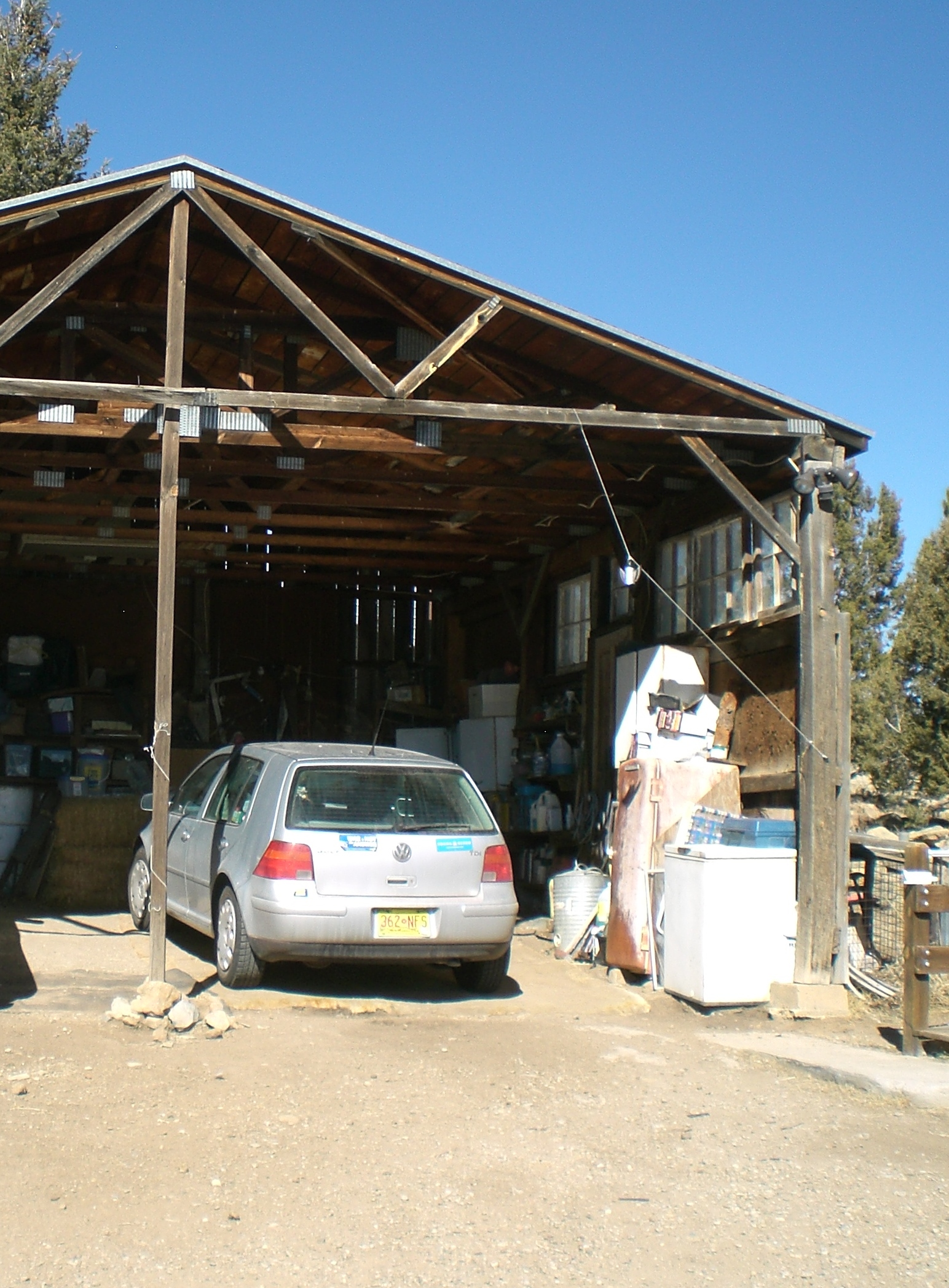
The vehicle being used is my ‘second’ car – the back-up GMC that serves as my guarantee of transport should my trusty and trusted and much loved VW Rabbit ever fail me. (It has not done so, as yet, in ten years and nearly 220,000 miles of mostly solitary driving). I’ve realized already that I would be far more tested were I to be giving the lessons in the Rabbit. Not just because it’s a stick shift whereas the GMC is automatic. I have virtually lived in the VW; it’s packed with all that’s necessary for me to survive through a snow storm, hunker down to wait out a dust storm, take advantage of an unexpected opportunity to camp out overnight, be appropriately dressed for sudden changes in weather, provide roadside first aid in case I come across an accident… you get the idea.

Resting at Home

Resting at Home

My Rabbit has become far more than reliable, reasonably inexpensive transportation. It’s home away from home, an important means of connecting me to the world, a key element of my ability to earn my living and, because Rabbits remain relatively uncommon on our roads, a distinguishing mark of my presence. Not so long ago, I needed to let a mechanic drive the Rabbit so he could feel in the steering what I sensed was a developing problem. Sitting in the passenger seat as we went around the block was one of the harder things I’ve done recently.

Sitting in the passenger seat of the GMC has not been difficult. I don’t have much history with the Envoy, and my student is both a quick learner and a careful driver. The challenge for both of us is that he grew up using public transportation, not riding in cars, so he still has to acquire the non-verbal, body sense of what driving a car is all about. It’s not at all the same as riding a motor cycle, which he has done.

I’m also familiar with riding cycles – not driving them, but happily sitting on the back, free to enjoy the wind in my hair and the scenery flashing past with an immediacy totally lacking when one is shut inside a car or truck. I used to get the same sense of connection with my surroundings when I rode my horse out through the gate of my property and into the extensive acres of my neighbor’s ranch. A brisk canter to the far fence shut down thought and opened up my inner world. Yet another form of spiritual exercise.

Perhaps I should suggest to my student that he do a short contemplation before his next turn behind the wheel? Most physical skills come more easily when one relaxes into them (think of learning to float in order to swim). Those same skills suffer when one over thinks them (tensing up in the water, and sinking). Riding behind on a motorcycle, one has to relax and let one’s body bend with the curves in concert with the driver. Up on a horse, one must become one with the rhythm of the horse’s gait. Behind the wheel of my Rabbit, I feel in tune with every nuance of the vehicle, I know that car as if it were alive.

How does one teach that sort of awareness?

Hearing one’s True Voice in contemplation and then living from one’s Divine Self are, like driving a car well, skills which cannot be mediated through the mind. These skills cannot, therefore, be taught. They must instead be caught by the student, who first observes them being modeled by a teacher and who then, by trial and error experience, learns to shut down the mind and respond from a wise and capable Soul.

Inner commune, connection, inspiration, followed by action – the sequence of a spiritual exercise – is also the sequence many artists describe as their process of creation. Learning dance choreography many years ago, I was told by Miss Widener to stop thinking about my composition and instead to just feel my way through it. Yesterday I asked my student if he could feel how to respond to the impact of wind on the Envoy’s steering. Today I am challenged to create, with words, a feeling of intuitive understanding in my readers.

Do I evoke an “aha, yes, I am aware of that part of me?”
Do you go there, learn, trust, respond, live from that core? Yes? Then I’m happy for you.

If not, or not yet, teach someone to drive – or ride a bicycle, redecorate a room, weave a rug, or work with wood. As your student learns a new skill, you’ll gain a new level of awareness, and enjoy a new way of Being.

Whirlwind

March 30, 2014

My thoughts seem to be coming in song fragments. Some are personal. One asks to be shared.

“Tis a gift to be simple, tis a gift to be free, tis a gift to come down where you ought to be. To turn and to turn shall be my delight, and in turning, turning to come down right.”

My life is being turned upside down, and I’m simultaneously riding on the whirlwind and standing aside, watching the wind (up to 60mph outside my window at the moment) figuratively shred the golden chains that have held me trapped in patterns of thought, belief, behavior that appeared to be good but which were nonetheless ensnaring.

How subtle is our mental training to be “good”, to think in dichotomies, to turn away from what John Eldredge, in Wild at Heart, calls our God-given nature. In order to be “a good Christian” (Eldredge) or to be a responsible partner, or a good family man. Or so as not to be labeled “bossy” as a young girl, or called that other “b” word when, as a mature woman, I speak up, speak out, speak my truth.

“Be a good girl and…” do whatever I’m being asked to do, whether or not that something is good for me.
“Good little boys don’t…” do whatever it is the adult is unhappy at seeing happen.

It’s called socialization, and it’s what good parents do when raising their children to fit into society – and what not such good parents do when projecting their own malformed views onto their children. In both cases – and all the variations in between the two extremes of positive and negative parenting – the resulting imprinting takes a lifetime to understand and clear away, if one is even capable of understanding and clearing it.

What my Master calls iron shackles and golden chains – the imprinted concepts from upbringing and karmic bonds – are what his students work to become aware of, and to release. The shackles are usually obvious – habits like addiction, that limit and restrict opportunity, or behaviors that can be labeled anger, greed, attachment, pride. The golden chains are much more difficult to recognize because they come disguised as positives like responsibility, or being a good ______ (fill in the blank).

Remember What You Are

Remember What You Are

I’m not suggesting one shouldn’t strive to be good at whatever one sets as a goal – developing and using skills is a satisfying and fulfilling effort. Being good at is not the same as being good. Active little boys, expressing their inborn nature, may be good at stirring things up, exploring and challenging and daring to try, all behaviors that can get them labeled as disruptive by a teacher who wants them to sit still for school lessons. A bright little girl with natural leadership skills will hear that she’s being unacceptably bossy when she tries to take over direction of a playground game.

Breaking golden chains, then, can be considered as learning to distinguish being good from being good at, and giving oneself permission to simply Be… good at certain things, not so good at others, but acceptable and accepted and loveable and loved, nonetheless.

Because you are Soul, perfect and beautiful, warts and all.

‘Tis a Gift

March 23, 2014

I have only a little time this evening, set aside for writing, but without any strong motivation regarding a topic. There are four or five essays I’ve started at various points in the past few months – none of them grab me just now, asking to be completed and posted. Too abstractly intellectual; too much social commentary when I don’t feel particularly engaged; too removed from my current state of being… Too, too, too.

The only immediate concern that engages me in this moment of relaxation, is how to keep my present calm acceptance and contentment going when I am bombarded by Saturn’s powerful strictures, or the draining needs of others. I’m sure you’ve encountered people whose sense of deprivation, or overwhelming pain, or just plain exhaustion have turned them into emotional black holes, sucking life force from everything around them. I’m not referring to those who have been diagnosed with borderline personality disorder – the ultimate in black-hole-ness. Working effectively with these fragmented people requires professional training and a great deal of practice.

No, I’m referring to people who mostly manage to make their way in life, but lean extensively on anyone and everyone around them in order to function. They hold jobs, they raise families, and they suck up the energy, the enthusiasm, the very vitality of those around them. I’d forgotten how many such souls draw on our health care system for portions of their support. I’d forgotten to what an extent I have to develop mechanisms to balance myself out, after spending days working with these needy individuals.

Some of the exercises in my weekly Ba Gua class draw energy from the earth and bring it up through the body and out the fingertips. After a particularly challenging work day recently, I rooted myself in the standing tree pose until I felt a resurgence of chi in my body. The technique is effective, but not one I can practice easily in the car, traveling between clients.

Checking in with my Master helps, always.

So does the company of friends, though I feel cautious about relying on the energy of others, not wanting to become, myself, the sort of leech that I am seeking to recover from.

At Upaya, a Buddhist retreat center in Santa Fe, there will soon be a workshop on compassionate caring, subtitled how to be engaged without being entrapped. It sounds like an answer to the challenge of my present situation. I will have to absorb the lessons by osmosis, however – I can’t take that much time off from work just yet.

Nor do I think such a workshop will guide me in dealing with the most serious source of leeching energy – the brutally frustrating, inefficient, too often non-functional data software system with which I must interact on a daily basis at work. I’ve learned that my employer is threatening the computer system contractor with a breach of contract lawsuit – and cancellation of the contract for failure to perform. One part of me is cheering wildly at the thought of becoming free of the monster. Another, though, cringes at the idea of having to redo – in a new data base – all the work already completed since the first of the year.

You’ll get some idea of how awful the data system is, if I say that keeping paper records and duplicating multiple entries by hand would be far more efficient and user friendly than the program we are expected to negotiate, when it works – if it works. I had set today aside for data entry – and couldn’t even get into the system until almost 1PM, effectively losing half my work day. To keep up and not feel totally overwhelmed by unmet obligations, I’ll have to work on Saturday – again.

I can work on Saturday. I’m free to work on Saturday. I have paid work to do on Saturday. I have a good paying, mostly enjoyable job being of service to others, after many long months of being turned down for every sort of work I sought.

No, I’m not practicing affirmations, just reversing a possible spiral into negativity that could begin with today’s frustrating failure, yet again, of a system that is supposed to be an asset in my work my life.

Giving attention to that which uplifts, enjoying the company of friends, sharing a bit of my daily life with these words – these are activities which allow me to regain energy, to move forward into my next day of interaction with whatever sentient or mechanistic black holes cross my path. Outstanding astrologer, Eric Francis of PlanetWaves, urges that we face the coming months of a unique and powerful astrological grand square by daring to trust. For me, that translates to moving forward with confidence that my inner sun is strong enough (provided I remember my Source) to keep shining despite any loss of energy or sapped strength.

To have the opportunity to experience this constant regeneration is a gift for which I am most grateful.
CIMG1281

Japanese Rituals and Tea

March 16, 2014

A dear friend commented on my essay on English tea, that this elaborate meal is very different from an Asian tea – leading me to consider my experience with traditional Japanese tea ceremonies. The first time I benefited from participation in this ancient ritual I was not quite thirteen years old. My mother and I were traveling from the U.S. to Vietnam by ocean liner, a zigzag course from San Francisco to Hawaii to Osaka to Manila to Hong Kong, where we were to land and meet my father for the last leg by plane to Saigon. My mother got bored with life on the ship and decided we should get off in Osaka, and spend a week in Japan before flying to Hong Kong.

Not one to enjoy noisy, busy cities, I found Tokyo interesting but overwhelming. In particular, an hour spent inside a large department store left me feeling frazzled, and as though I were picking people out of my hair and off my skin. Near to the store was a public garden and within the garden a large building which proved to be a cultural museum. Just at the time my mother and I arrived at the entrance to the museum, a young woman in a beautiful kimono announced that a tea ceremony would begin in five minutes. Joining the group that followed her, we walked into a spacious central room where we were invited to be seated on cushions on a tatami floor. In rows, facing an open area, we waited, some talking quietly until the hostess politely shushed everyone.

The walls and ceiling were carved wood, decorated sparingly with niches containing a vase, or a statue, or a calligraphy scroll. The impression was of richness but also a quiet simplicity. Despite being part of a relatively large group (we must have been thirty people) I felt as though a space had opened around me, allowing me to relax and expand. Perhaps it was the size of the room, or its dimensions that created the sense of airiness which I found so soothing.

The tea master entered silently, gliding to his place facing us, a low table and a brazier arranged so as to be within easy reach, yet artistically angled to present to us, his guests, a broken line reminiscent of waves breaking across the tatami sand. The master bowed to us, and we somewhat raggedly bowed back. That is, the Japanese in the group bowed gracefully and in unison – we few Westerners belatedly realizing what was expected, followed as best we were able.

The hostess knelt to the side of the tea master, again gracefully angled to enhance the pattern presented to us. She passed items to the master in perfect rhythm with his movements, and without any visible requests. I concluded that she knew the ritual as thoroughly as he did. Each gesture of each of their four hands was controlled, graceful, careful and complete – a dance of fingers wiping bowls, rotating the tea canister, positioning the kettle, showing off the items used to scoop the tea powder, to stir it, and finally rotating the bowl of tea to present its most beautiful face to the guest for whom it was intended. In turn, the hostess brought a bowl of tea to each of us, then returned the drained vessel to a row behind the master. When we had each had our few sips of thick, bitter, refreshingly energizing, green beverage, and all our bowls were lined up facing us, the hostess and master bowed to us and we – this time collectively, no laggards – bowed back.

The master rose and left the hall, and the hostess signaled for us to also stand. The Japanese rose gracefully while we Westerners found our own, often inelegant ways to our feet. We were escorted back to the entrance hall of the museum, and quietly invited to tour the rooms, which included ancient tea ceremony implements, and gorgeous kimono. I did my best to carry the silence, the stillness, the ritual formality and peace of the ceremony with me as I studied the displays. I still remember how tempted I was to scold the few Western visitors who burst into conversation near by, criticizing the tea as not being what they expected, barely drinkable, not something they would ever willingly have again.

Unlike with English teas, which I’ve enjoyed many times in many lands, I have only experienced that one fully formal Japanese tea ceremony. An acquaintance who married a Japanese, and lived many years in his family home, recently invited me to a tea ceremony that she arranged for a small group of friends at a lovely gallery in Albuquerque. The rituals of turning and admiring and wiping the bowls, of slow-moving hands doing a dance with the tea implements, were familiar despite the many long years since my visit to Japan. At the same time, I was aware of the difference between the formality of the museum ritual, and the “welcome to my home” informality of the ceremony in New Mexico. What they had in common was the creation, through gesture and tradition, of a sense of peace, harmony, stillness, contemplation.

I left the museum on that long ago day, better able to exist within the rush and burble of humanity surrounding me. The ceremony created within me a place of quiet and privacy to which I could retreat, and which I could to some extent then carry with me out into the rest of the day. I’ve learned in later years that other cultural customs also developed in Japan, to provide a sense of privacy to people who live in close proximity, in rooms divided only by paper. For example, the occupant of a room must acknowledge someone who enters before the latter may speak. If unacknowledged, the visitor knows to silently withdraw. Only if the reason for entering the room is of grave importance will the visitor remain, still and silent, until an acknowledgement is offered.

Living most of my life in a very different culture – one that seems to rush to fill any silence with words or music or some sort of noise – I’ve chosen to live in a rural location, in a small house with many large windows that minimize my separation from the trees, grasses, birds and wind surrounding me. Within this retreat I enjoy tea, sometimes green, often strong and black, which I drink from a hand crafted mug. I have my own rituals – the water must be boiling, the tea of good quality, the pot a pretty one. Neither English nor Japanese, nor the Russian of my father’s tea preference, but a blend of all three and a link to cultures and countries and lives I’ve been privileged to encounter.

In Full Glory

In Full Glory


Only Fragments

Love Letters to the Tar Pit

KarusaaVerse

Words that Sparkle, Thoughts that Ignite: Fueling Your Imagination

Leaf And Twig

Where observation and imagination meet nature in poetry.

Millarson Diaries

Personal Musings and Thought Experiments

The Beauty Along the Road

Discovering Beauty in the small details of our lives

Flowerwatch Journal

Notes on Traveling with Flowers

1eclecticwriter

Wide-Ranging Commentary

Spirituality Exploration Today

Delving into the cross roads of rationality and intuition

smilecalm

Life through Mindful Media

A Good Blog is Hard to Find

I will shatter a word and scatter the contents into the wind to share it with the world.

Ray Ferrer - Emotion on Canvas

** OFFICIAL Site of Artist Ray Ferrer **

AKA The Versatile

Fashion | Lifestyle | Food & Travel | Beauty | Fitness | Education | Product Reviews | Movies | Doodling | Poetess

Aging Abundantly | Women Over Fifty | Empty Nesters | Caregivers | Aging Gracefully

Finding Joy at Every Age with writer/philosopher Dorothy Sander

ARTZZLE

Helping with the Pieces in Life's Puzzle of Art and Design

Project Light to Life

A bucket list blog: exploring happiness, growth, and the world.

The Daily Post

The Art and Craft of Blogging

Any Shiny Thing

MIDLIFE MAGIC

allmostrelevant

@allmostrelevant

The Irrefutable Opinion

Assaults on the Casually Mundane by K. Jean King