Posts Tagged ‘My Life’

Lemon Delight

June 1, 2014

Fixing myself a salad supper using Belgian endive and lemon flavored olive oil, I flashed back to the first time I was offered this salad by the housekeeper employed by my parents, in Paris. Francine had worked in a large hotel most of her life, and had quite a number of stories to tell about life under the German occupation. Some were funny, others distressing, like the one about her desperately hungry coworker who was whipped for eating two bites from the discarded remains of an apple she found on a supper tray set out into the hall.

Francine is also the person who first began to teach me patience, how to mask my reaction to a situation and to bide my time until I could find a safe and effective way to retaliate. In different terms, she taught me to convert reaction into response.

My friend from Cameroon describes the French, who ruled his land for decades – as part of French West Africa – as duplicitous people who mask what they really mean behind polite phrases. He has gently scolded me for being “like the French” when I ask what he would prefer in a situation, rather than state what I think and then ask his opinion of my proposal. At first I was puzzled by this interpretation, since in my own mind I was genuinely neutral, and willing to do whatever he wished. Now, I’ve adapted my communication, to state that I have no preference among several options and would like him to choose for us both.

I’m still learning, in other situations, to feel comfortable openly asking him for what I would like. A lifetime ago, a mentally ill mother who took pleasure in denying me anything I wanted, set me on a path of masking my desires. Francine refined my skills of indirection. Time, experience, life as it happens all combined to instruct me to accept and be happy with what I could get, rather than to demand the fullness of what I wanted.

There is value in patience, in being tactful, in making lemonade from lemons.

Scent of Lemons   by Janet Triplett

Scent of Lemons
by Janet Triplett

But there is also a time for a serving of lemon meringue pie!

I’m savoring my slice just now – a demanding but satisfying job as the (gluten-free) crusty base, a delightfully sweet/tart lemony balance of romance and a social life for the filling, and a meringue topping of frothy happiness and spiritual delight.

There. I’ve said it. That I have what I want.

In the saying, I am confirming my right to this happiness, rather than daring fate to snatch it away from me in the way that, so long ago, my small pleasures were demeaned or destroyed.

How very long it sometimes takes to undo negative conditioning! Especially when that training wears the face of positive qualities like acceptance, patience, diplomacy, tact.

My spiritual teacher, from MasterPath, speaks of iron shackles and golden chains being equally binding. The shackles are clearly negative and therefore easier to identify and shed. The golden chains are so subtle and seemingly so benign. But oh, how constraining they can also be.

I feel blessed, to become able to perceive and free myself from them. I thank Thee, Master, for showing me the way.

Visitors

May 25, 2014

Why is human nature so perverse?

Praying for rain, hoping for rain, wishing for rain, deploring the drought, finally it rains.

Now on the third successive day of grey skies and autumn chilliness, instead of continued joy at the moisture, there’s a sliver of … what is it exactly?
Resentment?
Regret?
For the absence of sun, or for coolness when I’m ready to wear my light summer clothes?

I’m remembering the first summer I lived in Sapello, an historically wet period that hasn’t been matched in the quarter century since. I never did get into my light clothing that year. I wore long sleeves and often a cotton sweater the entire summer season. I have pictures – old fashioned print ones, not digital to be shared here – of the flooding sheets of water carving gullies in my driveway and turning the lower pasture into a lake.

It’s unlikely that this summer will prove to be anything like that one in 1990, which followed the coldest winter in decades and completed a most memorable weather year. My rational mind knows that several weeks of continued rainy weather will only just barely put a dent in our parched conditions. My spirit is delighted to see a return of the long-missing summer pattern of overcast nights, clearing mornings and afternoon thunderheads spilling precious rain. The little, irrational corner of being that feels chilly will just have to suck it up and put on a sweater.

I used to know that outdoor activities like riding my horse needed to be completed in the morning.
I used to ensure that rain boots rode in the trunk of my car (boots in the boot), and that I had an umbrella always on hand, from May to September.

Those days and those habits are long gone. Is it time to bring them out of the closet of memory, press them into freshness, and begin wearing them once more?

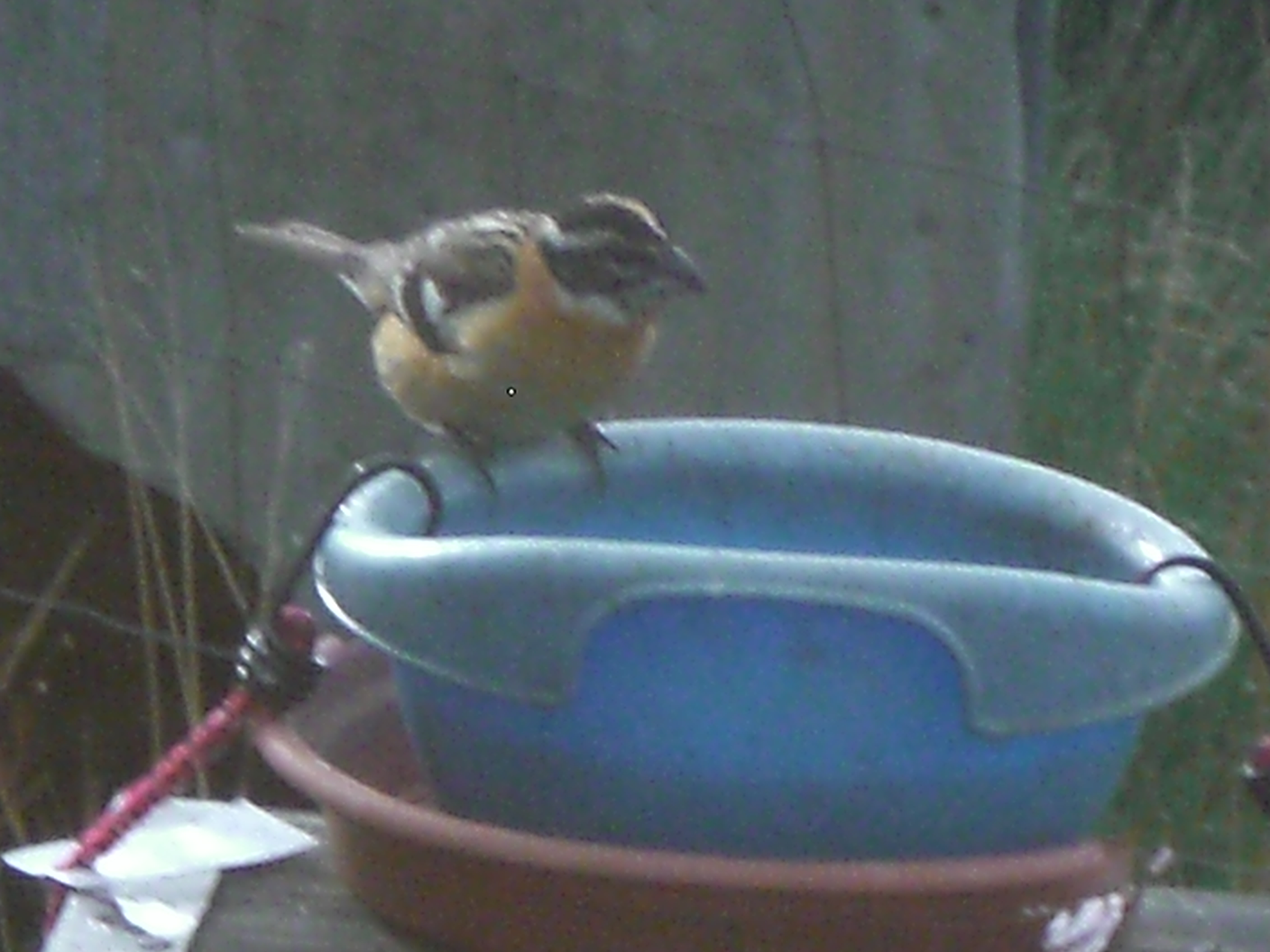
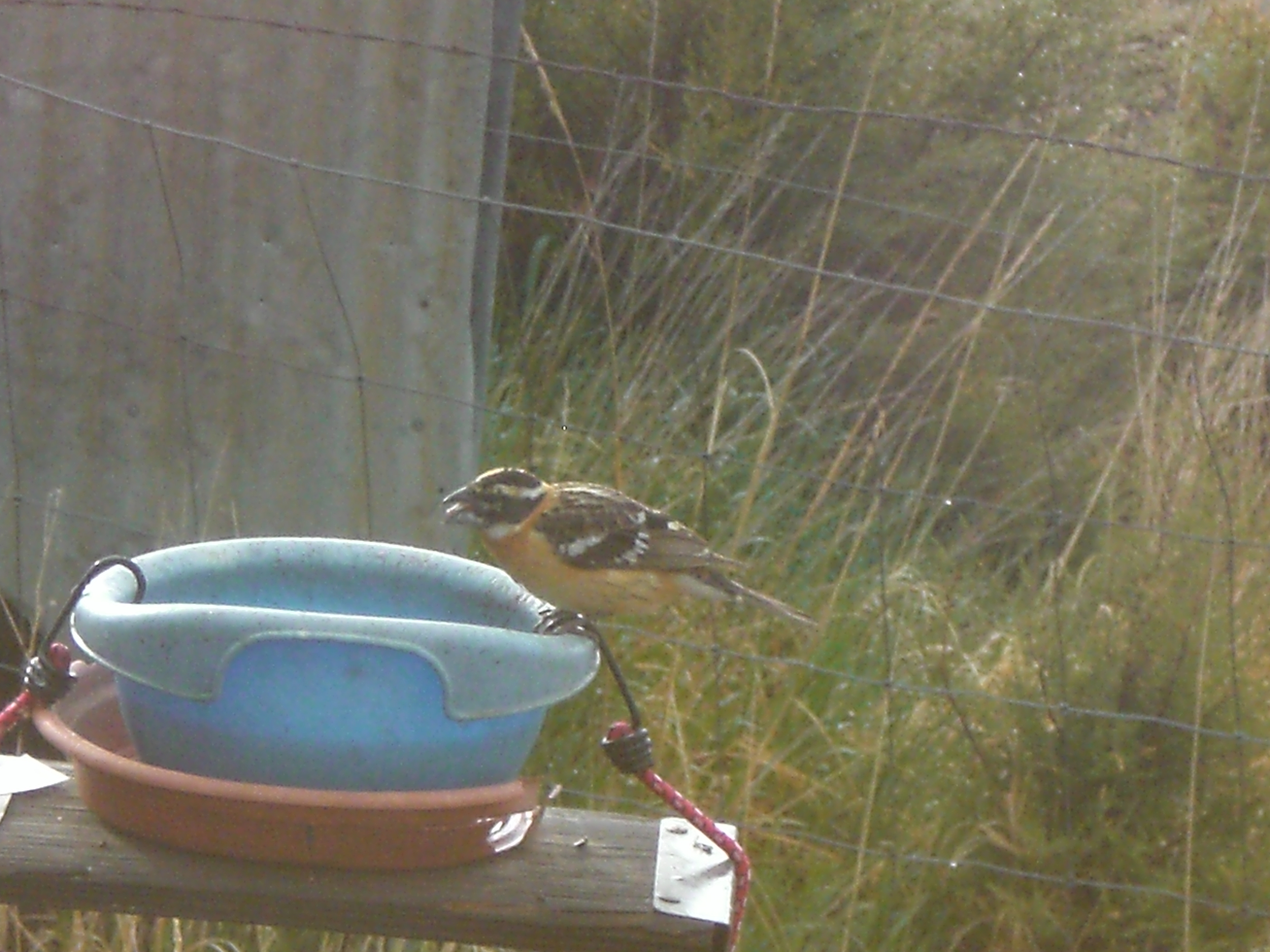
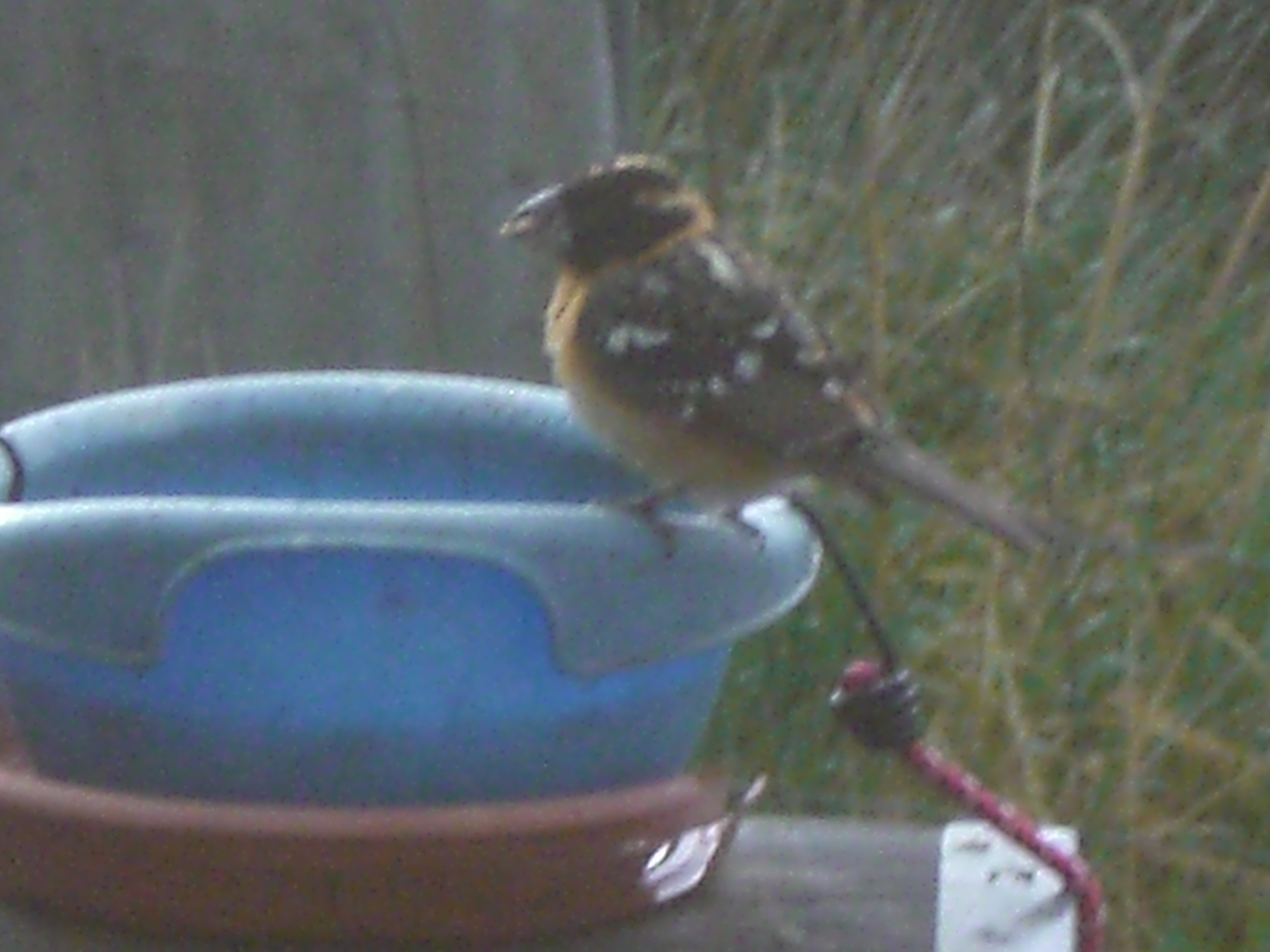
I’ve been seeing a different mid-sized bird at the feeder the past few weeks. Orange chest, tan belly, orange spot on the top of a head striped with deep brown and a bit of white, patterns of brown and white running head to tail on the back.

I am a ?

I am a ?

Can you tell I’m not a birder? I seem to remember having lent my bird identification book out and apparently not gotten it back. At least, it’s not on the shelf where I expected to find it.

Another view

Another view

I do wonder if these new visitors are indicative of a shift in weather (and wind) patterns that has broader meaning, perhaps an alert that we’re resuming the nearly forgotten routine of summer afternoon rains?

Cute, n'est-ce pas?

Cute, n’est-ce pas?

For now, I can only note that my day unfolded with repeated short downpours across a wide swath of northern and central New Mexico, perfectly timed. When I needed to load the car, it was clear. While I ate lunch in my favorite Chinese restaurant, it rained. Shopping in the big indoor mall in Albuquerque, it rained. During the two hour drive home, it drizzled, but when I needed to bring my purchases into the house, it was clear.
Who could ask for more?

The Colors of Sedona

May 18, 2014

In Honor of Khin and Clyde

Driving the long miles across New Mexico and Arizona, from Albuquerque to Flagstaff, the relatively flat and very dry and dusty landscape easily reminded me of the dustbowl years when what is now I-40 was Highway 66. Only as we arrived at Flagstaff did the landscape change to forested hills and high mountains masking the depth of Grand Canyon and other beautiful canyons, down one of which we descended, and descended and twisted to Sedona.

Western New Mexico has red rock terrain, but little or no green. Sedona has awesome red rock sculptures rising into blue sky, lit by a glowing yellow sun, footed in all tones of green. All the primary colors laid one over another. Yes, I know green isn’t primary to artists, being a mix of yellow and blue – but it is one of the four basic colors used for photography and screen printing, and the one least available to me in my usual world, so I insist on giving it an honored place here.

All the Primary Colors

All the Primary Colors

The town of Sedona and its appendages, extensions, and neighboring communities are laid out along twisting roads up and down notable hills, with homes tucked away under trees, behind a screen of brush or otherwise barely visible by day and showing as points of light at night. The main streets are clustered with shops, tastefully similar in style, with wide sidewalks that encourage walking – and climbing the sets of steps necessitated by the hilly terrain. Good exercise to walk off the temptations of hand-made chocolate or original flavors of ice cream.

The wedding I’m here to attend is to take place in one of the campground parks on the southern outskirts of town, a place attractive to the couple, who engaged in many outdoor activities during their courtship. It is scheduled for five in the evening, when the lowering sun promises to make the colors of the environment that much more beautiful. My camera is ready!

Red rock Tower

Red Rock Tower


The site of the wedding is a stretch of flat rock creased with crevices, a small stream flowing nearby. To get there we walked about five minutes along the side of that stream, beneath forested green, enjoying the ripple of water and an area where visitors have, over time, created a rock garden of small piles of stones. The effect was of a temple garden, each cairn a tribute to someone’s wish, or hope or plan. Perfect for the approach to a wedding site.

Along the Shaded Walk

Along the Shaded Walk

Primary colors shone forth once more for the ceremony – light golden yellow in the bride’s dress, red and blue in the groom’s uniform – and green for the backdrop around their red stone meeting place. From these four colors, all others are mixed in photography. From these four colors, all life is given depth and variety. How suitable for the surroundings of a marriage.

Together

Together


May we each, separately and together, find inner harmony and the unique expression of the blending of the colors of our lives.

Random Thoughts

May 11, 2014

What was that nudge to parents from quite a number of years ago…”It’s two a.m. Do you know where your children are?”…

Well, it’s four a.m. and I’m awake and writing.

Not with a coherent topic in mind, but rather with the flow of reflections that has been keeping me from sleep. Starting with the circumstances of a mother and son whom I visited in Taos a few days ago, for my “day” job (the one that has been running seven days a week of late).

The son is a mildly developmentally delayed and very hyperactive boy, youngest of six children, with all his older siblings grown and moved on. The mother is a 350 pound woman requiring constant oxygen, and in severe pain, barely able to stand long enough to move from bed to chair. They live in two cluttered, unheated rooms at the back of an old adobe house belonging to her mother and brother. I don’t want to know what lies beneath the piles of clothing, baskets, blankets and miscellany filling the floor and every corner of the rooms.

She cares about her son’s development, is worried that he has started to be bullied in school, wants to teach him to “man up” and not cry when he is teased (he’s ten). She has managed to buy him a computer, and he is enrolled in Little League, but is only able to participate in a few of the games because mom can only rarely manage to leave the house to drive him to the field. She wants a companion for him, someone to take him out to activities and help him develop a social life.

The day before, I was with a 97 year old woman whose family was gathering to celebrate her birthday. She birthed 17 children, of whom 14 are still living. She is frail, forgetful, incontinent, but cheerfully recovering from a broken hip and with a goal to walk using only a cane, not her walker. And the day before that, my visit was to a thin, grieving, agitated widow who had just lost her youngest brother, the third family death since the first of the year. She is a survivor – her husband had violently abused her, ending only when the shotgun he pulled out to shoot her misfired and killed him instead. She is in constant pain due to a metal plate in her neck, a repair from when he fractured her vertebrae in a prior attempt to kill her. Despite the violence and her recent grief, she is focused on what she can do to help her young nieces and nephews who have just lost their father.

Against such examples of striving for life in the face of dire need, I find it very difficult to be patient with anyone who takes for granted the support, care and concern offered by others.

++++++++

A young friend of mine is getting married this coming week, and I’m taking some leave days to go to the wedding in Sedona, Arizona. I’ve been doubling up on work this past week, in order to keep to the deadlines imposed by the state’s implementation of a new Medicaid model of service delivery. And I’ll be doubling up on work when I return from my four day trip (two days for the travel, two days for the wedding activities). Which is why unfocused issues are floating around in my head rather than coalescing into a coherent essay for this post. Too busy “doing” to “be” with any one thing long enough for it to form a pattern in my mind. “Doobee, doobee, doo” as a friend of mine has said, about the tension that arises between doing and being.

++++++++

I am most grateful for the support now in my life – a daily injection of humor, appreciation, respect, distraction and loving that is a vastly different experience than my mostly solitary path has been. I truly could not do my job, be of service to so many people in so much need, and manage the challenges in other parts of my personal life, were it not for the companionship and partnering I am delightedly experiencing.

++++++++

“When you walk through a storm, hold your head up high
And don’t be afraid of the dark
At the end of the storm is a golden sky
And the sweet silver song of a lark
Walk on through the wind, walk on through the rain
Though your dreams be tossed and blown
Walk on, walk on with hope in your heart
And you’ll never walk alone
You’ll never walk alone.”

A song from long ago, from the musical Carousel

Words to live by.

Have a great week!

Driving into Awareness

April 6, 2014

I am teaching someone to drive – again – no, I am again teaching someone to drive. There, that’s better, more accurate.

The same process of correction, of attention to exact explanation is required of me as the driving teacher (not driving the student hard, but teaching the student the art of driving). And it is as much art as science. Getting the feel of the vehicle, of the wheel, of how the car wants to straighten itself out from a turn so that trying to do the straightening produces an over-correction. Learning to position oneself in the lane, noticing important warnings of the intentions of other drivers, processing what one sees and hears without needing the time to consciously think it all through. Driving, especially in traffic, requires quicker responses than conscious thought permits.

I am, again, teaching someone to drive, and valuing this opportunity to become conscious of what I do instinctively. Valuing, also, this occasion to notice not just what I do right, but what I’ve gotten a bit sloppy about, and don’t want to continue to do, now that I need to be a role model of safe, defensive driving.

My daily spiritual practice is essentially an exercise in shutting down thought, in order to become aware of the subtler levels of my being. Very close to what I must do to teach someone a skill at which I am so practiced that I conduct the activity beneath the level of awareness and thought. When I come out of my daily contemplation, I often bring a new insight with me, into consciousness, then do my best to put into words and actions what I’ve been gifted to perceive. Very much like the way in which I am opening to the subtle habits ingrained by so many years of driving, and attempting to give voice to them in order to instruct my student.

So teaching someone to drive is a spiritual exercise! Or at least it can be, if one chooses to make use of the experience for one’s own growth in understanding. And in patience. And in trust.

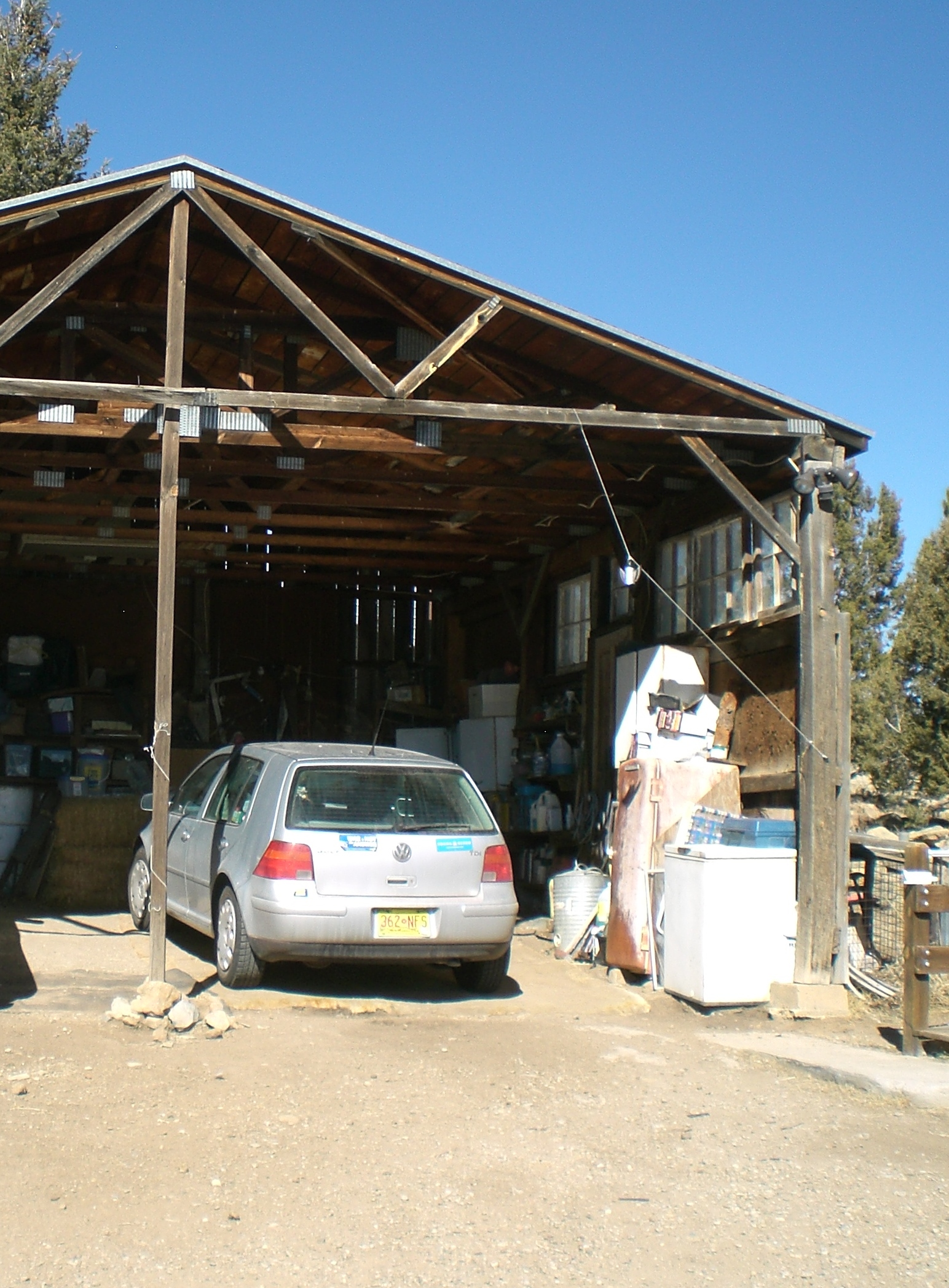
The vehicle being used is my ‘second’ car – the back-up GMC that serves as my guarantee of transport should my trusty and trusted and much loved VW Rabbit ever fail me. (It has not done so, as yet, in ten years and nearly 220,000 miles of mostly solitary driving). I’ve realized already that I would be far more tested were I to be giving the lessons in the Rabbit. Not just because it’s a stick shift whereas the GMC is automatic. I have virtually lived in the VW; it’s packed with all that’s necessary for me to survive through a snow storm, hunker down to wait out a dust storm, take advantage of an unexpected opportunity to camp out overnight, be appropriately dressed for sudden changes in weather, provide roadside first aid in case I come across an accident… you get the idea.

Resting at Home

Resting at Home

My Rabbit has become far more than reliable, reasonably inexpensive transportation. It’s home away from home, an important means of connecting me to the world, a key element of my ability to earn my living and, because Rabbits remain relatively uncommon on our roads, a distinguishing mark of my presence. Not so long ago, I needed to let a mechanic drive the Rabbit so he could feel in the steering what I sensed was a developing problem. Sitting in the passenger seat as we went around the block was one of the harder things I’ve done recently.

Sitting in the passenger seat of the GMC has not been difficult. I don’t have much history with the Envoy, and my student is both a quick learner and a careful driver. The challenge for both of us is that he grew up using public transportation, not riding in cars, so he still has to acquire the non-verbal, body sense of what driving a car is all about. It’s not at all the same as riding a motor cycle, which he has done.

I’m also familiar with riding cycles – not driving them, but happily sitting on the back, free to enjoy the wind in my hair and the scenery flashing past with an immediacy totally lacking when one is shut inside a car or truck. I used to get the same sense of connection with my surroundings when I rode my horse out through the gate of my property and into the extensive acres of my neighbor’s ranch. A brisk canter to the far fence shut down thought and opened up my inner world. Yet another form of spiritual exercise.

Perhaps I should suggest to my student that he do a short contemplation before his next turn behind the wheel? Most physical skills come more easily when one relaxes into them (think of learning to float in order to swim). Those same skills suffer when one over thinks them (tensing up in the water, and sinking). Riding behind on a motorcycle, one has to relax and let one’s body bend with the curves in concert with the driver. Up on a horse, one must become one with the rhythm of the horse’s gait. Behind the wheel of my Rabbit, I feel in tune with every nuance of the vehicle, I know that car as if it were alive.

How does one teach that sort of awareness?

Hearing one’s True Voice in contemplation and then living from one’s Divine Self are, like driving a car well, skills which cannot be mediated through the mind. These skills cannot, therefore, be taught. They must instead be caught by the student, who first observes them being modeled by a teacher and who then, by trial and error experience, learns to shut down the mind and respond from a wise and capable Soul.

Inner commune, connection, inspiration, followed by action – the sequence of a spiritual exercise – is also the sequence many artists describe as their process of creation. Learning dance choreography many years ago, I was told by Miss Widener to stop thinking about my composition and instead to just feel my way through it. Yesterday I asked my student if he could feel how to respond to the impact of wind on the Envoy’s steering. Today I am challenged to create, with words, a feeling of intuitive understanding in my readers.

Do I evoke an “aha, yes, I am aware of that part of me?”
Do you go there, learn, trust, respond, live from that core? Yes? Then I’m happy for you.

If not, or not yet, teach someone to drive – or ride a bicycle, redecorate a room, weave a rug, or work with wood. As your student learns a new skill, you’ll gain a new level of awareness, and enjoy a new way of Being.

Japanese Rituals and Tea

March 16, 2014

A dear friend commented on my essay on English tea, that this elaborate meal is very different from an Asian tea – leading me to consider my experience with traditional Japanese tea ceremonies. The first time I benefited from participation in this ancient ritual I was not quite thirteen years old. My mother and I were traveling from the U.S. to Vietnam by ocean liner, a zigzag course from San Francisco to Hawaii to Osaka to Manila to Hong Kong, where we were to land and meet my father for the last leg by plane to Saigon. My mother got bored with life on the ship and decided we should get off in Osaka, and spend a week in Japan before flying to Hong Kong.

Not one to enjoy noisy, busy cities, I found Tokyo interesting but overwhelming. In particular, an hour spent inside a large department store left me feeling frazzled, and as though I were picking people out of my hair and off my skin. Near to the store was a public garden and within the garden a large building which proved to be a cultural museum. Just at the time my mother and I arrived at the entrance to the museum, a young woman in a beautiful kimono announced that a tea ceremony would begin in five minutes. Joining the group that followed her, we walked into a spacious central room where we were invited to be seated on cushions on a tatami floor. In rows, facing an open area, we waited, some talking quietly until the hostess politely shushed everyone.

The walls and ceiling were carved wood, decorated sparingly with niches containing a vase, or a statue, or a calligraphy scroll. The impression was of richness but also a quiet simplicity. Despite being part of a relatively large group (we must have been thirty people) I felt as though a space had opened around me, allowing me to relax and expand. Perhaps it was the size of the room, or its dimensions that created the sense of airiness which I found so soothing.

The tea master entered silently, gliding to his place facing us, a low table and a brazier arranged so as to be within easy reach, yet artistically angled to present to us, his guests, a broken line reminiscent of waves breaking across the tatami sand. The master bowed to us, and we somewhat raggedly bowed back. That is, the Japanese in the group bowed gracefully and in unison – we few Westerners belatedly realizing what was expected, followed as best we were able.

The hostess knelt to the side of the tea master, again gracefully angled to enhance the pattern presented to us. She passed items to the master in perfect rhythm with his movements, and without any visible requests. I concluded that she knew the ritual as thoroughly as he did. Each gesture of each of their four hands was controlled, graceful, careful and complete – a dance of fingers wiping bowls, rotating the tea canister, positioning the kettle, showing off the items used to scoop the tea powder, to stir it, and finally rotating the bowl of tea to present its most beautiful face to the guest for whom it was intended. In turn, the hostess brought a bowl of tea to each of us, then returned the drained vessel to a row behind the master. When we had each had our few sips of thick, bitter, refreshingly energizing, green beverage, and all our bowls were lined up facing us, the hostess and master bowed to us and we – this time collectively, no laggards – bowed back.

The master rose and left the hall, and the hostess signaled for us to also stand. The Japanese rose gracefully while we Westerners found our own, often inelegant ways to our feet. We were escorted back to the entrance hall of the museum, and quietly invited to tour the rooms, which included ancient tea ceremony implements, and gorgeous kimono. I did my best to carry the silence, the stillness, the ritual formality and peace of the ceremony with me as I studied the displays. I still remember how tempted I was to scold the few Western visitors who burst into conversation near by, criticizing the tea as not being what they expected, barely drinkable, not something they would ever willingly have again.

Unlike with English teas, which I’ve enjoyed many times in many lands, I have only experienced that one fully formal Japanese tea ceremony. An acquaintance who married a Japanese, and lived many years in his family home, recently invited me to a tea ceremony that she arranged for a small group of friends at a lovely gallery in Albuquerque. The rituals of turning and admiring and wiping the bowls, of slow-moving hands doing a dance with the tea implements, were familiar despite the many long years since my visit to Japan. At the same time, I was aware of the difference between the formality of the museum ritual, and the “welcome to my home” informality of the ceremony in New Mexico. What they had in common was the creation, through gesture and tradition, of a sense of peace, harmony, stillness, contemplation.

I left the museum on that long ago day, better able to exist within the rush and burble of humanity surrounding me. The ceremony created within me a place of quiet and privacy to which I could retreat, and which I could to some extent then carry with me out into the rest of the day. I’ve learned in later years that other cultural customs also developed in Japan, to provide a sense of privacy to people who live in close proximity, in rooms divided only by paper. For example, the occupant of a room must acknowledge someone who enters before the latter may speak. If unacknowledged, the visitor knows to silently withdraw. Only if the reason for entering the room is of grave importance will the visitor remain, still and silent, until an acknowledgement is offered.

Living most of my life in a very different culture – one that seems to rush to fill any silence with words or music or some sort of noise – I’ve chosen to live in a rural location, in a small house with many large windows that minimize my separation from the trees, grasses, birds and wind surrounding me. Within this retreat I enjoy tea, sometimes green, often strong and black, which I drink from a hand crafted mug. I have my own rituals – the water must be boiling, the tea of good quality, the pot a pretty one. Neither English nor Japanese, nor the Russian of my father’s tea preference, but a blend of all three and a link to cultures and countries and lives I’ve been privileged to encounter.

In Full Glory

In Full Glory

Dayenu

March 9, 2014

Have you noticed how subtly, but pervasively, some of us become conditioned to be happy with crumbs, accepting far less from the banquet of life than we may want, or even than may be available?

In my case, I recognize that this training began in my earliest childhood, as the result of my mother’s severe psychological problems. Anything I looked forward to, anything I really wanted, she found a way to make unpleasant or to turn into an unhappy experience. You think your birthday should be special, maybe a few playmates over for a small party? Think again. “I don’t choose to accept responsibility for anyone else’s children in my house.”

If I admired some small item in a shop window, wishing someone might think enough of me to buy it for a present, I might very well find it at home – on my mother’s dresser, after she bought it for herself and preened over her lovely new figurine. Primary school graduation, all the girls dressing up in pretty new clothes and patent leather party shoes? “It’s a school day. You wear your sturdy Oxfords, no buts and no arguments, do you hear me!”

I learned to be grateful for a day without being repeatedly slapped, for an hour alone with my grandfather, just going for a walk around the neighborhood (“You haven’t earned the right to go to the zoo with him this week, you’ve been far too much trouble to me”). I learned to accept that only grownups got new clothes from the store; mine were roughly sewn together from one of three basic patterns and handed to me with, “I worked hard to make this for you, don’t you dare complain that it looks like all your others. It’s a different color. That’s more than enough. The children in Africa are lucky if they have any clothes at all!” Those children in Africa were lucky if they had food, or a warm bed, or a place to get out of the rain, or…

I wanted to visit those children in Africa, to see if their lives were really so bad. Somehow, even at only five or six or seven years of age, I suspected that many of them had loving parents and enough to eat and maybe they even got presents sometimes, and hugs and kisses instead of punishments.

If we’re diligent about maturing, about taking responsibility for ourselves and who we become, we grow out of a variety of early conditions to become decent, engaged, thoughtful people. We stop blaming our bad decisions on our parents’ inadequacies, we learn from our mistakes, and we move forward. But underneath, all too often, we retain a fundamental attitude that we must feel satisfied with crumbs.

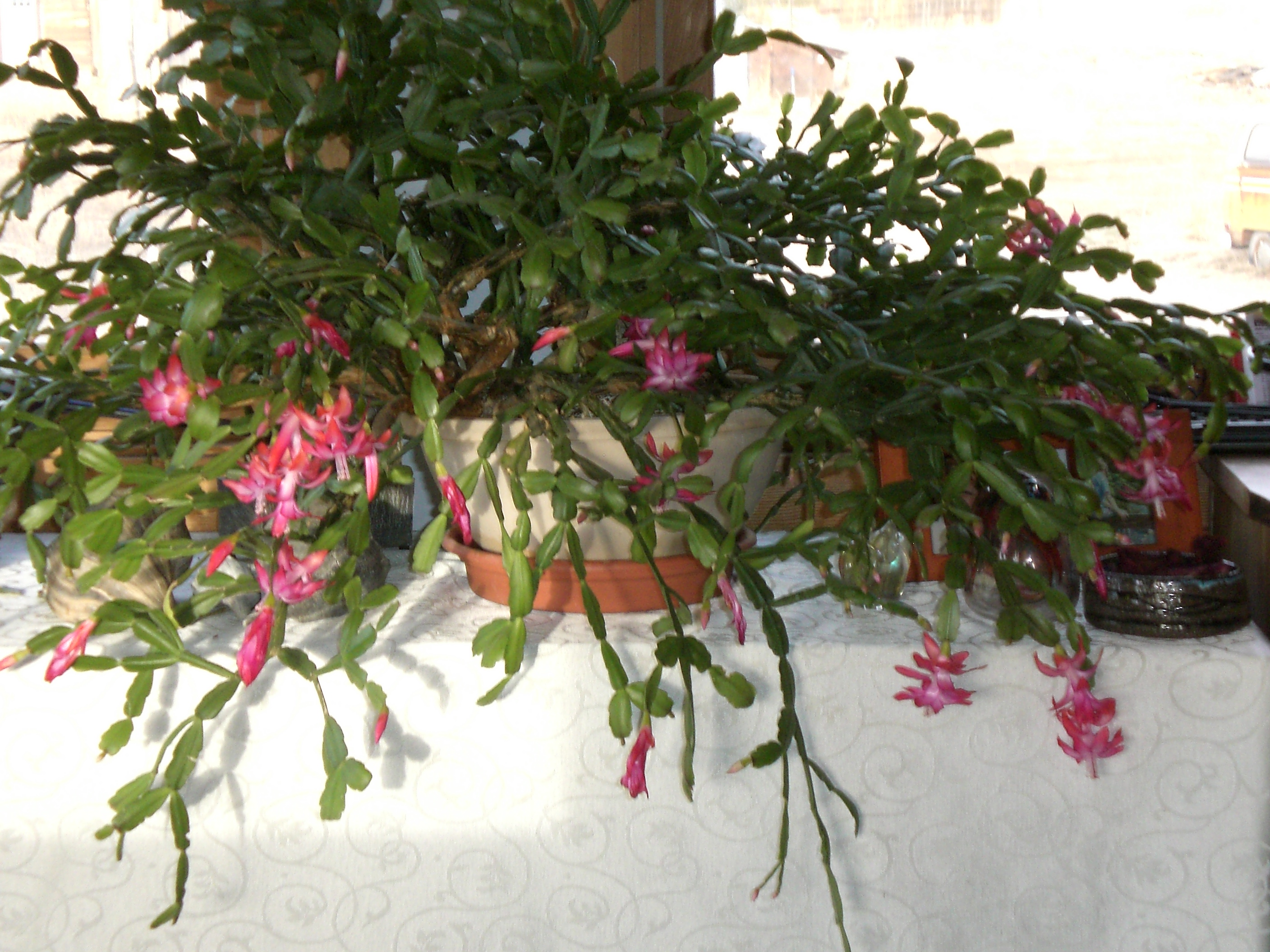
Don’t misunderstand – I fully support approaching each day with “an attitude of gratitude” for the many small positives to be found in it. I’m amused by the antics of the rabbits in the pasture. I smile at my confused (or misnamed?) Christmas cactus which stayed plain at that holiday, but is now flowering for Easter. I’m quietly, inwardly thankful for the opportunity to work once more at a job I enjoy, after years of toil in a less rewarding environment.
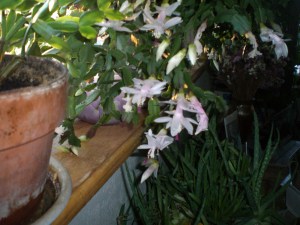
At Easter

At Easter

At the same time, I recognize that I spent many more years in that previous, stressful workplace than perhaps I “should have” done, because I was (am still?) conditioned to accept a small salad plate from life’s banquet rather than grabbing a big dinner plate and seeing that it is filled. The latter behavior is so often called greedy, selfish, and thoughtless of the needs of others.

If what one is going after falls in the material world – money, possessions, power – then yes, trying to get as much as possible for oneself may well be greedy and selfish. Lord knows I can’t comprehend how people already making hundreds of thousands of dollars a year can think they are also entitled to bonuses! Some, like Bill Gates or Michael J Fox, turn around and give back a generous portion of what they acquire, and thereby help the rest of us. I am thankful for them, and their charitable foundations. Too many others grab for, demand, and keep outrageous salaries, even insisting they be paid after they’ve been asked to resign. The public face of this activity is labeled “buying out a contract.” I think it is purely obscene. We working folks who don’t perform to standard get fired, not paid to leave. Why should it be any different just because one has an exalted position with an already very generous pay rate?

But I’m not talking about the material world, when I say we’re conditioned to settle for less. I’m not even talking about the emotional world, or the necessity of accepting that very few relationships are perfect, that we cannot count on another to “make me happy.”

I’m reflecting instead on the extent to which we cut ourselves off from fulfilled happiness by telling ourselves we do not need, are not entitled to, don’t have the right to, should not want or expect that fulfillment. In a portion of the Seder, the Jewish celebration of Passover (and the ritual being observed by Jesus at the Last Supper) a litany of blessings is recited, and after each step in the path to freedom the sentiment is expressed “Dayenu = It would have been enough.” If God had done just X, it would have been enough. If God had done just X+Y it would have been enough. If God had done just X+Y+Z it would have been enough.

I learn from this ritual that being grateful for what I have need not prevent me from welcoming more into my life. That I want more does not say I don’t value what I have. Only the subtle, pervasive, underlying conditioning of unworthiness so many of us have absorbed dictates that I should not try for gold, now that I have silver in hand.

I have silver, and rubies, and ambrosia, a wealth of gifts of the spirit. Dayenu. I appreciate how much that means to, is sought after by, people who have less. I happily share my blessings as best I can. And I’m going for more.

Reaching for a full platter does not mean I appreciate my present plate any the less. It does mean I’ve decided not to hang back, not to duck and cover, not to “settle” before I must do so. Maybe I’ll trip. Maybe I’ll fail. Maybe I will, in the end, have neither gold nor silver. But as a former prisoner and student of mine once wrote, “Mighty Casey, he struck out. What does it feel like to get into the game?”

I’m going to find out! And whatever the outcome, it will be enough. Dayenu.

A Piece of a Past

March 2, 2014

Dear Much Appreciated Readers:

I have driven something over 600 miles between Wednesday morning and Saturday afternoon of this past week, reflecting a busy-ness that has left me no time to write. Please accept as this week’s post, a short essay I wrote last year and stored as a back-up piece, to be used in just this sort of situation.

A Memory of Tea

The first English tea I remember having was on the lawn of an elegant house in Victoria, British Columbia. My mother and I were on our zigzag way from Washington DC to join my father at his post as an economic officer at the U.S. embassy in Saigon, Vietnam. Back before anyone in the U.S had even heard of Vietnam. Just after that country’s successful fight for independence from France. I was twelve.

We children had just finished up a game of croquet. Tea included jam tarts and my first encounter with scones and cream. I remember the tea cups had roses on them, and were of such delicately thin china that the late afternoon sun shone through them. My mother gloried in experiencing a scene that could have come from her favorite Jane Austen novel. I gloried in the fact that she was, temporarily, enjoying herself, with her attention distracted from its usual petulant unhappiness with everything, including me.

My next English afternoon tea was in steamy Saigon, at the home of the British ambassador. His wife had taught her Vietnamese cook to make the pastries and scones, but there was no cream available. Tinned milk did not substitute. We ate the scones with a thick, rich marmalade instead.

I don’t recall having a proper tea again until some five years later. A friend of my father’s (both left Germany as young men, my father to settle in the U.S. but Eric to establish himself in England) had become a successful surgeon heading a hospital outside Sheffield. My parents were taking a driving vacation through southern England, from my father’s posting in Paris. I needed an operation on my wrist. “Uncle” Eric and his wife Hilda came down to collect me, welcoming me to their home with a full high tea served in their lovely back garden. How quickly did I learn not to insult the flower-filled space by calling it a yard (as it would be in the U.S.) And how quickly I also learned not to insult “Aunt” Hilda’s special face flannels by calling them by the American term wash cloths! I remember the Sheffield tea was served in pottery mugs, and the meal which accompanied them had a meat and cheese pie and salad, in addition to its pastries and scones with jam and cream.

Returned to the U.S. for college (university, to a Brit) and graduate school, I eventually settled in northeastern New Mexico, over 7000 feet high up in the foot hills of the Rocky Mountains. High plains desert landscapes, mostly brown – especially in the past ten years of drought – fit better with rodeo cookouts than English tea. Until my friend Anne Bradford arrived in town, to open The Carriage House Bed and Breakfast and offer afternoon tea. She made them fancy, a multi-tiered sandwich and pastry tower for each table, choice of at least three different types of tea, sausage rolls and cucumber sandwiches, scones with cream or jam, and strawberries. Her collection of teacups decorated the public rooms of the huge Victorian house, when they weren’t part of the meal service.

Anne grew up in Ardingly, in Sussex, and managed an elegant hotel in San Diego, California, before moving to Las Vegas, New Mexico (the original Las Vegas, the old one dating back to the 1600s, not the new gambling center in Nevada). Obviously adaptable herself, Anne succeeded in making traditional English teas seem perfectly appropriate to the old Southwest. They became a popular way to celebrate a birthday, graduation, or other special event. And they became a taste of home for the students from Great Britain who attended the United World College (UWC) located in nearby Montezuma.

After Anne closed the B and B, and went to work for the Plaza Hotel, she continued making teas available. For the birthday of one of my staff, we all dressed and celebrated in the hotel’s Victorian elegance.

Tea at the Plaza Hotel

Tea at the Plaza Hotel

We were among the last groups to enjoy the event before Anne left the hotel – which subsequently changed ownership.

Now, when I welcome UWC students, I fix tea in my own home. The atmosphere is far more casual, and the meal is possibly less authentic. But we do have pretty china cups, sandwiches, and plates of scones and cream. And we share my memories of a tradition that continues to span the world, linking anglophiles in jungles, in deserts, in vintage homes and in commercial hotels. Linking Sapello, New Mexico with Sheffield, England and all the far flung places where afternoon tea has been – and often still is – enjoyed.

Being Present

February 23, 2014

As I woke this morning, three little puffs of cloud – the only ones in the sky – were framed in the window at the foot of my bed. I lay watching them through the leaves of a night-blooming cereus plant, waiting for the sun to come up above the eastern hill and finish lighting the sky. The clouds seemed immovable, virtually unchanging in what is obviously a windless day. Then, just as the sun began to shine directly into the east window, the puffs merged into one larger pillow, rising up and out of my sight. When I got up to look for what remained of them, the white fluff had thinned and was disappearing against the lighted blue background of a clear morning sky.

I’ve reflected on snow, and last week on the howling wind. This morning of remarkable stillness seems to be a special invitation to stop and consider the hectic pace of my recent weeks, not only of work but in my private and inner life as well. Never one to rush into new situations, new relationships, I have been meeting three to five people (clients) a week, and getting to know them and their family members quite intimately. Drawn into helping them access services which will resolve serious problems they are facing, I am exposed to the challenges and rewards of life in a very personal way that reveals how nothing stands still, even when we feel as though nothing is changing.

First gifts

First gifts

Several small birds have appeared in my long picture widow, flitting around one juniper tree, and two neighbor dogs have just trotted into the pasture, sure to initiate a barking greeting from my ever-vigilant min-pin Doodles and his woolly poodle companion, Warrior. The sun now slants directly into the window at my side, forcing me to lower the shade in order not to be blinded. Small changes – an inch of rise of the sun, a flutter of birds – and the day has shifted. A contrast to the experience of focusing on a single issue – such as finding a job, or getting a driving license – when it can seem as though nothing changes day after day because the single object of focus and desire is not obtained.

One of the greatest gifts from my MasterPath instruction has been an increasing ability to notice the small differences and changes occurring during periods of waiting for some larger event. My Teacher speaks of the need for certain karmas (external situations) to exhaust themselves in our lives, stressing that spiritual growth need not be delayed until after XXX (I get sober, I am able to retire, I find a job). How one views one’s days and the way one approaches the occurrences of each day are both the means and the opportunity for growth. In that light, the AA injunction of “one day at a time” is an important reminder that life is lived, and changes evolve, not in some distant future, but here and now, day by day.

Wisdom of my Teacher

Wisdom of my Teacher

It seems as though my recent spiritual lessons have emphasized not just one day at a time, but one hour, sometimes one minute – bringing out how malleable time, or one’s perception of time – can be. I began with a comment about the hectic pace of my recent weeks, yet that pace only seems hectic when I look at how few days I’ve spent entirely at home, compared to pre-job weeks of days when I didn’t leave the house. If I count how many trips I’ve taken to different communities, how many new clients I’ve met, how much driving around the countryside has filled my recent weeks, I can feel as though there has been no time for me, no time to reflect, to write, to evolve. On the other hand, I remember that I noticed snow geese amongst the Canadians by the pond near town; watched a hawk catch a rabbit on the prairie outside Roy; learned more about Cameroon from stories shared during some of the longer drives; observed the relaxation of a tense body as a harried son who gave up his job last fall, to care full-time for his disabled mother, learned from me that he could have income within a month, being paid to provide that care. I remember these small moments, and time stretches.

Hectic, for me, is when I feel as though events have been rushing at me with no time to consider them, to notice details, to organize and structure experiences or – related to my new work – to prioritize what must be done. From that perspective, my commitment to myself to continue to post weekly is a commitment to limit the hectic pace the job could demand. At least once a week I must stop and reflect, and in this moment’s case, realize that I also stop and reflect frequently throughout each busy day. Noticing the geese, the hawk, the easing of tension are moments of reflection, of being present rather than reaching forward to an as yet non-existent future.

Only Canadians, no Snows

Only Canadians, no Snows

My mind has challenged the idea of being present with the moment when that moment is perceived as difficult, painful, scary or otherwise negative.

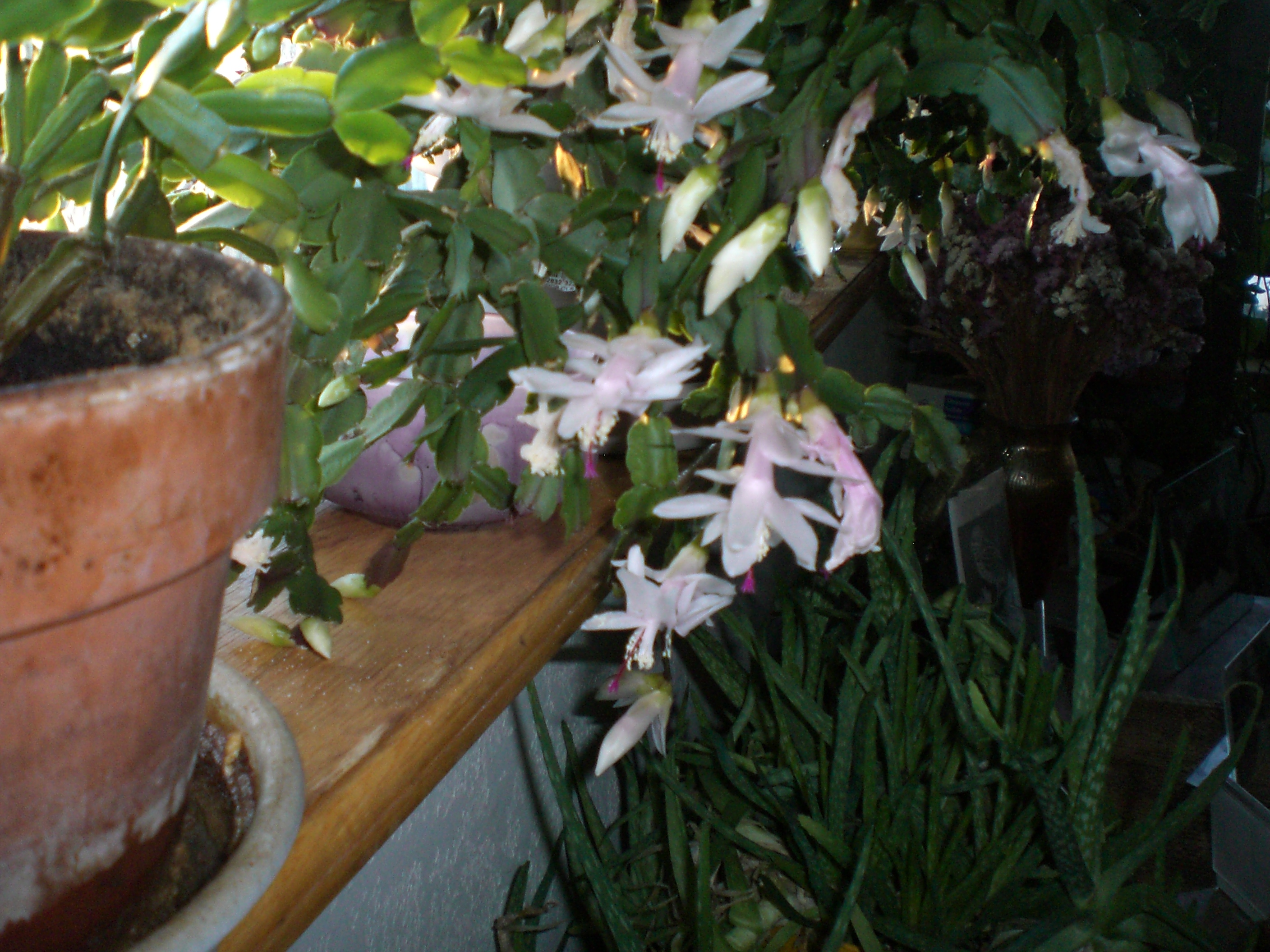
Why would one want to be fully present in a recent day of flu-induced aching and nausea? The lesson mind needed to learn was that during that day, other things were also occurring worth noticing, worth being present with. During that day, my one large dog, a retriever-cross named Blackjack, stayed on the porch and insistently close to me rather than spending his time as he usually does, out in the pastures. During that day, cotton tails appeared three separate times in the pasture. During that day one Christmas cactus put forth a single white flower, though the plant had never bloomed before.

On a recent day when I was physically exhausted but nonetheless had to drive 80 miles of winding roads on an urgent visit to a client, I was gifted to have a companion for the drive, and to receive the encouragement of expressed appreciation for my effort, from both the companion and from the client. I also saw multiple frozen waterfalls glued to rocks in the canyon through which I drove, and remembered and shared the story of a triple rainbow that had filled one field when I traveled that road in the past.

Little things to be present with. Little things which, accumulated, become large, become the frame and the tone and the import of each day. Again, my Teacher instructs that we are always free to choose what we give our attention to. Attention is food – what is fed grows. I choose to feed appreciation, present moments, what is. In such small steps, with present moments of attention, what can be is also fed, given form, and enabled to appear.

Baraka bashad.
Amen.
May the Blessings Be.

Letting the Wind Blow Through

February 15, 2014

A friend just mentioned he’d enjoyed my reflection on snow, bringing to mind the gorgeous silence of that recent morning, a stillness in dire contrast with the roaring, shaking, blustering, hollering wind blasting my home tonight. Gusts over sixty miles an hour have been hammering at us for five hours now; fortunately the general temperatures were warm enough today that the blasts are not unduly chilling. At least not chilling in temperature. But those who are made uncomfortable by wind can find our New Mexico spring weather intimidating. Tonight’s blasts are not unusual. A little early in the year perhaps, and lasting later into the night than normal, but very familiar nonetheless.

When I was fifteen I wrote a poem about standing up to wind, not a very good poem though the underlying thought was worth the effort. It had been triggered by standing on the edge of a precipice, at Les Baux in southern France. The town sits atop what here in the southwest we’d call a mesa, overlooking a broad plain called the Val D’Enfer. Reputedly the Dark Ages lords of Le Baux forced trader traveling through the valley to pay tribute – often exorbitant tribute – for safe passage, making the traversing of the plain a veritable descent into hell. My poetic effort attempted to recognize the strength it takes to stand up against a powerful wind, and the strength it took for travelers to risk passing near Les Baux.

I’d prefer more quiet tonight, to assure a better night’s sleep. It’s been a very long, productive but tiring day. If wishes were horses, beggars would ride… so says the adage that echoes in my mind wherever I let myself dwell on what isn’t. So instead, I’m using the blasting wind as a motivator to write this week’s post. We’ll have to see how the essay turns out! Smooth and slick, or choppy and irritating? The wind is both at once – will my essay mimic the wind, or express its essence?

“Love me, love me, say you do.
“Let me fly away with you.
“For our love is like the wind,
“And wild is the wind, the wind,
“Wild is my love for you.”

The most recent theory, from a study in Germany, of why older people take longer to respond to memory tasks, is not that ability fades with age but rather that there is so much more stored in an older person’s brain, it takes longer to sort through everything to find the relevant bit of information. I like that explanation, not just because it is more flattering. I like that explanation because it takes into account all the bits and pieces of song lyrics, like the one above, that pop out of the storage cabinet at mostly – but not always – appropriate times.

Say the word English, and I’m apt to begin quoting, “Her English is too good,” he said, “which clearly indicates that she is foreign. Whereas other people are instructed in their native language, English people aren’t.” And on and on, in Rex Harrison’s voice. I learned the entire performance of My Fair Lady when I was eight. Don’t ask me why, and don’t ask me why it’s still all there in the lumber yard storage of my brain.

That’s the term that was used, disparagingly, by the wave of neurologists who discarded “old” brain storage theories in favor of computer-link images that propose an entirely different set of rules for how our brains perform our thinking and memory functions. That new set of rules is the one that posited an eroding of capacity with age. One more reason I stand in opposition to all the supposedly “better” connectivity and computer-based emphasis of our “modern” world.

Inventors create a new toy and suddenly scientists see everything through the lens of that new technology. Wisdom of centuries is derided, practiced ways of relating to the world and to one another are treated as out-of-date. All theories, all explanations must fit the new paradigm.

Until a brave soul stands up and says “no” to forced conformity to what is new. Until a study from Germany says older brains are just as efficient as younger ones, but they have more data to process, more varied possibilities to consider, and so take longer to come up with answers. Until I suggest to a friend, who has been angered by a phone call wakening him at 3AM, that he can, in fact, turn his cell phone off when he wants to sleep.

What a novel idea to the ethos of today – to be disconnected!

In the midst of the wind storm, I am barraged with sound. Fortunately, I know the storm will pass and it will become quiet again. I really can’t conceive of living in the middle of a non-stop gale, any more than I can relate to those people who live constantly connected – mobile phone always on, always at hand, computer permanently turned on with multiple pages open, Youtube, Facebook, LinkedIn and Skype all demanding attention.

There are reasons to be available to others. If one is living far from home and family, computer connections bridge time zones and allow relatively inexpensive contact. The nature of my present job is such that I must be reachable in emergencies. That doesn’t mean all clients can call me twenty-four hours a day, however. They call a central, toll free number for triage. Only the true emergencies are put through to me in the late, or early, hours of a day.

Connectivity, like the wind, has its season. I do hope that before the passing of all those of us who have lived when (or where) there was not a phone in every home, those born to the age of connectivity will have tired of disrupted sleep and life in a fishbowl. I do hope for an opportunity to teach the continuing values of concentration, of solitude, of silence, of windless days and of attention to one thought, one person, one experience at a time.

*****

Awakening this morning, I first register the silence. The storm has passed, the wind abated. A new day, and new environment surround me. I appreciate the renewed quiet, the ability to focus inward before joining the network of souls who will make up my work day. And I’m happy to think that, now that a research study has been published which respects older brains, perhaps some of the thoughts and beliefs dwelling in those older brains will also be given new respect.

Wouldn’t that be a novel and pleasant experience!


Only Fragments

Love Letters to the Tar Pit

KarusaaVerse

Words that Sparkle, Thoughts that Ignite: Fueling Your Imagination

Leaf And Twig

Where observation and imagination meet nature in poetry.

Millarson Diaries

Personal Musings and Thought Experiments

The Beauty Along the Road

Discovering Beauty in the small details of our lives

Flowerwatch Journal

Notes on Traveling with Flowers

1eclecticwriter

Wide-Ranging Commentary

Spirituality Exploration Today

Delving into the cross roads of rationality and intuition

smilecalm

Life through Mindful Media

A Good Blog is Hard to Find

I will shatter a word and scatter the contents into the wind to share it with the world.

Ray Ferrer - Emotion on Canvas

** OFFICIAL Site of Artist Ray Ferrer **

AKA The Versatile

Fashion | Lifestyle | Food & Travel | Beauty | Fitness | Education | Product Reviews | Movies | Doodling | Poetess

Aging Abundantly | Women Over Fifty | Empty Nesters | Caregivers | Aging Gracefully

Finding Joy at Every Age with writer/philosopher Dorothy Sander

ARTZZLE

Helping with the Pieces in Life's Puzzle of Art and Design

Project Light to Life

A bucket list blog: exploring happiness, growth, and the world.

The Daily Post

The Art and Craft of Blogging

Any Shiny Thing

MIDLIFE MAGIC

allmostrelevant

@allmostrelevant

The Irrefutable Opinion

Assaults on the Casually Mundane by K. Jean King