Posts Tagged ‘parental conditioning’

To Heal a Tummy

January 11, 2015

The weather has been on a crazy whirl this past week – sunny and a spring-like sixty-five one day, icy twelve degree fog the next coating everything in sheaths of white rime. Then another warm day melting it all, to be followed once more by ice rime and black-ice accidents on the highways. We’re projected to have several more of these mood swings in the next week, around which I am trying to plan my work-related travel.

I regularly go up over the mountain (part of the Rockies) from my home to Taos. I have to accommodate my planning not only to the fluctuations of weather as I experience them where I live, but also as they manifest quite differently on “the other side.” Just last week, I spent a warm and lovely day seeing clients in Taos, and did not know it had been a fogged-in and icy day at home until I came back over the ridge in the late afternoon, and looked down onto clouds.

Above the fog

Above the fog

Bodies react to these unpredictable changes in climate. Old injuries begin to ache, remnants of bronchitis flare, sinuses swell and congest, even tummies become sensitive and refuse to function properly. There is a very direct cause and effect for the bone and joint aches – heat soothes and cold aggravates these types of reminders of past incidents. To the extent that the warmth releases pollens, chest and sinus irritations can also be understood as directly related to weather. But tummies?

I’m one of those who are most sensitive to what affects tummies. Mine has been – my husband sweetly calls it fragile – since infancy. I’m more inclined to use harsher words, like irritable, aggravating, infuriating. It’s definitely where any and every stress lands. My mother complained to all who might sympathize, that the only formula I could tolerate as a baby was one which required a great deal of work – a complicated process involving twenty-four hours of advance preparation and multiple periods of cooking. I also had many food allergies, and did not outgrow them until I was well into my teens. Some I have retained all my life, in the form of sensitivities I’ve learned to recognize.

Some days I can eat eggs, other days they make me very sick. And I react horribly to the ‘flu vaccine, incubated in eggs. I love fresh tomatoes, but have to moderate my consumption, and must avoid most cooked tomato products, like spaghetti sauce. Thankfully, I can usually enjoy strawberries, and most thankfully I’ve never, as an adult, re-experienced hives from eating hard-shell seafood. I am gluten intolerant, have probably been so all my life but have only accepted and adjusted to that limitation in more recent years… hmm… nearly ten years now.

I’ve repeatedly questioned why, when I mind my diet and adhere to its restrictions, I can still suffer from severe and usually totally unanticipated abdominal distress. It’s too easy to blame the weather, claiming some as yet unrecognized link between storms and digestive upsets. My latest bout was with an actual bug that is going around.

Identified cause, commonly experienced effect.

I treated the episode partially with a special form of deep breathing I’ve learned in Ba Gua, something called empty breathing. The unpleasant symptoms of stomach ‘flu remained present. Empty breathing did not eliminate them, but it did seem to reduce the pain and cramping side effects. And I recovered quickly, for me. Instead of a week of subsequent hypersensitivity, I was able to eat my normal diet by the third day.

Which set me to reflecting further on breathing as a relaxation technique, and breathing helping my tummy recover, relaxation being related to quick recovery… maybe relaxation being related to not being so fragile, going forward?

I’ve begun 2015 focused on doing what arises for me, to the best of my ability, in a flexible way that does not allow for me to berate myself for what is not done – or what is not done as thoroughly as I might like. I’ve even incorporated that goal into the “work-related achievement objective” that I must create as part of my employee evaluation criteria for this new calendar year. My personal achievement objective (another requirement) dovetails, in that I’m committing to a certain number of blog posts, which means committing to a consistent pattern of taking time for myself in quiet reflection.

I’ve learned that if I don’t write, I don’t reflect – and conversely if I don’t take time to reflect, I can’t write. And I’ve also learned that my tummy is less fragile if I’ve reflected more. Because I breathe differently when I reflect? Maybe. Because I release tension when I reflect? Certainly.

Which brings me inexorably to the conclusion that my childhood must have been filled with tensions (gee, I had no idea) and was consequently one of frequent sickness. I learned a pattern then, related to my mother’s fierce dislike of “the sick room”, which was that if I was sick, I was left alone (not harassed, nor subjected to demands). No wonder, for years, when I began to feel overwhelmed, I’d fall ill. Even after I was on my own, and being ill only added to the pressures I was experiencing, rather than providing relief from them.

Then, finally, I recognized that pattern and the need to release it. I came to the realization that if I didn’t take time to care for my spiritual self, I’d get sick several times a year – brought to a halt, confined to bed, enabled to contemplate what had brought me there.

Lesson learned.

As noted above, now I mind my diet, I exercise, I pursue my daily spiritual practice, and I treat myself as respectfully as I treat others. But still there remains that fragile tummy, that I’d like to see be more durable and tolerant, especially when it comes time to travel with my husband to Cameroon.

So it seems I’m being asked to take a next step, to actively and consciously come to recognize the tensions I habitually tuck into my gut, and to stop doing this basically harmful practice.

We all store tension somewhere. If I see my husband stretching his neck, rolling and flexing his shoulders, or holding his head somewhat rigidly when turning to look to the side, I know to ask what family matters are bothering his mind. He quite literally “carries the weight of the world on his shoulders.” I, on the other hand, apparently absorb and “swallow” the cares of others.

People – especially my clients – are inclined to say that they feel better after talking to me. I’m very glad for that ability to help them, and do not want in any way to diminish that form of service to those in need of a listening ear. However, I do want to learn to recognize when I am taking their cares into my body and Being, and to stop doing so, on however subtle a level I internalize their issues.

My Master teaches us about the goal of being “a pure and open channel” for the Shabda, or Divine Soul Current, or Sound, or – to Christians – the Holy Spirit. When one is such a channel, others are enabled to clear their own karmic issues, while the channel remains free of the shadow of those issues. Putting the abstract into a very mundane image, one becomes able to clear the soot from a wood stove without getting that soot on one’s hands and clothes.

I obviously have a way to go, down this new path of understanding. I’m still at a point equivalent to getting soot on my hands when I load wood into the stove for burning. But each time I load that stove, less soot transfers. Each time I notice my tummy being “unhappy with me” I can stop, breathe deeply, and tell it lovingly to release whatever emotional tension I’ve unthinkingly crammed into it. And above all, I can remind myself daily that my job, my busy days, my world are all too big for my puny mind to encompass, let alone control. As soon as I no longer try to control my days, they sort themselves out far more perfectly than I could ever have imagined.

Ice Dance at Sunrise

Ice Dance at Sunrise

THAT is the blessing of not being a human being, but rather “being a Spiritual Being, having a human experience.” (T. de Chardin).

Accomplishments

December 21, 2014

In high school, I was required to complete English to French translations on a weekly basis. In college, minoring in French, the translation obligation continued. I became quite adept at it, even thought about a career as a translator but life took me in a different direction. Over the many long years I’ve lived in New Mexico with minimal occasion to use French, I gradually lost my fluency.

A year ago, I felt that if I did not do something – urgently – to begin using French again, I would cease to be able to express myself in the language. I sought out someone with whom to speak and not only regained fluency but totally transformed my life. Now, a year later, I was called upon last night to translate English into French once more. The task was only a short prayer for Advent, but I found myself able to complete the project easily and rapidly. Few recent accomplishments have given me as great a sense of satisfaction as that paragraph of translation, flowing readily from my pen.

Over the course of a day, I reflected on why I value the resurrection of bilingual skill so much more highly than I do the talents that let me do my daily work effectively. I have been complimented on what others perceive as my unique work skills which they value and appreciate. I don’t exactly take my talents for granted, but – like my ability to cook – they come so naturally as to be simply a part of me.

Is it the perceived effort involved, that affects what I feel to be an accomplishment?

Once upon a time, I suppose, cooking took effort. That was so very long ago that I truly don’t remember not being easy in the kitchen, as I was when recently called up to create a satisfying Asian/African meal for 3 hungry men with only an hour’s notice. It did please me that the meal satisfied my guests. I expected nothing less of myself.

My mother had a part-time job, when I was small, that took her out of the house just before I arrived home from school. She would leave me notes listing my chores for the day, often including the beginning preparations for that night’s supper. I apparently absorbed the basics of cooking and seasoning so completely that, years later, I “created” a chicken dish for company that was a big hit. I later served it to my parents when they came to visit. My mother took a bite, then said, “When did I give you this recipe?”
“You didn’t. I made up the meal when I wanted to do something different with chicken.”
“But I used to cook this same dish,” she insisted.
We compared notes on spices and preparation and she said I had copied her exactly. I was 24 then. The last time my mother could have cooked the meal for me, I was eight.

I cannot so easily point to the origins of my skill with people, and with words, that contribute to the appreciation I have lately experienced in my work. Living in different cultures certainly played a part. So did my parents’ emphasis on speaking correctly. I remember my father walking around the house practicing “around the rough and rugged rock the ragged rascal ran” in order to soften his Germanic r’s. In recent years, I’ve had to consciously undo some of that early language training. It comes across to some people as arrogance or snobbishness, qualities that interfere with establishing the rapport essential to my job in health care.

It still surprises me, that people perceive me as having a unique talent for connecting “with all sorts” in many different environments. People interest me. Understanding them is necessary to assisting them. I’m just “doing what comes naturally.” Which brings me back to the idea that there must be some effort involved in an activity, for me to feel that it is an accomplishment. I had to work, this past year, to restore my comfort with French, so completing the translation feels like an achievement.

There is a caution offered, that one should beware of what comes easily. “Easy come, easy go.” I wonder if it is meant to warn against not taking one’s own easy talents for granted? If one disregards the talents, will one lose them? Certainly, not practicing and using French almost led to that sort of loss. But I cannot conceive of not knowing how to cook, and am now daily making meals pleasing to someone other than myself, using recipes I have not prepared in more than ten years.

My people skills and cooking seem to fall into the realm of habit – like riding a bike, swimming, or driving a car. I no longer need to think about them, I just do them. Habitual skills do not fade (except maybe with dementia or other brain malfunctions) for lack of practice. In fact, it took close to forty years of non-use for my ability to speak French to fade from fluent to almost erased. I’ve been told that my French was not at risk of extinction, only dormant and waiting for the proper environment to cause it to rise once more to a serviceable level. Maybe. It didn’t feel that way last year at this time.

Am I alone in not taking much credit for habitual skills? Is it common to only value that which one has worked to achieve? If skills and talents already developed are sufficiently satisfying, does one then “rest on one’s laurels” and perhaps cease to learn and grow?

Aspiration Accomplished

Aspiration Accomplished

I don’t have answers today, only questions… seulement des questions, pas de reponses.
Merci de me lire et de me repondre.

Lemon Delight

June 1, 2014

Fixing myself a salad supper using Belgian endive and lemon flavored olive oil, I flashed back to the first time I was offered this salad by the housekeeper employed by my parents, in Paris. Francine had worked in a large hotel most of her life, and had quite a number of stories to tell about life under the German occupation. Some were funny, others distressing, like the one about her desperately hungry coworker who was whipped for eating two bites from the discarded remains of an apple she found on a supper tray set out into the hall.

Francine is also the person who first began to teach me patience, how to mask my reaction to a situation and to bide my time until I could find a safe and effective way to retaliate. In different terms, she taught me to convert reaction into response.

My friend from Cameroon describes the French, who ruled his land for decades – as part of French West Africa – as duplicitous people who mask what they really mean behind polite phrases. He has gently scolded me for being “like the French” when I ask what he would prefer in a situation, rather than state what I think and then ask his opinion of my proposal. At first I was puzzled by this interpretation, since in my own mind I was genuinely neutral, and willing to do whatever he wished. Now, I’ve adapted my communication, to state that I have no preference among several options and would like him to choose for us both.

I’m still learning, in other situations, to feel comfortable openly asking him for what I would like. A lifetime ago, a mentally ill mother who took pleasure in denying me anything I wanted, set me on a path of masking my desires. Francine refined my skills of indirection. Time, experience, life as it happens all combined to instruct me to accept and be happy with what I could get, rather than to demand the fullness of what I wanted.

There is value in patience, in being tactful, in making lemonade from lemons.

Scent of Lemons   by Janet Triplett

Scent of Lemons
by Janet Triplett

But there is also a time for a serving of lemon meringue pie!

I’m savoring my slice just now – a demanding but satisfying job as the (gluten-free) crusty base, a delightfully sweet/tart lemony balance of romance and a social life for the filling, and a meringue topping of frothy happiness and spiritual delight.

There. I’ve said it. That I have what I want.

In the saying, I am confirming my right to this happiness, rather than daring fate to snatch it away from me in the way that, so long ago, my small pleasures were demeaned or destroyed.

How very long it sometimes takes to undo negative conditioning! Especially when that training wears the face of positive qualities like acceptance, patience, diplomacy, tact.

My spiritual teacher, from MasterPath, speaks of iron shackles and golden chains being equally binding. The shackles are clearly negative and therefore easier to identify and shed. The golden chains are so subtle and seemingly so benign. But oh, how constraining they can also be.

I feel blessed, to become able to perceive and free myself from them. I thank Thee, Master, for showing me the way.

Whirlwind

March 30, 2014

My thoughts seem to be coming in song fragments. Some are personal. One asks to be shared.

“Tis a gift to be simple, tis a gift to be free, tis a gift to come down where you ought to be. To turn and to turn shall be my delight, and in turning, turning to come down right.”

My life is being turned upside down, and I’m simultaneously riding on the whirlwind and standing aside, watching the wind (up to 60mph outside my window at the moment) figuratively shred the golden chains that have held me trapped in patterns of thought, belief, behavior that appeared to be good but which were nonetheless ensnaring.

How subtle is our mental training to be “good”, to think in dichotomies, to turn away from what John Eldredge, in Wild at Heart, calls our God-given nature. In order to be “a good Christian” (Eldredge) or to be a responsible partner, or a good family man. Or so as not to be labeled “bossy” as a young girl, or called that other “b” word when, as a mature woman, I speak up, speak out, speak my truth.

“Be a good girl and…” do whatever I’m being asked to do, whether or not that something is good for me.
“Good little boys don’t…” do whatever it is the adult is unhappy at seeing happen.

It’s called socialization, and it’s what good parents do when raising their children to fit into society – and what not such good parents do when projecting their own malformed views onto their children. In both cases – and all the variations in between the two extremes of positive and negative parenting – the resulting imprinting takes a lifetime to understand and clear away, if one is even capable of understanding and clearing it.

What my Master calls iron shackles and golden chains – the imprinted concepts from upbringing and karmic bonds – are what his students work to become aware of, and to release. The shackles are usually obvious – habits like addiction, that limit and restrict opportunity, or behaviors that can be labeled anger, greed, attachment, pride. The golden chains are much more difficult to recognize because they come disguised as positives like responsibility, or being a good ______ (fill in the blank).

Remember What You Are

Remember What You Are

I’m not suggesting one shouldn’t strive to be good at whatever one sets as a goal – developing and using skills is a satisfying and fulfilling effort. Being good at is not the same as being good. Active little boys, expressing their inborn nature, may be good at stirring things up, exploring and challenging and daring to try, all behaviors that can get them labeled as disruptive by a teacher who wants them to sit still for school lessons. A bright little girl with natural leadership skills will hear that she’s being unacceptably bossy when she tries to take over direction of a playground game.

Breaking golden chains, then, can be considered as learning to distinguish being good from being good at, and giving oneself permission to simply Be… good at certain things, not so good at others, but acceptable and accepted and loveable and loved, nonetheless.

Because you are Soul, perfect and beautiful, warts and all.

Dayenu

March 9, 2014

Have you noticed how subtly, but pervasively, some of us become conditioned to be happy with crumbs, accepting far less from the banquet of life than we may want, or even than may be available?

In my case, I recognize that this training began in my earliest childhood, as the result of my mother’s severe psychological problems. Anything I looked forward to, anything I really wanted, she found a way to make unpleasant or to turn into an unhappy experience. You think your birthday should be special, maybe a few playmates over for a small party? Think again. “I don’t choose to accept responsibility for anyone else’s children in my house.”

If I admired some small item in a shop window, wishing someone might think enough of me to buy it for a present, I might very well find it at home – on my mother’s dresser, after she bought it for herself and preened over her lovely new figurine. Primary school graduation, all the girls dressing up in pretty new clothes and patent leather party shoes? “It’s a school day. You wear your sturdy Oxfords, no buts and no arguments, do you hear me!”

I learned to be grateful for a day without being repeatedly slapped, for an hour alone with my grandfather, just going for a walk around the neighborhood (“You haven’t earned the right to go to the zoo with him this week, you’ve been far too much trouble to me”). I learned to accept that only grownups got new clothes from the store; mine were roughly sewn together from one of three basic patterns and handed to me with, “I worked hard to make this for you, don’t you dare complain that it looks like all your others. It’s a different color. That’s more than enough. The children in Africa are lucky if they have any clothes at all!” Those children in Africa were lucky if they had food, or a warm bed, or a place to get out of the rain, or…

I wanted to visit those children in Africa, to see if their lives were really so bad. Somehow, even at only five or six or seven years of age, I suspected that many of them had loving parents and enough to eat and maybe they even got presents sometimes, and hugs and kisses instead of punishments.

If we’re diligent about maturing, about taking responsibility for ourselves and who we become, we grow out of a variety of early conditions to become decent, engaged, thoughtful people. We stop blaming our bad decisions on our parents’ inadequacies, we learn from our mistakes, and we move forward. But underneath, all too often, we retain a fundamental attitude that we must feel satisfied with crumbs.

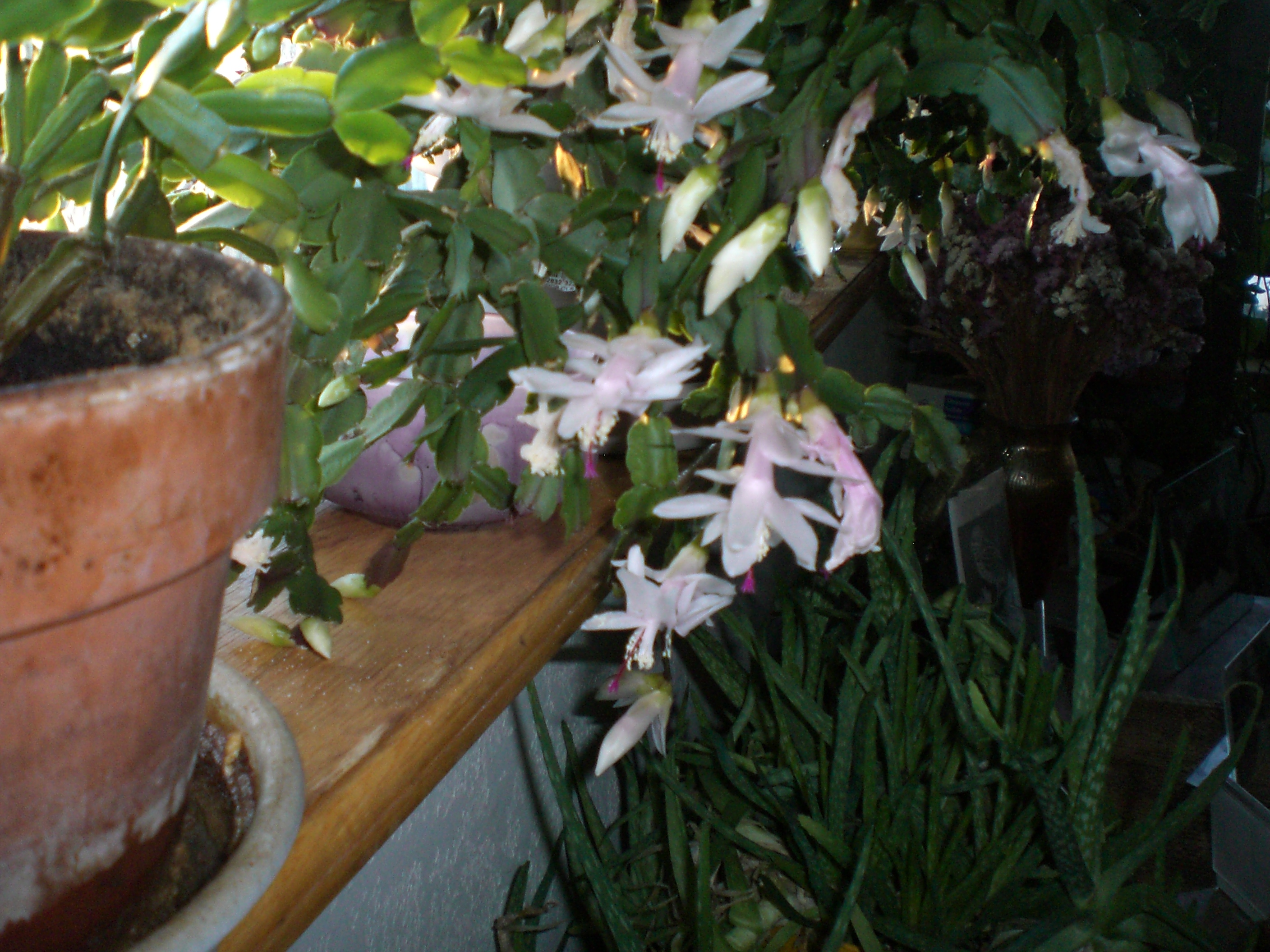
Don’t misunderstand – I fully support approaching each day with “an attitude of gratitude” for the many small positives to be found in it. I’m amused by the antics of the rabbits in the pasture. I smile at my confused (or misnamed?) Christmas cactus which stayed plain at that holiday, but is now flowering for Easter. I’m quietly, inwardly thankful for the opportunity to work once more at a job I enjoy, after years of toil in a less rewarding environment.

At Easter

At Easter

At the same time, I recognize that I spent many more years in that previous, stressful workplace than perhaps I “should have” done, because I was (am still?) conditioned to accept a small salad plate from life’s banquet rather than grabbing a big dinner plate and seeing that it is filled. The latter behavior is so often called greedy, selfish, and thoughtless of the needs of others.

If what one is going after falls in the material world – money, possessions, power – then yes, trying to get as much as possible for oneself may well be greedy and selfish. Lord knows I can’t comprehend how people already making hundreds of thousands of dollars a year can think they are also entitled to bonuses! Some, like Bill Gates or Michael J Fox, turn around and give back a generous portion of what they acquire, and thereby help the rest of us. I am thankful for them, and their charitable foundations. Too many others grab for, demand, and keep outrageous salaries, even insisting they be paid after they’ve been asked to resign. The public face of this activity is labeled “buying out a contract.” I think it is purely obscene. We working folks who don’t perform to standard get fired, not paid to leave. Why should it be any different just because one has an exalted position with an already very generous pay rate?

But I’m not talking about the material world, when I say we’re conditioned to settle for less. I’m not even talking about the emotional world, or the necessity of accepting that very few relationships are perfect, that we cannot count on another to “make me happy.”

I’m reflecting instead on the extent to which we cut ourselves off from fulfilled happiness by telling ourselves we do not need, are not entitled to, don’t have the right to, should not want or expect that fulfillment. In a portion of the Seder, the Jewish celebration of Passover (and the ritual being observed by Jesus at the Last Supper) a litany of blessings is recited, and after each step in the path to freedom the sentiment is expressed “Dayenu = It would have been enough.” If God had done just X, it would have been enough. If God had done just X+Y it would have been enough. If God had done just X+Y+Z it would have been enough.

I learn from this ritual that being grateful for what I have need not prevent me from welcoming more into my life. That I want more does not say I don’t value what I have. Only the subtle, pervasive, underlying conditioning of unworthiness so many of us have absorbed dictates that I should not try for gold, now that I have silver in hand.

I have silver, and rubies, and ambrosia, a wealth of gifts of the spirit. Dayenu. I appreciate how much that means to, is sought after by, people who have less. I happily share my blessings as best I can. And I’m going for more.

Reaching for a full platter does not mean I appreciate my present plate any the less. It does mean I’ve decided not to hang back, not to duck and cover, not to “settle” before I must do so. Maybe I’ll trip. Maybe I’ll fail. Maybe I will, in the end, have neither gold nor silver. But as a former prisoner and student of mine once wrote, “Mighty Casey, he struck out. What does it feel like to get into the game?”

I’m going to find out! And whatever the outcome, it will be enough. Dayenu.

Friends

February 2, 2014

There is nothing intrinsic to my speaking French that excludes women.

There is something significant to the pattern of my friendships, which were primarily with males until I was well into my adult and professional life.

I had one close girlfriend as a small child – Sara Harwood – whose family moved away from Washington DC when I was about nine. I ran away ten blocks to her house after one particularly horrible encounter with my mother. Her mother sat me down with milk and cookies, listened to me, then called my home to say I was invited to spend the night with my playmate. The next day Sara’s mother drove me home. I have no idea what she said to my mother – but nothing changed in how I was treated.

I also played with a neighbor – Keith Fleming – until my family moved away from Washington DC when I was twelve. Keith had a wonderful playhouse her father had built in their back yard. We were both only children; neither of our families was comfortable with the other, limiting our interaction to the hours we spent building fantasy lives in the playhouse.

From the time we moved to Vietnam, as I turned thirteen, I was a loner – or had friends who were boys and, as I grew older, a sequence of boyfriends. I missed out on slumber parties. Not allowed to attend, and my mother steadfastly refused to take on responsibility for anyone else’s children so I never had friends over to visit in my home. Without the opportunity to reciprocate, I became uncomfortable spending time in other homes, reinforcing my loner path through my teens.

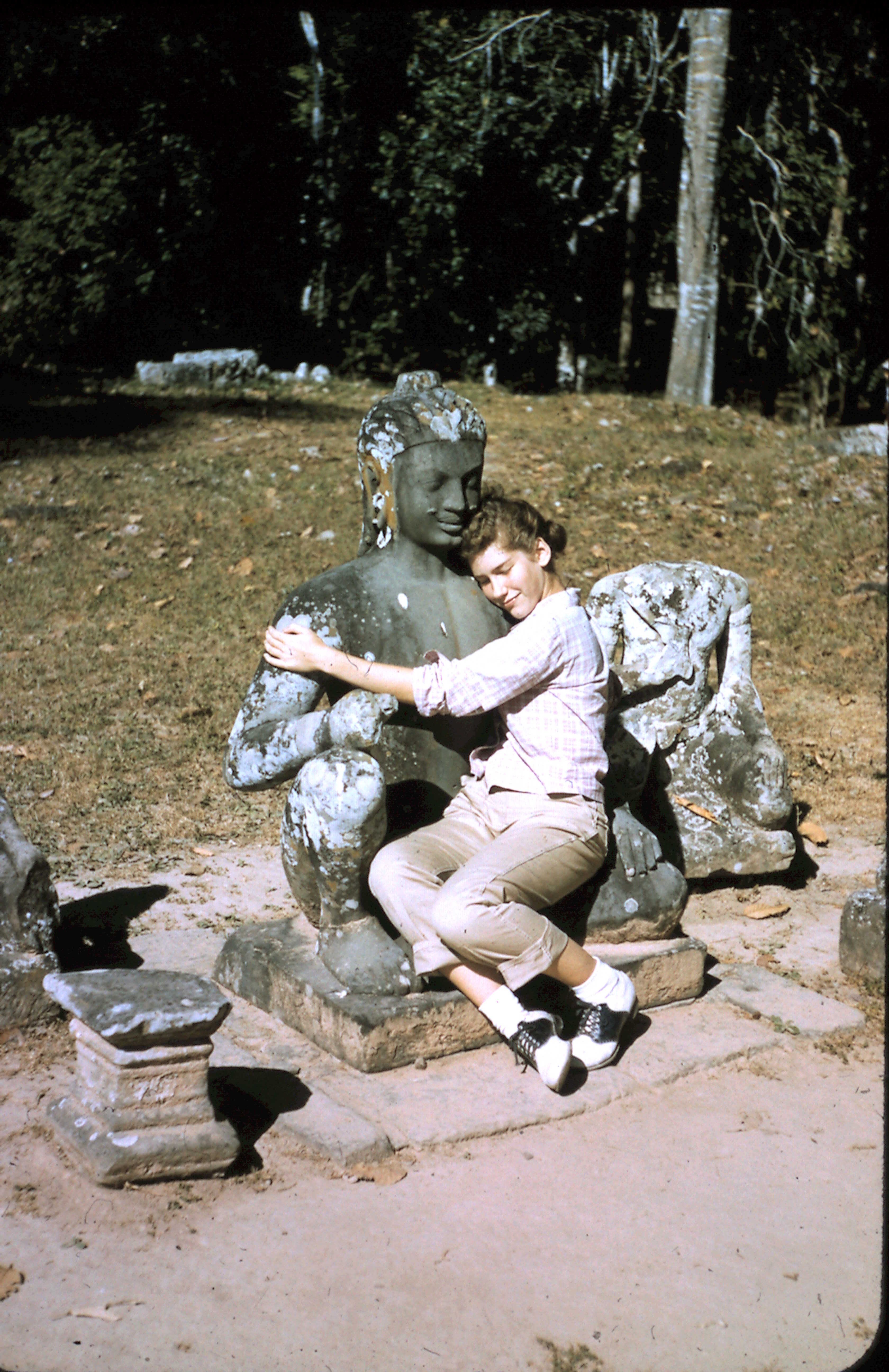
In the arms of the Leper King - Angkhor Wat

In the arms of the Leper King – Angkhor Wat

Undoubtedly the difficulties of life with my severely emotionally disturbed mother produced subtle bias against forming relationships with women. By contrast, I received affection from the one grandparent in my life – my Grampa – and at least intermittently from my father. Not surprising, therefore, that I was more comfortable with boys than with girls – and consequently not surprising that my memories from my French-speaking life are of interactions with males.

Overlooking Athens

Overlooking Athens

Not surprising either – perhaps – that for much of my early career I worked in male-dominated areas, encountering relatively few women from amongst whom to find friends. Clinical research in Boston, employment testing and then wildlife management planning in Santa Fe, then teaching in the New Mexico penitentiary… surrounded by men, in some cases the only female professional in the group. It wasn’t until I reached my mid-thirties that I developed close friendships with several women. Interestingly, they remain my friends today – thirty some years later. So once the barrier came down, friendships with both sexes became my norm.

Sivan at Mesa Verde

Sivan at Mesa Verde

Come to think of it, those first friendships with women had a common thread – all of us had had difficult relationships with our mothers. We were mature enough to not feel the need to vie, as teens so often do, for “who had it worst” (or best, or easiest). Absent that competitive tone, we could learn from each other and bond over our shared solutions to the psychological slings and arrows we had endured. Just a week ago, one of those friends commented to me that she’s always thought of me as sexy although she’d never mentioned the trait to me. I am surprised – it’s not at all how I think of myself, although I do enjoy and embrace that aspect of life. Reflecting on her remark, I realize that there is still a corner of my psyche that accepts my mother’s strictures against behaving improperly – i.e. in a sexual manner. And believe me, she saw sexual innuendo everywhere!

A meal with Leon at San Felipe

A meal with Leon at San Felipe

I don’t. And where I do see it, I am not offended nor embarrassed, nor do I think of myself as improper because I enjoy all aspects of my being. My female friends, I suspect, do the same, though that is not a subject we’ve found it necessary to discuss. Instead we talk about our careers, balancing personal with professional life. We share excitement over new endeavors, and commiseration over frustrated aspirations. And, with those who are, like me, followers of MasterPath, we share the outward manifestation of our inner spiritual discoveries.

It no longer seems to matter to me if a friend is male or female – the nature of the bonding remains the same. Shared values, interest in new aspects of life, finding ways to be useful and to be appreciated, these are my building blocks for any constructive relationship. I’m pleased to know that my early misdirection away from females has been overcome; now I just need to encounter some French-speaking women to bring full balance to my language-dictated relationships.

A happy Khin

A happy Khin

Not a Christian

December 21, 2013

“I am not a Christian.” A simple, declarative sentence.
My housemate’s aide asked why we do not yet have a tree up, and I answered, “I am not a Christian.”

Why is this the first time I’ve made that statement so openly? In the past, I’ve evaded. “We don’t make a fuss over the holiday, since it’s just the two of us.” Or, “I wasn’t raised to celebrate Christmas.”

It’s true, I wasn’t. My culturally but not religiously Jewish upbringing included commemoration of holidays as a remembrance of history rather than as spiritual practice. I’m old enough to have attended public schools that started the day with both the Pledge of Allegiance and a prayer. For all of my first 6 years in school, I would silently add “Cross that last line out, God” when the teacher ended the prayer “In Jesus name.” Later, at convocations, graduations, other public events in pre-politically-correct times, I didn’t bother with the amendment. Other people could pray as they wished, and assume what they wished about me.

While I lived in Vietnam, in order to participate in a choir, I practiced with the group at a non-denominational Protestant church. My mother did not let me perform with them on Sundays, however. I lit incense at a temple with our Chinese housekeeper, and watched the elaborate funeral parades of some of Saigon’s wealthiest families. The first time I encountered the concept of reincarnation, I knew it to be truth, resolving as it did so many of my questions and doubts.

One of Many

One of Many

In college I took several courses in comparative religion, and sat in silence with the Quakers, drawn both by their lack of ritual and their commitment to social action. The practice of seeing “that of God in every man” enabled me to feel part of a larger whole, in contrast to my life’s lessons of being an outsider. I diligently sought, in the silence, to discern “God’s will for me” and to listen to the “still small voice” giving direction to my life.

I’ve rarely had – or perhaps only rarely remembered having – dreams. The few vivid ones that have occurred have always been crystal clear as to their meaning, and prophetic. My access to inner answers has been simpler, more direct than dream interpretation. If I frame a question before going to sleep, I awake with the answer. If I frame a question before participating in Quaker Meeting, I leave the meditation having received – either from within myself or from a spoken message – a sense of direction. I never conceive of this instruction as God speaking directly to me. Rather, I remember my grandfather’s answer to a question about why one should do right. “Because you know it is the right thing to do.”

I have followed my inner instruction because I know it to be right for me. Living and working these past twenty years amid practicing Christians, primarily Catholics, I’ve kept my views to myself in order not to offend, in order not to disturb their settled beliefs. I’ve been respectful of our differences, not feeling any need to explicate those differences.

For more than twenty years I have been student of MasterPath – a spiritual teaching, an instruction in how to find “one’s way back home” to realization of one’s true nature as Soul. Practitioners number now in the tens of thousands, come from many countries and a wide variety of faith – or no faith – backgrounds. What we have in common is the desire to know our Divine purpose – to know and be our true selves, to manifest wisdom unadulterated by considerations of body, emotions and mind.

Different religions use terms like man’s purest essence, Buddha nature, the Soul self, Christ consciousness to describe the state of pure consciousness to which my Path leads me. Many religions ascribe the capacity to manifest that pure consciousness only to the founder(s) of the religion, as something outside oneself, to be worshiped and admired, but not to be attained.

Regrettably many religions are now adulterated by ego interpretations of what it means to act “as a ______” (fill in the blank with Christian, Muslim, Hindu, Sikh, Jew, Buddhist, Taoist, etc.) so that instead of manifesting the beauty and truth of their faith, they demonstrate violence, intolerance, exclusion and dominance all in the name of religious purity. It should not surprise anyone that atheists point to the history of war waged in the name of religion as proof that belief in God has a negative influence on humanity.

Religious history has little to do with why I reached my seventh decade before stating plainly, “I am not a Christian.” Or maybe it does? Maybe the intolerance of differences reflected in all those wars waged in the name of religion has seeped into my being, quietly persuading me to not make an issue of my difference from my neighbors?

No, I think it has taken me this long to be truly comfortable with who I am and what I know to be Truth; to achieve a genuine indifference to reputation and how others perceive me; to feel certain in my knowledge of my Inner Being. In other words it has taken me this long simply to Be, and hence to be free to speak my own truth. I need not weight myself down with a responsibility not to offend others. If they are discomforted by me, so be it. In a far from cartoonish and Popeye’d way, I am what I am.

In the words of a blessing spoken at the start of a lovely Ba Gua exercise called Swimming Dragon, “I am health, I am beauty, I have enough.” It is enough, that I AM.

Ba Gua Lessons

October 12, 2013

As I count down the days until the start of the intense training period for my new job, I find myself in yet another dichotomy. Do I laze about as much as possible, wallowing in the freedom-to-do-nothing that is about to vanish from my life? Or do I begin a disciplined adaptation to going to bed earlier, getting up early, and organizing my days to accomplish tasks that it will be hard to fit into my upcoming schedule? Or, more practically, do I aim to achieve a balance of both tendencies?

My acupuncturist/friend/wise-teacher commented that it is often the case that moving to the extreme of yin (doing nothing) pushes one into yang (activity) so that resting instead of participating in activities can be an excellent preparation for the burst of energy that will be required of me. I liken this approach to the one I’m learning from the same friend and teacher when we practice Ba Gua, wherein movements are designed to “coil” muscles like tightened springs, until the point of release. The force of the release may serve as the attack (the martial part of the art) or may be contained and redirected into intensifying the next coiling movement.

It’s difficult to consider what Western culture calls laziness and idleness as appropriate preparation for a required, new and busy schedule. In that mentality, I definitely should already be adhering to the new (yang) schedule of waking, and filling my days with tasks, accustoming my body to delivering energy and clarity of mind across the ten or so hours of an upcoming busy day. But what happens if I rename the preparation period (the yin) in an Eastern fashion, and say that I am practicing stillness and emptiness? Then I am setting up a powerful contrast, with the potential for sustained energy emerging from the containment being practiced this week.

What a difference a few words make! Try them out. Spend a chunk of time playing solitaire, or just sitting and watching the wind blow the drying grasses of autumn.

Bosque del Apache, New Mexico

Bosque del Apache, New Mexico

Call yourself idle and lazy for failing to do something constructive with your time. Then, rename that time as allowing yourself to be still and mindless, outside your usual sense of yourself. Which set of terms weakens you? Which seems to relax and yet energize you?

To a large extent, even when I’m not engaged in writing, I live my life through words. My grandfather taught me the importance of choosing the right ones, when he talked to me about his poetry. His choices were in Hebrew, and constrained not only by the meter and rhyme of his verse, but by his dedication to purity of the language. (Words created for items that did not exist in ancient culture should, in his opinion, follow the traditional structural frame as to number of consonant sounds).

My experience of parents whose behaviors were often in contradiction with their words led to my dedication to accurate and clear communication. A lonely and isolated childhood built my desire for connection with others, and to the understanding that communication is a two-way street. I do not communicate when I talk (or write); I only communicate when what I say is heard and understood by another.

For others to hear and understand me, I need to understand them – hence my choice of psychology as a major in college, and my continuing interest in neurology now. Also my engagement with the several programs I lead or teach (including Alternatives to Violence Project and Chronic Disease Self- Management), both having to do with learning concepts that help one direct and control behavior.

Which brings me back to Ba Gua, teaching my body new ways of moving, and simultaneously reinforcing flexibility of mind. And back to the importance of just the right words – stillness and emptiness creating a vacuum which attracts energy, to be stored and contained until it explodes into action. So much more sustaining than to label my down time as idle laziness that should be filled with doing.

The first time I attended a feast day dance at one of New Mexico’s Pueblos, I observed a dancer carrying an old-fashioned alarm clock, the sort that is wound with a key, ticks loudly and has a clanging alarm. The dancer teased non-Native observers with the clock, shaking it in our faces, setting off the alarm suddenly and startling visitors with its discordant noise. Eventually, he tossed the clock away and joined the line performing traditional steps in a mesmerizing, repetitive pattern. Time did then disappear, as spectators and participants focused totally on what was happening in the moment.

I suggest that much that we like, whether a good book, a particular hobby, an activity, or a piece of art or music is liked precisely because it has the capacity to capture our attention strongly, and thus to eliminate our sense of time and ego. Being present in the moment with the object of our attention creates a satisfying energetic stillness, and an expanded sense of connection, of capacity, of self.

Those fortunate individuals who are able to combine such likes with their means of employment do not describe what they do as work. They are more apt to describe a career as pursuing a passion. Those less fortunate in the choice or conditions of employment go to work, and then try to find free time for pleasures to balance what they have sacrificed for the earning of income.

You may have noticed in previous posts that I have not called my new job “work”. For the past eighteen months, I’ve been able to live mostly in the present moment, doing what is in front of me to do each day. I really like this way of being. My intention is to continue in this manner, acknowledging that there will be more things in front of me to do, in many of the upcoming days, than there have been in the past ones. I have determined not to change my approach to the doing of them. I will find energy for the doing by assuring that I remain centered in being.

As my body improves its stability and strength through Ba Gua practice, so too my mind – and its use of words – expands its capacity to “hold the tension of opposites” and to achieve balance. For important external reasons, I am starting a new job. For vital internal ones, it will not be work. Activities required of me by the new job will be integrated into the pattern of observing, of writing, of being that has nourished me of late.

Please, if you notice that I’m falling away from center, alert me! If my words seem poorly chosen, my posts less reflective, give me a nudge. I need to know that I’m continuing to communicate with you, not slipping into a stress-driven rant.

Thank you for reading, and for feedback.

An Appreciation of Habits

October 6, 2013

Interesting how many unthinking habits are revealed when the pressure tank in the well fails, and a household is without water! Over the years, we’ve been waterless several times, for different reasons. The most difficult was the winter it got down to 30F below and someone forgot to leave faucets dripping, resulting in a frozen water line. That time it took 4 days to restore water flow, fortunately without associated broken pipes. Four days of not being able to flush toilets, or easily wash hands. Of hauling water in three gallon bottles, doling it out in dribbles for washing with a cloth in the sink, “birding off” as a friend used to call it (another acquaintance used to refer to the same process, I know not why, as a whore bath).

This latest episode of being without running water lasted only a little over 24 hours, in warm enough weather to need to shower, not just dab and dry. I gained experience at showering without access to running water back in my early teens, when we lived in Saigon.

Our House, a Very Very Very Fine House - Saigon, 1956

Our House, a Very Very Very Fine House – Saigon, 1956

Water only flowed in our housing compound for about two hours a day. The live-in maid would fill large vats with a hose from a standpipe, then carry buckets up to the bathroom whenever someone needed to bathe. Showering became a matter of pouring a bucket over oneself, soaping, pouring another bucket to rinse, and drying off. In the steamy heat, two or even three showers a day were necessary. A five person household used a vat of water just for bathing. The second vat supplied water for cooking and mopping and hand washing.

In those days, I also learned how to throw a bucket of water (the third vat’s supply) with just the right force, at just the right angle, into a toilet to force it to flush. In recent days, I learned I am still able to shower by the bucket, but have lost the knack of the toilet flush. Or maybe modern toilets are less amenable to alternative flushing procedures? In any case, the knowledge of how to manage without running water rose up from depths, at the same time as I caught myself automatically reaching behind to flush the toilet that had no water in its tank. Knowing there was no water did not stop the unthinking hand gesture.

How many other actions of daily life, including much less mundane ones, do we unthinkingly perform? How many aspects of our routine do we take for granted? And what about people… how often do we take them for granted? Or respond to them out of habit? Or respond to a present situation with an inappropriate habit learned in childhood?

Regrettably, my mother was only able to experience disappointment with life. She had a unique knack for projecting that disappointment, ensuring by her actions that anything I looked forward to with happy anticipation would fit her world view, and therefore not materialize positively in my life. My childhood was one of fearing to express what I wanted, since to do so was to assure it would not happen. Put differently, I became ingrained with the behavior of waiting for the other shoe to drop. As I matured, left home and began living my own values, I gradually freed myself from maternal negativity, and experienced lots of positives. Life brings mostly what one looks to receive from it – and I look with curiosity for new opportunities, good friends, and spiritual growth. I’ve been blessed to receive an abundance of all these.

So – how surprising to discover, in recent days, that a corner of my being is busy defending itself against a shoe dropping, in relation to my upcoming new employment! Why am I suddenly hearing myself reason that I should delay certain purchases because one should never “count chickens before they are hatched?” In ten weeks of living and working on the Maine coast at a home without electricity, I ‘forgot’ the habit of reaching for a wall switch when I entered a dark room. So why do I, after 50 years of living away from my mother’s fearful negativity still subconsciously duck and cover in response to upcoming positive and desired changes?

The Habit of Following Along

The Habit of Following Along

Well, at least I recognize the old emotional habit and can now practice setting it aside. I hope I have more success breaking that pattern than I’ve had with the one that leads me to look up to the right as I leave my living room. For nearly 20 years I had a clock on that right-hand wall – it’s been gone for 2 years now but I still glance there to see the time. And then laugh at myself. I suspect that being able to laugh at practicing an outdated habit is a step in the direction of letting it go, so I will chuckle to myself if I fall back into emotional duck and cover. What better way to switch over to a positive attitude?

And I do intend to retain the habit of washing with minimal water, although not the bucket method needed so recently. Collecting the water that accumulates until a suitable temperature is reached, and turning off the shower while soaping up, have become common sense habits in our continuing drought-plagued environment. Hmmm… I wonder, if someday I move to a place where water is abundant, will my water-saving habits endure?

Memory Lane

September 8, 2013

Told that you will be spending two days with a former partner – lover, ex, intimate friend – from whom you parted on amicable terms but have not seen in 45 years, what would you expect to experience? Assuming, of course, that you are old enough to have so much time elapse between encounters. If you’re younger, compress the time appropriately, and include an awareness that you and the former partner knew you had different goals and would be traveling different paths. You parted amicably.

So here you are at the other end of a long separation, having pursued your divergent aims. You are going to meet not just your ex-partner, but that person’s current mate about whom you know absolutely nothing. Would you, like me, wonder if you’d find anything familiar in your former partner? Would you ask yourself questions about “the road not taken” and be curious to learn if you’d been correct to leave it? Would you – unlike me – obsess about your looks and how you’d aged and whether you’d still be found attractive?

Turns out, I had the interesting and enlightening experience of both appreciating the qualities that originally drew me to this particular former partner (FP), and recognizing how our differences had deepened into a rift which would inevitably have pulled us asunder. We were indeed lucky – or perceptive – enough to have realized that we should separate “before any harm was done.”

What I didn’t anticipate was the extent to which the visit brought back other memories from my earlier life – memories not necessarily connected to the relationship, including memories of events from my early childhood. It was as though, once broached, the closet where I’d shoved recollection of much of my early life behaved as any physical closet stuffed to overflowing – it spewed out random items when the door cracked open.

Going for a Walk

Going for a Walk

Visits to the zoo with my grandfather, during which he talked about life, and values, and the challenge of finding just the right word for his latest poem. He queried my week and my interests and what I was reading. I was vividly reminded of those Sunday conversations when FP gently probed how I live and who I am now, in much the same way as my grandfather had sought to know me.

Memories of intensely difficult times with my mother, who had serious psychiatric problems. It took me quite a few years to overcome the effects of her paranoia, explosive anger, and abuse. FP perceptively commented on his recollection that my mother also had an abusive mother, in the context of mentioning that he and his present wife were lucky to have grown up amid very positive family lives. I know now what it’s like to feel supported and encouraged by a set of caring supporters. And I also appreciate to what extent my adventurousness and my inability to fit neatly into the socially defined role FP offered, arise from the instability and emotionally volatile nature of my childhood. I’ve not had an easy life, but I’ve certainly had a varied, challenging and infinitely rewarding one.

Also tumbling out of the closet were memories of other relationships, rather a lot of them, mostly all pleasant. Such a range of different types of people I’ve come to know and value as friends! People who are very far removed from the European immigrant, advanced-degree-educated, middle class traditionalist pattern of my parents and of FP. Motor cycle riders, cowboys, ex-cons, and prisoners still serving time who participate in the Alternatives to Violence Program workshops I facilitate in the New Mexico prison system. Sixth generation descendants of Spanish families who migrated into the New Mexico territories from Mexico, and who still speak English only as a second language. Some of them are conversos (crypto-Jews) rediscovering their family origins. FP and his wife, conservative Jews, were deeply interested to learn about this link to an area they now plan to revisit.

I’ve known mechanics whose crossword puzzle skills rival my own. Believers and practitioners of a host of religions, and of no religion at all. Providing home health care throughout a large rural section of the state, I’ve been welcomed into ancient adobe homes with sod roofs, ranch headquarters in the midst of thousands of acres of range land, luxury second homes for people who spend half their year in Texas, and the truly mobile homes of a couple living permanently in their Winnebago.

Amidst the tumble of memories spilling forth, I find and grab onto a gem of an idea. I ended the relationship with FP because I knew I did not fit within what felt to me like a confining, prescribed role. I was not at home within a “family” structure. It turns out I’m not at home within any other established structure I’ve encountered in my life journey. I’ve fit myself into them (work, a variety of different cultural norms) to get along, but none have felt like ‘home’. I belong nowhere. Ergo, I belong everywhere!

Perhaps that’s why I’m planning to start a new career within weeks of turning seventy, and then, four or five years from now, I’d like to take off to live once more in a different country. Somewhere with a comfortable climate for older bones, where I can teach, and learn, and continue my life adventure. I’ve been dipping into memories from the past. I’ve defined a possible future to hold in intent. Meanwhile, it’s time to resume the most important aspect of Being – living in, and appreciating, each moment of the present.


Only Fragments

Love Letters to the Tar Pit

KarusaaVerse

Words that Sparkle, Thoughts that Ignite: Fueling Your Imagination

Leaf And Twig

Where observation and imagination meet nature in poetry.

Millarson Diaries

Personal Musings and Thought Experiments

The Beauty Along the Road

Discovering Beauty in the small details of our lives

Flowerwatch Journal

Notes on Traveling with Flowers

1eclecticwriter

Wide-Ranging Commentary

Spirituality Exploration Today

Delving into the cross roads of rationality and intuition

smilecalm

Life through Mindful Media

A Good Blog is Hard to Find

I will shatter a word and scatter the contents into the wind to share it with the world.

Ray Ferrer - Emotion on Canvas

** OFFICIAL Site of Artist Ray Ferrer **

AKA The Versatile

Fashion | Lifestyle | Food & Travel | Beauty | Fitness | Education | Product Reviews | Movies | Doodling | Poetess

Aging Abundantly | Women Over Fifty | Empty Nesters | Caregivers | Aging Gracefully

Finding Joy at Every Age with writer/philosopher Dorothy Sander

ARTZZLE

Helping with the Pieces in Life's Puzzle of Art and Design

Project Light to Life

A bucket list blog: exploring happiness, growth, and the world.

The Daily Post

The Art and Craft of Blogging

Any Shiny Thing

MIDLIFE MAGIC

allmostrelevant

@allmostrelevant

The Irrefutable Opinion

Assaults on the Casually Mundane by K. Jean King