Posts Tagged ‘self-acceptance’

Rooster Knows

June 12, 2016

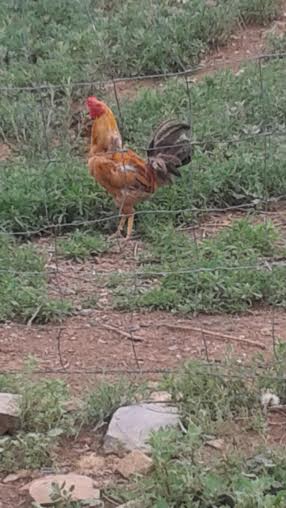
You know you’re in the country when… your rooster lets you know not just when it’s morning, but when the hens are wandering farther afield then he thinks right, or the goats are butting each other away from their food, or the dark clouds of summer afternoon rain are looming and the flock should take cover. I’m told that chickens in Cameroon only get under cover when a serious rain is impending. For a few drops they will continue their foraging undeterred. I’m waiting to see if the same applies here in high desert northern NM.

Being able to differentiate mild from major disruptions may be an inherent skill for Cameroonian chickens. It does not seem to be so for humans. Rather, we can spend a lifetime learning to “not sweat the small stuff”. Finding one’s way to feeling happy with oneself and one’s life – a goal most of us strive toward – requires not only relaxing about those small irritants, but also accepting that it’s okay to be happy.

From several sources recently, I’ve been reminded of how much more readily we identify with loss, pain, difficulties and challenges then we do with being “temples of God”, the home of Soul, or inherently divine beings entitled to feel happy and fulfilled. Many years of spiritual practice can increase the ease and frequency of identifying with one’s highest Soul essence, but still we can (or at least I find that I can) be tripped into the pit of unworthiness by surprisingly small stuff.

Why is it so easy to identify with negatives, to point always to what’s missing, and so hard to embrace being loved, appreciated, fulfilled, happy?

Believers of some religions would say it’s because we are born in sin. I think rather that the concept of being born in sin originates in a mind’s effort to explain our propensity to see imperfection rather than perfection. Yes, this is a cart and horse debate, one that cannot be decisively resolved. But in my experience, looking for what’s right rather than poking around in what’s wrong makes for a much happier and more satisfying life. It does take persistent attention and regular refocusing, to not let past experience of lack distort present enjoyment of wealth. I’m including within wealth all the tangible and intangible benefits one can enjoy – supportive relationships, worthwhile employment, a sense of purpose, relaxed ease of emotions, meaningful spiritual practice… a comprehensive list would run many pages.

Research study after research study reveals that negative behaviors of adulthood originate in childhood – abusers were bullied and abused as children, jealous spouses never learned to feel worthy of love, rage-aholics had explosively angry parents, etc. We hear much less about how good childhood experiences with positive role models produce happy and successful adults. Just as news of disasters sells papers, it seems explanations of negative behavior result in academic publication. Would that it were otherwise!

My favorite feature in The Week is entitled “It Wasn’t All Bad” and cites (usually) three stories of generosity, (a fire fighter who bought a month’s groceries for a citizen whose kitchen fire he had been called to help extinguish); achievement (a 101 year old great-grandmother getting her high school diploma alongside her great-granddaughter); or heart-warming connection (a dog lost for over a year being found and returned to the developmentally disabled child who was its original owner). I wish that fully half the weekly magazine’s content could be similarly summarizing positive stories – but it’s a magazine devoted to reviewing the “top” stories in the world press, and most of those are less than heart-warming.

About our bodies, it is said that we are what we eat. About our minds and emotions, it is also true that we become what we give our attention to. Looking always to the negative, we cannot help but feel unworthy. I prefer to “count my blessings instead of sheep, and fall asleep counting my blessings” – at least until the rooster thinks I should be aware and alert to one of his small concerns.
Cock Calls

Cock Calls

Time to Look Back

May 15, 2016

“Work should not be given priority over relationships.”

Quite a challenge for perfectionist, Type A workaholics but a very pertinent statement made by Pastor Katie at Las Vegas’ First Presbyterian Church in the course of her first sermon as the new leader of this congregation. She spoke movingly about the spiritual lessons that come through mundane daily events, such as those surrounding her recent transplant from Colorado to New Mexico.

One of these lessons was about the need we all have, to have persons to whom we can vent our toxic thoughts, persons who will listen and help us clear our spirits without judgement. I recognize this to be my primary role with some of my clients at work. Not as part of my formal job description, which only talks about assisting them to access the services and supports necessary for them to achieve and maintain the maximum of health and quality of life. We include mental health in the range of services we Care Coordinators support, and many of my clients do have counseling or psychotropic medications included in their service plans. They manage the scheduling of their services and their overall health maintenance with little input from me beyond completion of the mandatory assessments which enable them to become eligible for those services.

Some clients, however, cannot accomplish this self-management without an outsider to their daily lives to whom they can express their frustrations, fears, angers or constraints – and they have elected me to be the receptor of these toxic thoughts and feelings. I’m glad when I can provide this service, sometimes also having a suggestion or insight to offer that helps the client move past the blockage. In rare instances, I’ve been used as the means for two people, each with a need, to connect and jointly resolve their separate concerns. I know, when that happens, that I’ve been what I aspire always to be, a “clear channel” for the Divine to work through.

Why is it so much harder to be a similarly clear channel when the issues are not someone else’s but my own?

Why can I “speak truth to power” on behalf of a client but find it so difficult to speak up for myself appropriately in my own relationships and my daily interactions with the various manifestations of power, such as erroneous charges on a bill, or petty tyrants who take pleasure in making me wait unnecessarily before fulfilling their job duties providing service to me?

Is it because I’m female, of “a certain age” and therefore raised before feminism brought out the extent to which women have historically been taught to accept the denial of their right to dignity and respect?
Or is it just my own personality, resultant from an upbringing in a less-than-positive or supportive family?

Does the reason even matter?

I would like to be able to maintain a clarity and simplicity of day-to-day existence such that I can be aware of the spirit flowing through me in service of my own needs, in the same way that I’m able to let it flow through me to serve others. Instead, it seems that ego, or the rough edges of my personality, or both or neither but something else altogether, create blockages and I end up feeling drained and exhausted.

“Too much outflow without enough inflow” my MasterPath teacher would say. Or, as Pastor Katie also shared, not enough quiet time taken to process what is being left behind before new experiences are presented to be taken in. She recognized the need to grieve leaving behind a home where she’d raised her family, and planted iris given her by her mother-in-law.

We have in common that we have both worked in Hospice care, and understand the need to grieve losses, including ones less dire than loss of a loved one to death. A training program I attended for grief counselors emphasized that seemingly small losses can become the triggering event for previously unexpressed pain over the loss of a family member – the man who seems to handle the death of his wife but collapses a year later when the family pet dies, for example. One of the exercises in the workshop required that we attempt to catalogue all the losses we have experienced in our lifetime, to help us recognize things we should give ourselves permission to grieve. Also to help us hear what is implied but not clearly stated when a family member of a deceased client expresses extreme anger at a factually minor loss of respect or status on their job, six months after the death.

Moving from one community to another is a clear transition that will bring up for any sensitive soul – as it did for the pastor – the need to grieve what is being left behind. Other life changes should also be accompanied by time to grieve, but are less likely to be recognized as such. My own fairly extreme change in life pattern is one such, that I did not see as needing to include time for grief, until the pastor’s sermon brought it to my attention. I do appreciate that I am able to hear the suggestion and receive the input just when I need it. I think I’m not being unduly self-congratulatory when I accept that I must be in a fairly “clear” state to be gifted with just the right input at just the right time, even though I felt anything but clear. Indeed, before hearing the sermon, I was angry, feeling disrespected and as though there was no longer room for “me” in my daily life.

All because, as Pastor Katie instructed in her list of lessons learned during her move, work should not be given undue priority over relationships. Including one’s relationship with oneself. I have been so busy trying to meet, to a perfectionist’s standard, the many demands of my job, my clients, my marriage and my daily existence, that I’ve neglected my relationship with me and, more importantly, my relationship with the Divine.

I have been so engaged with my exciting, rewarding but very busy new life that I’ve also not left myself space to process the loss of the old (semi-retired, leisurely and thoughtful) life left behind two years ago. Nor have I been able to properly grieve the termination or the transformation of some relationships from that old life. Pastor Katie will always have the memory of her yard full of blooming iris, but she is no longer able to walk out of her house into that yard. I will always have my memories of frequent and satisfying visits with distant friends, but I can now see those friends only rarely and under different circumstances. The pastor and I each carry an aspect of the past with us into our new lives, but we each also know a sense of loss that deserves attention and time to be grieved.

So much emphasis is placed on the window that opens when a door closes, that people seem to feel guilty paying attention to what’s behind that closed door. We are urged to move on, look forward, appreciate what is being offered and let go of what is being left behind. Good advice, overall, but sometimes too hastily offered.

Moving forward without reviewing and properly saying goodbye to what is past can have the feeling of devaluing that past, and the consequence of leaving us feeling devalued ourselves.

Taking time to dig up a few flowers and bring them along to a new home helps assure that we give ourselves time to say good bye to the life behind that closing door. It is thus that we increase our ability to be clear, and present, with the new experiences coming in through the window, and – for me – it seems that taking time to properly grieve what has been lost is essential to clearing out the toxins that prevent me from achieving a level of clarity of spirit for myself that at least approaches the level which I try to offer to others.

Added benefits – improved health and easier maintenance of desired weight. But that’s a topic for another day.

Autumn Color

Autumn Color

Making Friends

April 17, 2016

My husband’s current work schedule is such that I am alone on Friday evenings. I’ve been scheduling late client visits for my own work, or a massage or other self-care activity into those evenings, but this past week my appointment was cancelled at the last minute. I found myself, after shutting down work at 7 PM, in that odd state referred to as being at loose ends. Sort of wanting to get together with someone for conversation and perhaps a drink, sort of not wanting to be put to the effort of driving to town (twenty minutes). And I was made aware that I do not have much of a list of people to call to meet with at short notice. In the end I settled on the couch with a small drink and a good book and read the evening away. Enjoyable, relaxing – but not sociable.

Between chapters I guess I also thought about the nature of friendships, and socializing, and the fact that I’m one of those who has a few close friends (not necessarily close in proximity), and so many personally engaging work interactions that I usually want quiet and silence and solitude at the end of my work day/week. Spending long working hours helping people with their health needs seems to use up my quota of “people contact” tolerance, leaving little to devote to building friendships of the sort that can provide either planned or spontaneously arranged relaxation.

Or maybe it’s just my personal makeup?

Being an only child, raised by parents who preferred not to “be responsible for other people’s children” as my mother expressed it, and consequently not free to invite playmates to my home, I think I lost out on learning how to relate easily, happily, casually with others. I don’t “do” party chitchat, and never know the latest gossip.

It occurs to me that my strong preference for writing – as emails, letters or this blog – rather than talking on the phone comes from the same lack of learning to connect in that way as a young person. It must seem strange to those fully comfortable in the current “connected” environment, that I was in my early twenties before I lived in easy proximity to a telephone. There weren’t home phones in Saigon, and only very few in Paris where my father did have a phone in his study, but it was paid by and used only for his work.

To this day, I very rarely spend more than a few minutes on the phone in conversation. The exceptions are those special times when I talk with a dear friend who lives at some distance from me, Washington (the state, not D.C.), Minnesota, or Singapore for example. Our close personal connection is already established, I can “see” the person I’m speaking with, and am able to make myself ignore the discomfort of hanging onto a phone. (Don’t say to put the phone on speaker – my conversation is not for all to hear).

A preference for writing over talking should not be taken to mean I do not enjoy dialog. On the contrary, my close friends know that I take great delight in a lively discussion. One of my clients, an elderly gentleman living in a tiny hamlet in the rural “frontier” of New Mexico, saves up news tidbits from his TV watching, that he hopes will “get me going” on a social or political topic. He’s been known to be intentionally provoking, most often when he has also been shorted on good conversation. We agree more often than not, but both enjoy dissecting the broader implications of some current event. He is fighting cancer now – seemingly successfully – and during a recent celebration of a “cancer undetectable” medical report, he humbled me with his comment that he wasn’t ready yet to leave our debate dates.

One of the measures of self-acceptance is purported to be the ability to be comfortable with one’s one company.  Achieving that status does not, apparently, confer freedom from self-questioning, at least at the “I wonder what/why/if” level. I’ve not just spent time alone, but have traveled, eaten in restaurants, gone to night clubs, to the theater, and camping with only myself for company, enjoying all those activities as readily as I have savored them while sharing them with others. My evening with a glass and a book was no less satisfying than it would have been in the company of a friend. I do wonder what would have to change, for me to have a circle of people whom I could have called to share the evening with me?

I’m not one to say it’s too late to change – especially not with the huge alterations to my personal life that have occurred in the past few years. I do question, in the specific case of my social interaction patterns, whether I’m sufficiently motivated to change. I’ve tried, at times in the past, to participate more readily in casual social events and achieved some modest success, measured not just by people coming out at my invitation but by receiving invitations to join them on short notice for coffee, or lunch, or to go to a party. Those periods didn’t last, largely I must admit, because I don’t fundamentally enjoy what feels to me to be superficial chitchat. And yes, I am aware that my lack of enjoyment is recognized.

“You’re too intense (substitute intelligent, intimidating, independent) for most people” is the feedback I get.

With Popeye, “I yam what I yam”, and it’s okay.

Which doesn’t prevent me from wondering at times what it would be like to be someone different, at least in the area of socializing. Perhaps I’ll find that out in my next lifetime? Meanwhile, I have a good book to get back to reading, a stack piled on the shelf waiting for me when this one is done, and an amazingly compatible partner due home in just a few minutes.

IMG-20160306-WA0007

What Am I?

April 10, 2016

Once one has lived a moderate number of years, a large variety of situations can lead to reflection on the nature of self, what it means to be K, or N, or Mrs. M. Retirement planning seminars stress the importance of developing a set of interests outside of one’s profession, to ease the transition to a new concept of self. Being abruptly laid off due to down-sizing prevents this sort of planning. So does the onset of physical illness, or an accident which seriously alters ones capabilities. Even a slowly progressing illness can reach a turning point, where activities previously manageable suddenly become impossible.


A common expression of the challenge faced in such a transition is who am I if I’m not … working as a plumber, teaching classes, acting in plays? At a still more sensitive level, who am I if I can no longer button my shirt, use the bathroom without assistance, or sit outside in the sun when I wish to do so?


In an ongoing conversation with a dear friend of long standing, this transition has been jokingly referred to as the Do Be Do Be Do discussion. My friend recently referred to an unnamed source whose contribution to the topic was the statement “God is a verb”. I took that into contemplation today, during our monthly Quaker Meeting for Worship, and found myself reflecting that both doing and being are verbs, i.e. action words. Shouting, dancing, running, doing are perhaps more noisy than sitting, dreaming, accepting, thinking, being – but all are verbs, all are forms of action.


So standing and waiting is being active, albeit in a passive-feeling way.


My friend’s dilemma arises partially from his career as an actor, radio personality, radio program director – highly satisfying activities which involve exchange with an audience, a cyclical/reciprocal engagement with contributing to the lives of others that has been a primary value throughout his life. Now that he can no longer participate in those roles, and must often measure achievement in successfully moving himself from point A to point B (because Parkinson has control of his body) he questions what he is contributing to the well-being of people around him. Is it sufficient, to accept gracefully the offers of help which others do feel good about extending? That is only half the cycle. What is traveling outward, to be received by the other, processed and returned?


If God is a verb, and Being is a verb, then in simply being, we are godly. If also God is Love – loving is a verb – then in loving we are being godly. Loving travels outward, to be received by others, processed and used – and hopefully also returned. Reciprocation need not be tangible to be complete.


Another participant in today’s Quaker Meeting contemplation shared her morning’s experience of “shedding” – elk on her property shedding antlers, a friend shedding light on a problem, and the value of shedding outdated concepts of oneself. Shedding is a verb. Perhaps the key to a smooth transition from active verbs like doing, to quieter ones like being, is to be ready to shed constricting definitions – of self, of what constitutes contributing, of what it means to love.


The challenge – in a positive, active sense – becomes one of accepting a new and refined sense of manifesting that of God within. Aging with grace, letting one’s love shine out in a smile, holding a state of being such that others walk away from one’s presence feeling enriched and glad to have been there… these are valuable contributions. In the noise and busy-ness of daily life, such sweet giving is too rare. We need more of such Being, more of God manifesting through us, to both strengthen and soften our human interactions. I can’t think of a more important purpose to incorporate into daily life.

Returned

April 3, 2016

I’ve done the one thing I’ve been told is lethal to a blogger’s career – abandoned posting without an explanation. Do I have any followers left? I guess I’ll find out now – or maybe not, since I rarely received comments even when I was posting reliably, although Cheryl at Artzzle always responded and I greatly appreciate her for that.

When I started this blog, I thought I was embarking on a new phase of a sporadic writing career that has spanned decades. I finished a novel and was starting to look seriously at marketing it; a blog with followers was a step toward finding an avenue to get my novel published and read. Then I got a job – a really good job with most of the characteristics I desired: working with people, working from home, good pay and a modestly flexible schedule. The volume of work has, however, been rather overwhelming, stretching to 55 or more hours a week. My limited “free” time has been devoted to a new marriage and other changes in my personal life. As I said in one of the few posts to go out in the past year, I’ve been too busy living to reflect on or write about my experiences.

The demands of my job are finally reducing a bit, to something closer to 40-45 hours a week and the schedule within my personal life has settled as well, giving me two evenings a week, alone, which I can use for interests that have been shorted of late.

One of those interests is reading. Most of my life I’ve buried myself in a book whenever I had an unoccupied moment – even standing in the grocery checkout line, or on occasion when stuck in a traffic jam. I was fortunate to be encouraged to learn to read very young, sitting in my grandfather’s lap and following along as he read me “I Went for a Walk in the Forest”. Fictional worlds soon became my escape from an unpleasant family life. Long before the household was transferred to Asia and then Europe, for my father’s work, I had visited many countries – both real and imaginary – and had great adventures solving crime with Nancy Drew, or uncovering ancient tombs on archeological digs on the plains of Argolis.

What better indicator of just how demanding my job has been, than the realization that over a period of 18 months I read at most 6 books – the number I normally devour in a month. In the past half year, I’m pleased to see, by the size of the pile of books ready to go to the exchange, that I’ve been able to resume reading at something closer to my habitual rate.

And with reading comes reflection, ideas, and the urge to resume writing.

So here I am, probably not with any consistency yet, but back from the deep silence of the past … oh my goodness, nearly a year!

My apologies for the abandonment.

Theme and Variations

November 22, 2015

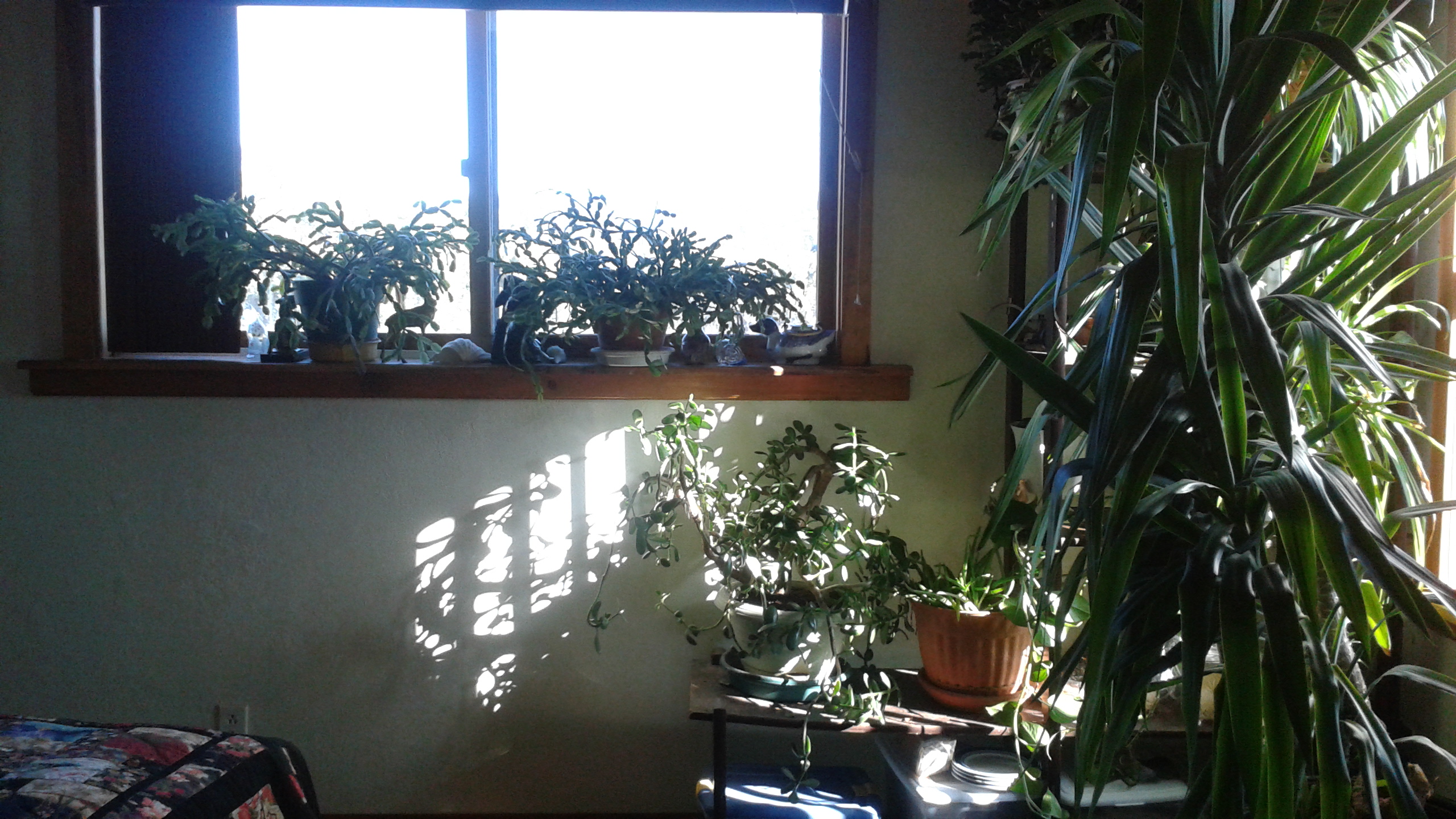
After several days of wood-stove heated cold weather, the temperature has soared to cotton shirtsleeve comfort, and an afternoon originally intended for housekeeping has turned into one spent on whatever could be completed outside in the sunlight. For my husband, that has meant washing cars. I, meanwhile, cooked some of his habanero pepper sauce on the outdoor grill (its bite sets everyone sneezing and crying if prepared inside) and re-potted houseplants. Or rather, transferred cuttings that had taken root in water into new pots, and repositioned one jade plant that, for reasons of its own, has chosen to grow so lopsidedly that its pot is highly prone to tip over. Reoriented, the main stem now angles sharply to one side, but seen from a distance the whole plant looks much more balanced.

straighter now beneath the window

straighter now
beneath the window

Why do some natures veer off crookedly? How do several children raised in the same supportive environment take such different attitudes forward into their adult life? Why are some people seemingly constitutionally unable to appreciate what is offered and available to them, while others build wondrous achievements out of little more than scraps and string?

My household greenery includes five different Christmas cactus plants, one of which has begun to bloom in anticipation of Advent. If previous years are any indicator, one or two more will flower before the holiday for which they are named, and one – the largest and oldest – will only flower around Easter time. Each is a different color, one white, one pink, and three distinct shades of red. They all get similar light, water and food, and are exposed to the same temperature variations, yet each takes its own turn to blossom.

If it’s true that no two snowflakes are alike (is it so?) then my examples of variation, where similarity might be expected, become rather insignificant and small. But more people seem to be affected by personality differences among siblings than are concerned with verifying the uniqueness of snowflakes or the reasons for oddities in the flowering cycle of plants.

Discussing one of my husband’s English writing assignments brought me up against the debate about how to treat addiction – as a disease that was not chosen any more than one chooses to have cancer, or as an intentional act with moral consequences. The former position is supported by medical evidence showing that when alcohol or drugs cause the release of endorphins in stressed individuals, their brains process this chemical change as life-saving. Future use/misuse of substances becomes, at a purely neurological level, a matter of survival. There is no longer any choice involved, just as a cancer patient does not have a choice about whether his untreated, abnormal cells replicate. Addicts need to seek treatment to recover from their addictions just as cancer patients need to seek treatment to (hopefully) recover from their malignancies.

Choice – and judgement – enter this scenario when the alcoholic refuses to admit he has a problem, or fails to seek treatment. Choice – and judgement – also enter the scenario when a person chooses not to undergo chemotherapy and/or radiation to treat cancer. The same variability that leads us to ask why two siblings should turn out so differently from one another can then lead us to wonder why two similarly situated alcoholics (married, with children, good jobs and reasonably effective support systems) should follow very different paths. Where one recognizes the harm being caused to family, and seeks treatment, the other dives into denial and eventually loses spouse, family and job without ever accepting the many offers of help being extended.

Is it that we need to believe we have free choice, no matter what? Is that why we insist there is a moral standard that is appropriately applied in all life situations? Two children have the benefit of the same loving parenting. One thrives and succeeds and gains our respect. The other struggles and turns to drink and becomes an object of scorn.

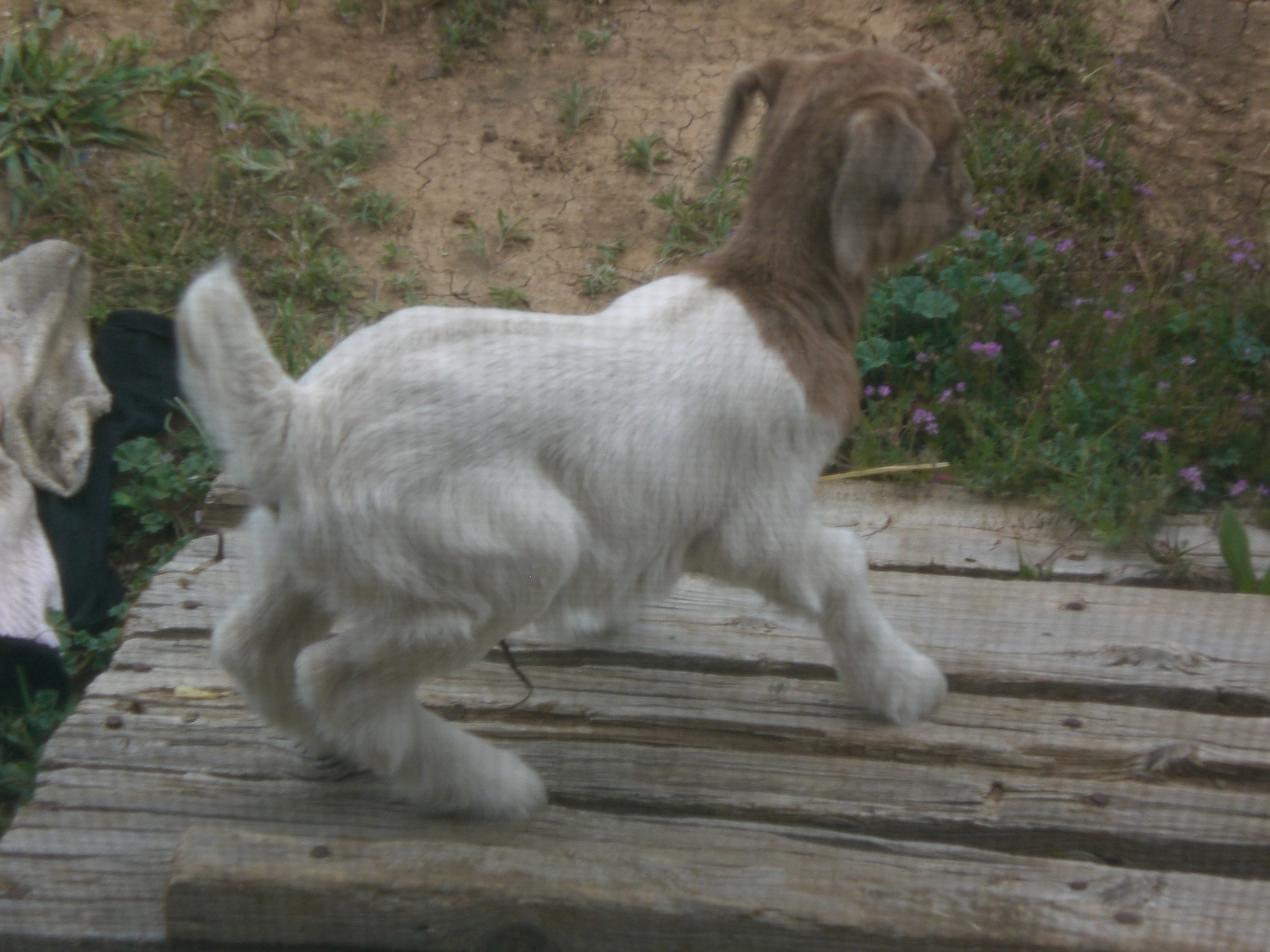
We do not scorn the cactus that fails to flower at Christmas. We are happy to welcome its flowering whenever it chooses to show its colors. I do not blame my goat Storm for persistently worming her way between the bars of the pasture gate; it is just her nature to want to get to that greener grass on the other side of the fence. I can’t imagine anyone blaming a snowflake for not looking identical to its neighbors on the patio. Why, then, are we so hard on ourselves and our fellow humans? Why can’t we simply accept that there is a wide range of individual variation in how people grow and respond and live, that our natures are as different, one from another, as are the many snowflakes that covered my yard four days ago? Then it was icy, snowy and cold while today it’s balmy and delightful outdoors. I don’t hear anyone saying “that’s wrong, that’s bad, Nature shouldn’t be so variable and inconsistent.”

Am I asking too much to wish that people could be as accepting of one another’s variability as we are of flowers, snowflakes, weather and stubbornly determined animals? To do so doesn’t mean abandoning standards of conduct, or being obliged to accept anything and everything as “cool, man” or “whatever.” If I meet someone who doesn’t seem to share my values, I am free to choose not to pursue the relationship. I don’t need to judge them, try to change them, or moralize about how and why they are as they are. And I can hope that they would, reciprocally, let me pass on without being subjected to attempts to change my vibrant red colors to muted pink ones.

Aspiration Accomplished

“Pantsing” as a Way of Life

October 22, 2015

A blog on elder issues that I follow, Time Goes By, Time Goes By recently discussed the idea of writing a ”final” post to be put up on a blog when the writer has passed away. Sort of an extension of making one’s funeral preferences known, completing a living will, etc. The stated intent, however is to have a way to say farewell to online followers/friends who may wonder what has happened, when posts cease to appear.

This is NOT my final blog, although my followers may indeed be wondering what has happened to me. I haven’t dared to check how long it’s been since my last post!

Not that I’ve stopped living, nor even stopped reflecting on all the living that is filling my days. I have, however, stopped making time to write out what I’ve been discovering during the rather brief reflective gaps in the hectic pace of my days. Perhaps now that the weather is changing, and more sedentary indoor days loom, I’ll be able to return to writing posts regularly.

Odd, that – I write regularly every day, just not “for pleasure” as is the case with this blog. I write summaries of the needs of my clients, I write persuasive letters to justify insurance coverage of exceptional procedures, I write recommendations to management for procedure changes to simplify my (and my 100 field co-worker) tasks. I even enjoy some of what I write for my “day job” but it is writing from the logical functions of my brain.

What tends to emerge in my essays that become blog posts is much more intuitive and – to me – more pleasurable. I don’t often know, when I start an essay, where it will end because I don’t “know” what it is that I know on the subject about which I have been cogitating. I wait for – and fortunately reliably receive – flashes of inspiration which mold themselves into coherence as I formulate the words to express the ideas and images which rise to awareness.

Should I be admitting in a public forum that I often don’t know what I’m going to say when I start to write? Will an editor at some future point read my manuscript submission and say that it’s obvious I have no idea what I’m writing about and that I’ve admitted as much already?

I hope not, since I do rework, rewrite and thoroughly edit the books and stories I send out (far too rarely now – my submission listing is sparse indeed). And I reread and edit my posts although not with the same degree of critical assessment as I give to works of fiction. It is part of the pleasure, for me, of posting, that I feel free to share what comes to me, rather in the way one speaks freely in a conversation with friends. Having to “watch one’s words” in fact describes a stilted and tense relationship between people, or at best a formal and careful one such as is the case for my day job writing which I mentioned above.

An interview I read recently asked a writer whether he was a “planner or a pantser” in the production of his novels. Like many of us would, I think, he replied that it depended on the circumstances. Some works require planning, others seem to take on life all on their own and – for me at least – write themselves through me. Those are the most fun and happily they quite commonly occur when I’m in the process of completing a post.

Pantsing this essay, I’ve come to a stop without feeling, in the logical part of my brain, that I’ve come to a coherent conclusion. Perhaps I have, however, accurately reflected the incoherent way my days are unfolding, full of unexpected events, and flashes of insight that bear little relationship to what I think of as the pattern of my days. I guess I’m pantsing my life at the moment, when I’ve always been something of a planner in that arena. Hmm… I should expect interesting new insights to accompany the very novel way my days are being filled.

Not a bad gift to self for the birthday in honor of which I’m putting up this post.
Best wishes to all – and thank you to my readers – for my new year ahead.


Autumn Color

Autumn Color

Right, Just and Good

June 16, 2015

A number of times lately I’ve set out to write a post and instead have spent my time playing solitaire. Forty Thieves occasionally but mostly Free Cell. I have no idea if I have set any sort of record on the latter – 4600 consecutive games without being stymied. I undo and start over when I see one not playing out – and a few times have had to repeat that process four or five times before I succeed. I think maybe that’s “cheating’’ when it comes to setting records, but since I’m not playing for a record I don’t suppose it matters.

What am I playing for? A sort of mindless zone out that lets my attention relax and float free, to be with my spiritual Master on the inner. Oddly, doing something seemingly profoundly mental (a card game) serves me as an avenue out of Mind and into a non-mind status.

Coming back to conscious awareness, I often have new insights, including ideas for posts – but too often have used up my free time that otherwise might have been spent writing. Alas, no matter how elastic time sometimes seems to be (long when I’m tired but obligated to keep working at my primary job, so short when I have a rare day to relax) it simply doesn’t stretch to encompass all that I want to accomplish in my “off work” hours.

Especially not now that I am coaching my husband through his demanding load of summer classes. He’s taking his first psychology course, being exposed to the discipline that was my major in college. I participated in a reunion (I won’t say which one) by Zoom conference last week, the first time I’ve ever attended any such activity. I enjoyed visiting with a few classmates, and seeing how differently we all look. But I realized, also, that I have very little interest in looking backwards to my years at Swarthmore. I greatly value the education I received, which has continuously served me well as I have taken up employment in a series of different fields. My appreciation of my teachers and the learning process is a present condition, however, with very little nostalgia attached.

Apparently one of the undertakings of my classmates on campus was to share personally significant memories about our years at school. I find that almost all of mine arise out of my own achievements, with relatively few memorable events, other than friendships made, involving other people. I was not “social”, although my senior year I captained the archery team, and I regularly performed with the modern dance troupe.

In that capacity, at the start of my senior year, I posted a notice seeking a musician to improvise in response to a dance I’d choreographed. The drummer who answered became one of my best, certainly most long-term and special friends, as we are still in communication close to a lifetime later. The experience of connection when I performed the dance for him to watch, with the next run-through a perfect match of music to movement, is a significant personal memory of Swarthmore.

Another is my feeling of floating over the ground as I left the oral exam for my philosophy courses. I’d spent over an hour with the visiting examiner, analyzing a statement I’d made in one of my written tests, to the effect that good, right and just are coextensive concepts, a core tenet and summary of my personal belief system. At the end of the session, the professor stepped back, looked over the blackboards that we’d filled with examples, and said “I think you have a coherent philosophical system laid out here.” It was not merely a validation of my intellect, but a deeply felt validation of my ethics and spiritual concepts of right conduct, or what I would now call Knowing, Being and Seeing.

Just as I now find value in what could seem to be mindless time wasting, moving cards around on a board, I guess I do also see value in occasionally looking back. If nothing else, when change is incremental and in such small steps as to be easily missed, looking back can provide a signpost marking the fact that change has in fact occurred – or perhaps it has not.

The important thing is not to get stuck with one’s sight turned to the past. Equally important, is to not be so focused on the future that the present is overlooked. I appreciate and value the reminder that “Life is what happens while you’re making other plans.” To be able to reach my end with as few regrets as my grandfather (who wished he’d learned to play the mandolin) I know I need, daily and here and now, to manifest the ethics that covered that classroom board and to Be in my life in each moment of it. When I succeed, I know such happiness 

In Ones and Twos

May 25, 2015

I’m taking my time reading In the Shadow of the Banyon, by Vaddey Ratner. Each section of a chapter is a meditation, a vividly imaged reflection on an aspect of relationships, whether between father and daughter, human and landscape, chaos and sanity, or physical and spiritual realities. Set in the time of the Khmer Rouge takeover of Cambodia, it is a marvelously sensitive and mature child’s view of life. The landscapes are familiar to me – Cambodia as described is much like the Vietnam of my childhood. The recounting of emotions stirred up by violence and turmoil, by loving relationships and by subtle but profound parental education of children is flawless, presenting – again – a familiar landscape. How can a story set in what I know to have been a devastating massacre of more than a third of the country’s population seem so quietly normal?

Maybe I’ll find an answer to that question by the time I finish the novel. Maybe I won’t, and the question will join others that I ponder about humans and our treatment of one another.

A discussion at the supper table recently explored a different aspect of the human condition, this one looking into interpersonal dynamics. The participants were, with the sole exception of me, young and not so young men from Cameroon studying here and trying to improve their lives and those of their families. Each of us has had a similar experience of a few people who are supportive of our efforts to advance, to learn, to become contributing partners in business or family – and each of us has been dismayed at some point by the negative response of a sibling, or cousin, or coworker.

What, we were asking, makes an older brother, working and well established in a good profession, refuse to help pay a school fee to enable his younger sibling to continue studies (and to remain in status vis a vis the US Immigration Service)? What makes an older sister complain to parents that the student struggling to survive in an unfamiliar culture has neglected to call her and inquire how she is doing? Why doesn’t she initiate the call? She is the elder, and yes one owes respect to one’s older siblings, but they in turn owe care and support to those coming behind them (at least in traditional Cameroonian village culture).

I have no siblings, so I can’t comment on how/whether there is a similar implicit set of obligations in western families. I can note that we acknowledge certain rights and corresponding obligations that go with seniority at work – and that there are usually one or more coworkers who object to this tradition. The Cameroonians commented that too often in their society, people fail to see the hard work, perseverance and sacrifice that goes into family advancement. They only look at the outcome and attribute the family’s change in status to graft, or black magic, or some similarly negatively acquired advantage which isn’t earned by merit.

Our discussion included the image of crabs in a barrel, reflecting the way some members of a group will not try to join the one climbing up and out but instead collect together and do their best to pull the leader back down to their failing level. I encountered the latter attitude locally, when I first started my role as director of a home health agency regional office. One of the nurses I hired for “as needed” visits had been employed as a clinic LPN for a number of years, attending school part-time to get her RN. When she did achieve it, the doctor heading her clinic gave her roses and I gave her a happy hug and a pay raise. Her several nurse co-workers scorned her achievement and excluded her from their circle.

At the dinner table, we didn’t talk about competition versus cooperation as a societal dynamic – but we could have done. Instead we stayed on a more individual level and came to the conclusion that people seem to fall into two main categories when it comes to achievement. The first group is of people who are motivated to achieve for the group of which they are members (family, clan, work team). They are generally open minded and flexible, enabling them to see and take advantage of opportunities that present themselves. They grab their chances, work hard and try to make the best of the gifts that come their way, gifts for which they easily express gratitude and thanks.

The second group is made up of those who single-mindedly think of and for themselves and their own advancement. They often seem to believe that the way forward is by finding an edge, an advantage, perhaps the softhearted person who can be persuaded or manipulated into giving them what they want. They work hard also – but their energy is devoted to manipulating others into giving them the preferment, the promotion, the degree or the job. And they disdain those who don’t cater to their sense of entitlement.

One thing we did all agree on, is that parenting and education play a role in which route a growing child decides to take – but neither parenting nor education explains why in a family of five or six siblings, there will always be at least one who falls into each of the two groups. In other words, nature plays a role, not just nurture. We did not digress into beliefs as to what makes for those inherent, nature-based differences. That is a topic for another dinner, or week of dinners, and another post.

Our conversation instead moved on to how we each (believing and being perceived by the rest as members of the first group) have chosen to deal with our relations who are part of the second group. Here, we parted ways. Some continue to try to engage the disdaining other by placating, by continuing to reach out despite the lack of reciprocity, and by “not sinking to their level”. Others have resolutely drawn a line, stating that “he has my number, when he chooses to call me I will talk to him but otherwise I’m functioning as if I don’t have a brother at all.” Neither route is satisfactory – nor were any of the several balancing acts falling between these two end points. However any of us decided to manage the situation, however comforted we felt that we are not alone in our quandary, however clearly we understood the nature of the differences between ourselves and those others, none of us was satisfied, not having a final answer to the question of “why” our opposites were the way they are. The closest we came was “C’est entre les mains de Dieu.” It’s in God’s hands.

As I write now, I’m aware that once again, as so often of late, I feel I have come up against a limit of rationality, a limit to mind’s ability to understand. Trying to reason my way to a course of action regarding the Group Twos in my life is futile. I need instead to let mind go still, and hear the inner voice of spirit directing me on what to do in this moment of this particular relationship. I need to remember that what is appropriate in this moment may be quite different in another moment of the same relationship.

Mind thinks in abstracts and wants answers that will be good for a period of time. Reality only exists in the moment, so there really are no answers to mind’s questions. It is enjoyable – and creates new and positive bonds – to talk things out with others, but the process does not, cannot lead to answers because the questions are by their nature unanswerable in the mental realm.

Which is undoubtedly why I am finding In the Shadow of the Banyon such a rewarding read – it invokes life as a constantly flowing series of moments of now, wherein questions are asked and answers have at least a possibility of arising. It speaks to the spirit within, more than to the mind. It covers births, and deaths, separations and new bonding. It beautifully reflects life. As does the newest member of our household, born just a week ago, on May 18th. Welcome to our world, Storm.


One Week Lively

One Week Lively

Winding Down

April 28, 2015

I seem, finally and despite much inner resistance, to be entering a phase of acceptance that my accumulated years have worn down my endurance to the point that I have to ration my energies.

In the near term this means giving up several of my enjoyable “sideline”’ activities like facilitating Alternatives to Violence Project workshops in the New Mexico prison system. My “day job” is so demanding of time, energy and attention that it exhausts my reserves by week’s end, and I need at least a full day of minimal responsibility to recuperate and regenerate the ability to work another week. Fortunately, I don’t have to remain totally idle for that day of rest; I do have to limit myself to relaxing activities – reading, walking, contemplation, lighthearted conversations – and occasionally also the composition of a blog essay. It’s heartening to realize that writing has become a relaxation exercise for me. I may no longer be able to teach an eight hour workshop after my week of work, but I can probably write for nearly that long if I choose to begin work on another book.

In a recent discussion, I tried to express how different it is, letting go of an activity – or reducing the intensity of one’s participation in it – when one is forty years of age versus when one is in one’s seventies. Somehow, at the younger point, at least for me, there remained a sense of vast opportunity and choice not unduly limited by a reduction in energy or ability. If I could no longer work all day plastering or laying a flagstone floor, without paying a stiff physical penalty – so be it. I would switch to painting or setting tile and carry on earning income in home construction, between professional positions that used my brain more than my back.

Now, however, accepting that I can’t both work full time and also lead workshops or teach, I don’t feel the same ease of adjustment to alternatives. I am being required to give up something, not just switch focus from one type of activity to another. This forced giving up might have come to my attention sooner, if I’d continued to be reliant on my physical strength for my livelihood. It is, after all, an ebbing of strength that is now curtailing my work weeks and reminding me that I can’t go thirteen days at a stretch without a break (two six- day work weeks and the Sunday in between).

Might I be able to continue the workshops and teaching if my work weeks were s more normal forty hours, instead of the fifty plus that they now run? Perhaps… I know for certain that I don’t have the energy to go looking for a different, less intense, job. And I acknowledge that I’m reluctant to give up a position that allows me to work from home several days a week, even though it also involves many miles of weekly travel to see clients, and many evening and weekend hours invested to meet deadlines.

When I consider the adjustments I’m facing, they are minor compared to those some of my clients – and friends – have had to face, due not so much to the wear and tear of life as to illness or accident. One friend who’s pride has been that, the only woman on the county crew, she is as strong and tough as the men, injured her back and is now unable to work, unable to stand for more than a short while, and equally unable to sit for long without severe pain. She has had to give up not only her job but all the housework, animal care and other activities that structured her days. Fortunately she likes to cook and bake, and can manage time in the kitchen by alternately sitting and standing, with breaks to lie down and ease her pain. She has no choice but to develop a new way of defining herself.

Is it easier to accept change if one is confronted with a sudden and total decline of functional level, rather than to feel oneself slowly slipping into loss of abilities? I’m not sure. The question is rather like that discussed in training sessions with nursing staff – whether it’s easier on families to care for a loved one over an extended decline in health, or to lose the family member suddenly from an accident or rapid health crisis, like a fatal stroke or heart attack.

When loss or change comes suddenly and irreversibly, one has no choice but to deal with the consequences. When the loss or change is slow or incremental, it is easier to deny that any adaptation is needed, or at least to insist that it’s “not needed yet”. But it may ultimately become harder to adapt if the needed changes are postponed too long.

I have a good many goals yet to accomplish. If I’m to live long enough, and have the necessary energy to achieve them, I must begin making adjustments now. Fortunately, I now have a partner to help, encourage, nudge, remind and sometimes insist that I give myself down time. It’s easier for me to accede to the change, and not feel guilty about the activities I’m no longer supporting, when I can say I’m doing it a the behest of someone else. Which I recognize is an admission that I still haven’t gotten over the feeling that I must justify myself by my actions. But that’s another topic, for another reflection, on another day. For now, I need only begin the process of finding myself comfortable doing less. Or as a dear friend has said, when we talked about doing versus being, turn the challenge now facing me into the refrain of a song – do be do be do be do.


Only Fragments

Love Letters to the Tar Pit

KarusaaVerse

Words that Sparkle, Thoughts that Ignite: Fueling Your Imagination

Leaf And Twig

Where observation and imagination meet nature in poetry.

Millarson Diaries

Personal Musings and Thought Experiments

The Beauty Along the Road

Discovering Beauty in the small details of our lives

Flowerwatch Journal

Notes on Traveling with Flowers

1eclecticwriter

Wide-Ranging Commentary

Spirituality Exploration Today

Delving into the cross roads of rationality and intuition

smilecalm

Life through Mindful Media

A Good Blog is Hard to Find

I will shatter a word and scatter the contents into the wind to share it with the world.

Ray Ferrer - Emotion on Canvas

** OFFICIAL Site of Artist Ray Ferrer **

AKA The Versatile

Fashion | Lifestyle | Food & Travel | Beauty | Fitness | Education | Product Reviews | Movies | Doodling | Poetess

Aging Abundantly | Women Over Fifty | Empty Nesters | Caregivers | Aging Gracefully

Finding Joy at Every Age with writer/philosopher Dorothy Sander

ARTZZLE

Helping with the Pieces in Life's Puzzle of Art and Design

Project Light to Life

A bucket list blog: exploring happiness, growth, and the world.

The Daily Post

The Art and Craft of Blogging

Any Shiny Thing

MIDLIFE MAGIC

allmostrelevant

@allmostrelevant

The Irrefutable Opinion

Assaults on the Casually Mundane by K. Jean King