Posts Tagged ‘spiritual development’

Warm Furries

November 30, 2013

Five doves are fluffily hunched on the gate to the long pasture, seeming to emit waves of discontent because their bird food plate is piled high with snow rather than seed. I will probably succumb to the pressure shortly, and wade around the house with a bowl of feed for them. I doubt that my steps will imitate my Shih Tzu’s curious snow shuffle, though. I’ve been watching Shian Shung coming toward me down the drive, each front paw’s forward motion initiating a wave of snow rippling slightly sideward. It is the strangest looking movement, suggesting he has suddenly acquired the widely feathered feet of a nun pigeon. Or as though he is swimming his front legs through the fluffy white stuff that is belly deep for him.

De-iced

De-iced

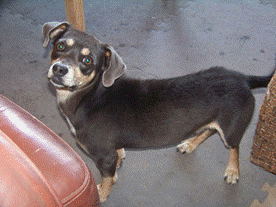
My Min-Pin, Doodles, being a short hair, seems able to bounce through the same drifts, almost as though he’s walking on top of the snow instead of wading through it. Not any taller than Shian Shung, he has more of his minimal height in his legs, and an overall springier step. When excited, he can easily bounce to shoulder height on my Lab/Collie cross. And does so frequently, trying to get Blackjack’s attention away from the food bowl, gnawed deer bones, or the treats in my hand.
Aw, please...

Aw, please…

Doodles survived in his earliest life as a dumpster diver – he was about six months old when I collected him from a distant ranch and brought him to live with the rest of my motley crew. Eighteen months of ample and regular food has not yet broken him of the need to be in charge of any edible in the vicinity. Fortunately, Blackjack has a tolerant demeanor, only rarely exerting his considerable might to retain possession of a favored goodie.

Blackjack in Charge

Blackjack in Charge

The fourth member of my canine family is an elderly toy poodle – like Blackjack and Doodles also a rescue – with more serious personality issues. I know nothing about his earlier life, but it cannot have been easy. He was found at death’s door, totally dehydrated, his fur invisible beneath a matting of burrs, his belly distended and sagging to the ground. He growled and snapped at every attempt to care for him, requiring sedation by the vet before medical attention and a total body shave. Damaged intestines, causing the sagging belly, seems likely to be the result of being hit by a car; the injury continues to cause him intermittent constipation.

Warrior newly clipped

Warrior newly clipped

If left by himself, Warrior whimpers ceaselessly, or barks non-stop for an hour or more. Six months after arrival, he began to let me pet or groom him. Diametrically opposite to Doodles, he is reluctant to accept treats, which he requires be set down in front of him, to consider at length, before he will venture a nibble. Consequently, he loses them to Doodles unless they are offered when the other three dogs are off exploring. Which happens reliably enough that Warrior does get treats, but is also unhappily alone for periods of the day.

Blackjack shows remarkable patience with the littles. He lets Doodles and Shian Shung play out attack strategies, his legs and ears the more common targets. He makes sure Warrior has the warmest spot on the porch, and tolerates Doodles’ determination to be first at the food bowls. I remember to give him an extra rub around the head and muzzle, and to tell him he is the senior, and most essential, member of the pack. His calm demeanor, his defining of the boundaries outside which the others should not roam, his lessons about what is and is not fit to eat, and his manner of greeting – or guarding against – visitors to my acres all combine to transmit the expectations I have set about tolerance, respect, and appropriate behavior.

The Littles

The Littles

Over the 40 years I’ve lived in rural settings here in northern New Mexico, my one consistent rule for all pets has been that they must get along with one another. Not like, not necessarily interact, but tolerate and make space for all who wind up calling my home theirs. As a result, I’ve had a dog who let newborn kittens nurse on her while their mother took a break from the constant demands of parenting. I have photos of a cat cuddling with a Bouvier de Flandres large enough to squash her if he’d rolled over. That same Bouvier encircled an escaped rabbit and kept it safely between his paws until I got home and returned Mr. Bunny to his cage.
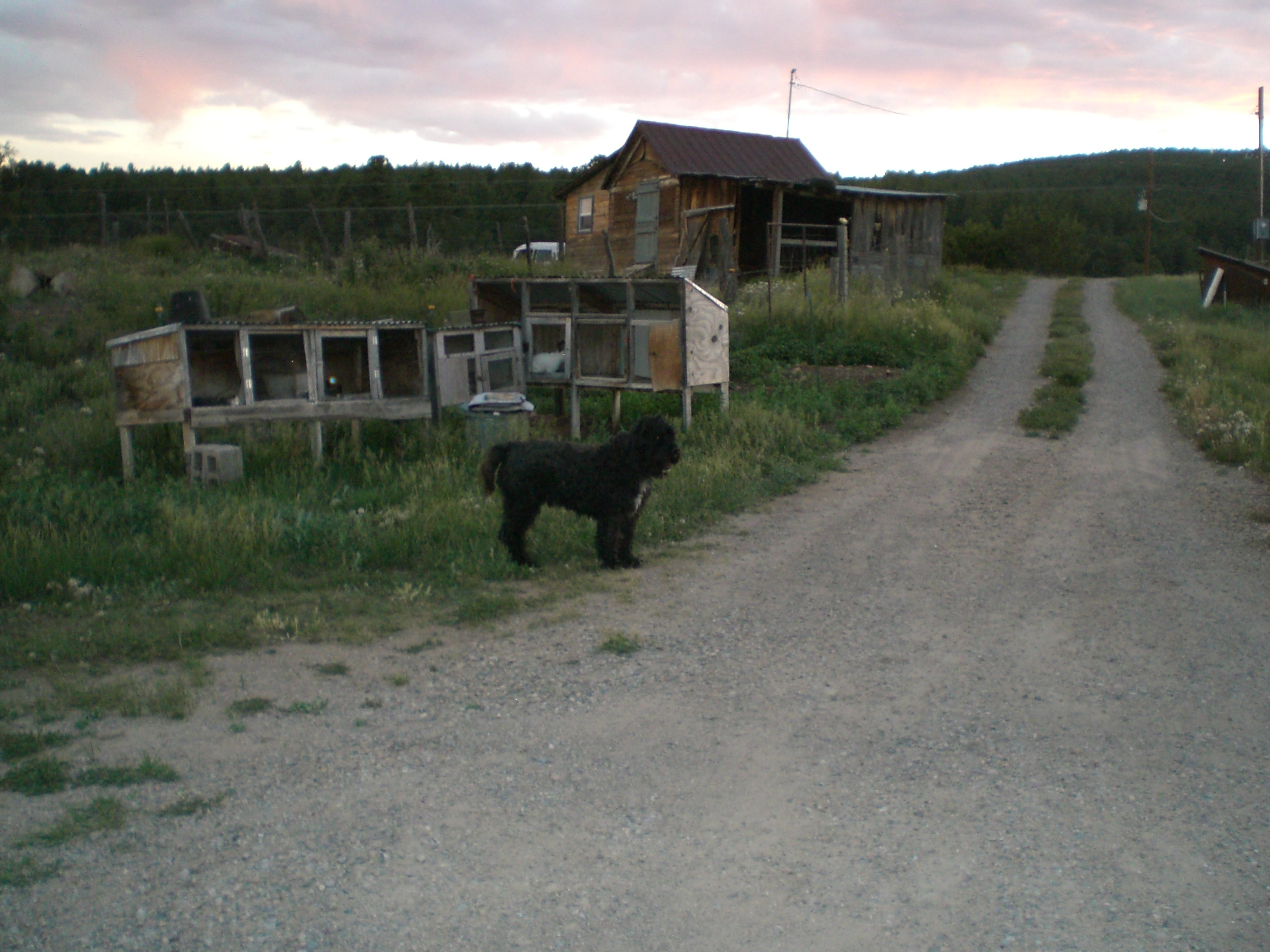
Guarding the rabbit cages

Guarding the rabbit cages

The coincidence of Thanksgiving with the first day of Hanukkah – an event apparently not to reoccur for an enormously long time – allows me to celebrate my two favorite holidays in one. Favorite because both encourage not just thankfulness, but also appreciation of freedom, joy in new beginnings, and the pleasure of connecting across boundaries.

In a heap

In a heap

I am grateful to have observed these same feelings played out amongst my four-legged family members.
I am grateful to be reminded by my furry friends, each time I hunker down to pet and play with them, that I don’t have to wait for Thanksgiving or Hanukkah to participate in a demonstration of tolerance, respect, and appreciation.
They keep me sane, they make me welcome, they direct me back to balance when I start to tilt off center, they define home.
For all this, a lower reflection of the inner beauty being shown me by my spiritual Master, I am thankful.

Ba Gua Lessons

October 12, 2013

As I count down the days until the start of the intense training period for my new job, I find myself in yet another dichotomy. Do I laze about as much as possible, wallowing in the freedom-to-do-nothing that is about to vanish from my life? Or do I begin a disciplined adaptation to going to bed earlier, getting up early, and organizing my days to accomplish tasks that it will be hard to fit into my upcoming schedule? Or, more practically, do I aim to achieve a balance of both tendencies?

My acupuncturist/friend/wise-teacher commented that it is often the case that moving to the extreme of yin (doing nothing) pushes one into yang (activity) so that resting instead of participating in activities can be an excellent preparation for the burst of energy that will be required of me. I liken this approach to the one I’m learning from the same friend and teacher when we practice Ba Gua, wherein movements are designed to “coil” muscles like tightened springs, until the point of release. The force of the release may serve as the attack (the martial part of the art) or may be contained and redirected into intensifying the next coiling movement.

It’s difficult to consider what Western culture calls laziness and idleness as appropriate preparation for a required, new and busy schedule. In that mentality, I definitely should already be adhering to the new (yang) schedule of waking, and filling my days with tasks, accustoming my body to delivering energy and clarity of mind across the ten or so hours of an upcoming busy day. But what happens if I rename the preparation period (the yin) in an Eastern fashion, and say that I am practicing stillness and emptiness? Then I am setting up a powerful contrast, with the potential for sustained energy emerging from the containment being practiced this week.

What a difference a few words make! Try them out. Spend a chunk of time playing solitaire, or just sitting and watching the wind blow the drying grasses of autumn.

Bosque del Apache, New Mexico

Bosque del Apache, New Mexico

Call yourself idle and lazy for failing to do something constructive with your time. Then, rename that time as allowing yourself to be still and mindless, outside your usual sense of yourself. Which set of terms weakens you? Which seems to relax and yet energize you?

To a large extent, even when I’m not engaged in writing, I live my life through words. My grandfather taught me the importance of choosing the right ones, when he talked to me about his poetry. His choices were in Hebrew, and constrained not only by the meter and rhyme of his verse, but by his dedication to purity of the language. (Words created for items that did not exist in ancient culture should, in his opinion, follow the traditional structural frame as to number of consonant sounds).

My experience of parents whose behaviors were often in contradiction with their words led to my dedication to accurate and clear communication. A lonely and isolated childhood built my desire for connection with others, and to the understanding that communication is a two-way street. I do not communicate when I talk (or write); I only communicate when what I say is heard and understood by another.

For others to hear and understand me, I need to understand them – hence my choice of psychology as a major in college, and my continuing interest in neurology now. Also my engagement with the several programs I lead or teach (including Alternatives to Violence Project and Chronic Disease Self- Management), both having to do with learning concepts that help one direct and control behavior.

Which brings me back to Ba Gua, teaching my body new ways of moving, and simultaneously reinforcing flexibility of mind. And back to the importance of just the right words – stillness and emptiness creating a vacuum which attracts energy, to be stored and contained until it explodes into action. So much more sustaining than to label my down time as idle laziness that should be filled with doing.

The first time I attended a feast day dance at one of New Mexico’s Pueblos, I observed a dancer carrying an old-fashioned alarm clock, the sort that is wound with a key, ticks loudly and has a clanging alarm. The dancer teased non-Native observers with the clock, shaking it in our faces, setting off the alarm suddenly and startling visitors with its discordant noise. Eventually, he tossed the clock away and joined the line performing traditional steps in a mesmerizing, repetitive pattern. Time did then disappear, as spectators and participants focused totally on what was happening in the moment.

I suggest that much that we like, whether a good book, a particular hobby, an activity, or a piece of art or music is liked precisely because it has the capacity to capture our attention strongly, and thus to eliminate our sense of time and ego. Being present in the moment with the object of our attention creates a satisfying energetic stillness, and an expanded sense of connection, of capacity, of self.

Those fortunate individuals who are able to combine such likes with their means of employment do not describe what they do as work. They are more apt to describe a career as pursuing a passion. Those less fortunate in the choice or conditions of employment go to work, and then try to find free time for pleasures to balance what they have sacrificed for the earning of income.

You may have noticed in previous posts that I have not called my new job “work”. For the past eighteen months, I’ve been able to live mostly in the present moment, doing what is in front of me to do each day. I really like this way of being. My intention is to continue in this manner, acknowledging that there will be more things in front of me to do, in many of the upcoming days, than there have been in the past ones. I have determined not to change my approach to the doing of them. I will find energy for the doing by assuring that I remain centered in being.

As my body improves its stability and strength through Ba Gua practice, so too my mind – and its use of words – expands its capacity to “hold the tension of opposites” and to achieve balance. For important external reasons, I am starting a new job. For vital internal ones, it will not be work. Activities required of me by the new job will be integrated into the pattern of observing, of writing, of being that has nourished me of late.

Please, if you notice that I’m falling away from center, alert me! If my words seem poorly chosen, my posts less reflective, give me a nudge. I need to know that I’m continuing to communicate with you, not slipping into a stress-driven rant.

Thank you for reading, and for feedback.

An Appreciation of Habits

October 6, 2013

Interesting how many unthinking habits are revealed when the pressure tank in the well fails, and a household is without water! Over the years, we’ve been waterless several times, for different reasons. The most difficult was the winter it got down to 30F below and someone forgot to leave faucets dripping, resulting in a frozen water line. That time it took 4 days to restore water flow, fortunately without associated broken pipes. Four days of not being able to flush toilets, or easily wash hands. Of hauling water in three gallon bottles, doling it out in dribbles for washing with a cloth in the sink, “birding off” as a friend used to call it (another acquaintance used to refer to the same process, I know not why, as a whore bath).

This latest episode of being without running water lasted only a little over 24 hours, in warm enough weather to need to shower, not just dab and dry. I gained experience at showering without access to running water back in my early teens, when we lived in Saigon.

Our House, a Very Very Very Fine House - Saigon, 1956

Our House, a Very Very Very Fine House – Saigon, 1956

Water only flowed in our housing compound for about two hours a day. The live-in maid would fill large vats with a hose from a standpipe, then carry buckets up to the bathroom whenever someone needed to bathe. Showering became a matter of pouring a bucket over oneself, soaping, pouring another bucket to rinse, and drying off. In the steamy heat, two or even three showers a day were necessary. A five person household used a vat of water just for bathing. The second vat supplied water for cooking and mopping and hand washing.

In those days, I also learned how to throw a bucket of water (the third vat’s supply) with just the right force, at just the right angle, into a toilet to force it to flush. In recent days, I learned I am still able to shower by the bucket, but have lost the knack of the toilet flush. Or maybe modern toilets are less amenable to alternative flushing procedures? In any case, the knowledge of how to manage without running water rose up from depths, at the same time as I caught myself automatically reaching behind to flush the toilet that had no water in its tank. Knowing there was no water did not stop the unthinking hand gesture.

How many other actions of daily life, including much less mundane ones, do we unthinkingly perform? How many aspects of our routine do we take for granted? And what about people… how often do we take them for granted? Or respond to them out of habit? Or respond to a present situation with an inappropriate habit learned in childhood?

Regrettably, my mother was only able to experience disappointment with life. She had a unique knack for projecting that disappointment, ensuring by her actions that anything I looked forward to with happy anticipation would fit her world view, and therefore not materialize positively in my life. My childhood was one of fearing to express what I wanted, since to do so was to assure it would not happen. Put differently, I became ingrained with the behavior of waiting for the other shoe to drop. As I matured, left home and began living my own values, I gradually freed myself from maternal negativity, and experienced lots of positives. Life brings mostly what one looks to receive from it – and I look with curiosity for new opportunities, good friends, and spiritual growth. I’ve been blessed to receive an abundance of all these.

So – how surprising to discover, in recent days, that a corner of my being is busy defending itself against a shoe dropping, in relation to my upcoming new employment! Why am I suddenly hearing myself reason that I should delay certain purchases because one should never “count chickens before they are hatched?” In ten weeks of living and working on the Maine coast at a home without electricity, I ‘forgot’ the habit of reaching for a wall switch when I entered a dark room. So why do I, after 50 years of living away from my mother’s fearful negativity still subconsciously duck and cover in response to upcoming positive and desired changes?

The Habit of Following Along

The Habit of Following Along

Well, at least I recognize the old emotional habit and can now practice setting it aside. I hope I have more success breaking that pattern than I’ve had with the one that leads me to look up to the right as I leave my living room. For nearly 20 years I had a clock on that right-hand wall – it’s been gone for 2 years now but I still glance there to see the time. And then laugh at myself. I suspect that being able to laugh at practicing an outdated habit is a step in the direction of letting it go, so I will chuckle to myself if I fall back into emotional duck and cover. What better way to switch over to a positive attitude?

And I do intend to retain the habit of washing with minimal water, although not the bucket method needed so recently. Collecting the water that accumulates until a suitable temperature is reached, and turning off the shower while soaping up, have become common sense habits in our continuing drought-plagued environment. Hmmm… I wonder, if someday I move to a place where water is abundant, will my water-saving habits endure?

Creativity in a Second Language

September 15, 2013

I’ve started a new class through Coursera – a MOOC – that apparently has close to 125,000 people signed up for it worldwide. Mind boggling to think of that many students going to class together. The topic is Creativity – and in keeping with the course’s intent to promote more creative lives among the students, I’ve joined a subgroup of French speakers enrolled in the class. A challenging way to resurrect my skills with a language which I once spoke and wrote fluently, but which I’ve had little occasion to use in the last thirty years. Since the class is on-line, that means I’m writing French – the most difficult way to use a language skill. Should be an interesting eight weeks!

The first assignment included an option to make a sort of life map – identifying a core value at the center of everything one does, and then listing 3-5 priorities in each area of life, such as family, career, community, etc. I found the exercise relatively easy to do, given that my spiritual path (MasterPath) calls for a consistent effort to examine and process one’s life experiences. But I also attribute some of the ease to age – one doesn’t get to 70 and still engaged with employment, learning and community service, without having examined one’s priorities, and kept tabs on how they evolve over time.

What didn’t get addressed by the Life Ring activity was what I’d call a question of style – how do you, I, we approach daily life? I’m scheduled to facilitate an Alternatives to Violence Project (AVP) workshop with a competent co-leader who is very organized, detail oriented, and most comfortable when every aspect of the workshop is clearly spelled out in advance, including how each activity links to a small number of specific topics. I on the other hand, like to ‘wing it’ for at least part of the weekend. I’ve put together an agenda that includes exercises which can be related to a number of different topics. Part of the challenge – and the learning – that I value in AVP is how it reveals interrelationships that participants have not previously considered. I trust my own skill at helping tie those relationships together, and therefore like to leave room for the unexpected to emerge as the activities are processed.

There’s a lot to be learned co-facilitating with someone whose style differs from mine. Birds of a feather may indeed flock together – but do they learn how to get along with those of a different plumage? We draw reassurance from associating with others like ourselves. We learn and grow when challenged by those with whom we have differences. Which makes the concept of thousands of students from a hundred or more different cultures all joining together to explore creativity a highly innovative concept.

The Francophone subgroup is on LinkedIn, enabling me to check the careers and interests of other members, as they can review mine. Most of those I’ve looked up so far are younger, in business, engineering, industry, very few list teaching, none that I’ve found so far work in social service or health-related careers as I have done. The instructors for the course want the students to find ways to apply the concepts we study to our fields of endeavor, and to work together in teams to develop those projects. I seem to have set myself up to stretch my creativity to the max, finding ways to apply my skills, in a second language, to areas of life with which I have little if any experience! Should be fun…Meanwhile, the course does stress that we all have the capacity to be creative – and that our styles do indeed differ. We have all been asked to take a survey that classifies us along a continuum from adaptively creative to innovatively creative. I come up moderately innovative. I suspect my AVP co-facilitator would land somewhere on the adaptive end of the dimension. I’m realizing, as I write, that by putting on the workshop with her later this month, I will have completed the major assignment of the course – which is to apply the principles of creativity, in conjunction with others, to an aspect of my professional life. Thankfully I don’t have to put on the workshop in French!

Older… and Wiser?

August 30, 2013

Have you noticed that the ‘older’ part of ‘older but wiser’ is singularly obvious in wrinkles, aches, and the need for Post-It notes littered over every surface – but the wiser part is much harder to recognize? Especially when the dog mouths one of those Post-It notes, and you have to make an extra trip back to town for the three forgotten items of the six that you need to make supper.

How delightful, how ego-boosting it is, then, when circumstances allow you to recognize that the ‘wiser’ at least occasionally manifests. A recent experience allowed me to feel grateful for whatever passes for wisdom in my brain. I had thought to pursue a course of study which would require me to hold in equal respect two conflicting paths to spiritual understanding. My training directed me along one path, my mental inclination tempted me onto the other. The studies would have meant constantly balancing two goals, two world views, two concepts of self. The outcome of the program would have enabled me to practice in a field I’d like to enter, for which I do not – at least at this point – see another means of qualifying.

So I did all the paperwork, wrote the essays, completed the application – and then was denied acceptance. What to do now???

Here’s where the wiser comes in. I did nothing, just let the fact of the denial settle into my awareness. Within a few days, I had one of those blessed “aha” experiences, a flash of insight that allows me to lay at least passing claim to wisdom. Recognition is enough! Seeing the differences between the two paths, understanding how different aspects of myself are drawn to each of them, and knowing that I am capable of continuing to follow one while learning the other – that is the recognition. And it is enough. I don’t have to also undergo the stress of carrying awareness of the paths and their differences through a two year course of study.

Wiser seems to be at work in my growing ability to move through a mine field of life choices while maintaining a ‘neither for nor against’ mentality.

Older is definitely a handicap in my search for paid employment. I cannot help but believe that the on-line application and screening systems which substitute for preliminary job interviews include an edit that discards all applications with college graduation dates before 1990 (the application isn’t accepted if a graduation date is left blank). No other explanation accounts for a year of denials of my applications for positions for which I meet every criterion, which mirror work I have already done successfully, and which are written using all the key words of the job description included in my work summary. Wiser allows me to keep the constant rejection at arm’s length, not translating it into a feeling of personal inadequacy. The right income opportunity will come my way, so long as I keep an open, explore-everything approach to the search – and all this rejection is good practice for the inevitable “send out twenty stories to get one accepted” that mark a writing life.

+++++++++++++++

Older is what I will be – starting another decade – on my next birthday in the autumn. Wiser is what I hope also to be by then, having learned the parameters of a new job which I’ve been offered, and having experienced yet again the virtues of patience. I’ve been hired into a position which exceeds every criterion I had set – flexible hours, service to others, supportive and enjoyable coworkers. And I have almost two months to discern how to maintain my established writing pace while fulfilling the job’s requirements. I’m old enough to know that won’t be easy. Hopefully I’m wise enough to know both how important the writing is to my sense of well-being, and how possible it is to “have it all.” With patience, I will see the way.

Choices

August 18, 2013

For the past year I’ve been living in a way most of us are taught not to… day to day, with no ‘life goals’ and few plans that reach more than a week or two into the future. It’s a natural way to be; children wake each morning to a truly new day, one full of possibilities. They have to be trained to ignore distractions and to stay focused on mandates – good grades, keeping a room picked up, personal cleanliness, helping with household chores, thinking ahead.

Oh yes, thinking ahead. You didn’t make your bed when you should have done, so now you have to do it instead of watching your favorite TV show. You should have thought ahead! You’ve been skimping on your homework, now you’re failing 5th grade, though you’ve been warned over and over. You only have one six week grading period left to bring your work up to acceptable level. You’ll be doing nothing but school work from now until the term ends. No trips, no play, no time for fun… you should have thought ahead!

Sorry, Mom and Dad, but I’ve been determinedly not thinking ahead. There is a point, ahead out there somewhere, when I will run out of savings and, without income, be destitute. I’m not ignoring that fact, but I’m not focused on it. My wise teacher instructs that attention is food – what one attends to grows in one’s life.

Conversely: ”If you want something to leave your life, take your attention off of it.”

I see no benefit from worrying about a maybe some three years off into the future, so I am attending to what is here with me in the present. I have been searching job boards, applying for everything that seems a possibility. Like many older people in the job market, I get few responses. Experience seems not to be valued any longer. Employers want new young minds to train to their special priorities. They want to mimic parents, who know instinctively that training children to think ahead, plan for the future, and learn habits of daily living is easier when the children are young and haven’t yet had enough experience to question the parental dictates.

So how do I communicate, in a standard application and resume submission, that part of my experience has been learning to be open to new ways of doing things, new goals and new achievements? Do I say that I have been living day to day for a year now, proof of my ability to be flexible and adaptable? Do I use, in a cover letter, another image from my spiritual teacher, of riding a horse up a creek and, at a moment’s notice and for no conscious reason, jumping the horse up onto the bank? Knowing when to listen to one’s inner voice (intuition, or spiritual knowing) can indeed be the skill that saves one, in what turns out to be the nick of time, from a tumultuous flash flood gushing down the creek bed.

Asked what I’m looking for in new employment, I could perhaps best answer by saying I seek the employer who will appreciate the depth of meaning in my teacher’s story. Or one who could read Lesley S. King’s recent post entitled Face Your Inner Mischief, about her yapping mind, and understand it for the beautiful parable it is. I seek an employer who has the ability to appreciate the innovative, the creative, the self-directed in others because that is what he/she is also. Someone not threatened by new ideas, not hearing questions as challenges to authority but rather as the positive contributions of an assistant engaged in the process of achieving goals which, themselves, may shift with time and experience.

Living each day for what it offers, as I have done of late, could be considered a rejection of the values my parents, particularly my father, taught – to plan, to delay immediate gratification for a larger achievement; to save and be mindful of expenses, so as to have financial resources when they are needed; to be cautious and consider all possible consequences before acting. Indeed, much of my life could be seen as a rejection of those values; I’ve left higher paying jobs for lower paying ones on a matter of principle; I’ve spoken out about fundamental rights and been blacklisted; I’ve challenged the status quo in large and also in small ways, living as my friend Jane said recently, when she wrote, “I did what the Holy Spirit led me to do, and I can do no other.”

Nonetheless, there is a way in which I still embody the underlying lesson my father – and most parents – try to teach their children. That silent message is about acquiring the ability to choose – i.e. to have an understanding of cause and effect, an ability to be patient long enough to experience outcomes, and a sense of what information comes from within one’s being and what is imposed from ‘outside’. With these three skills, one can choose – to follow outside dictates or respond in opposition to them; to stick with an unsatisfactory job or to leave it without another already in place to go to; to value integrity more than security, or patience more than impulsiveness.

Ultimately, it is our choices – or lack of them – that define our lives. Lucky is the child of a parent who knows to teach how, but not what, to choose. Blessed is the individual who learns from a spiritual teacher that worlds exist beyond the mundane, and that we all have within us the capacity to manifest Truth, to Hear the Word, to be led by the Holy Spirit, in whatever language or manner of Knowing we choose to embrace.

As I continue to practice not knowing, living open to whatever turns out to be my ‘next step’, I am content. I have made my choices and, again like my friend Jane, I have paid a price, but “I would do it all over again.”

It’s good to know that I’m fulfilling my promise to myself, made shortly before my grandfather’s passing, to live my life so that whenever my time of transition arrives, I will have as few regrets as he did on his deathbed. His nearly final words to me were, “I possibly should have remarried – it would have been better for your mother, but I never found a woman I wanted to marry… and I wish I’d learned to play the mandolin.”

May we all make our choices such that we can sum up our lives as contentedly and succinctly!

Plenty of Nothin’ is Plenty

August 4, 2013

I wonder if the hardest part of getting older is not the challenges of coping with a failing body and mind, nor the inevitable sorrow of losing friends and peers, but the gradual – or sometimes very sudden – loss of illusions, loss of aspirations, loss of hope. At some point we all face the recognition that a cherished desire or goal is not going to be fulfilled. What then?

Psychologists have given labels to the behavior engendered by some of these confrontations – empty nest syndrome and male menopause being the most prominent. Those two experiences are primarily about accepting transitions in one’s life path rather than about loss of a way forward. It may be hard for a mother to accept that her children are grown and must be allowed to live their own lives while she redefines herself – she will still be a mother, but engaged differently in the lives of her family. And just as business managers must adapt their style when a company transitions from growth to maintenance mode, so some men must accept – at some point in their careers – that they have reached a plateau where they may expect to be for the rest of their working lives.

(Yes I’m aware of the sexist, stereotypical nature of the two above examples. Men may indeed have troubled letting go of a familiar pattern of fathering, and career women also have to recognize the point at which their professional lives plateau.)

Except, of course, that creative men and women reinvent themselves, begin new careers, take up new interests and continue to make contributions to their community, their families and themselves, often to the end of their days. Of what is that creativity made? Is it something more than a stark refusal to concede to lost illusions, lost aspirations, lost hope?

Consider a particular expectation – that of finding someone with whom one can walk life’s path, a partner to share the joys and sorrows, someone to ‘be there’ when support is needed. Some of us are lucky enough to find such a mate. Almost all of us are given the expectation that we will be in that lucky group. We read novels about these ‘good’ marriages and we see – or think we see – examples around us. We may or may not also learn that romantic love doesn’t hold up well to the stresses of married life, but that if again we are lucky, we discover a more stable, enduring form of love that does survive the inevitable losses life brings. Above all, if we are lucky, we find someone with whom we can share (and thereby halve) the pain, and share (and thereby double) the pleasures life brings our way.

But what of those who do not find such a partner? Or who find a partner incapable of sharing in a way meaningful to us? There are many such people, their stories recorded over and over again in country western songs. How do we move past the realization that we have come to a point in life where it is clear there will not ever “be someone to hold me while I cry?”

Those of us who are fortunate enough, wise enough to let go of the demand for a single person to fulfill the human need for companionship often find ourselves with support in unexpected but very meaningful ways. When I cracked my spine in a horseback riding accident, a neighbor showed up daily to do my chores and another took off from her work whenever needed, to drive me to my own work and appointments. And years ago, after the love in my life was yanked away, an acquaintance from the Quakers volunteered herself into my new home to help me unpack and settle, and to hold me while I cried.

My spiritual teacher instructs that attention is food. What we give attention to multiplies. Inversely, the way to remove something unwanted from one’s life is to simply take one’s attention off it. Focusing on what is missing from life (a forever mate for example) will only push the possibility of finding one farther away. Psychologists have used transactional analysis to spell out the emotional dynamics of this truth, and shown how unhealthy, unequal relationships are formed from neediness. Most are unfulfilling and unsustainable. In the end, they rupture and dump the needy person right back where he/she began, in the classic cycle of repetitively marrying an abuser, an alcoholic, a philanderer, et cetera. I love the accuracy of the title of the landmark book in this field, Games People Play.

We have the option not to play games. Creatively fulfilling our needs for companionship, for attention, for support by drawing on a variety of resources – including ourselves – shifts attention away from lack and loss and toward plenty. With attention on plenty, it multiplies in a happy way. Porgy, in the operetta Porgy and Bess, expresses giving attention to sufficiency so well:
I got plenty of nothing,
And nothing’s plenty for me.
I got no car – got no mule,
I got no misery.
Folks with plenty of plenty,
They’ve got a lock on the door,
Afraid somebody’s gonna rob ’em
While they’re out (a) making more – what for?
I got no lock on the door – that’s no way to be.
They can steal the rug from the floor – that’s OK with me.
‘Cause the things that I prize – like the stars in the skies – are all free.

I have so much more than nothing. Most of us do. Whether or not all our dreams are fulfilled, are we not plenty-full?

Plenty

Plenty

Solitude

July 28, 2013

Keeping on, keeping on

I’ve just finished reading Sara Donati’s Fire in the Sky, committing to myself to find the next book in her series about the Bonner family, and life in upstate New York in America’s early years. In an afterward, Donati states that she hopes she has done her work well enough for readers to seek out histories of the period, the War of 1812, which she feels is given short shrift in school history lessons. If my own experience is any indicator, she’s correct. My recollection of what I learned in elementary school about that war is limited to the battle at Fort McHenry and its role in the origin of our national anthem. High school American history class gave me even less about the War of 1812 – undoubtedly because the lesson was taught in a school in Paris, by a British woman who dismissed the entire affair as a “skirmish on the edge” of the important war happening at that time – Britain versus Napoleonic France.

My take-away from Donati’s writing is not, however, an interest in researching the complexities of what U.S. history books also refer to as the ”period between the French and Indian Wars and the settling of the West” (i.e. all the anguish and horror of the Amerindian experience with European intolerance). My take-away from Donati’s well written, engrossing series is far more personal – a profound feeling of loss, and a bone-deep sense of aloneness. Unlike the characters in this novel, who are an extended family with deep interconnections and emotional commitments to one another – unlike these people written into vivid life – I am alone. Profoundly alone. Only child of older parents long deceased, no first cousins, formerly married to a loner whose own small family (one brother and his children) made me welcome but with whom I have too little in common to connect. I have no children of my own, and never had the occasion to adopt any.

Mind you, I am not lonely. I like my own company, indeed find that I need solitude and tire quickly of constant interaction on those occasions when I am in extended social situations. When, with my husband, we went to visit his brother for a weekend, my sister-in-law was first puzzled, then amused to know that if I went missing, she could usually find me settled in the back seat of our car, with a book. Never happy unless surrounded by the noise and chatter of her children, nephews, cousins and visitors, my sister-in-law struggled to understand how overwhelming so many people could be to a person like me. I was raised in a home dominated by the quiet of parents who, because they did not like each other much, spoke little and went their own ways – until my mother would explode in rage. Noisy interaction, to me, means anger, shouting, ugly accusations, slaps, and being punished for non-existent infractions of unstated rules.

I am well aware of other types of noisy, social family dynamics. Adults happy to be together, chattering about their shared past and planned future, children busy with invented games that send them chasing among the adults, teens congregated on the porch giggling and talking (now also texting) their secrets to one another… I see all this around me as a positive experience, but know myself unable, now, to become part of it. Know that I was set onto my solitary path as early as kindergarten, where my tentative efforts to join the other children and make friends were undermined by my mother’s belief that it wasn’t safe for me to visit in any of their homes, or get to know them outside of the classroom. I know, as an adult, that it was her own self-doubt, her own fears that she was projecting outward, creating an environment around me that forbade socializing in groups.

I’m grateful that I’ve learned to enjoy people, and have been blessed over the years with companions and close friends. I’m also blessed with the ability to enjoy life as a single person, not needing to be part of a couple or in anyone’s company to eat at a restaurant, go to a concert or play, take a road trip, or vacation abroad. I have seen how family dynamics can become warped, twisted into lifelong animosities and unforgiven grudges. I know that much of the appeal in Donati’s stories (beyond the fact that she is an excellent writer) lies in becoming engaged with an ideal of family caring. The members support each other through their various trials, remaining in the end united despite distance or even death. The appeal of romances is that they portray an ideal, of love overcoming obstacles, achieved in the end. The appeal of traditional westerns is of clear cut right and wrong, an ideal justice achieved in the end.

The appeal of an ideal… Is there an ideal of solitude?

Not noticeably in fiction, but perhaps in religion or spiritual pursuits. The Buddha, sitting alone in contemplation. The Benedictine brothers at Christ in the Desert, living a vow of silence in their isolated monastery. The occasional lone backwoodsman – Robbie, in Donati’s Lake in the Clouds – an exemplar of a character choosing to live alone. Spiritual practitioners of solitude do carry the qualities of an ideal. The fictional characters do not. They are portrayed, even the most positive of them, as missing some important element of life. They are portrayed as strong enough to live alone, but nonetheless in some way damaged and unable to connect appropriately with society.

Why this disconnect between the positive image of spiritual solitude and the flawed one of social solitude? I am happy to have ample alone time for my spiritual practice, during which I feel embraced and held close in the joy of the Divine’s presence. I only question my aloneness when I encounter – usually in fiction, but occasionally in daily life experiences – the ideal of family, and then my emotional self begins to wonder if I’ve missed something important. A co-worker has been diagnosed with cancer. His family – sister and two adult daughters – have come from across the country to visit with him, provide support, and enjoy his company. Who would come if the same challenge were to arise for me?

I am looked after and cared for most completely by my spiritual Beloved. I know in my bones, in my gut, in my Soul, the certainty that I am not alone, not forgotten, not adrift in a life without purpose or meaning. As life challenges arise, the tools to meet them will be provided to me, in ways and forms I cannot invent nor imagine, as has already been proven true when I review my Path thus far. Indeed, my current querying of my state of aloneness, my curiosity as to whether I’ve missed out in some way by not experiencing the ties of family, my observation of the ideal of those ties as presented in fiction – all this reflection is an example of the process by which I am gifted to acquire whatever tools I will need going forward. It is just my mind, like a little child, tugging at my spiritual skirts and whining, “I want a sister, I want a brother, to talk to, to play and share with.”

Maybe next lifetime?
Careful, there. Remember the adage about being selective in what you ask for!

. . . Was the Word

July 20, 2013

 valley viewI wrote my first poem, in my teens, after standing up to a howling wind blowing across the rim of Les Baux, in southern France. Below me was the Val d’Enfer (Valley of Hell), so named, I was told, because it was the site of attacks on merchant caravans whose masters tried to avoid paying tithe to the lords of Les Baux. My poem sought to express a sense of standing up to challenge.

Now, in my so-called golden years, I live in one of the windiest areas of the USA, the foothills of the Rockies in northeastern New Mexico. As I write, the wind swirls around my home, slamming against the house before fading to a conifer-leached sigh. With my eyes closed, the sounds could be those of the ocean, hitting the Maine coast and splashing me with spray or, from even earlier in my life, the rolling tumult of storm-roiled combers crashing onto Rehoboth Beach, Delaware, below where I stand hanging onto the railing of the boardwalk.

Just last month, the wind lifted tin off the roof of my loafing shed (fortunately no horses were around to be frightened into bolting). I arranged to re-roof the cottage to which the shed is attached, so tonight there is no clatter and rattle, only the almost intelligible language of an ocean of wind, once again attempting to tell me all the truths of the world.

Heavenly Wind

Heavenly Wind

The wind, no matter in what spot in the world I experience it, brings change. Sometimes merely a change in the weather, other times a practical change like the needed, but previously postponed, new roof. The wind, no matter in what spot in the world I experience it, always brings me to inner change.

Awareness of a power beyond my small self, clinging to the boardwalk rail.
Awareness of good and evil across the ages of man’s time on earth as I looked into hell’s valley from the heights where I was sheltered and protected.
Awareness of the power in wind-driven, fragile drops which shattered to spray against mica-rich Maine rocks, before falling back into the sea and rising again to the work of eroding those rocks over eons of time.
Awareness tonight that, living amidst frequent winds, I have placed myself in the perfect outer environment to match the pace of my inner spiritual evolution. Washed by waves of wind-sound, like the Maine rocks, I am inexorably cleansed, my ego eroded to allow the bright mica reflections of Soul to shine forth.

Cleansing started, and will end, with the Word, spoken by the lips of the wind, into the ears of those who wish to hear.

Whoooo Are Youoooo?

July 13, 2013
I Dare You...

I Dare You…

The neurology course I finished last month on line, through Coursera – and the Cardiac Resuscitation Science one I just finished – both touched briefly on brain phenomena which have been observed to accompany what people describe as near death experiences. By wiring up Hospice patients to study brain patterns as life ends, or monitoring brain activity in the emergency room during CPR and defibrillation, scientists have observed bursts of brain activity which accompany the last moments of life – and which also occur in those who are “brought back”.

I’m not sure where I stand with regard to the effort to explain all cognitive experiences in terms of brain physiology. On one hand, the brain is fascinating in its complexity, flexibility, capability – and in the fact that there is so much we still don’t know about how it functions. On the other hand, I am strongly drawn to a spiritual life that knows phenomena by direct, non-mental, experience. It’s an easy out to say that when we fully understand the brain, we will fully understand transcendental experiences. I am more inclined to maintain that when we fully understand the brain we will fully understand that not all phenomena of experience can be explained by physiology.

How I wish that I could inquire of my three year old Shih Tzu what his experience was when he recently flat-lined and was resuscitated with extended CPR at the vet’s during what should have been a routine, minor surgery. When I picked him up he showed only the usual post-anesthesia grogginess – and his recovery was reasonably normal for what he’d experienced. It took him a few days to regain easy movement after the bruising and soreness from chest compressions, and he slept more than usual for about a week. He now seems his normal self in most activities, but there is a slight yet noticeable change in his personality (okay, his behavior, if you prefer a more rigorous, scientific terminology).

From puppyhood a rousing, adventurous and typical “boy”, Shian Shung would tussle with all comers, chase after rabbits, try to dominate larger dogs at the food bowl and to herd the neighbor’s horses if they came too close to ‘his’ property He manifested an assertive command of his life. He accepted human affection and tolerated my ministrations to his infected eye, but would generally leave people with the impression that, catlike, he was gracing us with only a portion of his attention and that only for a limited amount of time before more pressing demands took him off into the fields or to a game with his peers. (I have four dogs and a cat, while neighbor dogs and cats – including the striped and stinky variety – regularly visit our acreage).

Since his resuscitation, Shian Shung has been seeking out human contact, wanting to spend time on laps or in the house around people. Just today, he tried to climb into the car of a new person coming to our home, rather than standing to one side as he used to do, barking to let her know she was on his turf. He is as energetic as usual, but milder and less dominating of the other dogs. And he has stopped chasing the cat. Because he has “seen the Light?” He was intubated during the CPR and did not suffer oxygen loss to the brain, so cell death in motor or instinctive behavior areas did not occur and thus cannot be invoked as a cause of his behavior change.

Personality is the subtlest of the selves by which we are known and recognized. One might say it is the aspect of oneself closest to one’s real essence, or core reality. Changes in personality do occur with changes in brain function, as often happens with the onset of Alzheimer’s Disease. But that does not obviate the possibility that a personality change can occur without any apparent change in brain function. The sense of self we all recognize as part of our being and project through our personality has, as it were, a life of its own. If we suffer brain damage from accident or chemical changes, we may behave differently but we retain – in almost all cases – our ‘selfness’ unaltered.

How I wish I could inquire of Shian Shung whether he recognizes his changed behavior (personality)!

I think I’m on solid ground when I project that he would not be aware that he has changed, just as we humans are rarely aware, until circumstances or another person force the point, that we have begun to respond differently than we did in the past. We think of ourselves as impatient people striving to improve until one or more situations arise which we handle with a consummate patience for which we are praised. “Oh,” we say. And look back at our behavior with some surprise, recognizing that we have indeed been patient, not only in the most recent encounter but also, upon reflection, in those of the past several months as well. The interesting question is whether we then alter our self-concept to include being patient, or continue to cling to the idea that we are impatient but ‘doing better on occasion.’

There so often is a disconnect between so-called reality, and our perceptions of it, especially when the subject of the perception is some aspect of ourselves. Humans are famous for perceiving themselves as fatter or thinner or older or uglier than reality – the consensus of others – dictates. Some of us can feel fat one minute and not-so-fat a few minutes later (when trying on new clothes for example) despite there being no change whatsoever in our actual size. How much more flexible, and divorced from reality, are our perceptions of our personalities.
So who are we, really? A body commanded by a brain to move through time and space? A mind inhabiting and directing a body to move through time and space? A Soul or Spirit temporarily linked to a mind and body and animating it within time and space? Something else altogether?

If Shian Shung could communicate with me about his death and resurrection, would he express it in terms similar to those used by people to describe their own near death experiences? Or would the fact that the canine brain differs significantly from a human brain mandate that the experience be perceived differently? I wish I knew – or do I?

Each advance in science, seeking answers to these ancient questions, seems over the course of recorded history to have only raised new versions of the same questions. Quantum physicists posit abstract entities, the descriptions of which sound a great deal like the energies that mystics have attempted to describe with terms like Soul or spirit. Neurologists use the laws of physics to describe brain function at the level of the neuron. Neuroscientists have completed experiments which purport to show that neurons are activated in support of one option in an either/or choice milliseconds before the subject becomes conscious of deciding to act. From these results, they propose that free will, like the concept of a self which is separate from brain function, is an illusion – a byproduct of brain functioning.

A contrarian argument arises – that the need to believe brain function can explain all aspects of human experience, is itself a brain-generated belief and not the ‘choice’ of a rational, scientific mind. I need to stop at this point. Taking the iterations any farther will land me in the far reaches of hypothetical thinking, and I will have come full circle once more from science to philosophy, from the brain to the Self or Soul – without knowing anything more about the inner experiences of my dog.

For now, I am content that he survived, that he is healthy, and that he enjoys time on my lap.


Only Fragments

Love Letters to the Tar Pit

KarusaaVerse

Words that Sparkle, Thoughts that Ignite: Fueling Your Imagination

Leaf And Twig

Where observation and imagination meet nature in poetry.

Millarson Diaries

Personal Musings and Thought Experiments

The Beauty Along the Road

Discovering Beauty in the small details of our lives

Flowerwatch Journal

Notes on Traveling with Flowers

1eclecticwriter

Wide-Ranging Commentary

Spirituality Exploration Today

Delving into the cross roads of rationality and intuition

smilecalm

Life through Mindful Media

A Good Blog is Hard to Find

I will shatter a word and scatter the contents into the wind to share it with the world.

Ray Ferrer - Emotion on Canvas

** OFFICIAL Site of Artist Ray Ferrer **

AKA The Versatile

Fashion | Lifestyle | Food & Travel | Beauty | Fitness | Education | Product Reviews | Movies | Doodling | Poetess

Aging Abundantly | Women Over Fifty | Empty Nesters | Caregivers | Aging Gracefully

Finding Joy at Every Age with writer/philosopher Dorothy Sander

ARTZZLE

Helping with the Pieces in Life's Puzzle of Art and Design

Project Light to Life

A bucket list blog: exploring happiness, growth, and the world.

The Daily Post

The Art and Craft of Blogging

Any Shiny Thing

MIDLIFE MAGIC

allmostrelevant

@allmostrelevant

The Irrefutable Opinion

Assaults on the Casually Mundane by K. Jean King