Archive for the ‘environment’ Category

When Life Gives You Lemons

April 13, 2014

Ah, the wonders of modern reliance on connectivity!

I had set aside an important three hours on Friday morning, to enter client assessments into the data base system on which my job relies. Guess what? Not only could I not connect, the entire system is down. The only way I can complete any aspect of my work is by telephone – calling into the IT number from time to time, to learn whether the massive problems have been solved. With several thousand employees disbursed across the large state of New Mexico, there is no way – apparently – to alert all of us to a change in status.

Disaster preparedness lessons are certainly now being scheduled.

One of my duties as a Care Coordinator is to educate the clients on my caseload about disaster preparations – to help them think through where they will go if they must evacuate, what they need to have ready to take with them, how they will have their needs met in a new location, etc. The area where I live – and across which my clients are scattered – has been in severe drought for close to ten years, with this past winter being one of the driest on record. Spring is showing in town as forsythia flowering, but looking out my window I see only the dry brown of parched end-of-summer. Driving into the nearby mountains yesterday, there was no hint of green on bare branches of scrub oak, which should already be leafed out.

Like most of my neighbors, I watched TV news of feet of snow being repeatedly dumped on the Midwest, and wondered why the prevailing winds could not let some of that moisture drop on us here, rather than sailing by, overhead. Surely the scientists who can put a man on the moon can figure out how to redirect moisture flows here on earth and distribute needed water more evenly!

When will those individuals supposedly concerned with the nation’s welfare stop bickering about the reality of climate change in the abstract, and focus instead on solving the very real problems of weather extremes being experienced right now? These extremes are causing disasters of varying sorts, every season. That is a fact, not an abstract.

Does it matter whether one believes or not that there are major, impending climate alterations for which mankind is responsible? Not at all, if the priority is to address the very real drought – and the equally real polar vortex – being experienced in different regions of our country.

Stop bickering, and just fix it, already.

Meanwhile, it’s an interesting experience to observe a huge non-profit brought virtually to a standstill for an entire day, because somehow its computer networks have failed. I don’t know as of this writing whether it’s the servers themselves, or access to the Internet, or some other issue that prevents us from emailing one another, or using any of our data base systems. I only know that it is obviously dangerous to build a service delivery system around an expectation that all information one needs to perform ones job can be accessed via the computer.

I’ve ranted here before on the limited vision of techies who build their systems in the midst of large cities with good Net access, and who then expect those of us living in the mountains and “on the frontier” to be able to use those systems. I have to admit I’m perversely glad that serious problems have arisen today right in the center of New Mexico’s largest city. Maybe now, the voices of those of us who are frontier people will be heard!

Maybe now, as well, local stores will consider making the ability to do simple arithmetic and to give change a job requirement once again. They’ve had to shut down serving customers when we’ve had power outages that turn off the cash drawer calculators. Oh, that’s right, the store’s inventory tracking is based within those calculators, and heaven forbid they make a sale that isn’t tracked. After all, doing business is about making money, not about serving customers – right?

Inability to distribute food or other essential goods because the power is off, or the computer is down – now that is a recognizably man-made disaster! No need to get into the debate about man’s contribution to the current climate extremes being experienced – just look at the many local mini-disasters we most certainly cause by ignoring the fallibility of our mechanical creations. Millions of vehicles recalled, dams that crack and flood, power grids that rupture… Haven’t we collectively figured out that if it can be built, it can fail?

No, I guess not. So today I don’t work as expected. Or rather, I will schedule extra clients to visit, collecting information in an old-fashioned, hand-written file folder. Whenever the technical problem is fixed, I’ll have a backlog of data to enter – as will many of my co-workers. I do hope the upsurge in computer usage doesn’t cause a new crash! Is that potential disaster being planned for, as the current repairs are undertaken? We’ll see.

Meanwhile, if the present computer problem isn’t fixed before Monday, I’ll actually have a whole weekend off, for the first time since January 1.
Make lemonade.
Drink lemonade.
Enjoy lemonade.
YES!
A Snowy Contemplation

February 9, 2014

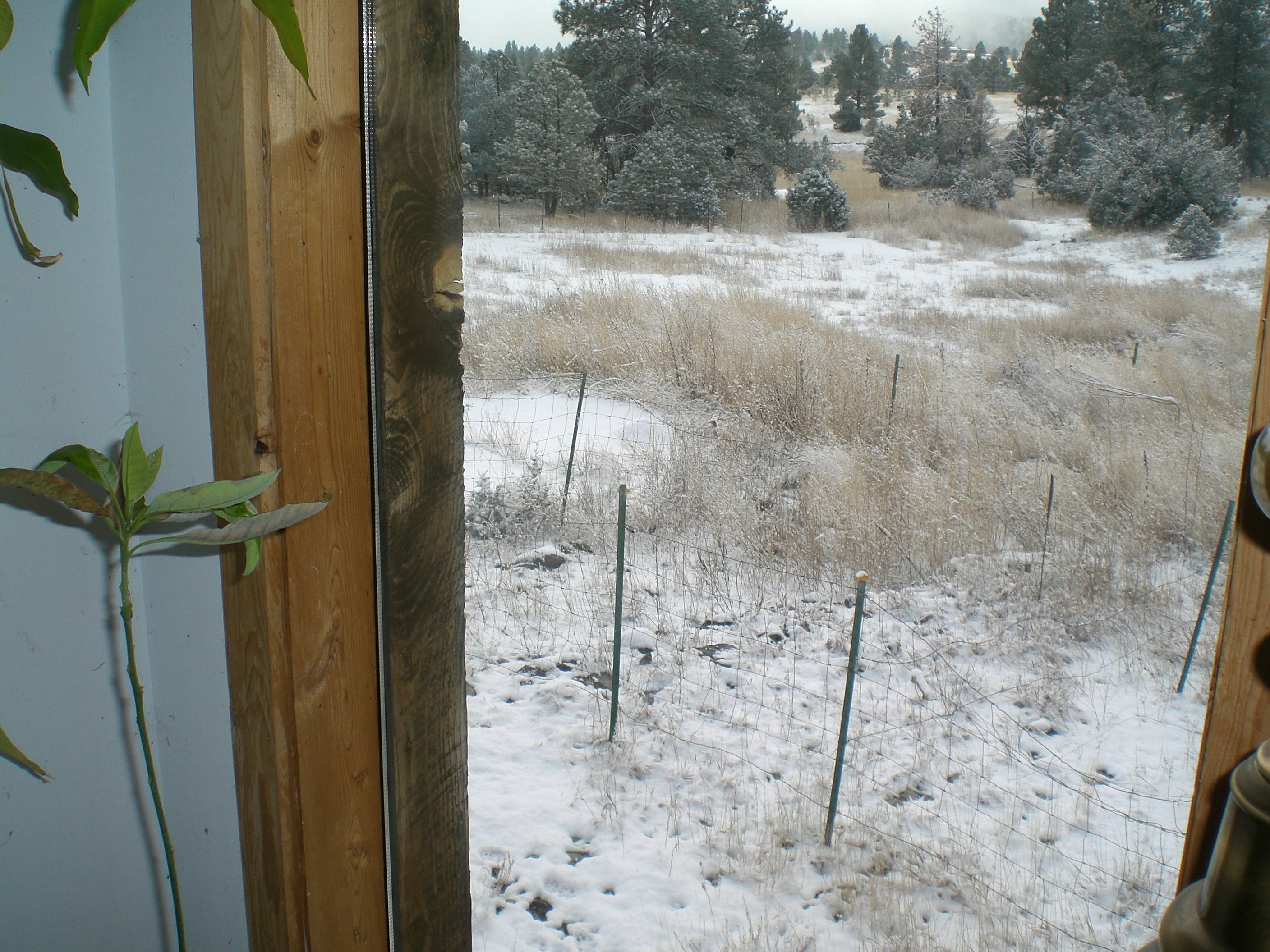
Have you noticed the unique silence that accompanies a fall of snow? The white blanket covering the ground somehow muffles ordinary noises of a country stillness, so that the world is – for a short time – truly quiet. I see birds at the feeder, fluffing themselves to shake dampness off their feathers, but they are not noisily jostling as they were yesterday. Even my dogs lie in, enjoying their heated porch rather than running barking at the rising sun.

From my Window

From my Window

Not much snow fell, not much more than a promise of wetness to our parched land. But the sky is still grey, except where the rising sun has broken through a cloud bank to paint a few slashes of peach and gold. Perhaps a few more drops will bless the earth from the clouds in the west. That is the direction our winter wetness comes in from. In summer it is often the reverse – systems stretch up from the gulf off Texas to give us summer rains. This past year, Texas did not share, and after a good start in late fall, the weather gods have chosen to send all the moisture either north of us into Colorado, or farther east where the blizzards and cold have caused major havoc.

Have you noticed how people’s temperaments are affected by the climates in which they dwell? It is an almost universal truth that cultures in hot, wet environments become gregariously noisy, even in Asian regions that one tends to think of as possessing a pattern of restraint. The silence of traditional Japanese people passing each other in public (it snows in Japan you know) is vastly different from the voluble street harangues of Vietnamese pedestrians in a country where the difference between hottest and coldest weather is less one of temperature than of moisture – monsoon season, or “dry” season when the humidity is perhaps 60% rather than 85%.

I knitted my first sweater in Saigon, when I was fourteen, and wore it twice on “cold” dry season days. Not days really suited to wearing a sweater, but I did so want to show it off. By the time I arrived in a cold enough climate to need a sweater, I’d outgrown it. A pretty dark cherry red pullover, with cap sleeves and a mini-turtleneck, the sweater went with me on to college and to Boston and eventually here to the desert, where I finally gave it to the daughter of a friend to be worn during what used to be our very coldest weeks of January. Used to be – it got down to 30 below at night and not much more than 5 for a daily high over at least a couple of weeks each January, even as recently as 20 years ago when I moved to my present home. For the past ten years, the night time temperature here has not dropped below minus 10, and the sun has warmed us comfortably every day. Pleasanter living than the mid-west’s polar experiences, but dire for our drought.

A snowplow has been by, and the school bus’ flashing lights indicate it has picked up my neighbor’s boys. I see cars making their way down the road that curves toward town, heading into the start of another workday. But still it is silent here around me, in a way only snow produces. It won’t last, neither the silence nor the snow, so I cherish it.

Have you noticed how people’s expressions of temperament change with their circumstances? A man courting a woman asks cautiously will she do this, would she help him to do that. Having won her, he issues orders – we will do this now, you must do that. The woman still has choices. She can simply agree, or she can learn in what way to express her own preferences so that she is heard. It is not significantly different in non-traditional relationships – we learn each other’s ways of being and how to express ourselves to influence the nature of the relationship. We learn how to help one another grow, and sadly, we also often learn how to block or stifle one another in an expression of frustrated, never-outgrown teenage envy.

Have you noticed how, entering a new relationship, there is a tendency to ask oneself, “Should I trust this person? How far? With how much of the truth about myself?” Past personal history of support or betrayal, extent of confidence in one’s self, willingness to risk, curiosity about different life styles, what a friend of mine simply calls open-mindedness, can all blend together into a force that shapes how a relationship develops. That is the common way.

How differently the issues of trust, of exploration and communication and growth of understanding unfold, if one considers a new relationship from the perspective of why the Divine ( God, or Fate, one’s Master, one’s karma, one’s wise inner self, or a Higher Power) “has brought this person and this experience to me at this time.” All the ambiguities of trusting in another person are released to the trust that we are alive for a reason, and that we can understand that reason, learning and thriving in our understanding.

Like the rare silence of a snow-covered early morning landscape, achieving an understanding of ourselves in relationship is a blessing. The moments of silence are brief; I woke early to enjoy them. The opportunities to intuit “what we’re here for” are also brief. I wake early to contemplate them.

The line of cars I see driving to work has warmed the thin snow covering on the road, and it is already turning to splashing slush. My big dog is out and barking to let the world know he has started his new day alertly. His two little companions romp patterns into the snow of my long, curving driveway. Outside, and in, the world is no longer silent. A new day of life has begun. What will I learn? What will I hear? What will I come to understand? What will I teach? What will I give, and what will I receive? Soon enough, I’ll have answers. Soon enough, too, I’ll have another opportunity to practice trusting that what is, is so, for a reason I may or may not be able to fathom. In trusting, I live. To cease trusting would be death – and I’m a long way from ready to die!

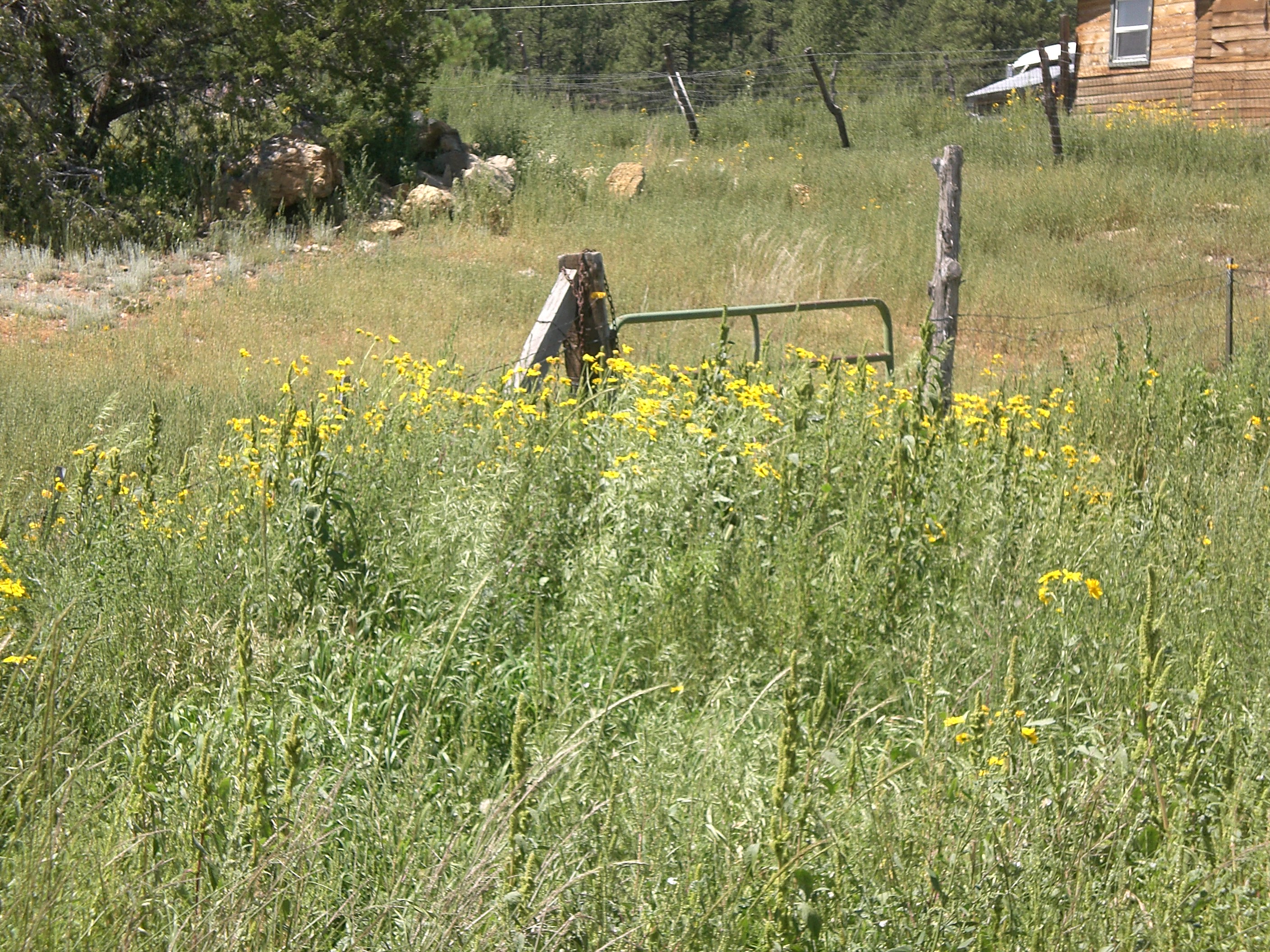
Across the Pasture Gate

Across the Pasture Gate

Another wave of snow clouds is sweeping in, flecks of white are drifting across the window. I will delay, just briefly, starting my own work day. Because I can do so, I choose to savor for a few moments more the regained silence (dogs still, birds quiet, no cars passing on the road), the blessing of extra drops of precious water, and another opportunity to consider why I am where I am, and for what inner purpose my outer life has taken on its latest form. Thank Thee, Master, for these gifts!

Choosing an Attitude

December 14, 2013

One of the elements of my new job that was most appealing – working from home – is also revealing itself to be a challenge in ways I did not experience the last time I had a similar employment. Just a few changes in external circumstances are making a significant difference in how I relate to my obligations.

The first time I worked from home was more than 20 years ago, when I had just moved to Sapello. I lived alone, and was hired to manage and build up the clientele of a home health agency. I enjoyed being able to spread my work over the seven day week, scheduling my leisure activities intermittently with travel to clients’ homes and with the inevitable administrative work required. While I was never “off duty”, I did have a lot of choice about what I did when. I was flexibly able to fit my personal obligations and desires around work demands, rarely feeling pressured because there seemed to be enough time for everything.

Eventually the agency grew to the point that we established an office, and I became subject to a more consistent and common work schedule. I left briefly, for personal reasons, and spent eighteen months self-employed. I completed several contracts and saw clients privately for counselling sessions. When I returned to the agency, again as its branch manager, I was subject to the standard “8-5 in the office” schedule, to which I adhered for fourteen years. Eighteen months of semi-retirement and job search brought me to my present full time, salaried and home-based position.

I do not now live alone. I share my very small house with my disabled former husband, for whom I am guardian and with whom I remain friends. His health is slowly and steadily declining. A sequence of aides come to the house, to help him during the day and to see that he gets supper. The schedule is meant to assure his safety when I am away. In consequence, there are several different people added to our small space, to whom I must accommodate when I am at home. While I am, mostly, relieved of responsibility for my housemate’s care, I do have to step in, unpredictably, when an aide is unavailable. And I am responsible to assure that the schedule of services is established and maintained.

Over time, our home has become divided into “my” room, which is also the living room that contains the day bed where I sleep, and the rest of the space – sleeping area for my housemate, dining area with the table covered with items he uses for his craft projects, kitchen and bath which we share. While I was still employed at the agency, the aides were scheduled during my work hours. In the eighteen months since, I find my necessary privacy and quiet time at night, often writing (as at this moment) or reading. My housemate watches TV with earphones on, allowing me valued silence for contemplation and creation.

Embarked on my new job, I have been away from home for extended periods of orientation and training. Shortly, I expect to be scheduled for long, busy days traveling to clients’ homes, interspersed with long and demanding days at home entering information into the complex computer systems my employer has been training us to use. I’ve had just a few weeks at home, to set up my “office” and establish those systems as functional in my rural, no-cell-service area. The systems are only partially in place so far. I do not yet have a land-based work phone, and I continue to uncover wide areas from within which I have no connection to the Internet. For clients who live in those areas, I will have to take notes and then enter data later at night, after I get back home.

My office is now in a corner of the dining area where my housemate – and his aide – spend most of the day. I’m having to learn to shut out their conversation in order to concentrate on the tasks that come to me by computer. On a recent visit to a building in Albuquerque newly occupied by some of the staff of my company, I walked through a huge room of employees in cubicles, thinking how grateful I am not to be similarly situated. I only have to shut off two voices, not hundreds.

I’m realizing that one of the serious sources of stress over the last years of my former employment came from the lack of doors on offices in the various buildings that agency occupied. As a manager, I relied on knowing (hearing) what was going on throughout the office. As a person, my need for silence around me, for auditory privacy, was consistently challenged. Personal validation and social support, also important to well-being, came from co-workers and from those engaged in the various volunteer activities I’ve pursued. For recuperation, reflection, and privacy I could count on quiet at home.

Changes in my housemate’s health, including recent medical emergencies disrupting my work day plans, new aides requiring instruction that he does not provide, and the expectation from my present employer that I be available on an 8-5 Monday to Friday schedule, have combined to eliminate my control over how and when I do what needs to be done. As a result, work is not staying in balance. It is seeping into my sleep time, rousing me at 5 am to try yet another way to solve a computer problem that proves not to be solvable by me. I begin to feel encroached upon by lack of quiet personal time – and by the necessity of at least temporarily giving up almost all of my volunteer activities.

During a recent two nights alone at home, while my housemate was in hospital, I was jolted to realize that many years have elapsed since the last time I had this space to myself for more than two hours! There is already so much activity filling the house, can I actually bring work here too, without losing the last bits of “me” space?

+++++

Yes, I recognize my issue is a matter of mental attitude. My spiritual Path teaches that “the mind is an excellent servant but a terrible master.” Private, quiet, contemplative space for myself will exist wherever I am, if I make it a priority – and “set my mind”  (no, actually not my mind, but my attention) to assuring it occurs.

I may not be able to go strictly by the clock, dividing work time from private time, especially while I’m still learning how to accomplish work tasks in an efficient manner. I cannot force my work computer to move through its paces more quickly. I cannot fix my situation of intermittent Internet connectivity, which disrupts the intended work flow process and requires me to “do double work” entering data already recorded on paper.

On a Recent Misty Morning

On a Recent Misty Morning

I can teach myself not to be frustrated by the computer’s slowness, and I can line up tasks to do during the waits (like creating a  card file of important numbers and contacts). I can “take time to smell the roses” or, in this winter season watch the birds. I can revel in my ability to look up from my computer to see snow dappled fields inviting to deer, doves perched in a row on the fence beside the feeder, a squirrel gorging himself on seeds, and little birds on the ground waiting to collect what the doves and the squirrel shove over the side of the dish.

Yum!

Yum!

I may need to extend work hours into the evenings and weekends – but I can still define times when I turn off all electronics and soak up the natural sounds of wind, dogs chasing rabbits, birds arguing over priority at their feeder, and snow dripping from the eaves.

Serenity surrounds me. I need only put myself within it. I am blessed.

Warm Furries

November 30, 2013

Five doves are fluffily hunched on the gate to the long pasture, seeming to emit waves of discontent because their bird food plate is piled high with snow rather than seed. I will probably succumb to the pressure shortly, and wade around the house with a bowl of feed for them. I doubt that my steps will imitate my Shih Tzu’s curious snow shuffle, though. I’ve been watching Shian Shung coming toward me down the drive, each front paw’s forward motion initiating a wave of snow rippling slightly sideward. It is the strangest looking movement, suggesting he has suddenly acquired the widely feathered feet of a nun pigeon. Or as though he is swimming his front legs through the fluffy white stuff that is belly deep for him.

De-iced

De-iced

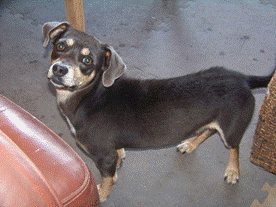
My Min-Pin, Doodles, being a short hair, seems able to bounce through the same drifts, almost as though he’s walking on top of the snow instead of wading through it. Not any taller than Shian Shung, he has more of his minimal height in his legs, and an overall springier step. When excited, he can easily bounce to shoulder height on my Lab/Collie cross. And does so frequently, trying to get Blackjack’s attention away from the food bowl, gnawed deer bones, or the treats in my hand.

Aw, please...

Aw, please…

Doodles survived in his earliest life as a dumpster diver – he was about six months old when I collected him from a distant ranch and brought him to live with the rest of my motley crew. Eighteen months of ample and regular food has not yet broken him of the need to be in charge of any edible in the vicinity. Fortunately, Blackjack has a tolerant demeanor, only rarely exerting his considerable might to retain possession of a favored goodie.

Blackjack in Charge

Blackjack in Charge

The fourth member of my canine family is an elderly toy poodle – like Blackjack and Doodles also a rescue – with more serious personality issues. I know nothing about his earlier life, but it cannot have been easy. He was found at death’s door, totally dehydrated, his fur invisible beneath a matting of burrs, his belly distended and sagging to the ground. He growled and snapped at every attempt to care for him, requiring sedation by the vet before medical attention and a total body shave. Damaged intestines, causing the sagging belly, seems likely to be the result of being hit by a car; the injury continues to cause him intermittent constipation.

Warrior newly clipped

Warrior newly clipped

If left by himself, Warrior whimpers ceaselessly, or barks non-stop for an hour or more. Six months after arrival, he began to let me pet or groom him. Diametrically opposite to Doodles, he is reluctant to accept treats, which he requires be set down in front of him, to consider at length, before he will venture a nibble. Consequently, he loses them to Doodles unless they are offered when the other three dogs are off exploring. Which happens reliably enough that Warrior does get treats, but is also unhappily alone for periods of the day.

Blackjack shows remarkable patience with the littles. He lets Doodles and Shian Shung play out attack strategies, his legs and ears the more common targets. He makes sure Warrior has the warmest spot on the porch, and tolerates Doodles’ determination to be first at the food bowls. I remember to give him an extra rub around the head and muzzle, and to tell him he is the senior, and most essential, member of the pack. His calm demeanor, his defining of the boundaries outside which the others should not roam, his lessons about what is and is not fit to eat, and his manner of greeting – or guarding against – visitors to my acres all combine to transmit the expectations I have set about tolerance, respect, and appropriate behavior.

The Littles

The Littles

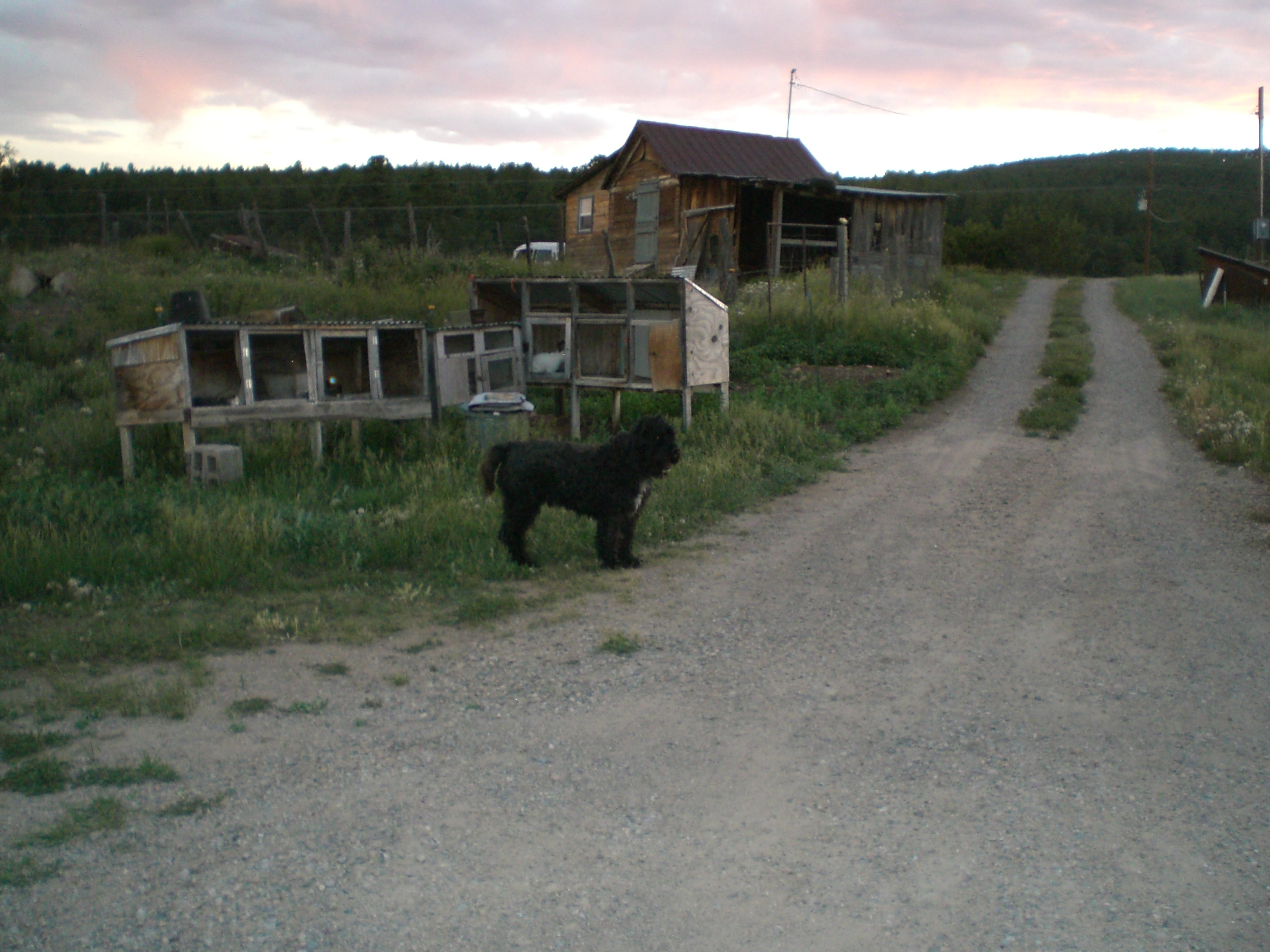
Over the 40 years I’ve lived in rural settings here in northern New Mexico, my one consistent rule for all pets has been that they must get along with one another. Not like, not necessarily interact, but tolerate and make space for all who wind up calling my home theirs. As a result, I’ve had a dog who let newborn kittens nurse on her while their mother took a break from the constant demands of parenting. I have photos of a cat cuddling with a Bouvier de Flandres large enough to squash her if he’d rolled over. That same Bouvier encircled an escaped rabbit and kept it safely between his paws until I got home and returned Mr. Bunny to his cage.

Guarding the rabbit cages

Guarding the rabbit cages

The coincidence of Thanksgiving with the first day of Hanukkah – an event apparently not to reoccur for an enormously long time – allows me to celebrate my two favorite holidays in one. Favorite because both encourage not just thankfulness, but also appreciation of freedom, joy in new beginnings, and the pleasure of connecting across boundaries.

In a heap

In a heap

I am grateful to have observed these same feelings played out amongst my four-legged family members.
I am grateful to be reminded by my furry friends, each time I hunker down to pet and play with them, that I don’t have to wait for Thanksgiving or Hanukkah to participate in a demonstration of tolerance, respect, and appreciation.
They keep me sane, they make me welcome, they direct me back to balance when I start to tilt off center, they define home.
For all this, a lower reflection of the inner beauty being shown me by my spiritual Master, I am thankful.

Chaplin and Me

November 9, 2013

As I headed toward the employee entrance to Presbyterian Tuesday morning, I flashed on an old movie – a Charlie Chaplin, I’m pretty sure but I don’t recall the title – of flocks of workers pouring into a plant, each showing an ID card and punching in before taking their places on an assembly line. In Albuquerque on Tuesday, we were a smaller clutch of workers, each wearing an ID badge which provides access via a scanned bar code, through multiple levels of security-locked doors, to our classroom, desks, and computers. How did I get to my seventh decade without ever working in such a large, regulated establishment? Even the government programs where I’ve been employed feel relatively small by comparison.

In orientation, we were told that Presbyterian hires about 2000 people per year, employs more than 8000, and receives over 100,000 applications for the annual openings created by turnover or – in the present case – by the expansion of its Medicaid program services. We were congratulated on being “special” because we were part of the select group chosen to be hired. I listened to the numbers in some awe, not in self-congratulation but rather in disbelief. What have I gotten myself into?

These past two days my subgroup (half the class of new Care Coordinators) received training on the still-being-completed-and-tested computer system which will be the primary support of our jobs. We will receive our assignments, create our case files, document our time and our activities, meet State and Federal mandates all within this one system. Given that there are quite a few bugs in the program, and pieces that have not yet been implemented, the training was likened to teaching us “to run the systems that fly the plane that the State still hasn’t finished building.” Take off is set for January 1st. Ready or not, off we go.

What fun!

Assigned to work within the Presbyterian computer system from my hotel room, I spent two hours in frustration at my inability to get through multiple layers of access in order to connect my highly secured work laptop to the hotel’s Internet. A classmate finally figured out the path, based on issues she’d had previously with her connectivity from home. I remember, back in the dark ages when they were new to the workplace, how we were assured that computers would make things easier.

Hah!

My homework included an opportunity to provide feedback on fixes the system needs to make it into a more effective tool of care management. The programmers have had barely seven months to design a system that normally is budgeted for a year or more of development and testing. I do appreciate being given a voice – I just wish there were fewer issues for me to speak up about! And that the changes and improvements could come sooner than the projected six months out from “going live”, which happens in less than two months.

Is any of this beginning to sound like Healthcare.gov?

Remember, Niki, you were hired for your “adaptability, independence, ability to think on your feet” and your implied tolerance for a very unstable and changing work environment. I do have those skills in person, and person to person. I’m not so sure I have them when it’s a matter of interacting with “technology”. I still complete the cards my students earn in their CPR certification classes on a (gasp) typewriter because that is easier for me than trying to create a computer template that will instruct my printer to produce them with all the right info in the correct small spaces.

Call me a Luddite – I’ll wear that badge proudly!

Until now, even the “field” workers for Presbyterian have been based in offices in towns and cities. They speak of those of us who will be working from our homes scattered in rural areas as working on the “frontier” – but still plan for us to use systems that rely on urban technology. I’ve only been able to access DSL at my home within the past year. If I lived a mile farther up the road I would not have it at all, would be dependent on satellite (or dial-up) and couldn’t get my work computer even to boot up due to timing out from the connection. As it is, the DSL flickers enough to pause my work on my fast and lightly loaded personal laptop – it repeatedly froze me out on the work computer which is slow and cumbersome, weighted down with multiple very complicated programs. Yet the concept is that I will take the laptop with me to client homes, to complete interviews and assessments.

I don’t think so.

Not when most of those homes don’t have connectivity at all – isn’t that what’s meant by the frontier? Out where people are living simply, often in the same way as their parents, grandparents, great grandparents, etc.?

We’re told we’ll be given paper copies of all the documents we have to fill in – and that we can then scan and send them to an assistant in the central office who will code them into the computer. That procedure will allow me to get my work done within the established time frames. It is offered as a support strategy – so why do I feel as though it means I will be dumping chunks of my work off onto someone else?

Because in my 20 plus years as regional manager for a home health agency serving that same rural frontier, I had no administrative support? If I needed copies, I made the copies. I typed my own letters, entered all my own work into the computer systems, and was the support for my staff when they got behind, or needed help tracking certification due dates, etc. We were a branch office of 5 with a case load around 300 clients and a field staff of close to 350, for whom I was the top-of-the-chain-of-authority supervisor.

(Now you know why, as I went job-hunting this past year, I determined I wanted a position in which I would only be responsible for my own work product!)

Had all those employees come into the office every day, we would have looked like my experience of this past Tuesday, or the Chaplin film, minus the time clock and swipe cards.  But my field staff were dispersed across a quarter of the large state of New Mexico. I went to them (as I will be doing to member homes in my current position) rather than bringing them to me. In between visits, I communicated with them by phone – either directly, or via their supervisors.

My new supervisor expects me to communicate primarily be email – with phone calls when email isn’t available. The company does recognize that even cell service is spotty “on the frontier” so they are acquiring a few satellite phones to be checked out to staff when they may be needed. I suspect, if I end up covering the same area now as I did for the home health agency, I will have one of those phones permanently in my car. Along with my emergency survival kit, including an extra book (paper, not Nook) to keep me entertained if I’m stranded.

Along the Open Road

Along the Open Road

My new job will definitely be an adventure! I’m curious to see how the blending of futuristic programming and frontier life plays out. I look forward to working in an environment that stresses being part of a team, offering clerical and administrative support I’ve not been used to receiving. I’ll do my best to not be a burden on my support staff, which means I’m committing to becoming as proficient with the computer systems as my connectivity will allow. I’ll need encouragement to resist being tempted by my paper “backup” procedures.

Will you come along on this adventure with me?     

One of a Kind

November 2, 2013

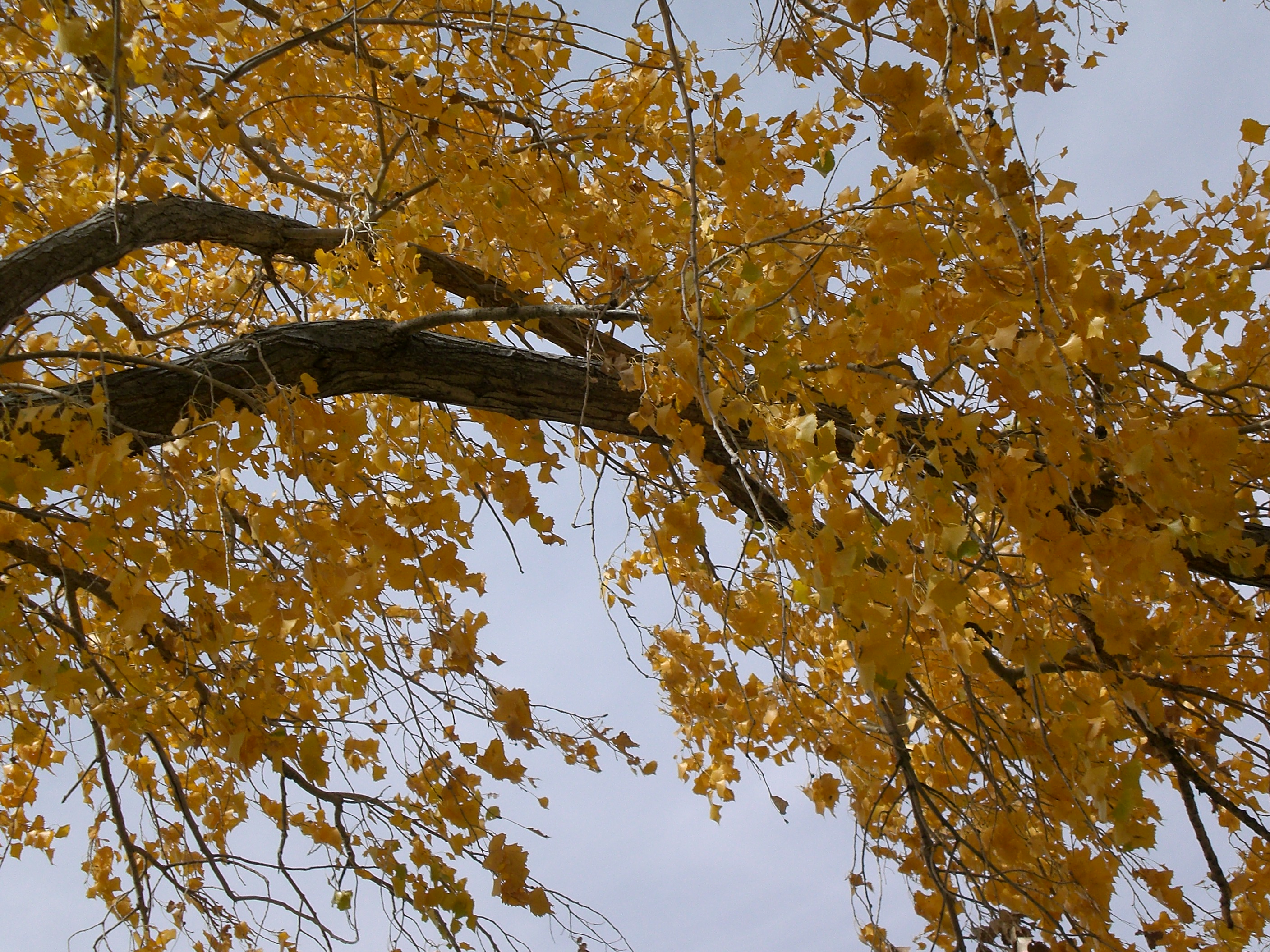
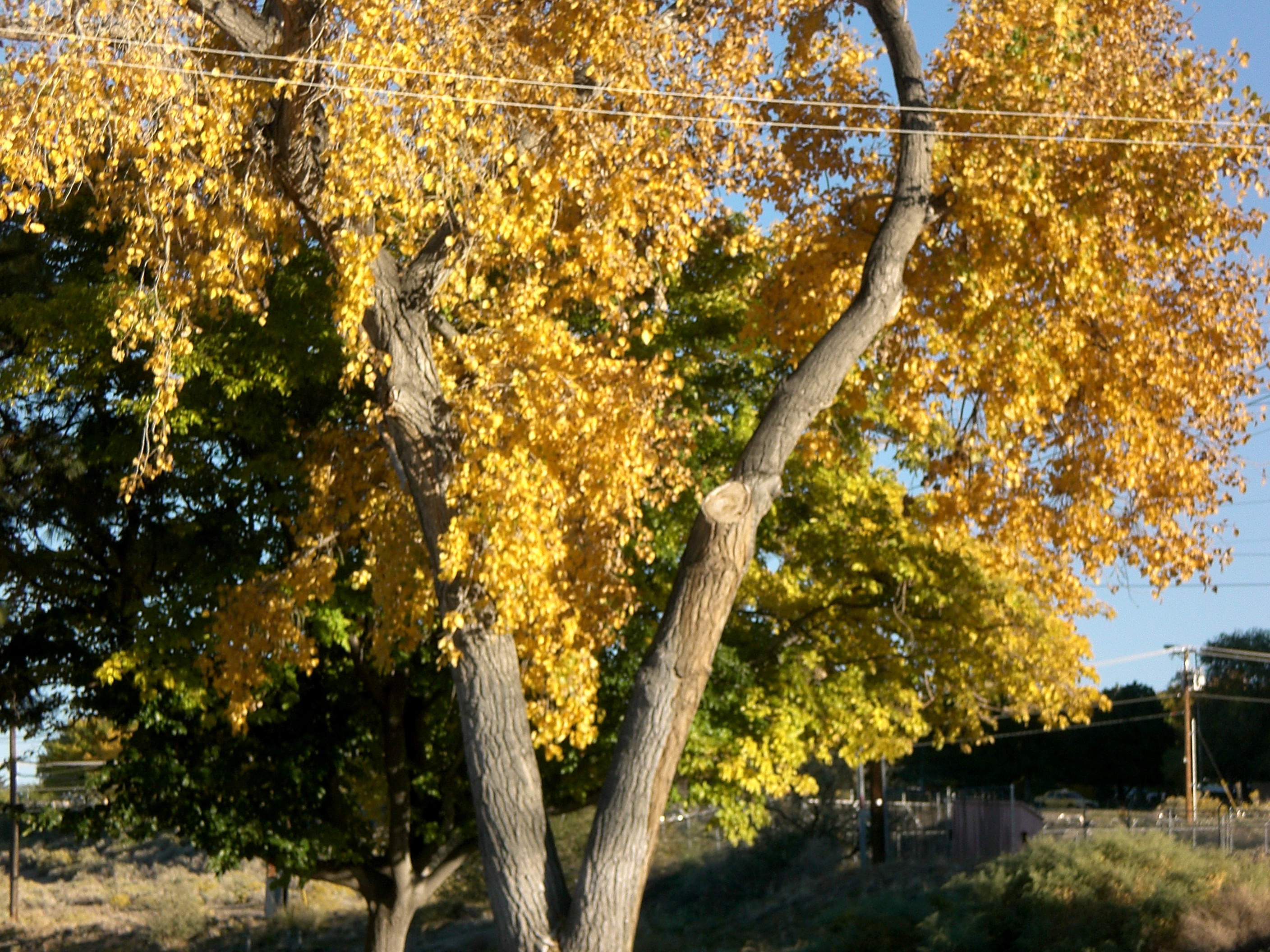
It’s a gorgeous, sunny, crisp yet warm autumn afternoon. I’m driving down from my home at 7500 feet towards Albuquerque. Down as in south, down as in descending to the city’s 5000 foot altitude. I pass from full-color glory of cottonwoods in deep gold, dotted here and there along arroyos which occasionally run but are now dry, to clusters of trees beside small streams which show a mixed blend of yellow tones. Here and there on hillsides I see an occasional, rare in the desert, sprinkling of red leaves where scrub oak is doing its part to show off. Wishing I had time to stop and take pictures at each of the scattered sites, I slow down and drink in the brilliant color enhanced as it is by a bright sun and a postcard-perfect clear blue sky.

An Arc of Gold

An Arc of Gold

Much of the land is once again brown, grasses dried and earth showing little sign of the week of heavy rain that caused flooding in New Mexico as well as Colorado. Oh, you didn’t know that we had floods? Not surprising. When it comes to national reporting, New Mexico doesn’t exist. Our flooding was not mentioned; our drought is equally overlooked, although we have officially been the driest state in the nation. Only when Los Alamos lay in the path of wildfire, and last year when the biggest wildfire raging in the country ate tens of thousands of acres southwest of Santa Fe, did New Mexico make the news. “Listen my children, and you will hear…” stories like those handed out to tourists in a booklet entitled “One of Our Fifty is Missing”  –  but that is the subject of another posting.

On the Prairie

On the Prairie

The rain is gone. One week in August, then a torrential week in September that dumped more than the land could absorb – now we’re once again living with drought, seeing long stretches of dun and tan prairie grasses, and encountering bears on the edges of our communities, some even making their way into the center of large cities in search of food. Acres of monochrome are suddenly interrupted by a line of golden cottonwoods. Looking out across the prairie, those trees beckon with the promise of a water course. Many of these small rivulets are dry, their banks eroded by the flash floods which accompanied that week of September rain, sometimes to the point that tree roots are exposed. Tree roots reaching down deeply, to what little is left of moisture; tree roots anchored in brown to give life to riotous gold.

A Survivor

A Survivor

I pass yet another cluster of trees about ten miles south of Santa Fe, and see cars pulled off the side of the road. Looking more closely, I spy a group of artists, easels lined up, some standing, others on camp stools, each of them trying to capture autumn glory. I wish I could stop and join them! Instead I continue down the highway, across dry flat lands, then down one last hill. Spread out before me is the bosque of the Rio Grande, a wide and many-miles-long swath of cottonwoods, in every possible shade of yellow. It is almost too much to take in – acres of dancing golden tones sating the eye to the point that I must look away, watch the highway and the traffic, overfull.

As I enter Albuquerque, I find myself searching out the occasional red of an intentionally-planted maple (they are not native here) and wonder if the householder responsible for the tree is, like me, originally from the East Coast. I delight in the rare splashes of red in equal measure as I responded to the occasional golden cottonwoods earlier in my trip.

Rosy red

Rosy red

I remember autumn in New England, red upon orange upon grape upon wine, each color seeming to stand out and be enhanced by its subtle differences from its neighbors. I never tired of those shades of red in the way that today I ceased to be drawn to the yellows in the bosque.

Neighbors

Neighbors

I perceive that, because there were so many different types of trees producing multi-hued woodlands, autumn in the East, with its continuous experience of changing colors, did not become “too much” in the way that miles of yellow upon yellow have exhausted my ability to be inspired. I ask myself how much variety is enough to keep me from becoming sated? Is it actually variety that is important, or uniqueness? A clump of cottonwoods in a landscape of tan grasses is unique. A brilliant red maple stands out against an orange-toned oak whereas, in an acre of similarly colored trees, each cottonwood loses its distinction.

Do we not all strive to find our own unique color, to stand out from those around us?

Some of us are more strident, others quite subtle, but all of us seem internally driven to find a way to express individuality. Undoubtedly one of you readers will have objected that the acres of yellow in the bosque, the totality of which I found to be ‘too much’, would have delighted you with its abundance. The open, empty plains that I find soothing were frightening to my mother. On her one visit to New Mexico she felt unpleasantly vulnerable, as though naked and exposed. I, by contrast, feel invaded, almost assaulted, by the intensity of human activity in urban areas.

Standing Out

Standing Out

Going out for a walk after orientation class has ended, I find a patch of grass littered with slim, deep red leaves. I don’t know what sort of tree they have dropped from – I’m not an educated botanist. I do know that I’ll keep the handful I collected on my desk in the training room, until they turn brown and brittle. And to have them longer, I’ll photograph them to upload to my screen saver, along with pictures of cottonwood and of maple branches lit by late afternoon sun.

Red Delight

Red Delight

I may feel sated in the bosque; I will delight in retaining reminders of this colorful day, replete with images that speak to my soul while teaching lessons about the value of individual differences.

An Appreciation of Habits

October 6, 2013

Interesting how many unthinking habits are revealed when the pressure tank in the well fails, and a household is without water! Over the years, we’ve been waterless several times, for different reasons. The most difficult was the winter it got down to 30F below and someone forgot to leave faucets dripping, resulting in a frozen water line. That time it took 4 days to restore water flow, fortunately without associated broken pipes. Four days of not being able to flush toilets, or easily wash hands. Of hauling water in three gallon bottles, doling it out in dribbles for washing with a cloth in the sink, “birding off” as a friend used to call it (another acquaintance used to refer to the same process, I know not why, as a whore bath).

This latest episode of being without running water lasted only a little over 24 hours, in warm enough weather to need to shower, not just dab and dry. I gained experience at showering without access to running water back in my early teens, when we lived in Saigon.

Our House, a Very Very Very Fine House - Saigon, 1956

Our House, a Very Very Very Fine House – Saigon, 1956

Water only flowed in our housing compound for about two hours a day. The live-in maid would fill large vats with a hose from a standpipe, then carry buckets up to the bathroom whenever someone needed to bathe. Showering became a matter of pouring a bucket over oneself, soaping, pouring another bucket to rinse, and drying off. In the steamy heat, two or even three showers a day were necessary. A five person household used a vat of water just for bathing. The second vat supplied water for cooking and mopping and hand washing.

In those days, I also learned how to throw a bucket of water (the third vat’s supply) with just the right force, at just the right angle, into a toilet to force it to flush. In recent days, I learned I am still able to shower by the bucket, but have lost the knack of the toilet flush. Or maybe modern toilets are less amenable to alternative flushing procedures? In any case, the knowledge of how to manage without running water rose up from depths, at the same time as I caught myself automatically reaching behind to flush the toilet that had no water in its tank. Knowing there was no water did not stop the unthinking hand gesture.

How many other actions of daily life, including much less mundane ones, do we unthinkingly perform? How many aspects of our routine do we take for granted? And what about people… how often do we take them for granted? Or respond to them out of habit? Or respond to a present situation with an inappropriate habit learned in childhood?

Regrettably, my mother was only able to experience disappointment with life. She had a unique knack for projecting that disappointment, ensuring by her actions that anything I looked forward to with happy anticipation would fit her world view, and therefore not materialize positively in my life. My childhood was one of fearing to express what I wanted, since to do so was to assure it would not happen. Put differently, I became ingrained with the behavior of waiting for the other shoe to drop. As I matured, left home and began living my own values, I gradually freed myself from maternal negativity, and experienced lots of positives. Life brings mostly what one looks to receive from it – and I look with curiosity for new opportunities, good friends, and spiritual growth. I’ve been blessed to receive an abundance of all these.

So – how surprising to discover, in recent days, that a corner of my being is busy defending itself against a shoe dropping, in relation to my upcoming new employment! Why am I suddenly hearing myself reason that I should delay certain purchases because one should never “count chickens before they are hatched?” In ten weeks of living and working on the Maine coast at a home without electricity, I ‘forgot’ the habit of reaching for a wall switch when I entered a dark room. So why do I, after 50 years of living away from my mother’s fearful negativity still subconsciously duck and cover in response to upcoming positive and desired changes?

The Habit of Following Along

The Habit of Following Along

Well, at least I recognize the old emotional habit and can now practice setting it aside. I hope I have more success breaking that pattern than I’ve had with the one that leads me to look up to the right as I leave my living room. For nearly 20 years I had a clock on that right-hand wall – it’s been gone for 2 years now but I still glance there to see the time. And then laugh at myself. I suspect that being able to laugh at practicing an outdated habit is a step in the direction of letting it go, so I will chuckle to myself if I fall back into emotional duck and cover. What better way to switch over to a positive attitude?

And I do intend to retain the habit of washing with minimal water, although not the bucket method needed so recently. Collecting the water that accumulates until a suitable temperature is reached, and turning off the shower while soaping up, have become common sense habits in our continuing drought-plagued environment. Hmmm… I wonder, if someday I move to a place where water is abundant, will my water-saving habits endure?

Sounds of Silence

October 1, 2013

First, I should explain that a different type of silence was imposed on me over the weekend, preventing me from putting up this post when I intended to do so, on Sunday afternoon. The internet link at the motel where I was staying was somehow incompatible with my computer, and the IT people weren’t able to reset it properly. I am back home, and once again connected – able to ‘speak’.

Thank you for patience, for reading, for following, for being there.

Niki
**************


Noise pollution is one of the issues not being adequately discussed in relation to my county’s examination of a proposed fracking ordinance. I brought the topic into the discussion, and I have to keep raising it as others focus insistently on water quality and scarcity, and contamination of the air and soil. By comparison I suppose noise can be considered a less significant negative – but not to me.

I live in the countryside – what most people would consider a truly rural area. My small 900 square foot house is set back from the road, on four acres, abutting a several-hundred-acre ranch. I have three neighbors – houses close to the road with entrance driveways off it, in a cluster with my own entryway. Across the road are two more homes. Most of the time, those neighbors are quiet – so much so that I wonder if they are at home. No loud parties, nor growling outdoor machinery.

I do hear traffic on the highway. My house is situated on a hill toward which the road heads before it veers off, resulting in the longish driveway that snakes from the road up over a hill to my front door. Sitting in my living room, looking out its floor to ceiling windows, I can see a section of the road, and all the vehicles that travel up and down it. I cannot see – but can hear clearly – the heavy trucks and the rattle of gravel excavation that is going on a further 2 miles away, on a section of land that “ought” not to be considered to be in my neighborhood. Something about the lay of the valley funnels that noise straight up to my house.

The gravel operation is new this summer. I don’t know yet if I’ll notice it when my windows are closed, but I am very aware now, with windows wide open, of the days it is running and those, like today, when it is not. Perhaps I’m more sensitive than other people to the ambient noise within which I live?

I do not like to have music playing “in the background” of my days. I work better, think better, live better in silence. I enjoy music, go to concerts, play records (there’s an oldie for you) or CDs with intention to listen to them – emphasis on the intention to listen. If my intention is to work, I prefer to do so in silence.

Undoubtedly, that preference has something to do with my enjoyment of Quaker Meeting, and Buddhist zazen sessions, as well as my own daily spiritual contemplative practice. Undoubtedly it also has something to do with my appreciation of the skill of the young musicians from Curtis Institute who performed Britten’s Quartet #3 for Strings at a recent Music From Angel Fire concert near my home. Two of the piece’s five movements, including the last one, end with a prolonged silence defined by the musicians holding their bows immobile above the strings of their instruments until, as one, they relaxed in their seats, signaling the end of the silence that was part of the movement, and the beginning of the silence into which the audience could inject its noises of appreciation.

Once before, many years ago in Boston, I attended a concert which featured a piano performance that included long silences as part of the piece, and then too I was able to ‘hear’ the difference in quality between the silence that was integral to the music, and the silence of the piece’s end. That time, as I recall, I had no visual cue. I was sitting too far back, in the cheap seats, to see the pianist’s hands. I could only rely on my ears, and the pianist’s flawless sense of timing, to distinguish when musical silence transitioned to an appreciative silence from the audience, which in turn transitioned into loud applause.

A few of my acquaintances seem to understand what I mean when I express my awareness of the difference between the silence of Quaker Meeting, and that in a Zendo. Even the famously silent Meetings (the oldest, historical ones in Philadelphia) which I have attended, have a busy-ness to them, a sense of minds occupied with focused reflection, that is distinctly different from the no-thought silence of a practiced group of Buddhists in meditation. And different again from the life in silence of the Benedictines (and their guests) living at Christ in the Desert Monastery. Different yet again from the experience of many hundreds of chelas (students), attending to the silent communication from our Beloved Teacher at a MasterPath gathering. Dare I say that there are many different sounds of silence?

(Yes I know the Simon and Garfunkle song The Sound of Silence. It doesn’t fit into my narrative because the song is about the negative aspect of silence – silence as a barrier to communication and a symptom of loneliness.)

We seem, in the modern urgency of tuned-in lives, to have forgotten the old adage that silence is golden. We settle for the silver, the copper, even the dross of noisy, busy “I’m somebody, doing something important” daily life and think we are fulfilling ourselves. Just yesterday, I had a Facebook ‘chat’ with a young friend who is torn between his desire to study the classical languages necessary to read ancient Buddhist texts in their original, and the supposedly practical necessity of getting a degree in a subject that can lead to a job. How practical is it, to go against one’s nature, to ignore the still, small, inner voice directing one toward a path of spiritual fulfillment, in favor of a loud, outer, boisterous demand to focus on earning a living?

Inside golden silence, there is much to hear and learn. Whole worlds of perception, of wisdom, exist within our inner silent spaces. Would that we all, individually and collectively, were more insistent on spending time in that beautiful silence within! Would that we all, individually and collectively, could share the golden wealth to be acquired from listening to the songs of the Divine played so beautifully within us. Listen…. and you will hear…

The Tools of our Trades

September 23, 2013

I make it to the New Mexico State Fair just about every year, including this one. Some events, like the Fine Art show, and the Hispanic, Native American and African American art and cultural shows are housed in permanent buildings not too far from the entrance to the fairground. To get to them – and to all the other “housed” activities – one must walk past a midway full of rides and also past clusters of food booths selling barbecued turkey legs, ribbon potatoes, lemonade and – this year at least – such exotica as frog’s legs and fried ravioli on a stick.

Next one must negotiate the plethora of booths filling both sides of the main “streets” of the grounds. These are all commercial. They offer multiple opportunities to acquire surprisingly similar items, from painted faces to sports memorabilia and cell phone accessories, purses, dresses, make up, the latest fads in hair adornment, and cheaply made but not cheaply priced glitz jewelry.

Farther into the grounds are a Spanish village and a Native American village where culturally traditional items and foods are sold, and groups perform appropriate music and dances. Also near the middle of the grounds is a large building housing the many types of items we older folk associate with the shop and home economics classes that used to be mandatory in all junior high and high schools, but which now seem only to be found in the context of career programs at community colleges. Wood workers, quilters and seamstresses, experts in home canning and baking submit their finest products in hopes of winning a coveted blue ribbon.

Nearby there is also a space for flower arrangements. Other hobbies are represented as well. I acquired a book mark with my name in exquisite calligraphy, and watched two ladies carefully making lace, twisting bobbins around the pins which mark out a pattern. I remember seeing the famous lace makers of Bruge, in Belgium, sitting in the sun and chatting as their bobbins flew in complex designs they knew by heart from a lifetime apprenticeship in an ancient craft.

One has to complete a long walk across the full length of the fair’s main street in order to get to the true core of a state fair – the animals.

4-Hers and adults spend years breeding to obtain a perfect specimen to enter into their county competition before advancing to the state fair. Horses are trained to perform complicated maneuvers, mule and draft horse teams pull wagons or increasingly heavy loads on sledges, demonstrating their ability to perform the classic work of a ranch. Judging the quality of livestock is a learned skill, often passed down within families. As I walk along stalls with handsome palomino heads protruding to be admired, I overhear a discussion of which judge will be in charge – competitors clearly have their own favorites.

There is much less foot traffic at the livestock end of the fair grounds. Kids tug their parents to the petting zoo and pre-teen girls congregate in the open space between the rows of stalls where their horses wait with them to be called into the ring for their classes (the level of competition each has achieved, showing off the gait and conformation of their rides). Older teen boys lead cattle of various breeds and sizes to and from their show ring, talking about weight and sale price. Many of the animals, like much of the handwork in the crafts building, will be sold or auctioned before the fair ends.

Sitting on a bench near the horse stalls, enjoying a treat of ribbon fries, I try to imagine what the fair would be like without all the commercial booths – or at least only with ones related to farming and ranching. There are no representatives of John Deere on the main street. Instead, lines of old cars are displayed, most from the 1920s, including an early fire engine whose siren sounds whenever an ambitious child cranks its handle. What was marketed at the fair when the attendees arrived in those early Fords? Back where I relax in the livestock area, it is not hard to imagine myself in that earlier time.

I suspect there would have been many more teams competing in the draft horse heavy sledge pulls. And many of the contestants would have arrived by horse power, not automobile. Canned goods, instead of being one row of the crafts building, might well have taken up a tent all on their own. The same with sewing and quilting.

I can’t help but feel dismay that our modern preoccupations, if assessed by the balance of items offered up to view at this year’s Fair, have become so faddish. And so mass produced. And so poorly made.

OK, we’re living in a wired age and we are hooked on our technology. So, where are the hand-beaded cell phone covers? Why don’t I see tooled leather cases for laptops? What has become of pride in beautiful, well made, durable crafts to embellish the tools of our modern everyday trades? Why are hand painted Easter eggs, braided rugs and crocheted blankets considered only to be examples of “saving the skills of the past?” How did these arts become locked into traditional forms, instead of adapted to the items most commonly in use today?

In the Vicinity of Acoma

In the Vicinity of Acoma

English: Original lithograph for report of J.W...

English: Original lithograph for report of J.W. Abert of “His Examination of New Mexico in the Years 1846-47” to the Secretary of War (Photo credit: Wikipedia)

The day following my visit to the State Fair, I was escorted by a friend to one of the last places in New Mexico that I wanted – but had not yet made it – to see, Acoma Pueblo. The majority of current tribal members live in two communities in the valley, near Interstate 40 in the western half of my state. According to our guide, only about 30 people (of about 6000 tribe members) still live atop the mesa that is historical (from the 1100s) Acoma. Most of those who do live on the mesa appear to be the potters and practitioners of other traditional arts who market their wares to the groups of visitors escorted on tours coordinated by the tribe.

Our tour guide provided a lively account of the history of Acoma, in an interesting language style which notably did not use standard past tense. “The people were living atop the mesa and were welcoming the first Spaniards to come to their area. Because the straw in the mud coating of their sandstone homes reflected golden in the sun, the Spanish were thinking they had found the mythical Seven Cities of Cibola, so they were demanding that Acoma turn over its gold and, not believing there was none, they began subjugating the people with torture and killings.”

The effect of our guide’s narration was to make his listeners aware of how differently the Acoma people (and most other Pueblo tribal groups I’ve interacted with) perceive time – how intimately their distant history informs their present day lives. The mixture of tradition and history with modern innovation and adaptation is also evident in the Acoma art – mostly finely painted and incised pottery – which was on offer. Some of the artists appeared dedicated to repeating ancient family patterns; others clearly added personal perspectives and made use of new colors and forms, while still reflecting traditional cultural styles. I was delighted with the demonstrated Acoma talent for maintaining art forms yet adapting them to modern needs!

WLA brooklynmuseum Pueblo Acoma Water Jar

WLA brooklynmuseum Pueblo Acoma Water Jar (Photo credit: Wikipedia)

I hope some of my online friends whose work lies in the decorative arts will take up the challenge implicit in my two days of contrasting experience. Can someone run a contest to see how many different “traditional arts” can be adapted to making modern day accessories for our ubiquitous cell phones, laptops and pads? How about a quilted dash cover? A pretty lace wrist strap for the new wearable smart phones? It would be such fun to visit the State Fair again in a few years and, instead of what I overheard one visitor describe as “so much schlock”, see rows of booths offering well-made, hand crafted items of practical use to the modern, hip visitor!

A Good Day

August 23, 2013

It seems to be perversely part of human nature to never be satisfied.

Through months becoming years of drought, we in the northeastern New Mexico high-mountain desert worried about the lack of rain. Our brown grasslands, swirling dust devils, raging fires and smoke-poisoned air were prominent in every conversation.

Until just a month ago, when suddenly, for some of us, things changed.

Water began to come out of the sky, in thick sheets, on almost a daily basis. Not everywhere, not for long periods of time, but enough where it did appear – including where I live – to turn the prairie green and yellow – green weeds shooting to chest height, yellow wildflowers making wide swaths of color especially where run-off water has pooled.

Rain Gate

Now I hear complaints of pollen-allergies, and worries about the burrs and needle-like seeds that will permeate everything – especially the fur of four-legged pets – as soon as the short-lived grasses and flowers dry out this autumn. People hustle to find mowers and weed eaters, to chop down the lush growth, the absence of which was so recently bewailed.

Today, the sun is shining, there’s a cooling breeze, hummingbirds are hovering over the purple thistle flowers, and a dove is pecking seed from beneath my bird feeder. A few puffs of cloud float in a dust-free postcard blue sky. I’ve had to use the snips designed for nipping small limbs from trees, to cut down the largest red-root weeds blocking the steps to my home. A friend has promised to come mow, before I have company over Labor Day weekend. Not all my acres, just the area immediately around the house, so I can get to the bird feeder and the outside water hydrant without wading through chest-high weeds. So my guests can get into the cottage door without scratches to their legs and prickers in their clothes.

Nothing I can do will prevent the forthcoming torment to dogs and cat. Daily brushing, sessions of picking out burrs, even a close shearing of coats (canine at least) can reduce but not eliminate the pending assault by things that stick and sting and burrow into skin and paws. It’s been so long since we’ve had rain, and weeds, in summer that none of the current crew of pets has experienced what is in store for them. They are all too young.

Green Pastures

I am not too young. I remember, ten years ago, the last time we had summer rains and weeds and wildflowers and enough grass for horse hay to be a reasonable price. I remember the quill-like needles that result from those pretty yellow wildflowers dropping their petals, drying and disseminating their seed. I remember the cockleburs, brown and clawing, so sharp they pierce the leather of my shoes as I walk by them; so sharp they even caused my horses to limp until the spines were picked out of their hooves.

I remember, but today I will not complain. Today I enjoy the sun and the cool breeze and the green vistas and the dancing yellow flowers. Today I am grateful that we have had rain, and a respite from dust and fire and smoke. Today is a good day to Be.


Only Fragments

Love Letters to the Tar Pit

KarusaaVerse

Words that Sparkle, Thoughts that Ignite: Fueling Your Imagination

Leaf And Twig

Where observation and imagination meet nature in poetry.

Millarson Diaries

Personal Musings and Thought Experiments

The Beauty Along the Road

Discovering Beauty in the small details of our lives

Flowerwatch Journal

Notes on Traveling with Flowers

1eclecticwriter

Wide-Ranging Commentary

Spirituality Exploration Today

Delving into the cross roads of rationality and intuition

smilecalm

Life through Mindful Media

A Good Blog is Hard to Find

I will shatter a word and scatter the contents into the wind to share it with the world.

Ray Ferrer - Emotion on Canvas

** OFFICIAL Site of Artist Ray Ferrer **

AKA The Versatile

Fashion | Lifestyle | Food & Travel | Beauty | Fitness | Education | Product Reviews | Movies | Doodling | Poetess

Aging Abundantly | Women Over Fifty | Empty Nesters | Caregivers | Aging Gracefully

Finding Joy at Every Age with writer/philosopher Dorothy Sander

ARTZZLE

Helping with the Pieces in Life's Puzzle of Art and Design

Project Light to Life

A bucket list blog: exploring happiness, growth, and the world.

The Daily Post

The Art and Craft of Blogging

Any Shiny Thing

MIDLIFE MAGIC

allmostrelevant

@allmostrelevant

The Irrefutable Opinion

Assaults on the Casually Mundane by K. Jean King