Archive for the ‘life wisdom’ Category

Random Thoughts

May 11, 2014

What was that nudge to parents from quite a number of years ago…”It’s two a.m. Do you know where your children are?”…

Well, it’s four a.m. and I’m awake and writing.

Not with a coherent topic in mind, but rather with the flow of reflections that has been keeping me from sleep. Starting with the circumstances of a mother and son whom I visited in Taos a few days ago, for my “day” job (the one that has been running seven days a week of late).

The son is a mildly developmentally delayed and very hyperactive boy, youngest of six children, with all his older siblings grown and moved on. The mother is a 350 pound woman requiring constant oxygen, and in severe pain, barely able to stand long enough to move from bed to chair. They live in two cluttered, unheated rooms at the back of an old adobe house belonging to her mother and brother. I don’t want to know what lies beneath the piles of clothing, baskets, blankets and miscellany filling the floor and every corner of the rooms.

She cares about her son’s development, is worried that he has started to be bullied in school, wants to teach him to “man up” and not cry when he is teased (he’s ten). She has managed to buy him a computer, and he is enrolled in Little League, but is only able to participate in a few of the games because mom can only rarely manage to leave the house to drive him to the field. She wants a companion for him, someone to take him out to activities and help him develop a social life.

The day before, I was with a 97 year old woman whose family was gathering to celebrate her birthday. She birthed 17 children, of whom 14 are still living. She is frail, forgetful, incontinent, but cheerfully recovering from a broken hip and with a goal to walk using only a cane, not her walker. And the day before that, my visit was to a thin, grieving, agitated widow who had just lost her youngest brother, the third family death since the first of the year. She is a survivor – her husband had violently abused her, ending only when the shotgun he pulled out to shoot her misfired and killed him instead. She is in constant pain due to a metal plate in her neck, a repair from when he fractured her vertebrae in a prior attempt to kill her. Despite the violence and her recent grief, she is focused on what she can do to help her young nieces and nephews who have just lost their father.

Against such examples of striving for life in the face of dire need, I find it very difficult to be patient with anyone who takes for granted the support, care and concern offered by others.

++++++++

A young friend of mine is getting married this coming week, and I’m taking some leave days to go to the wedding in Sedona, Arizona. I’ve been doubling up on work this past week, in order to keep to the deadlines imposed by the state’s implementation of a new Medicaid model of service delivery. And I’ll be doubling up on work when I return from my four day trip (two days for the travel, two days for the wedding activities). Which is why unfocused issues are floating around in my head rather than coalescing into a coherent essay for this post. Too busy “doing” to “be” with any one thing long enough for it to form a pattern in my mind. “Doobee, doobee, doo” as a friend of mine has said, about the tension that arises between doing and being.

++++++++

I am most grateful for the support now in my life – a daily injection of humor, appreciation, respect, distraction and loving that is a vastly different experience than my mostly solitary path has been. I truly could not do my job, be of service to so many people in so much need, and manage the challenges in other parts of my personal life, were it not for the companionship and partnering I am delightedly experiencing.

++++++++

“When you walk through a storm, hold your head up high
And don’t be afraid of the dark
At the end of the storm is a golden sky
And the sweet silver song of a lark
Walk on through the wind, walk on through the rain
Though your dreams be tossed and blown
Walk on, walk on with hope in your heart
And you’ll never walk alone
You’ll never walk alone.”

A song from long ago, from the musical Carousel

Words to live by.

Have a great week!
Adapting

May 4, 2014

Today, I started my day before the sun came up, chatting with a friend in Lebanon via Facebook.

A simple statement about an activity that is far from extraordinary in today’s connected world.

But this is me – who remembers not having a telephone when I first moved to New Mexico, because there weren’t enough lines in Lamy to connect everyone.

I’m grateful for having experienced that sort of unconnected living; I learned patience and trust and self-reliance and a number of other qualities important to building and sustaining relationships.

None of which negates my current pleasure at connecting over huge distances, easily, now.

I’m equally glad the contact today was via written word; I would have had a hard time dealing with spoken conversation in the attenuated form likely to occur at such a distance. This past week I’ve been dealing with clogged ears – not sure if it’s allergies or an infection that has caused blockage, noticeably worse on the left side.

How limiting it is, to be obliged to hold a phone to my right ear and therefore not be free to use my right, dominant, hand during the conversation. Oh, I’ve tried holding the phone across my body, with my left hand, in order to write down information being given to me. It’s possible, but remarkably uncomfortable!

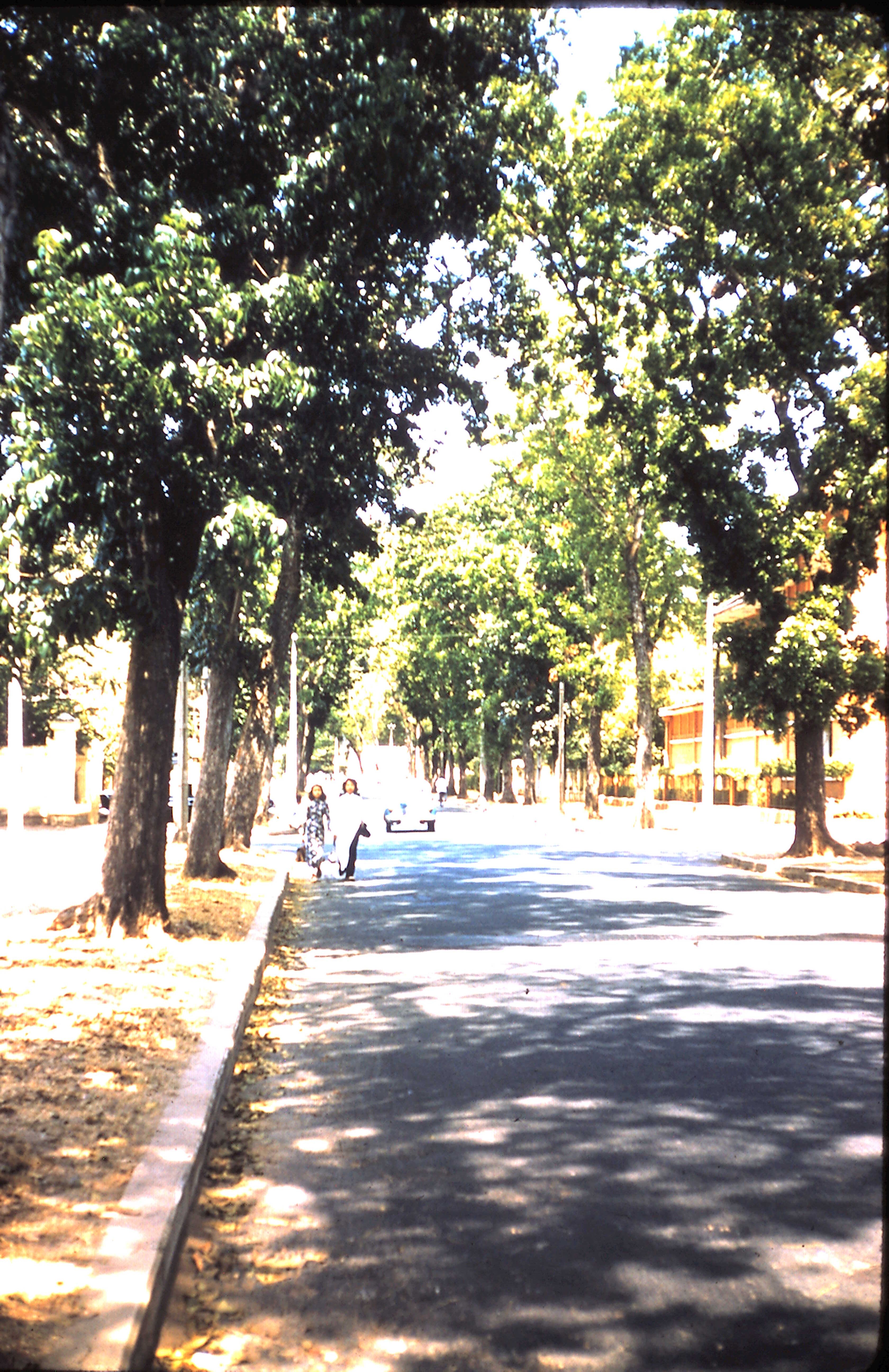
I’ve also had to alter my eating habits. Why, you ask? Because crunchy foods are now painfully loud inside my head. If my condition were to become permanent, would I adapt, learn to tune out the chewing noise? Probably, in the same way I learned, shortly after arrival in Saigon, to tune out the persistent noise of the cicada-like insects that created a permanent background concert in the trees. We kids enjoyed tormenting new arrivals (as I was tormented) by calling attention to the persistent chittering, just at the time that the newbie’s brain was beginning to accommodate, and thus cease to notice, the sounds.

In the Trees

In the Trees

We humans are marvels of accommodation. We live in the most diverse environments, we survive extremes of privation, we come in such a variety of sizes, colors and skill sets. . . No wonder accommodating to one another is considered to be such a virtue.

No wonder, either, that learning when to draw the line, when to limit adaptation, when to say enough, I want/need/seek to stand apart – no wonder learning how to express one’s integrity can be a challenge. Especially, it seems, for women. Even today’s emancipated, modern women. My Lebanese correspondent was writing me on her smart phone, waiting in the Beirut airport to fly to Dubai for a work day. And questioning her right to step away from a relationship because she’s not yet ready to “settle” for. . .

Accommodate, adapt, be flexible, accept what is.
Go for it, “be all you can be”, make the most of your time, your talents, your opportunities.
Conflicting imperatives, challenging us to know which one to apply in which situations.

Is it yet another sign of our adaptability that we can implement both types of behaviors? Or is it a sign of our integrity that we manage to achieve a balance between seeming contradictions?

I have my own answer to that question. I’ll let you find yours.

In Process

April 27, 2014

It’s early Saturday morning, and with only one client to see en route (sort of) to a shopping trip in Santa Fe, it actually feels like a day off work. Perhaps because I have no intention of opening up my work computer?

Yesterday I learned that a fairly recently hired co-worker, whose presence took a load off me, has given her resignation notice. The demands of the job are too much for her “at her age”. She’s ten years younger than I am. Hmmmm…

I am significantly aware that I have not participated in any of the several opportunities to sit with others in contemplation, as I was accustomed to do before January 1st. Engaging in moving meditation has taken on a whole new meaning – no longer a structured, slowly measured walk but rather brief minutes of focused consciousness while driving from one place to another. I am trying to also achieve moments of stillness and non-thought before starting each new task of the day, and especially before opening the work computer. It does seem that the better I am centered, the more smoothly the computer operates.

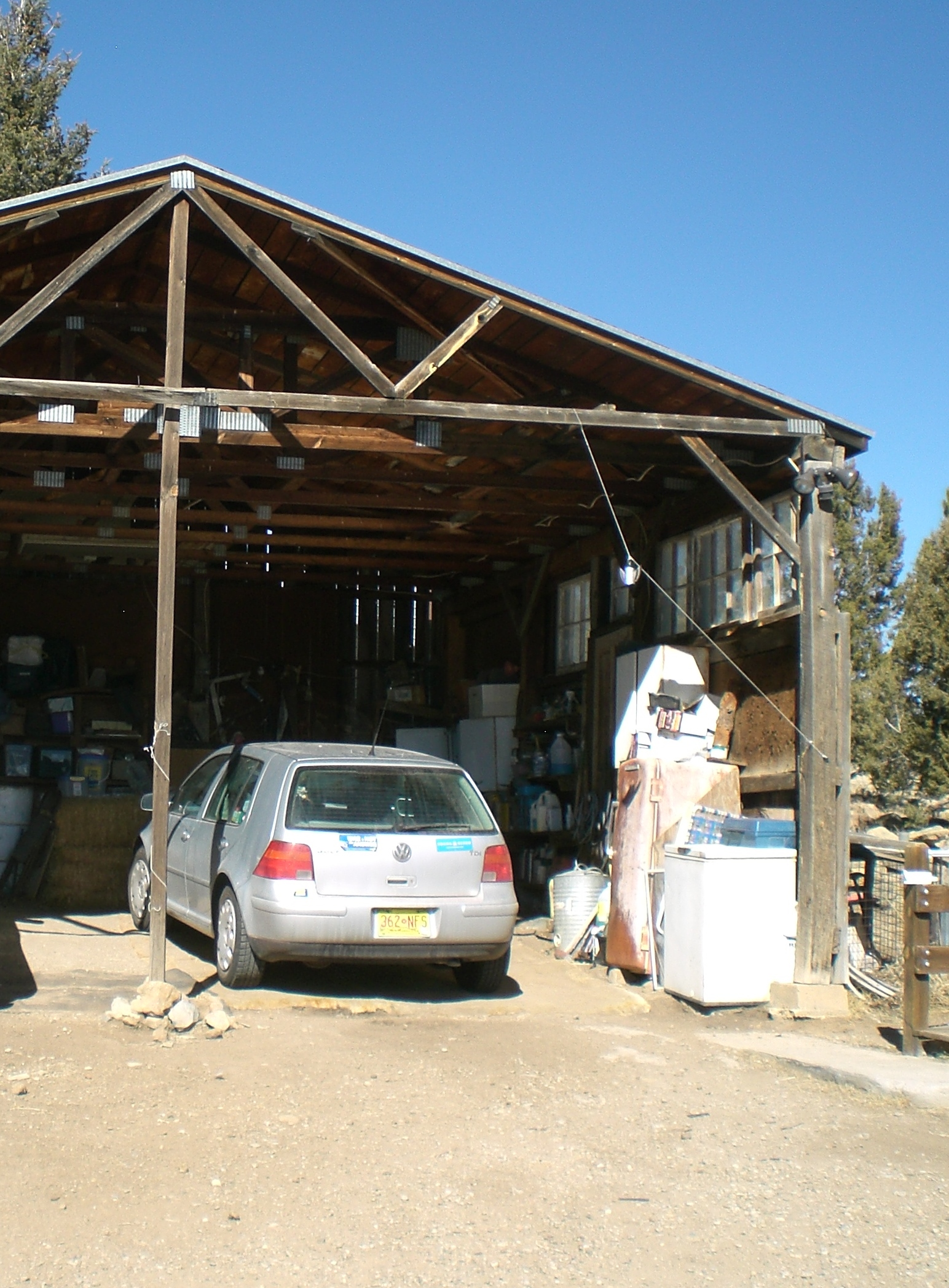
May I hope, in time, to feel the same connection to that computer as I do to my VW? I’ve scheduled the car for a visit to a local mechanic, ostensibly for a check over before I take a long drive to Sedona in mid-May, but actually because something about the way the car starts in the morning has alerted me that all is not well with my trusted steed. Will I ever reach the point of being able to tell, before opening the first screen of my job-dedicated computer, that one of its many layers of security interface is experiencing a glitch and that my work session will not go well?

Have you noticed how pervasive is the tendency to think one is doing something wrong, if a project encounters obstacles? We seem to expect that once we’ve planned a course of action, and put it into motion, all should go easily. Problems that crop up are taken as criticism of our planning, or perhaps of our intentions. How unrealistic, and egocentric a view that is! Some of us who meet such obstacles simply drop the project, believing we are not meant to succeed. Others try to force their will upon the perpetrators of the obstacle, bulling their way to the desired goal. Neither process is enjoyable, neither brings much sense of achievement.

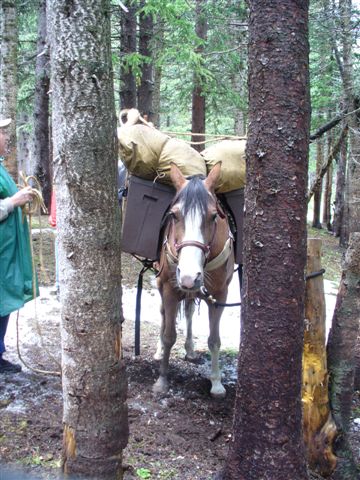
One of my teachers of MasterPath spoke of going for an outing on horseback, following a trickling water course up toward the mountains. She had to ride around large boulders, zigzagging from side to side of the stream and occasionally pushing her horse to scramble up onto one bank or the other to get around a fallen tree. Life is like that, she said – a path toward a distant goal but never smooth and straight. More than half way to the mountain, a thunderstorm erupted near the mountain top and wise woman that she is, she immediately pushed her horse up out of the arroyo and onto higher ground, heading back toward home at a brisk trot. Going to the mountains would be the project for another day. We need to be flexible, she said, and recognize when it is – and when it is not yet – time to undertake or complete projects. When it is right to push forward and when it is wise to step aside and wait.

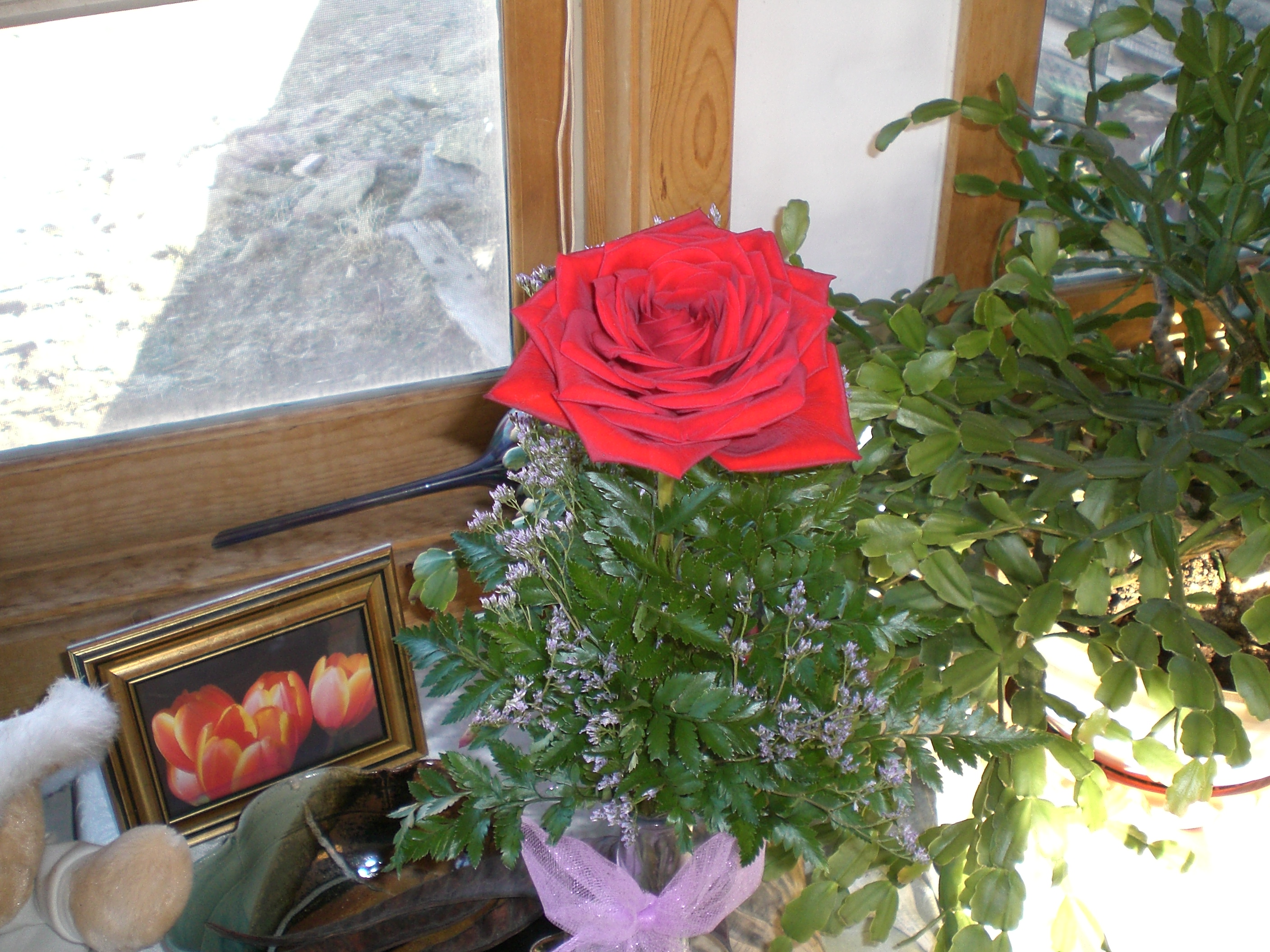
Valentine, with Choices

Valentine, with Choices

A true measure of success is not, then, about achieving goals in one’s predetermined time frame, Rather, it is about how one behaves, feels, enjoys the process of moving toward the goal and how flexibly one adapts to the inevitable obstacles and delays that are encountered.

I’m not revealing anything new here. Only reminding myself of my best course of action in managing my demanding new schedule so as not to reach the point where I must, like my co-worker, resign in order to survive. My choices are to increase my awareness of “the flow” so as to be better able to go with it; improve my patience so as to be better able to accept God’s timetable instead of my own; and enlarge the scope of my adaptability so as to be best able to “enjoy the process rather than focus on the outcome.” Oh, and definitely to have fun along the way!

Driving into Awareness

April 6, 2014

I am teaching someone to drive – again – no, I am again teaching someone to drive. There, that’s better, more accurate.

The same process of correction, of attention to exact explanation is required of me as the driving teacher (not driving the student hard, but teaching the student the art of driving). And it is as much art as science. Getting the feel of the vehicle, of the wheel, of how the car wants to straighten itself out from a turn so that trying to do the straightening produces an over-correction. Learning to position oneself in the lane, noticing important warnings of the intentions of other drivers, processing what one sees and hears without needing the time to consciously think it all through. Driving, especially in traffic, requires quicker responses than conscious thought permits.

I am, again, teaching someone to drive, and valuing this opportunity to become conscious of what I do instinctively. Valuing, also, this occasion to notice not just what I do right, but what I’ve gotten a bit sloppy about, and don’t want to continue to do, now that I need to be a role model of safe, defensive driving.

My daily spiritual practice is essentially an exercise in shutting down thought, in order to become aware of the subtler levels of my being. Very close to what I must do to teach someone a skill at which I am so practiced that I conduct the activity beneath the level of awareness and thought. When I come out of my daily contemplation, I often bring a new insight with me, into consciousness, then do my best to put into words and actions what I’ve been gifted to perceive. Very much like the way in which I am opening to the subtle habits ingrained by so many years of driving, and attempting to give voice to them in order to instruct my student.

So teaching someone to drive is a spiritual exercise! Or at least it can be, if one chooses to make use of the experience for one’s own growth in understanding. And in patience. And in trust.

The vehicle being used is my ‘second’ car – the back-up GMC that serves as my guarantee of transport should my trusty and trusted and much loved VW Rabbit ever fail me. (It has not done so, as yet, in ten years and nearly 220,000 miles of mostly solitary driving). I’ve realized already that I would be far more tested were I to be giving the lessons in the Rabbit. Not just because it’s a stick shift whereas the GMC is automatic. I have virtually lived in the VW; it’s packed with all that’s necessary for me to survive through a snow storm, hunker down to wait out a dust storm, take advantage of an unexpected opportunity to camp out overnight, be appropriately dressed for sudden changes in weather, provide roadside first aid in case I come across an accident… you get the idea.

Resting at Home

Resting at Home

My Rabbit has become far more than reliable, reasonably inexpensive transportation. It’s home away from home, an important means of connecting me to the world, a key element of my ability to earn my living and, because Rabbits remain relatively uncommon on our roads, a distinguishing mark of my presence. Not so long ago, I needed to let a mechanic drive the Rabbit so he could feel in the steering what I sensed was a developing problem. Sitting in the passenger seat as we went around the block was one of the harder things I’ve done recently.

Sitting in the passenger seat of the GMC has not been difficult. I don’t have much history with the Envoy, and my student is both a quick learner and a careful driver. The challenge for both of us is that he grew up using public transportation, not riding in cars, so he still has to acquire the non-verbal, body sense of what driving a car is all about. It’s not at all the same as riding a motor cycle, which he has done.

I’m also familiar with riding cycles – not driving them, but happily sitting on the back, free to enjoy the wind in my hair and the scenery flashing past with an immediacy totally lacking when one is shut inside a car or truck. I used to get the same sense of connection with my surroundings when I rode my horse out through the gate of my property and into the extensive acres of my neighbor’s ranch. A brisk canter to the far fence shut down thought and opened up my inner world. Yet another form of spiritual exercise.

Perhaps I should suggest to my student that he do a short contemplation before his next turn behind the wheel? Most physical skills come more easily when one relaxes into them (think of learning to float in order to swim). Those same skills suffer when one over thinks them (tensing up in the water, and sinking). Riding behind on a motorcycle, one has to relax and let one’s body bend with the curves in concert with the driver. Up on a horse, one must become one with the rhythm of the horse’s gait. Behind the wheel of my Rabbit, I feel in tune with every nuance of the vehicle, I know that car as if it were alive.

How does one teach that sort of awareness?

Hearing one’s True Voice in contemplation and then living from one’s Divine Self are, like driving a car well, skills which cannot be mediated through the mind. These skills cannot, therefore, be taught. They must instead be caught by the student, who first observes them being modeled by a teacher and who then, by trial and error experience, learns to shut down the mind and respond from a wise and capable Soul.

Inner commune, connection, inspiration, followed by action – the sequence of a spiritual exercise – is also the sequence many artists describe as their process of creation. Learning dance choreography many years ago, I was told by Miss Widener to stop thinking about my composition and instead to just feel my way through it. Yesterday I asked my student if he could feel how to respond to the impact of wind on the Envoy’s steering. Today I am challenged to create, with words, a feeling of intuitive understanding in my readers.

Do I evoke an “aha, yes, I am aware of that part of me?”
Do you go there, learn, trust, respond, live from that core? Yes? Then I’m happy for you.

If not, or not yet, teach someone to drive – or ride a bicycle, redecorate a room, weave a rug, or work with wood. As your student learns a new skill, you’ll gain a new level of awareness, and enjoy a new way of Being.

Whirlwind

March 30, 2014

My thoughts seem to be coming in song fragments. Some are personal. One asks to be shared.

“Tis a gift to be simple, tis a gift to be free, tis a gift to come down where you ought to be. To turn and to turn shall be my delight, and in turning, turning to come down right.”

My life is being turned upside down, and I’m simultaneously riding on the whirlwind and standing aside, watching the wind (up to 60mph outside my window at the moment) figuratively shred the golden chains that have held me trapped in patterns of thought, belief, behavior that appeared to be good but which were nonetheless ensnaring.

How subtle is our mental training to be “good”, to think in dichotomies, to turn away from what John Eldredge, in Wild at Heart, calls our God-given nature. In order to be “a good Christian” (Eldredge) or to be a responsible partner, or a good family man. Or so as not to be labeled “bossy” as a young girl, or called that other “b” word when, as a mature woman, I speak up, speak out, speak my truth.

“Be a good girl and…” do whatever I’m being asked to do, whether or not that something is good for me.
“Good little boys don’t…” do whatever it is the adult is unhappy at seeing happen.

It’s called socialization, and it’s what good parents do when raising their children to fit into society – and what not such good parents do when projecting their own malformed views onto their children. In both cases – and all the variations in between the two extremes of positive and negative parenting – the resulting imprinting takes a lifetime to understand and clear away, if one is even capable of understanding and clearing it.

What my Master calls iron shackles and golden chains – the imprinted concepts from upbringing and karmic bonds – are what his students work to become aware of, and to release. The shackles are usually obvious – habits like addiction, that limit and restrict opportunity, or behaviors that can be labeled anger, greed, attachment, pride. The golden chains are much more difficult to recognize because they come disguised as positives like responsibility, or being a good ______ (fill in the blank).

Remember What You Are

Remember What You Are

I’m not suggesting one shouldn’t strive to be good at whatever one sets as a goal – developing and using skills is a satisfying and fulfilling effort. Being good at is not the same as being good. Active little boys, expressing their inborn nature, may be good at stirring things up, exploring and challenging and daring to try, all behaviors that can get them labeled as disruptive by a teacher who wants them to sit still for school lessons. A bright little girl with natural leadership skills will hear that she’s being unacceptably bossy when she tries to take over direction of a playground game.

Breaking golden chains, then, can be considered as learning to distinguish being good from being good at, and giving oneself permission to simply Be… good at certain things, not so good at others, but acceptable and accepted and loveable and loved, nonetheless.

Because you are Soul, perfect and beautiful, warts and all.

‘Tis a Gift

March 23, 2014

I have only a little time this evening, set aside for writing, but without any strong motivation regarding a topic. There are four or five essays I’ve started at various points in the past few months – none of them grab me just now, asking to be completed and posted. Too abstractly intellectual; too much social commentary when I don’t feel particularly engaged; too removed from my current state of being… Too, too, too.

The only immediate concern that engages me in this moment of relaxation, is how to keep my present calm acceptance and contentment going when I am bombarded by Saturn’s powerful strictures, or the draining needs of others. I’m sure you’ve encountered people whose sense of deprivation, or overwhelming pain, or just plain exhaustion have turned them into emotional black holes, sucking life force from everything around them. I’m not referring to those who have been diagnosed with borderline personality disorder – the ultimate in black-hole-ness. Working effectively with these fragmented people requires professional training and a great deal of practice.

No, I’m referring to people who mostly manage to make their way in life, but lean extensively on anyone and everyone around them in order to function. They hold jobs, they raise families, and they suck up the energy, the enthusiasm, the very vitality of those around them. I’d forgotten how many such souls draw on our health care system for portions of their support. I’d forgotten to what an extent I have to develop mechanisms to balance myself out, after spending days working with these needy individuals.

Some of the exercises in my weekly Ba Gua class draw energy from the earth and bring it up through the body and out the fingertips. After a particularly challenging work day recently, I rooted myself in the standing tree pose until I felt a resurgence of chi in my body. The technique is effective, but not one I can practice easily in the car, traveling between clients.

Checking in with my Master helps, always.

So does the company of friends, though I feel cautious about relying on the energy of others, not wanting to become, myself, the sort of leech that I am seeking to recover from.

At Upaya, a Buddhist retreat center in Santa Fe, there will soon be a workshop on compassionate caring, subtitled how to be engaged without being entrapped. It sounds like an answer to the challenge of my present situation. I will have to absorb the lessons by osmosis, however – I can’t take that much time off from work just yet.

Nor do I think such a workshop will guide me in dealing with the most serious source of leeching energy – the brutally frustrating, inefficient, too often non-functional data software system with which I must interact on a daily basis at work. I’ve learned that my employer is threatening the computer system contractor with a breach of contract lawsuit – and cancellation of the contract for failure to perform. One part of me is cheering wildly at the thought of becoming free of the monster. Another, though, cringes at the idea of having to redo – in a new data base – all the work already completed since the first of the year.

You’ll get some idea of how awful the data system is, if I say that keeping paper records and duplicating multiple entries by hand would be far more efficient and user friendly than the program we are expected to negotiate, when it works – if it works. I had set today aside for data entry – and couldn’t even get into the system until almost 1PM, effectively losing half my work day. To keep up and not feel totally overwhelmed by unmet obligations, I’ll have to work on Saturday – again.

I can work on Saturday. I’m free to work on Saturday. I have paid work to do on Saturday. I have a good paying, mostly enjoyable job being of service to others, after many long months of being turned down for every sort of work I sought.

No, I’m not practicing affirmations, just reversing a possible spiral into negativity that could begin with today’s frustrating failure, yet again, of a system that is supposed to be an asset in my work my life.

Giving attention to that which uplifts, enjoying the company of friends, sharing a bit of my daily life with these words – these are activities which allow me to regain energy, to move forward into my next day of interaction with whatever sentient or mechanistic black holes cross my path. Outstanding astrologer, Eric Francis of PlanetWaves, urges that we face the coming months of a unique and powerful astrological grand square by daring to trust. For me, that translates to moving forward with confidence that my inner sun is strong enough (provided I remember my Source) to keep shining despite any loss of energy or sapped strength.

To have the opportunity to experience this constant regeneration is a gift for which I am most grateful.
CIMG1281

Japanese Rituals and Tea

March 16, 2014

A dear friend commented on my essay on English tea, that this elaborate meal is very different from an Asian tea – leading me to consider my experience with traditional Japanese tea ceremonies. The first time I benefited from participation in this ancient ritual I was not quite thirteen years old. My mother and I were traveling from the U.S. to Vietnam by ocean liner, a zigzag course from San Francisco to Hawaii to Osaka to Manila to Hong Kong, where we were to land and meet my father for the last leg by plane to Saigon. My mother got bored with life on the ship and decided we should get off in Osaka, and spend a week in Japan before flying to Hong Kong.

Not one to enjoy noisy, busy cities, I found Tokyo interesting but overwhelming. In particular, an hour spent inside a large department store left me feeling frazzled, and as though I were picking people out of my hair and off my skin. Near to the store was a public garden and within the garden a large building which proved to be a cultural museum. Just at the time my mother and I arrived at the entrance to the museum, a young woman in a beautiful kimono announced that a tea ceremony would begin in five minutes. Joining the group that followed her, we walked into a spacious central room where we were invited to be seated on cushions on a tatami floor. In rows, facing an open area, we waited, some talking quietly until the hostess politely shushed everyone.

The walls and ceiling were carved wood, decorated sparingly with niches containing a vase, or a statue, or a calligraphy scroll. The impression was of richness but also a quiet simplicity. Despite being part of a relatively large group (we must have been thirty people) I felt as though a space had opened around me, allowing me to relax and expand. Perhaps it was the size of the room, or its dimensions that created the sense of airiness which I found so soothing.

The tea master entered silently, gliding to his place facing us, a low table and a brazier arranged so as to be within easy reach, yet artistically angled to present to us, his guests, a broken line reminiscent of waves breaking across the tatami sand. The master bowed to us, and we somewhat raggedly bowed back. That is, the Japanese in the group bowed gracefully and in unison – we few Westerners belatedly realizing what was expected, followed as best we were able.

The hostess knelt to the side of the tea master, again gracefully angled to enhance the pattern presented to us. She passed items to the master in perfect rhythm with his movements, and without any visible requests. I concluded that she knew the ritual as thoroughly as he did. Each gesture of each of their four hands was controlled, graceful, careful and complete – a dance of fingers wiping bowls, rotating the tea canister, positioning the kettle, showing off the items used to scoop the tea powder, to stir it, and finally rotating the bowl of tea to present its most beautiful face to the guest for whom it was intended. In turn, the hostess brought a bowl of tea to each of us, then returned the drained vessel to a row behind the master. When we had each had our few sips of thick, bitter, refreshingly energizing, green beverage, and all our bowls were lined up facing us, the hostess and master bowed to us and we – this time collectively, no laggards – bowed back.

The master rose and left the hall, and the hostess signaled for us to also stand. The Japanese rose gracefully while we Westerners found our own, often inelegant ways to our feet. We were escorted back to the entrance hall of the museum, and quietly invited to tour the rooms, which included ancient tea ceremony implements, and gorgeous kimono. I did my best to carry the silence, the stillness, the ritual formality and peace of the ceremony with me as I studied the displays. I still remember how tempted I was to scold the few Western visitors who burst into conversation near by, criticizing the tea as not being what they expected, barely drinkable, not something they would ever willingly have again.

Unlike with English teas, which I’ve enjoyed many times in many lands, I have only experienced that one fully formal Japanese tea ceremony. An acquaintance who married a Japanese, and lived many years in his family home, recently invited me to a tea ceremony that she arranged for a small group of friends at a lovely gallery in Albuquerque. The rituals of turning and admiring and wiping the bowls, of slow-moving hands doing a dance with the tea implements, were familiar despite the many long years since my visit to Japan. At the same time, I was aware of the difference between the formality of the museum ritual, and the “welcome to my home” informality of the ceremony in New Mexico. What they had in common was the creation, through gesture and tradition, of a sense of peace, harmony, stillness, contemplation.

I left the museum on that long ago day, better able to exist within the rush and burble of humanity surrounding me. The ceremony created within me a place of quiet and privacy to which I could retreat, and which I could to some extent then carry with me out into the rest of the day. I’ve learned in later years that other cultural customs also developed in Japan, to provide a sense of privacy to people who live in close proximity, in rooms divided only by paper. For example, the occupant of a room must acknowledge someone who enters before the latter may speak. If unacknowledged, the visitor knows to silently withdraw. Only if the reason for entering the room is of grave importance will the visitor remain, still and silent, until an acknowledgement is offered.

Living most of my life in a very different culture – one that seems to rush to fill any silence with words or music or some sort of noise – I’ve chosen to live in a rural location, in a small house with many large windows that minimize my separation from the trees, grasses, birds and wind surrounding me. Within this retreat I enjoy tea, sometimes green, often strong and black, which I drink from a hand crafted mug. I have my own rituals – the water must be boiling, the tea of good quality, the pot a pretty one. Neither English nor Japanese, nor the Russian of my father’s tea preference, but a blend of all three and a link to cultures and countries and lives I’ve been privileged to encounter.

In Full Glory

In Full Glory

Dayenu

March 9, 2014

Have you noticed how subtly, but pervasively, some of us become conditioned to be happy with crumbs, accepting far less from the banquet of life than we may want, or even than may be available?

In my case, I recognize that this training began in my earliest childhood, as the result of my mother’s severe psychological problems. Anything I looked forward to, anything I really wanted, she found a way to make unpleasant or to turn into an unhappy experience. You think your birthday should be special, maybe a few playmates over for a small party? Think again. “I don’t choose to accept responsibility for anyone else’s children in my house.”

If I admired some small item in a shop window, wishing someone might think enough of me to buy it for a present, I might very well find it at home – on my mother’s dresser, after she bought it for herself and preened over her lovely new figurine. Primary school graduation, all the girls dressing up in pretty new clothes and patent leather party shoes? “It’s a school day. You wear your sturdy Oxfords, no buts and no arguments, do you hear me!”

I learned to be grateful for a day without being repeatedly slapped, for an hour alone with my grandfather, just going for a walk around the neighborhood (“You haven’t earned the right to go to the zoo with him this week, you’ve been far too much trouble to me”). I learned to accept that only grownups got new clothes from the store; mine were roughly sewn together from one of three basic patterns and handed to me with, “I worked hard to make this for you, don’t you dare complain that it looks like all your others. It’s a different color. That’s more than enough. The children in Africa are lucky if they have any clothes at all!” Those children in Africa were lucky if they had food, or a warm bed, or a place to get out of the rain, or…

I wanted to visit those children in Africa, to see if their lives were really so bad. Somehow, even at only five or six or seven years of age, I suspected that many of them had loving parents and enough to eat and maybe they even got presents sometimes, and hugs and kisses instead of punishments.

If we’re diligent about maturing, about taking responsibility for ourselves and who we become, we grow out of a variety of early conditions to become decent, engaged, thoughtful people. We stop blaming our bad decisions on our parents’ inadequacies, we learn from our mistakes, and we move forward. But underneath, all too often, we retain a fundamental attitude that we must feel satisfied with crumbs.

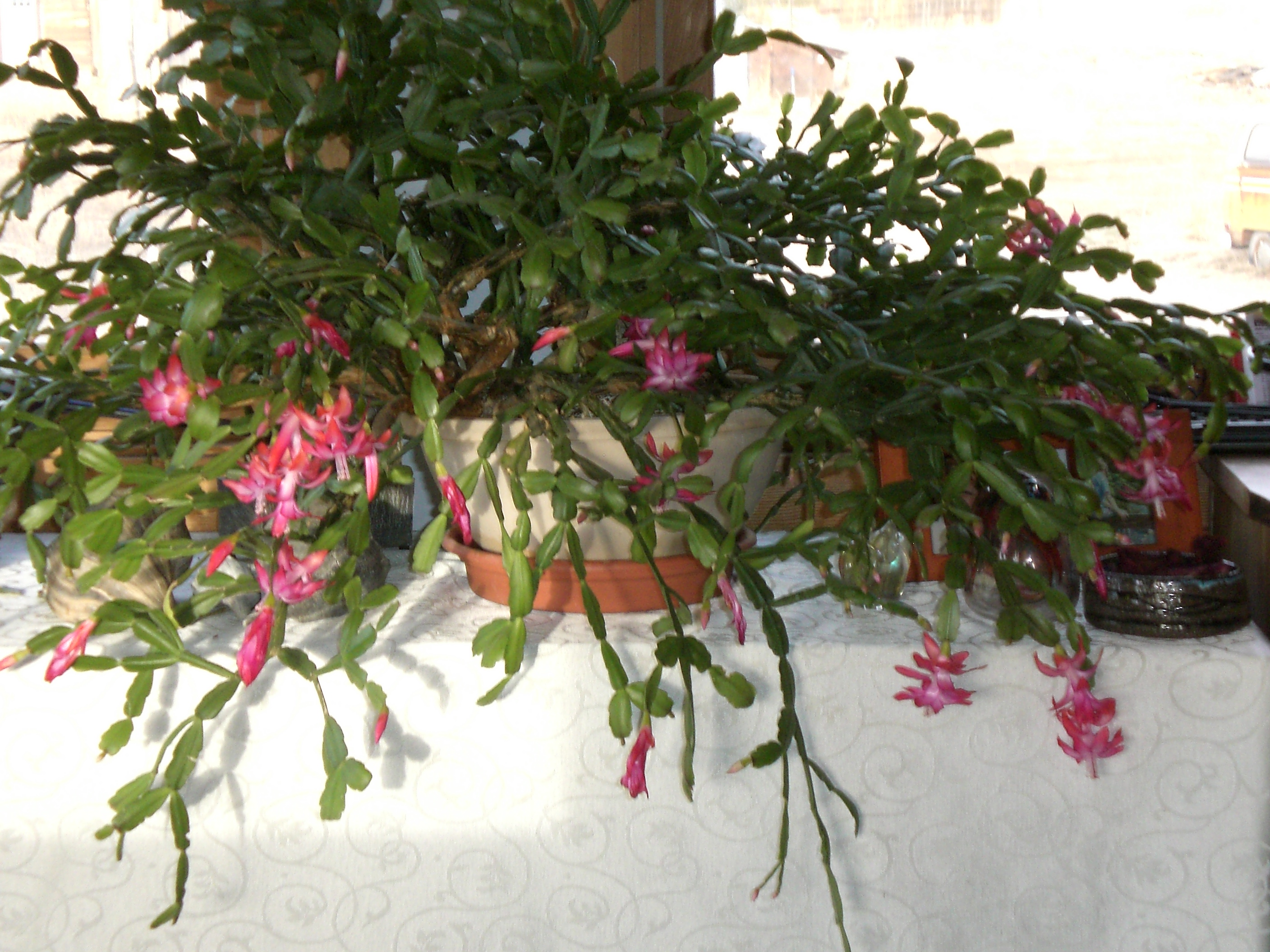
Don’t misunderstand – I fully support approaching each day with “an attitude of gratitude” for the many small positives to be found in it. I’m amused by the antics of the rabbits in the pasture. I smile at my confused (or misnamed?) Christmas cactus which stayed plain at that holiday, but is now flowering for Easter. I’m quietly, inwardly thankful for the opportunity to work once more at a job I enjoy, after years of toil in a less rewarding environment.

At Easter

At Easter

At the same time, I recognize that I spent many more years in that previous, stressful workplace than perhaps I “should have” done, because I was (am still?) conditioned to accept a small salad plate from life’s banquet rather than grabbing a big dinner plate and seeing that it is filled. The latter behavior is so often called greedy, selfish, and thoughtless of the needs of others.

If what one is going after falls in the material world – money, possessions, power – then yes, trying to get as much as possible for oneself may well be greedy and selfish. Lord knows I can’t comprehend how people already making hundreds of thousands of dollars a year can think they are also entitled to bonuses! Some, like Bill Gates or Michael J Fox, turn around and give back a generous portion of what they acquire, and thereby help the rest of us. I am thankful for them, and their charitable foundations. Too many others grab for, demand, and keep outrageous salaries, even insisting they be paid after they’ve been asked to resign. The public face of this activity is labeled “buying out a contract.” I think it is purely obscene. We working folks who don’t perform to standard get fired, not paid to leave. Why should it be any different just because one has an exalted position with an already very generous pay rate?

But I’m not talking about the material world, when I say we’re conditioned to settle for less. I’m not even talking about the emotional world, or the necessity of accepting that very few relationships are perfect, that we cannot count on another to “make me happy.”

I’m reflecting instead on the extent to which we cut ourselves off from fulfilled happiness by telling ourselves we do not need, are not entitled to, don’t have the right to, should not want or expect that fulfillment. In a portion of the Seder, the Jewish celebration of Passover (and the ritual being observed by Jesus at the Last Supper) a litany of blessings is recited, and after each step in the path to freedom the sentiment is expressed “Dayenu = It would have been enough.” If God had done just X, it would have been enough. If God had done just X+Y it would have been enough. If God had done just X+Y+Z it would have been enough.

I learn from this ritual that being grateful for what I have need not prevent me from welcoming more into my life. That I want more does not say I don’t value what I have. Only the subtle, pervasive, underlying conditioning of unworthiness so many of us have absorbed dictates that I should not try for gold, now that I have silver in hand.

I have silver, and rubies, and ambrosia, a wealth of gifts of the spirit. Dayenu. I appreciate how much that means to, is sought after by, people who have less. I happily share my blessings as best I can. And I’m going for more.

Reaching for a full platter does not mean I appreciate my present plate any the less. It does mean I’ve decided not to hang back, not to duck and cover, not to “settle” before I must do so. Maybe I’ll trip. Maybe I’ll fail. Maybe I will, in the end, have neither gold nor silver. But as a former prisoner and student of mine once wrote, “Mighty Casey, he struck out. What does it feel like to get into the game?”

I’m going to find out! And whatever the outcome, it will be enough. Dayenu.

Being Present

February 23, 2014

As I woke this morning, three little puffs of cloud – the only ones in the sky – were framed in the window at the foot of my bed. I lay watching them through the leaves of a night-blooming cereus plant, waiting for the sun to come up above the eastern hill and finish lighting the sky. The clouds seemed immovable, virtually unchanging in what is obviously a windless day. Then, just as the sun began to shine directly into the east window, the puffs merged into one larger pillow, rising up and out of my sight. When I got up to look for what remained of them, the white fluff had thinned and was disappearing against the lighted blue background of a clear morning sky.

I’ve reflected on snow, and last week on the howling wind. This morning of remarkable stillness seems to be a special invitation to stop and consider the hectic pace of my recent weeks, not only of work but in my private and inner life as well. Never one to rush into new situations, new relationships, I have been meeting three to five people (clients) a week, and getting to know them and their family members quite intimately. Drawn into helping them access services which will resolve serious problems they are facing, I am exposed to the challenges and rewards of life in a very personal way that reveals how nothing stands still, even when we feel as though nothing is changing.

First gifts

First gifts

Several small birds have appeared in my long picture widow, flitting around one juniper tree, and two neighbor dogs have just trotted into the pasture, sure to initiate a barking greeting from my ever-vigilant min-pin Doodles and his woolly poodle companion, Warrior. The sun now slants directly into the window at my side, forcing me to lower the shade in order not to be blinded. Small changes – an inch of rise of the sun, a flutter of birds – and the day has shifted. A contrast to the experience of focusing on a single issue – such as finding a job, or getting a driving license – when it can seem as though nothing changes day after day because the single object of focus and desire is not obtained.

One of the greatest gifts from my MasterPath instruction has been an increasing ability to notice the small differences and changes occurring during periods of waiting for some larger event. My Teacher speaks of the need for certain karmas (external situations) to exhaust themselves in our lives, stressing that spiritual growth need not be delayed until after XXX (I get sober, I am able to retire, I find a job). How one views one’s days and the way one approaches the occurrences of each day are both the means and the opportunity for growth. In that light, the AA injunction of “one day at a time” is an important reminder that life is lived, and changes evolve, not in some distant future, but here and now, day by day.

Wisdom of my Teacher

Wisdom of my Teacher

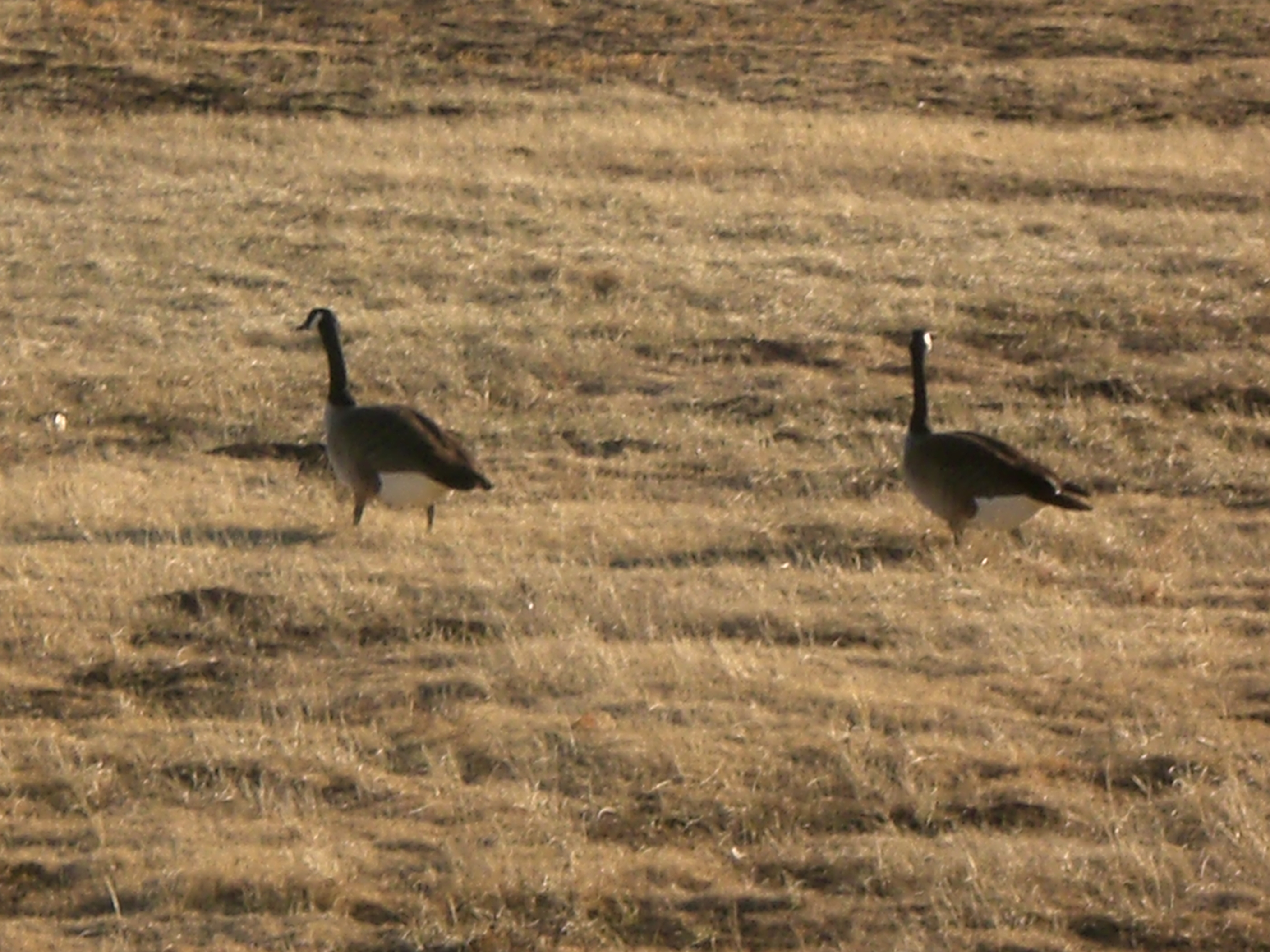
It seems as though my recent spiritual lessons have emphasized not just one day at a time, but one hour, sometimes one minute – bringing out how malleable time, or one’s perception of time – can be. I began with a comment about the hectic pace of my recent weeks, yet that pace only seems hectic when I look at how few days I’ve spent entirely at home, compared to pre-job weeks of days when I didn’t leave the house. If I count how many trips I’ve taken to different communities, how many new clients I’ve met, how much driving around the countryside has filled my recent weeks, I can feel as though there has been no time for me, no time to reflect, to write, to evolve. On the other hand, I remember that I noticed snow geese amongst the Canadians by the pond near town; watched a hawk catch a rabbit on the prairie outside Roy; learned more about Cameroon from stories shared during some of the longer drives; observed the relaxation of a tense body as a harried son who gave up his job last fall, to care full-time for his disabled mother, learned from me that he could have income within a month, being paid to provide that care. I remember these small moments, and time stretches.

Hectic, for me, is when I feel as though events have been rushing at me with no time to consider them, to notice details, to organize and structure experiences or – related to my new work – to prioritize what must be done. From that perspective, my commitment to myself to continue to post weekly is a commitment to limit the hectic pace the job could demand. At least once a week I must stop and reflect, and in this moment’s case, realize that I also stop and reflect frequently throughout each busy day. Noticing the geese, the hawk, the easing of tension are moments of reflection, of being present rather than reaching forward to an as yet non-existent future.

Only Canadians, no Snows

Only Canadians, no Snows

My mind has challenged the idea of being present with the moment when that moment is perceived as difficult, painful, scary or otherwise negative.

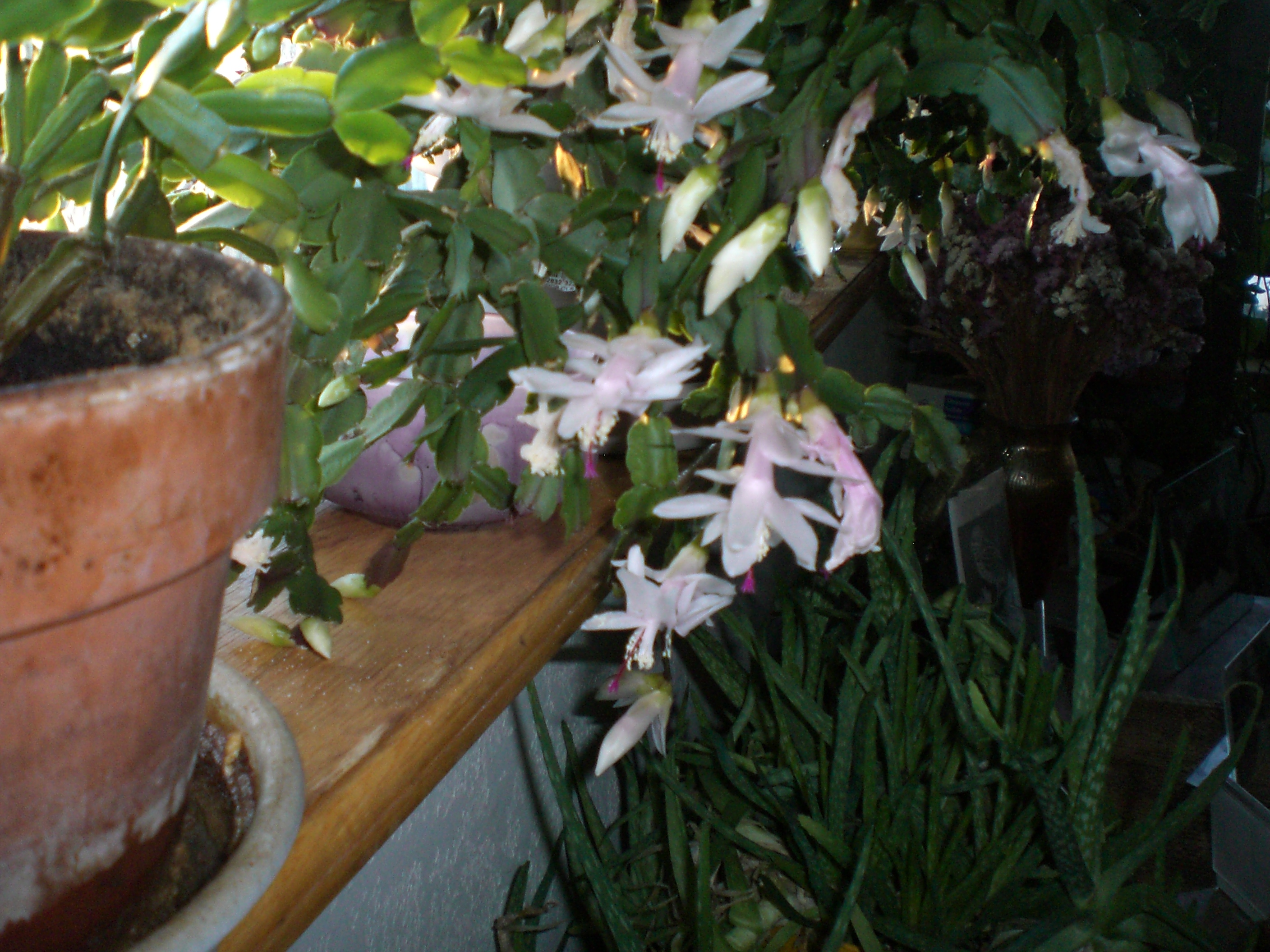
Why would one want to be fully present in a recent day of flu-induced aching and nausea? The lesson mind needed to learn was that during that day, other things were also occurring worth noticing, worth being present with. During that day, my one large dog, a retriever-cross named Blackjack, stayed on the porch and insistently close to me rather than spending his time as he usually does, out in the pastures. During that day, cotton tails appeared three separate times in the pasture. During that day one Christmas cactus put forth a single white flower, though the plant had never bloomed before.

On a recent day when I was physically exhausted but nonetheless had to drive 80 miles of winding roads on an urgent visit to a client, I was gifted to have a companion for the drive, and to receive the encouragement of expressed appreciation for my effort, from both the companion and from the client. I also saw multiple frozen waterfalls glued to rocks in the canyon through which I drove, and remembered and shared the story of a triple rainbow that had filled one field when I traveled that road in the past.

Little things to be present with. Little things which, accumulated, become large, become the frame and the tone and the import of each day. Again, my Teacher instructs that we are always free to choose what we give our attention to. Attention is food – what is fed grows. I choose to feed appreciation, present moments, what is. In such small steps, with present moments of attention, what can be is also fed, given form, and enabled to appear.

Baraka bashad.
Amen.
May the Blessings Be.

Letting the Wind Blow Through

February 15, 2014

A friend just mentioned he’d enjoyed my reflection on snow, bringing to mind the gorgeous silence of that recent morning, a stillness in dire contrast with the roaring, shaking, blustering, hollering wind blasting my home tonight. Gusts over sixty miles an hour have been hammering at us for five hours now; fortunately the general temperatures were warm enough today that the blasts are not unduly chilling. At least not chilling in temperature. But those who are made uncomfortable by wind can find our New Mexico spring weather intimidating. Tonight’s blasts are not unusual. A little early in the year perhaps, and lasting later into the night than normal, but very familiar nonetheless.

When I was fifteen I wrote a poem about standing up to wind, not a very good poem though the underlying thought was worth the effort. It had been triggered by standing on the edge of a precipice, at Les Baux in southern France. The town sits atop what here in the southwest we’d call a mesa, overlooking a broad plain called the Val D’Enfer. Reputedly the Dark Ages lords of Le Baux forced trader traveling through the valley to pay tribute – often exorbitant tribute – for safe passage, making the traversing of the plain a veritable descent into hell. My poetic effort attempted to recognize the strength it takes to stand up against a powerful wind, and the strength it took for travelers to risk passing near Les Baux.

I’d prefer more quiet tonight, to assure a better night’s sleep. It’s been a very long, productive but tiring day. If wishes were horses, beggars would ride… so says the adage that echoes in my mind wherever I let myself dwell on what isn’t. So instead, I’m using the blasting wind as a motivator to write this week’s post. We’ll have to see how the essay turns out! Smooth and slick, or choppy and irritating? The wind is both at once – will my essay mimic the wind, or express its essence?

“Love me, love me, say you do.
“Let me fly away with you.
“For our love is like the wind,
“And wild is the wind, the wind,
“Wild is my love for you.”

The most recent theory, from a study in Germany, of why older people take longer to respond to memory tasks, is not that ability fades with age but rather that there is so much more stored in an older person’s brain, it takes longer to sort through everything to find the relevant bit of information. I like that explanation, not just because it is more flattering. I like that explanation because it takes into account all the bits and pieces of song lyrics, like the one above, that pop out of the storage cabinet at mostly – but not always – appropriate times.

Say the word English, and I’m apt to begin quoting, “Her English is too good,” he said, “which clearly indicates that she is foreign. Whereas other people are instructed in their native language, English people aren’t.” And on and on, in Rex Harrison’s voice. I learned the entire performance of My Fair Lady when I was eight. Don’t ask me why, and don’t ask me why it’s still all there in the lumber yard storage of my brain.

That’s the term that was used, disparagingly, by the wave of neurologists who discarded “old” brain storage theories in favor of computer-link images that propose an entirely different set of rules for how our brains perform our thinking and memory functions. That new set of rules is the one that posited an eroding of capacity with age. One more reason I stand in opposition to all the supposedly “better” connectivity and computer-based emphasis of our “modern” world.

Inventors create a new toy and suddenly scientists see everything through the lens of that new technology. Wisdom of centuries is derided, practiced ways of relating to the world and to one another are treated as out-of-date. All theories, all explanations must fit the new paradigm.

Until a brave soul stands up and says “no” to forced conformity to what is new. Until a study from Germany says older brains are just as efficient as younger ones, but they have more data to process, more varied possibilities to consider, and so take longer to come up with answers. Until I suggest to a friend, who has been angered by a phone call wakening him at 3AM, that he can, in fact, turn his cell phone off when he wants to sleep.

What a novel idea to the ethos of today – to be disconnected!

In the midst of the wind storm, I am barraged with sound. Fortunately, I know the storm will pass and it will become quiet again. I really can’t conceive of living in the middle of a non-stop gale, any more than I can relate to those people who live constantly connected – mobile phone always on, always at hand, computer permanently turned on with multiple pages open, Youtube, Facebook, LinkedIn and Skype all demanding attention.

There are reasons to be available to others. If one is living far from home and family, computer connections bridge time zones and allow relatively inexpensive contact. The nature of my present job is such that I must be reachable in emergencies. That doesn’t mean all clients can call me twenty-four hours a day, however. They call a central, toll free number for triage. Only the true emergencies are put through to me in the late, or early, hours of a day.

Connectivity, like the wind, has its season. I do hope that before the passing of all those of us who have lived when (or where) there was not a phone in every home, those born to the age of connectivity will have tired of disrupted sleep and life in a fishbowl. I do hope for an opportunity to teach the continuing values of concentration, of solitude, of silence, of windless days and of attention to one thought, one person, one experience at a time.

*****

Awakening this morning, I first register the silence. The storm has passed, the wind abated. A new day, and new environment surround me. I appreciate the renewed quiet, the ability to focus inward before joining the network of souls who will make up my work day. And I’m happy to think that, now that a research study has been published which respects older brains, perhaps some of the thoughts and beliefs dwelling in those older brains will also be given new respect.

Wouldn’t that be a novel and pleasant experience!


Only Fragments

Love Letters to the Tar Pit

KarusaaVerse

Words that Sparkle, Thoughts that Ignite: Fueling Your Imagination

Leaf And Twig

Where observation and imagination meet nature in poetry.

Millarson Diaries

Personal Musings and Thought Experiments

The Beauty Along the Road

Discovering Beauty in the small details of our lives

Flowerwatch Journal

Notes on Traveling with Flowers

1eclecticwriter

Wide-Ranging Commentary

Spirituality Exploration Today

Delving into the cross roads of rationality and intuition

smilecalm

Life through Mindful Media

A Good Blog is Hard to Find

I will shatter a word and scatter the contents into the wind to share it with the world.

Ray Ferrer - Emotion on Canvas

** OFFICIAL Site of Artist Ray Ferrer **

AKA The Versatile

Fashion | Lifestyle | Food & Travel | Beauty | Fitness | Education | Product Reviews | Movies | Doodling | Poetess

Aging Abundantly | Women Over Fifty | Empty Nesters | Caregivers | Aging Gracefully

Finding Joy at Every Age with writer/philosopher Dorothy Sander

ARTZZLE

Helping with the Pieces in Life's Puzzle of Art and Design

Project Light to Life

A bucket list blog: exploring happiness, growth, and the world.

The Daily Post

The Art and Craft of Blogging

Any Shiny Thing

MIDLIFE MAGIC

allmostrelevant

@allmostrelevant

The Irrefutable Opinion

Assaults on the Casually Mundane by K. Jean King