Archive for the ‘Living and Learning’ Category

Sounds of Silence

October 1, 2013

First, I should explain that a different type of silence was imposed on me over the weekend, preventing me from putting up this post when I intended to do so, on Sunday afternoon. The internet link at the motel where I was staying was somehow incompatible with my computer, and the IT people weren’t able to reset it properly. I am back home, and once again connected – able to ‘speak’.

Thank you for patience, for reading, for following, for being there.

Niki
**************


Noise pollution is one of the issues not being adequately discussed in relation to my county’s examination of a proposed fracking ordinance. I brought the topic into the discussion, and I have to keep raising it as others focus insistently on water quality and scarcity, and contamination of the air and soil. By comparison I suppose noise can be considered a less significant negative – but not to me.

I live in the countryside – what most people would consider a truly rural area. My small 900 square foot house is set back from the road, on four acres, abutting a several-hundred-acre ranch. I have three neighbors – houses close to the road with entrance driveways off it, in a cluster with my own entryway. Across the road are two more homes. Most of the time, those neighbors are quiet – so much so that I wonder if they are at home. No loud parties, nor growling outdoor machinery.

I do hear traffic on the highway. My house is situated on a hill toward which the road heads before it veers off, resulting in the longish driveway that snakes from the road up over a hill to my front door. Sitting in my living room, looking out its floor to ceiling windows, I can see a section of the road, and all the vehicles that travel up and down it. I cannot see – but can hear clearly – the heavy trucks and the rattle of gravel excavation that is going on a further 2 miles away, on a section of land that “ought” not to be considered to be in my neighborhood. Something about the lay of the valley funnels that noise straight up to my house.

The gravel operation is new this summer. I don’t know yet if I’ll notice it when my windows are closed, but I am very aware now, with windows wide open, of the days it is running and those, like today, when it is not. Perhaps I’m more sensitive than other people to the ambient noise within which I live?

I do not like to have music playing “in the background” of my days. I work better, think better, live better in silence. I enjoy music, go to concerts, play records (there’s an oldie for you) or CDs with intention to listen to them – emphasis on the intention to listen. If my intention is to work, I prefer to do so in silence.

Undoubtedly, that preference has something to do with my enjoyment of Quaker Meeting, and Buddhist zazen sessions, as well as my own daily spiritual contemplative practice. Undoubtedly it also has something to do with my appreciation of the skill of the young musicians from Curtis Institute who performed Britten’s Quartet #3 for Strings at a recent Music From Angel Fire concert near my home. Two of the piece’s five movements, including the last one, end with a prolonged silence defined by the musicians holding their bows immobile above the strings of their instruments until, as one, they relaxed in their seats, signaling the end of the silence that was part of the movement, and the beginning of the silence into which the audience could inject its noises of appreciation.

Once before, many years ago in Boston, I attended a concert which featured a piano performance that included long silences as part of the piece, and then too I was able to ‘hear’ the difference in quality between the silence that was integral to the music, and the silence of the piece’s end. That time, as I recall, I had no visual cue. I was sitting too far back, in the cheap seats, to see the pianist’s hands. I could only rely on my ears, and the pianist’s flawless sense of timing, to distinguish when musical silence transitioned to an appreciative silence from the audience, which in turn transitioned into loud applause.

A few of my acquaintances seem to understand what I mean when I express my awareness of the difference between the silence of Quaker Meeting, and that in a Zendo. Even the famously silent Meetings (the oldest, historical ones in Philadelphia) which I have attended, have a busy-ness to them, a sense of minds occupied with focused reflection, that is distinctly different from the no-thought silence of a practiced group of Buddhists in meditation. And different again from the life in silence of the Benedictines (and their guests) living at Christ in the Desert Monastery. Different yet again from the experience of many hundreds of chelas (students), attending to the silent communication from our Beloved Teacher at a MasterPath gathering. Dare I say that there are many different sounds of silence?

(Yes I know the Simon and Garfunkle song The Sound of Silence. It doesn’t fit into my narrative because the song is about the negative aspect of silence – silence as a barrier to communication and a symptom of loneliness.)

We seem, in the modern urgency of tuned-in lives, to have forgotten the old adage that silence is golden. We settle for the silver, the copper, even the dross of noisy, busy “I’m somebody, doing something important” daily life and think we are fulfilling ourselves. Just yesterday, I had a Facebook ‘chat’ with a young friend who is torn between his desire to study the classical languages necessary to read ancient Buddhist texts in their original, and the supposedly practical necessity of getting a degree in a subject that can lead to a job. How practical is it, to go against one’s nature, to ignore the still, small, inner voice directing one toward a path of spiritual fulfillment, in favor of a loud, outer, boisterous demand to focus on earning a living?

Inside golden silence, there is much to hear and learn. Whole worlds of perception, of wisdom, exist within our inner silent spaces. Would that we all, individually and collectively, were more insistent on spending time in that beautiful silence within! Would that we all, individually and collectively, could share the golden wealth to be acquired from listening to the songs of the Divine played so beautifully within us. Listen…. and you will hear…
The Tools of our Trades

September 23, 2013

I make it to the New Mexico State Fair just about every year, including this one. Some events, like the Fine Art show, and the Hispanic, Native American and African American art and cultural shows are housed in permanent buildings not too far from the entrance to the fairground. To get to them – and to all the other “housed” activities – one must walk past a midway full of rides and also past clusters of food booths selling barbecued turkey legs, ribbon potatoes, lemonade and – this year at least – such exotica as frog’s legs and fried ravioli on a stick.

Next one must negotiate the plethora of booths filling both sides of the main “streets” of the grounds. These are all commercial. They offer multiple opportunities to acquire surprisingly similar items, from painted faces to sports memorabilia and cell phone accessories, purses, dresses, make up, the latest fads in hair adornment, and cheaply made but not cheaply priced glitz jewelry.

Farther into the grounds are a Spanish village and a Native American village where culturally traditional items and foods are sold, and groups perform appropriate music and dances. Also near the middle of the grounds is a large building housing the many types of items we older folk associate with the shop and home economics classes that used to be mandatory in all junior high and high schools, but which now seem only to be found in the context of career programs at community colleges. Wood workers, quilters and seamstresses, experts in home canning and baking submit their finest products in hopes of winning a coveted blue ribbon.

Nearby there is also a space for flower arrangements. Other hobbies are represented as well. I acquired a book mark with my name in exquisite calligraphy, and watched two ladies carefully making lace, twisting bobbins around the pins which mark out a pattern. I remember seeing the famous lace makers of Bruge, in Belgium, sitting in the sun and chatting as their bobbins flew in complex designs they knew by heart from a lifetime apprenticeship in an ancient craft.

One has to complete a long walk across the full length of the fair’s main street in order to get to the true core of a state fair – the animals.

4-Hers and adults spend years breeding to obtain a perfect specimen to enter into their county competition before advancing to the state fair. Horses are trained to perform complicated maneuvers, mule and draft horse teams pull wagons or increasingly heavy loads on sledges, demonstrating their ability to perform the classic work of a ranch. Judging the quality of livestock is a learned skill, often passed down within families. As I walk along stalls with handsome palomino heads protruding to be admired, I overhear a discussion of which judge will be in charge – competitors clearly have their own favorites.

There is much less foot traffic at the livestock end of the fair grounds. Kids tug their parents to the petting zoo and pre-teen girls congregate in the open space between the rows of stalls where their horses wait with them to be called into the ring for their classes (the level of competition each has achieved, showing off the gait and conformation of their rides). Older teen boys lead cattle of various breeds and sizes to and from their show ring, talking about weight and sale price. Many of the animals, like much of the handwork in the crafts building, will be sold or auctioned before the fair ends.

Sitting on a bench near the horse stalls, enjoying a treat of ribbon fries, I try to imagine what the fair would be like without all the commercial booths – or at least only with ones related to farming and ranching. There are no representatives of John Deere on the main street. Instead, lines of old cars are displayed, most from the 1920s, including an early fire engine whose siren sounds whenever an ambitious child cranks its handle. What was marketed at the fair when the attendees arrived in those early Fords? Back where I relax in the livestock area, it is not hard to imagine myself in that earlier time.

I suspect there would have been many more teams competing in the draft horse heavy sledge pulls. And many of the contestants would have arrived by horse power, not automobile. Canned goods, instead of being one row of the crafts building, might well have taken up a tent all on their own. The same with sewing and quilting.

I can’t help but feel dismay that our modern preoccupations, if assessed by the balance of items offered up to view at this year’s Fair, have become so faddish. And so mass produced. And so poorly made.

OK, we’re living in a wired age and we are hooked on our technology. So, where are the hand-beaded cell phone covers? Why don’t I see tooled leather cases for laptops? What has become of pride in beautiful, well made, durable crafts to embellish the tools of our modern everyday trades? Why are hand painted Easter eggs, braided rugs and crocheted blankets considered only to be examples of “saving the skills of the past?” How did these arts become locked into traditional forms, instead of adapted to the items most commonly in use today?

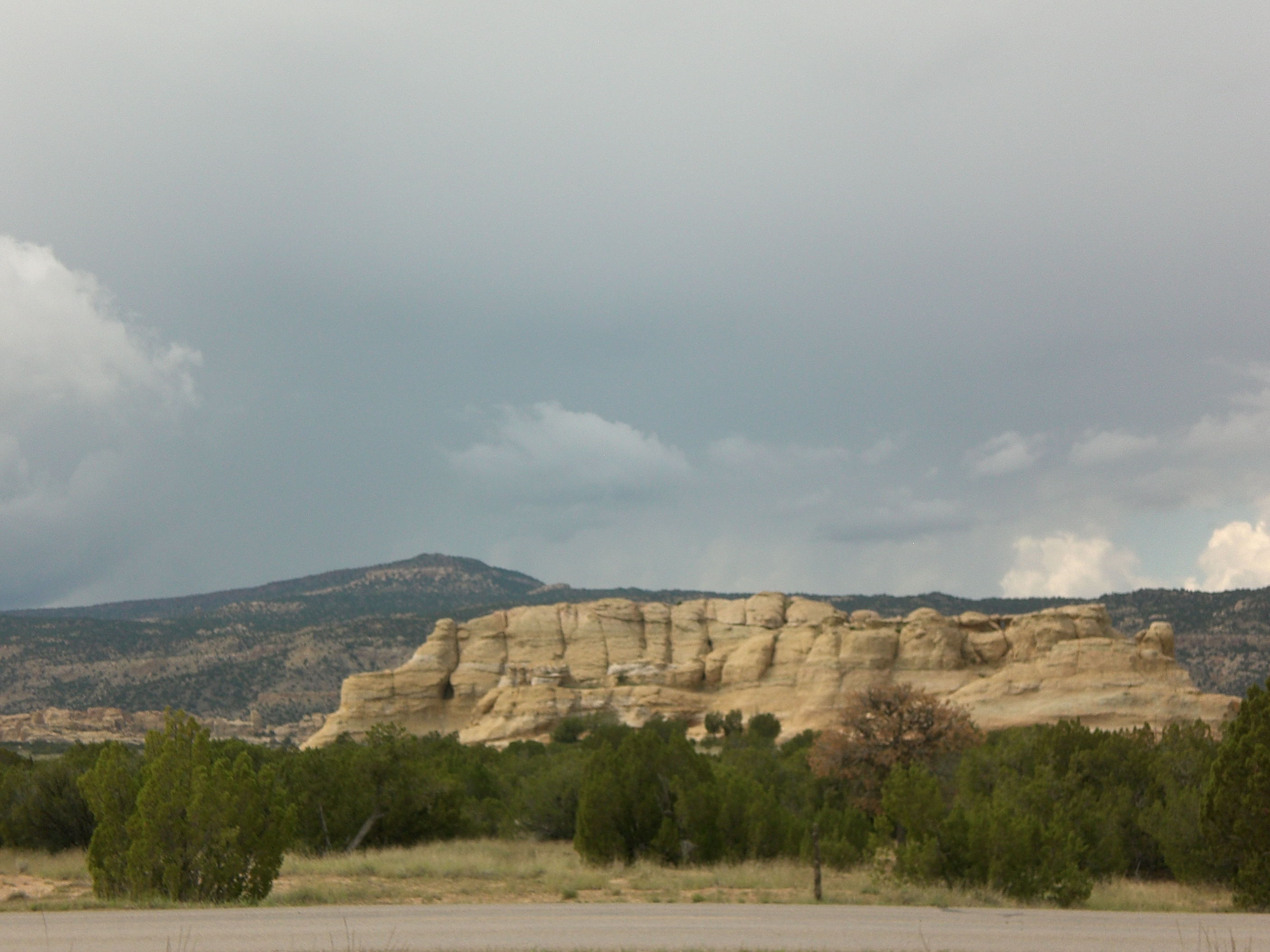
In the Vicinity of Acoma

In the Vicinity of Acoma

English: Original lithograph for report of J.W...

English: Original lithograph for report of J.W. Abert of “His Examination of New Mexico in the Years 1846-47” to the Secretary of War (Photo credit: Wikipedia)

The day following my visit to the State Fair, I was escorted by a friend to one of the last places in New Mexico that I wanted – but had not yet made it – to see, Acoma Pueblo. The majority of current tribal members live in two communities in the valley, near Interstate 40 in the western half of my state. According to our guide, only about 30 people (of about 6000 tribe members) still live atop the mesa that is historical (from the 1100s) Acoma. Most of those who do live on the mesa appear to be the potters and practitioners of other traditional arts who market their wares to the groups of visitors escorted on tours coordinated by the tribe.

Our tour guide provided a lively account of the history of Acoma, in an interesting language style which notably did not use standard past tense. “The people were living atop the mesa and were welcoming the first Spaniards to come to their area. Because the straw in the mud coating of their sandstone homes reflected golden in the sun, the Spanish were thinking they had found the mythical Seven Cities of Cibola, so they were demanding that Acoma turn over its gold and, not believing there was none, they began subjugating the people with torture and killings.”

The effect of our guide’s narration was to make his listeners aware of how differently the Acoma people (and most other Pueblo tribal groups I’ve interacted with) perceive time – how intimately their distant history informs their present day lives. The mixture of tradition and history with modern innovation and adaptation is also evident in the Acoma art – mostly finely painted and incised pottery – which was on offer. Some of the artists appeared dedicated to repeating ancient family patterns; others clearly added personal perspectives and made use of new colors and forms, while still reflecting traditional cultural styles. I was delighted with the demonstrated Acoma talent for maintaining art forms yet adapting them to modern needs!

WLA brooklynmuseum Pueblo Acoma Water Jar

WLA brooklynmuseum Pueblo Acoma Water Jar (Photo credit: Wikipedia)

I hope some of my online friends whose work lies in the decorative arts will take up the challenge implicit in my two days of contrasting experience. Can someone run a contest to see how many different “traditional arts” can be adapted to making modern day accessories for our ubiquitous cell phones, laptops and pads? How about a quilted dash cover? A pretty lace wrist strap for the new wearable smart phones? It would be such fun to visit the State Fair again in a few years and, instead of what I overheard one visitor describe as “so much schlock”, see rows of booths offering well-made, hand crafted items of practical use to the modern, hip visitor!

Creativity in a Second Language

September 15, 2013

I’ve started a new class through Coursera – a MOOC – that apparently has close to 125,000 people signed up for it worldwide. Mind boggling to think of that many students going to class together. The topic is Creativity – and in keeping with the course’s intent to promote more creative lives among the students, I’ve joined a subgroup of French speakers enrolled in the class. A challenging way to resurrect my skills with a language which I once spoke and wrote fluently, but which I’ve had little occasion to use in the last thirty years. Since the class is on-line, that means I’m writing French – the most difficult way to use a language skill. Should be an interesting eight weeks!

The first assignment included an option to make a sort of life map – identifying a core value at the center of everything one does, and then listing 3-5 priorities in each area of life, such as family, career, community, etc. I found the exercise relatively easy to do, given that my spiritual path (MasterPath) calls for a consistent effort to examine and process one’s life experiences. But I also attribute some of the ease to age – one doesn’t get to 70 and still engaged with employment, learning and community service, without having examined one’s priorities, and kept tabs on how they evolve over time.

What didn’t get addressed by the Life Ring activity was what I’d call a question of style – how do you, I, we approach daily life? I’m scheduled to facilitate an Alternatives to Violence Project (AVP) workshop with a competent co-leader who is very organized, detail oriented, and most comfortable when every aspect of the workshop is clearly spelled out in advance, including how each activity links to a small number of specific topics. I on the other hand, like to ‘wing it’ for at least part of the weekend. I’ve put together an agenda that includes exercises which can be related to a number of different topics. Part of the challenge – and the learning – that I value in AVP is how it reveals interrelationships that participants have not previously considered. I trust my own skill at helping tie those relationships together, and therefore like to leave room for the unexpected to emerge as the activities are processed.

There’s a lot to be learned co-facilitating with someone whose style differs from mine. Birds of a feather may indeed flock together – but do they learn how to get along with those of a different plumage? We draw reassurance from associating with others like ourselves. We learn and grow when challenged by those with whom we have differences. Which makes the concept of thousands of students from a hundred or more different cultures all joining together to explore creativity a highly innovative concept.

The Francophone subgroup is on LinkedIn, enabling me to check the careers and interests of other members, as they can review mine. Most of those I’ve looked up so far are younger, in business, engineering, industry, very few list teaching, none that I’ve found so far work in social service or health-related careers as I have done. The instructors for the course want the students to find ways to apply the concepts we study to our fields of endeavor, and to work together in teams to develop those projects. I seem to have set myself up to stretch my creativity to the max, finding ways to apply my skills, in a second language, to areas of life with which I have little if any experience! Should be fun…Meanwhile, the course does stress that we all have the capacity to be creative – and that our styles do indeed differ. We have all been asked to take a survey that classifies us along a continuum from adaptively creative to innovatively creative. I come up moderately innovative. I suspect my AVP co-facilitator would land somewhere on the adaptive end of the dimension. I’m realizing, as I write, that by putting on the workshop with her later this month, I will have completed the major assignment of the course – which is to apply the principles of creativity, in conjunction with others, to an aspect of my professional life. Thankfully I don’t have to put on the workshop in French!


Only Fragments

Love Letters to the Tar Pit

KarusaaVerse

Words that Sparkle, Thoughts that Ignite: Fueling Your Imagination

Leaf And Twig

Where observation and imagination meet nature in poetry.

Millarson Diaries

Personal Musings and Thought Experiments

The Beauty Along the Road

Discovering Beauty in the small details of our lives

Flowerwatch Journal

Notes on Traveling with Flowers

1eclecticwriter

Wide-Ranging Commentary

Spirituality Exploration Today

Delving into the cross roads of rationality and intuition

smilecalm

Life through Mindful Media

A Good Blog is Hard to Find

I will shatter a word and scatter the contents into the wind to share it with the world.

Ray Ferrer - Emotion on Canvas

** OFFICIAL Site of Artist Ray Ferrer **

AKA The Versatile

Fashion | Lifestyle | Food & Travel | Beauty | Fitness | Education | Product Reviews | Movies | Doodling | Poetess

Aging Abundantly | Women Over Fifty | Empty Nesters | Caregivers | Aging Gracefully

Finding Joy at Every Age with writer/philosopher Dorothy Sander

ARTZZLE

Helping with the Pieces in Life's Puzzle of Art and Design

Project Light to Life

A bucket list blog: exploring happiness, growth, and the world.

The Daily Post

The Art and Craft of Blogging

Any Shiny Thing

MIDLIFE MAGIC

allmostrelevant

@allmostrelevant

The Irrefutable Opinion

Assaults on the Casually Mundane by K. Jean King