Archive for the ‘Living and Learning’ Category

Odd One Out

November 19, 2017

I’m vacillating between two topics, Michelle Obama’s recent concise advice to “focus on what you can control”, and a rather more controversial reflection on color discrimination across species. I sense there’s a linkage underlying the two subjects which may emerge as I write. We’ll see.

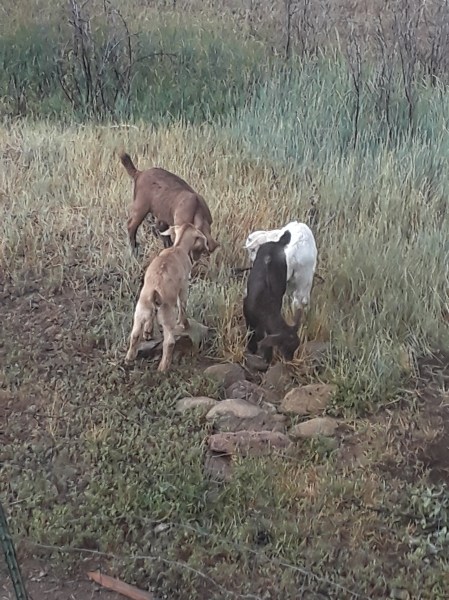
We have two mother goats of the Boer breed (white with brown and black markings around the head and neck) who were each impregnated by a handsome white billy and each produced twins. One set of a male and a female are shades of brown, the other of two males are opposites, one all white like his daddy, the other all black like none of the rest.

Knowing nothing more, if you were required to bet on which kid is the odd one out, how would you place your money?

Years ago when there was only one main prison facility in the state and I was teaching psychology in the New Mexico Penitentiary, an albino Black man in my classes wrote a paper about the unique discrimination of being an “oddity” within his culture. I’ve read that in some African cultures, albinos are considered to be evil, and are persecuted and driven out, if not killed shortly after birth. Albino individuals in Caucasian society are also at risk of suffering from humanity’s’ general intolerance for differences.

Have you now concluded that, as is the case, the pure white kid is the one who is pushed away from food, isolated and scorned, and the only one whom our dog actively harasses? Was the white one also your first bet?

I can discipline my dog to refrain from attacking and harming the white goat. I can do little about its isolation by the rest of the herd, beyond assuring that it gets enough food which, given the large pasture they all inhabit, is fairly well guaranteed.

By extension, does that mean I am right to focus my energies these days within my own world where I can have some influence, perhaps make small changes for the better without wasting energy on much of the larger political scene? I sign the petitions to those I think will listen, or who may be influenced by sheer numbers; I don’t bother with the ones I am certain will fall on deaf ears.

And I continue to wonder about the evident cross-species tendency to exclude, ostracize, put down and otherwise do harm to those perceived as “different”. Have we any hope, as thoughtful human beings, of altering on a large scale what appears to be a fundamental biological motivation? Is the current atmosphere of intolerance and defensive anger perceived in many countries around the world, simply a resurgence of basic human nature rather than a “swing to the right” or some other philosophical trend?

I have no answers. I do take comfort from following Mrs. Obama’s advice to “focus on what you can control”. Anything else is just a waste of energy.

The challenge, of course, is discerning what one can – and one one can never – succeed in controlling!20170727_092225
Hope Less, Be More

November 12, 2017

I’ve been trying to decide if I can write this reflection meaningfully, without first including the whole of Leslie S. King’s latest post, “Give up Hope” on The Inner Adventure. Finally I’m just going to start writing, refer to the lines that are most relevant to me at the moment, and encourage you to read her poem/post in its entirety for the images that may be more salient for you.

I have felt, of late, like the proverbial round peg in a square hole. Inundated with unpleasant, incessant, noisy and noisome news, arrogant attitudes, and pestering financial demands to support every cause that is under attack, every candidate promising to make things different/better for someone, somewhere. Trying vainly to balance quiet reflection and inward focus with the persistent shaming of “we have to resist”, “we have to fight back”, “we cannot afford to be cynical, or tired, or detached” from what is happening in politics and society, on TV and in sports, in all the venues that take place out there in time and space.  

How does one not react to outrageous public events? How achieve living fully in the present, when that present is perceived to be so ugly that one’s only wish is to escape it, shut it out, be other-where?

Enter Leslie’s poem, and the line that has echoed in my mind as the key to reestablishing balance, “When you quit hoping the rain will stop, you pull out your umbrella.” 

Hope entraps the attention into the time track, pushing us into living for a future that, one hopes, will be different and better than the present one is experiencing. Hope immobilizes. When I hope the weather will be fine tomorrow so I can exercise outdoors, I do not seek means to exercise on this damp and windy day, indoors.

Sitting and reading, instead of exercising, I come across another line, this one in the novel The Brutal Telling by Louise Penny, an extraordinarily skilled writer I’ve only recently discovered. “I just sit where I’m put, composed of stone, and wishful thinking.” Two very different sources giving me the same message – wishing and hoping are not the positives they are so often presented as being.

A pessimist, expecting the worst, does not escape the immobilizing effect of seeming to live in an as yet unrealized future. An optimist can appear by contrast to be in a better space – but that is an illusion. Our minds may expect the best, or the worst, but in either case they are ignoring the present, the only moment where Being exists. In Being is freedom, wisdom, love, infinite capacity for anything and everything to manifest, and also an open umbrella, sheltering and protecting from adversity.

Knowing this Truth does not mean I am able to make it my everyday reality. I get caught, distracted, tugged into the noisy flow of mental concepts, wound tight and held fast by hope, anticipation, expectation – choose a word, they all essentially mean being dissatisfied with the present moment. Moment after moment of dissatisfaction turns into a life of regret, broken only rarely by flashes of contentment. Not how I want to perceive my life, whenever the end of it looms imminent and it becomes time to make final assessments.

The standard advice for countering discontent it to count blessings. Quite a fine thing to do, certainly, but still a mental exercise often accompanied by trips into the past and renewed hopes for the future. Back on the time track, no longer present with the moment that is here, now, pure essence without any overlay of mental constructs.

And they are so subtle, those mental constructs! What can be wrong with aspiring to______? (Fill in the blank with any achievement you choose). How conditioned we are, from earliest childhood, to think in future tense. “What do you want to be when you grow up?” we ask of even the smallest of nursery schoolers. Rarely do we say to them, “Are you enjoying what you are doing in this moment, right now, right here?”

The Brutal Telling also quotes Pascal, “Most unhappiness comes from not being able to sit quietly in a room.” Sitting quietly, mind still or focused closely on what is immediately present, is a surprisingly rare skill, at least in the busy West where “doing” is given so much more respect than “being” (Yes, I hear you singing dear friend, doo be doo be doo). Despite the spread of various forms of meditation and Buddhist practice, despite the growing number of participants practicing contemplation on my spiritual program MasterPath, despite the Quakers who do sit silently in a room seeking “that of God within”, the predominant direction of attention in our culture is outward, looking back to learn lessons, forward to aspire for a better life.

I can’t help but feel that we are, collectively, rushing directly toward unhappiness and away from the only place where lasting joy can be found – right here, right now, in this moment. I know what it is to feel the joy of now, I have learned to expand now into what the clock measures as periods of time, but I recognize how limited my skills are, how much I still have to learn if I wish – and I do wish it – to remain permanently in that joy, permanently in now.

The first new skill clearly involves learning to revel in, instead of fear, the instruction to “abandon hope all ye who enter here”. Abandon hope, not because I am doomed but for the positive goal of knowing my Self as divine in this moment, complete and splendid right here, right now. Safe and sheltered whether I am in glowing sun, or serenely under an open, shining, divine umbrella.

People Are Crazy

October 29, 2017

Why is the gap between knowing what to do, and doing it, at times the widest chasm in the world?

Keep your attention on that which you wish to see enlarge in your life, and it will materialize.

If something upsets or displeases you, take your attention off it and it will fade away.

Maybe not grow or fade as fast as one might wish. There may be an appearance of events meeting expectations, but it is only an appearance. A bit of time passing is sufficient to expose the compliant facade.

The poisonous state of public discourse (or lack thereof, replaced by lies, outraged resistance, screaming headlines and moral indignation) has lately infected my inner space, leaving me restless, angry, impatient and stressed to contain those negative feelings and not dump them out inappropriately on those around me. At the same time, I have been actively seeking to shed a lifelong dependence on anger as a motivator, and to replace that useful but difficult emotion with something less hard on my health.

This morning, I woke with a country music refrain echoing in my head. “God is great, beer is good and people are crazy.” In my contemplation, I filled in alternatives to the middle option, not being much of a beer drinker. Wine is good, tea is good, walking is good, friends are good, having an interesting job is good . Essentially the middle option became a counting of my blessings, followed consistently with the completing phrase “and people are crazy” so why should I expect life to go forward the way I would wish it to do?

Lately there have been comparisons to Watergate and the unraveling of the Nixon administration behind too many lies. I think a better comparison with present times lies in the 1950s and this nation’s hysterical fear of the bogeyman COMMUNISM which so infected society that it ruined careers, lives, public discourse and American foreign policy, leading the nation into the state of endless war that continues today. We are supposedly fighting a different foe now (Taliban, radical Islam, Boko Haram) but still basically having our fears exploited and our lives ended, for the profit of a few, and to enable that small group to delude themselves into believing they are powerful.

Santa Fe New Mexico Quakers recently held a gathering to explore feelings about race relations, and how the Meeting might make a positive contribution to the dialog about cultural sensitivity. Four questions were posed, and attendees gathered in groups to discuss their answers. I was not able to participate, but did write out my response to the questions.

1) As a child do you recall your family discussing how the world would treat you differently from your home environment?

2)  What was your first memory of being conscious of race. What happened?

3)  Has there been or what would have been the reaction of your family to an interracial partnership?

4)  How has a relationship or friendship with someone (of either the same race or of a different race) given you a different perspective on race?

My long essay can best be summarized as an exposition of the value of meeting others from a place of curiosity and respect, open to learning and thinking more about “what can I give” than “what can I get” from the encounter. Knowing how best to approach those whom one perceives as “different” does not, however, mean being able to implement that approach. Once again, there is that chasm between know what to do, and doing it.

God it great, mutually respectful dialog is good, and people will nonetheless seem to be crazy.

Across the Lines

July 16, 2017

Over the years I’ve heard complaints from different people about other different people, that the Italians are so noisy, or the Greeks are loud, that Blacks are impossible when they get together in groups because of their noise level and lately, particularly, that Africans congregating make a constant racket. The speakers are, obviously, not Italians or Greeks or Black Americans nor Africans. The speakers are more likely of northern European or Asian backgrounds, from cultures where restraint, quiet voices, and minimizing confrontation are deeply embedded values.

I’m not out to compare the benefits of restraint versus airing one’s mind, not to suggest that one way of interacting is better than another; all are equally effective for the members of the defined groups. My interest is in a more personal appreciation of how the same action can feel very different when experienced by members of different cultures.

Specifically, I engaged with my spouse in a process of clarifying an assignment. Together we successfully sorted out what was required and he completed his work well before the deadline. The sorting out process went rather more by his cultural norms than my own, feeling to me like an argument with raised voices, almost shouting and bordering on anger, whereas he thought our volume was merely that of a beneficial discussion.

In a similar vein, as I’m making new friends among the Africans attending school near my home, I find I’m having to explain my quietness as “just my nature” and not the result of feeling ill or ill at ease. I speak up when I have something to say, but have never learned to put energy into debate for its own sake, nor to chat casually about non-essentials. I used to think this a failing on my part, this inability to make “social chitchat” as my mother scornfully called it. I used to wish I had acquired that skill, and tried to do so but without success. My efforts were perceived for what they were, a stilted pretense of interest. Only when I had/have a role, like hostess at a party, or instructor, or guide, am I able to talk easily to or in a group. Thankfully, I’ve finally reached a point where I can accept this way that I am, and not feel badly about it.

With that acceptance has come the ability to observe different cultural patterns of communication and even to learn how to participate in unfamiliar ones without too much stress. Not so very long ago, the assignment discussion with my husband would very possibly have turned into a genuine argument, not because we disagreed but because the feeling tone of the way we expressed our understanding of it was so very different. I would have gotten hung up on the sense that he wasn’t listening to me, or giving consideration to my opinion, and he might have given up trying to convince me that I didn’t understand the assignment. Instead of a successful solution, we would have been left with frustration.

In a larger social context it seems to me that our nation is expressing constant frustration these days, arising from lack of ability to communicate across a deep cultural divide. The intolerance on both sides of that divide gets translated into a false belief that trying to understand “the opposition” is a sign of weakness and a betrayal of values. I’m far from the first to point out that “my way or the highway” has replaced finding grounds for “meeting in the middle” to the detriment of civility and increasingly to the detriment of our civil institutions.

I’m old enough to remember my parents glued to the radio listening to the Army-McCarthy hearings that brought about the end of the ugly extremism of the early 1950s. I therefore have a degree of confidence, based on past history, that the present accusatory public debate will also resolve itself and allow us to move forward in a more civil and civilized manner as a society. We won’t get there by each side trying to out-shout the other. Rather, both sides need to find the bases for having sufficient confidence in themselves and their values that they can tolerate listening to a different opinion without feeling attacked.

If we each start with a one on one encounter with someone from another part of the political spectrum, what progress we as a whole might achieve!


As One Luddite to Another

July 8, 2017

I took a survey on Quartz about my interactions with artificial intelligence – questions about my familiarity with its current role in various fields as well as what I would or would not want it to be doing for me in five years. The process made me both aware of how many ways AI is already affecting my life, and the ways that I very strongly object to it doing so. At the most simplistic level, I have always turned off “auto correct” in my word processing software – my knowledge of correct grammar is better than that of any language correction program I have yet encountered. I don’t mind suggestions, I abhor being summarily overruled.

All the supposedly-tailored-to-my-interests advertising and “read this” article suggestions that pop up when I’m using a search engine make it clear how pervasive AI already is; also making it clear how inadequate it is in matching my interests. Because you see, when I’m searching for something i’m only interested in that single item. All the suggestions are irritating distractions. If AI were in fact intelligent it would know I hate and ignore them.

Recently I was given a loaner car while mine had serious undercarriage repairs. The new VW provided to me as an enticement to consider an upgrade/purchase came equipped with lots of gadgets not offered when I bought my custom-ordered Golf TDI in 2004. The various improvements on seat adjustment were nice. The polite requests that I turn on trip director and let the GPS system tell me where to turn felt almost insulting. I mean please, if I need to be told how to drive from my motel to my workplace, I shouldn’t be behind the wheel at all! Perhaps I could learn to adjust to using the screen that comes on when the car is put into reverse, but the perspective was disorienting and I looked over my shoulder to back into a parking space, as I have all my life.

It’s already apparent, when there’s a power failure at the checkout counter, that business grinds to a halt, and not just because the under 30’s cashiers can’t do simple arithmetic to make change. Inventory control, all sorts of other functions are now tied to the computers inside the cash registers and without power they don’t work. Annoying when standing in a store, unable to complete my shopping. Impossible when it’s a matter of getting where I need to go.

I really don’t see the point of a device meant to move me from one place to another being designed to be totally dependent on a computer (artificial intelligence) and thereby unable to do its primary job whenever there’s a ‘glitch’ in that device. The cars (and pickups) I grew up with could be wired together, adjusted and kept running by a reasonably intelligent layman. Those vehicles kept doing their primary job year after year after year. The new vehicles being presented as superior require a whole garage of high tech equipment just to diagnose what’s not working right. That doesn’t seem to me to be particularly intelligent.

I like and appreciate computers – in their proper place. They are good at supporting communication, quickly organizing or sorting data, making huge libraries of information readily available, enabling me to have face to face visits with friends and family around the world. I suppose the AI personal assistants can be considered to be highly skilled data organizers, keeping track of appointments, reminding of laundry that is ready for pickup, providing lists of nearby restaurants that meet the … hmm, owner? master? boss? human’s preferences,

We’re already told we use only a small portion of our brains. Why are we being moved toward using ever less of them? Shouldn’t we be expanding our own mental capacities rather than giving our already limited thinking capacity over to an artificial brain?

Makes no sense to me, unless maybe that artificial brain can quickly teach me to understand how Chrome works. My brain has been so programmed by Microsoft, that it fights adapting to Chrome. I know there’s no delete key, for example, but my hand keeps reaching for one anyway. Come on, unused brain cells, kick in and take over and learn this new system. Isn’t that what you were created for? To be used?


Moving Forward

June 11, 2017

If I were required to give a theme to my present set of priorities, it would be what I’ve taken as the title of this post – moving forward. Not necessarily by conscious choice, and not without some rather bumpy road to traverse. Rather, recognizing that the bumps are jostling my state of equilibrium and pushing it towards a new place, way of perceiving/being.

Not coincidentally, this is my marriage anniversary period, and also the start of a new way, for me, of accessing the “larger world” of technology, Internet, etc. Coming from a weekend MasterPath seminar with my spiritual teacher into a dramatic challenge, on Monday, of the theft of my purse, with driver’s license, credit cards and phone necessitated an immediate implementation of the lessons reinforced on Sunday. Regaining the critical items – driver’s license and phone – by Wednesday, through the attentiveness and caring of three strangers, demonstrated to me how protected I am from any serious harm.  Experiencing also the thoughtless and even ugly corporate responses of Walmart, MVD and La Quinta has pointed me toward engagement with “speaking Truth to power” that I have avoided in recent years. Moving forward in this arena means being clear in my intention, such that there is no anger in my communication. I’m not out to force changes that somehow “put things right”, only to point out clearly the values which are being trashed by blind corporate policy. If changes result, find. If they do not, so be it. I’m not attached to the outcome, only to the truth.

Being without my phone for most of a week was enlightening. I was made tangibly aware of the extent to which I have come to rely on it for access to news, as well as for the distracting pastime of playing various solitaire game. I already knew that I needed better access to email and various internet sites – including this one – and that I would have to get some sort of replacement for the recently deceased laptop I had been using. Without really any research, I went to Best Buy and came out with a Chromebook. It fits my financial limitations, and seems to actually fit my needs well, if I can just figure out how it works! Being old school and accustomed to printed materials, I feel the lack of a manual to teach me how to use such a different device. It helps that I’ve decided it’s about half way between a smart phone and a laptop. At least I have a frame of reference for thinking my way through accomplishing necessary functions. I have not yet figured out how to print a web page, if that is even possible? Yes, I know I can access manual sections on line, and will have to do so for the time being. And I can also use my husband’s computer (when he’s not busy on it) to find and print the manual. So why do those options feel unsatisfactory? Obviously, because they represent yet another way in which I am being pushed to move forward, away from familiar methods of doing things and onward into the new world order.

Caring without being attached, trusting without fear of being misled, speaking out without anger or other negative emotions, communicating clearly but without engagement with results… all avenues for moving forward into yet another new way of being, implementing yet another level of the fascinating path of spiritual evolution.

Thanks be.


I’m Not…

May 6, 2017

Whatever else is or is not right with the world, heavy snow and a high of 30F on the last days of April is most definitely not right. Maybe for Alaska, but not for New Mexico. Yes we get spring snows, even into May on rare occasions, but not wintry cold snow lasting more than two days and temperatures in the teens. Not later than March. But that is what we had last weekend, and now here it is looming again. Wind and damp and plummeting temperatures, icy rain on the way. Or maybe snow again? At least this weekend I did get a walk in the sun earlier this afternoon, before the weather turned.

I’m trying to put myself into a mood to be appreciative of the moisture which is always welcome in our high desert environment – but not succeeding very well, at least partly because we’ve had few pleasant weekend days to enjoy the outdoors. I feel stagnant, rusty, worn… I dare not say old, as several of my closest companions have forbidden me that word.

One benefit of living in a rural setting is ready access to the pleasures of nature, but the down side of living 15 miles from town is no easy access to indoor places for exercise. At least so I tell myself – that if I lived in town I’d get over to the indoor track and walk in winter as readily as I walk the rural lane near me in warmer weather. Maybe I delude myself? Would I really make the effort?

It’s regrettably easy to imagine how much differently – better – one would do things “if only”, rather than make the effort to do those things “despite”. Nothing prevents me from walking around and around in my house when I can’t get my walk outdoors – but I don’t do it. I don’t even give myself an excuse as to why I don’t do it. Nor do I question what it would take for me to develop a habit of in-the-house exercise. Obviously the activity just isn’t important enough to me at this time.

What is more important, but equally unresolved, is finding my way toward a change in how I relate to certain types of people. Specifically, how do I move past an emotionally based and negative attitude toward people whom I experience as dishonest, hypocritical users. They are what they are and that isn’t going to change. As often as possible, I have chosen to avoid engagement with such persons once it becomes apparent that no amount of tolerance and making allowances will produce a more honest and positive interaction. I know myself to be someone who leaves a good space for others to be as they choose to be but I do give myself permission to not engage with those whose conduct persistently offends me.

I also acknowledge that once they’ve crossed an ethical line, there’s no going back. I guess I embody the saying shared with me recently by my hairdresser. It’s something she found on line. “I’m not Jesus, and I don’t have Alzheimer’s, so don’t expect me to either forgive or forget.” My most common response is to avoid further contact, a tactic which has worked effectively until now.

For the first time in my life, I am faced with both a professional and a personal challenge to how I will deal with a person I cannot avoid but whom I also choose not to forgive. The work situation is the less difficult, in that I have relatively little direct contact with the upper level manager whose behavior is unacceptable. The personal situation is in-family and therefore much more difficult to avoid. Others whom I care about are involved so there’s not just my interaction with the person, but theirs also to consider.

So as I try to find some positives in the experience of winter on the last days of April, I find I must also reconsider what has felt like unforgivable behavior towards me. Needed moisture redeems the snow and cold. What might the equivalent be in regard to a relationship I have less than no desire to rekindle, after a long period of mutual avoidance?

My dilemma arises from the separate issues I have with this person’s behavior, above and beyond those that the others in my circle feel, and I feel on their behalf. How do I clear space for them to sort out their relationships with the problem person while I remain disengaged from the process?

“Won’t you accept an apology?” I was asked.

If I thought the person capable of offering a sincere one, and there was an accompanying change of actions, with a new and moderately respectful attitude toward me, then yes, I would accept the apology. Sadly, I know such a change is not forthcoming.

“If I’m shown a hypocritical face, I will show the same back” is the strategy to be used by one of the others involved. While that may in fact be an effective response, I know myself incapable of copying it. I’ve never been able to hide my emotions, to pretend something I don’t feel. As a good friend said to me recently, “When you are righteously angry, it is a powerful anger and everyone can feel it.”

So I will instead take myself out of the way, allowing those who choose to interact to do so, free of the added dimension of my presence. If it goes well, then maybe I’ll be willing to be present for the next interaction. If it does not go well, it will be clear that I did not have a role in the negative outcome.

And meanwhile, I will try to do what I know is right, but oh so hard – to let go of the entire issue, to “put it in the Master’s hands” and to accept whatever awaits. It is only ego, after all, that holds a grudge.

I Know What I Like

February 19, 2017

I sent an email to my (very understanding) supervisor recently, expressing my deep reservations about a proposed move to video visits being pushed by upper management. Not that I don’t know how to adapt my interviews to a video format, but I live in a region of limited Internet connectivity and the people with whom I am expected to conduct these visits have neither the technology nor the money to acquire the technology to participate. Most run out of minutes on flip phones before the end of each month.

More importantly, to my mind, is a concern for the disappearance of meaningful interpersonal connections. Too many of us now live in isolated bubbles, glued to smart phones and tablets, Googling for answers to test questions instead of reading and learning and thinking things through for ourselves. Too many of us can be seen sitting with others, everyone with his or her head down staring at a screen. Too many of us spend too much time “connected” only with those who visit the same websites, think the same thoughts, agree with whatever we say, and take righteous offense if anyone contradicts the group’s predetermined set of beliefs.

I’m not originating these thoughts – some of them I read in an analysis by Eric Francis, astrologer and writer and producer of PlanetWaves. Some I heard during an interview with a journalist scorned by his liberal peers for writing a biographical piece on Milo Yiannopoulos. The journalist’s original position was a sort of “know thine enemy” belief that one cannot effectively implement programs or persuade others who hold different views, if one hasn’t heard enough of those views to discover where there may be common ground upon which to build a successful compromise, or a persuasive argument for a different outcome.

I’m reminded of a speaker brought to my college campus in the early 1960s. Once a week the entire campus was gathered for Collection, to hear a presentation meant to give us food for reflection. Attendance was mandatory. One spring morning, the speaker was a South African government official who presented a defense of apartheid to an audience almost entirely composed of supporters of the civil rights movement then actively unfolding in the United States. Some students made an initial effort to block the speech, primarily because of the mandated attendance. The school administrators insisted that we hear the official’s viewpoint “in order to understand how best to argue against and counter it.” The speaker presented a closely reasoned and very persuasive argument in support of separation of races that could only be countered, I realized, by catching – and taking apart – his implicit assumption that people are more comfortable “with their own kind” and that race is a necessary and sufficient condition for dividing kinds of people. He only verbalized the comfortable with one’s own part of the premise; the racial implications corollary was never stated. In case you didn’t take logic in school, the speaker implied but never stated that in and of itself skin color creates an unbridgeable gap between people such that I as a Caucasian can never be the same kind of person as anyone with a Negroid complexion.

Had I not heard the South African speaker, I might never have been able to pinpoint the unstated assumptions on which so many people base their objections to the sort of social integration that has been experienced in the past 40 years in the US. And had I not heard that speaker, I probably would not have grown in my own ability to reach across very real differences, to find common ground with people whose views are significantly different from my own. I have friends, good and caring people, who support the newly elected Congress and President. I don’t agree with their political views, but I also cannot fault their day to day treatment of neighbors, nor their commitment to good education, appropriate care for the needy, and fair treatment for all.

The devil is in the details, as they say, and one of the details seems to be that we as a nation have lost the capacity to relate to anyone different from ourselves. How many people, now, would object to the statement that “people are more comfortable surrounded by those like themselves”? How many of us choose to go outside our “comfort zones” or our technologically reinforced personal bubbles to listen to, interact with, care about those whom we perceive as different from ourselves?

The journalist who was scorned for writing about Yiannopoulos had called himself a liberal, but reacted to their scorn by redefining himself as a “new conservative.” Not that he changed his own values, but that he perceives today’s “strident” liberals as unable to listen, unable to discuss, unable to tolerate different viewpoints from their own. They have become, he claims, just like the alt-right in that both sides are equally intolerant.

A Quaker friend (a Friend friend) of mine recently raised the question of how to reach out to those whose views differ from our own, in order to better understand steps to take to heal the growing divide which he sees as threatening to tear our democracy apart. I found myself wanting to answer “shut down the social media sites, turn off the Net, create an environment, at least for a week, that will force people to actually see and talk to and listen to one another. Don’t replace in person visits with video visits, don’t require doctors to focus on data entry into a computer when they should be listening to their patients. Don’t allow objectors to prevent a speech, however unpleasant the views of the speaker. And don’t let implicit assumptions about similarity and difference slip by unquestioned.

It may be true that we are generally most comfortable with those like ourselves. What matters is how we define the phrase, like ourselves. I remember that I used to say the only thing about which I am intolerant is intolerance. I suspect that is still true. Intolerance, to me, means lack of respect for the humanity of another. I need to ask myself whether I can respect the humanity of a bigot. Can I find that of God in a hater? I found it in killers who were my students when I taught in the NM Penitentiary. I have certainly found it in those friends referred to earlier, whose political views are so different from my own. If I can do so, it does NOT mean I accept anyone’s right to act on bigotry and hatred. But if I can do so, I think I’ll have a better chance of diverting the haters from implementing their bigoted agenda.


Patience and Attention

January 31, 2017

The two new members of our family are Akirri, a now-four-month old Akita/German shepherd cross puppy and Miss Kitty, also about four months old and now to have her name enhanced to Miss Patience Kitty.

As the picture posted a few days ago clearly shows, she’s a fraction of Akirri’s size, but in little over a week she’s established ground rules for their interactions and is “on top” of the relationship.

Akirri, which means Christmas in my husband’s tribal language of Ngie, is smart and learning to sit, and stay down (not jump up on me with muddy paws) but has not yet made much progress with ‘come’. Particularly not when the chickens are clustered to be fed and it’s such fun to run through them and watch them scatter.

Miss Kitty, on the other hand has already successfully trained me to have her breakfast tin of food open and ready for her no later than 7:30 AM, and her evening dry ration on her plate by 5:30. Her added name of Patience does NOT come from her attitude toward being fed. Rather, it’s a reflection of the way in which she tolerates being turned into a play toy by Akirri, emerging often from the encounters wet from doggy kisses, and looking slightly chewed over. When she’s had enough, she freezes in one place, hunkered down beneath Akirri and no longer fun to play with. Indeed, it’s as though she’s recognized that being boring is a sure way to cause Akirri to turn elsewhere for amusement. Looked at from a slightly different point of view, Miss Patience Kitty clearly knows and implements the basic lesson of disciplining – ignore the misbehavior and reward the good behavior and you’ll fairly quickly have a well behaved… animal or… child… or person?

I’ve been considering whether there isn’t a parallel to be drawn between the training going on just outside my front door (on the enclosed porch and the larger yard and pastures), and what might be effective on the political scene. Not that unconstitutional edicts can be ignored exactly, but they can simply not be followed, as has already happened with the scientists who will not be gagged, thet acting attorney general who determined to follow the Constitution, and the federal judges who have countermanded the recent “barred from entry” immigration edict.

Patience Kitty has other means to dominate Akirri. She easily achieves heights that put her out of Akirri’s reach. And she’s able to fit into or thorough small places where Akirri cannot follow. When she’s ‘had enough’ she slips through a narrow opening into a large enclosed area under the porch, and clearly enjoys taunting Akirri from her impenetrable safety zone.

So far, neither of the two has used her “weapons of war” – sharp doggy teeth and strong jaws, or equally sharp and lightening quick claws. Hopefully, they’ve already formed enough of a bond that this ‘nuclear option’ will not be called upon.

A line in a book I just finished (Deborah Crombie’s “A Finer End”) resonated with my concerns for “the times we are facing”. The story is set against the sense of ancient powers that pervade Glastonbury England, and how that elemental energy can interact with human failings to produce violence. An historian and expert on paganism, Goddess worship, and their integration into very early Christianity was asked in the narrative, why anyone would want to upset the balance of the powers of light and darkness. The line that caught me was her answer, “I am a Jew my dear. During the war I lost every member of my family to the camps. If you ask me what I believe, I can tell you that those atrocities were an incontrovertible example of the power of chaos, magnifying and abetting a very human evil.”

Akirri charging at the chickens generates chaos. Their fluttering panic encourages her to charge and charge again. Patience Kitty sheltering in place quickly stops Akirri’s rough-housing.

Strident panic, and flurries of media attention, in response to every new use/misuse of power would seem, similarly, to lend authority to their author. Calm counter measures akin to sheltering in place – standing witness, standing up for truth and our constitutional values, walking out of a hearing to prevent it going forward, would seem to be appropriate responses well worth pursuing.

My spiritual teacher tells us that “attention is food”. Give your attention to what you want to manifest in your life, and take your attention away from what you want to diminish and disappear. Our present national fearless (fearful? fearsome?) leader has made it plain how essential attention is to him. He must have his daily, even hourly doses of it.

So, in addition to taking steps to de-fund what we do not support (and pay for what we want – money=attention=food) should we not also be insisting that the news media, which most immediately direct our attention, give that attention to the actions, events, people and values we consider important? They contributed largely to the present chaos, giving undue attention to every showy bit of bluster in the name of reaching a wider audience and hence making more money. They surely have a responsibility now to introduce some balance, to try to undo some of the damage they were active participants in creating.

I can only imagine the tantrums that would be thrown if, for merely a day, there were a total media black-out on everything originating in the new presidential regime. I would love to imagine the tantrums being thrown because the press (and the social media) did indeed have the patience and courage to impose such a blackout!

Trump et al are doing their best to muzzle all opposition. How would they behave if given a taste of their own medicine? I’d love to find out.

A Way Forward

January 27, 2017

One of my followers, and fellow bloggers, recently inquired after my well-being, not having seen a post from me in quite some time. I appreciate the concern – am in general okay – but recognize that in subtle ways I have not been myself, or at least not the self who reflects and blogs.

Now that I’m coming out of the blank space, I can see that it was:
1) real (not an alternate fact),
2) somewhat akin to depression,
3) also at least partially rooted in a doctor-ordered change in thyroid treatment,
4) definitely influenced by political ugliness in both the U.S. and Cameroon,
5) full of flashbacks, or recognition of old patterns and feelings that no longer have a place in my current life, and
6) clearly an opportunity to process and release residual mental patterns that do me no good.

I know that some of the threads I pulled from the tangle included a deep anger that our society still values a sorry excuse for a man over an intelligent and accomplished woman – an anger that eased on January 21st.

Another thread was a profound fatigue, best reflected in one of the signs carried on January 21st by an older woman. “I can’t believe I’m still protesting this shit.” Really, do I have to do this all again, fifty years later?

Yet another thread was a vivid remembrance of my college years, in the infamous sixties, marching in protest against the war in Vietnam and in support of civil rights, dating an African fellow student and later marrying a Black American, living integration on a day to day basis at a time when that marriage was still considered illegal in several southern states. Today we have an Oscar nominee in a new movie about the legal case that ended miscegenation laws, but also an upsurge in attacks on mixed race couples and their children, legitimized by the new administration’s ugly rhetoric.

Yet another thread from the past woven into the present was my own feeling of limitation in what I could say or do to protest domination by values with which I profoundly disagreed. In my youth, that limitation resided in the fact that my father was an officer in the nation’s diplomatic corps and I was made to understand that my conduct could not undermine his position and responsibilities. He had written reports in the mid-1950s, warning of the quagmire into which the U.S. would fall if it followed the course of action then being dictated in southeast Asia. He was ignored, and then told to stick to economic reporting. He was back Stateside, and assigned to an academic setting, when I attended the very first march on Washington to protest the start of the Vietnam War. He warned me to be very careful where I went and what I said, just starting out on my working life, in order not to prematurely curtail my options – and also in order not to bring more censure down on him.

I was not then, and am still not now, a demonstrator in the public crowd sense. I tend rather to make my statement of values in the choices of how I live my daily life. I’ve become comfortable having friends from a variety of backgrounds, working in a helping profession (Care Coordinator for an MCO with Medicaid recipients as my caseload), married now to a Cameroonian studying here, and living in a “rural frontier” community in a state known for its multicultural heritage (Hispanic, Native America, Anglo and with a small but historically significant black population) that has also welcomed many Vietnamese and, lately, Tibetan and Middle Eastern immigrants.

I began to come out of my blank space when I read that my college Swarthmore, in Pennsylvania, has declared itself a sanctuary school. Santa Fe (NM), near my home, has declared itself committed to remaining a sanctuary city. I wear a safety pin on my outer garments ever since I learned of the act as a symbol that others, of whatever type, are safe with me. It seems that I’ve needed time to find my way into the acts that allow me to express my resistance to the present state of the nation. Because I am under constraints now, as I was all those decades ago. Again now, as then, people whom I care about can be harmed if I become too outspoken.

Am I truly having to go through this yet again? How could the nation have regressed so far, so fast?

I have not been writing, and therefore not posting, while I work through my response to what seems to be the undoing of everything I have cared about and supported my entire, many decades long, adult life. Living my values in my small corner of the state is necessary, but has not felt sufficient. I’m signing petitions, but ignoring the constant demand for cash contributions to fund more protests, because I don’t have the cash to donate (if I did, I wouldn’t still be working full time at long past retirement age). I’ve been seeking what would feel like an appropriate expression of my objections to the so-called swamp which, instead of being drained, has been broadened and deepened to cover the entire nation with greed and egotism and petulant childish tantrums and threats to our most fundamental Constitutional freedoms.

Today, when I heard that federal funds will be cut off to any entity that resists the government’s attack on immigrants, I remembered another piece of my past – tax resistance. As a Quaker, I refused to pay for war when I was young. Might I now refuse to pay for a wall, and a registry, and an immigration ban? Might I give my tax money directly to Santa Fe schools that will need it, instead of to the Federal government to spend on taking this country backward a century or more?

I don’t know how this idea will unfold, but it is clear to me that identifying a form of protest congruent with my life experience has been necessary to bring me the rest of the way out of my funk. Now let’s see if it also ends my silence.


Only Fragments

Love Letters to the Tar Pit

KarusaaVerse

Words that Sparkle, Thoughts that Ignite: Fueling Your Imagination

Leaf And Twig

Where observation and imagination meet nature in poetry.

Millarson Diaries

Personal Musings and Thought Experiments

The Beauty Along the Road

Discovering Beauty in the small details of our lives

Flowerwatch Journal

Notes on Traveling with Flowers

1eclecticwriter

Wide-Ranging Commentary

Spirituality Exploration Today

Delving into the cross roads of rationality and intuition

smilecalm

Life through Mindful Media

A Good Blog is Hard to Find

I will shatter a word and scatter the contents into the wind to share it with the world.

Ray Ferrer - Emotion on Canvas

** OFFICIAL Site of Artist Ray Ferrer **

AKA The Versatile

Fashion | Lifestyle | Food & Travel | Beauty | Fitness | Education | Product Reviews | Movies | Doodling | Poetess

Aging Abundantly | Women Over Fifty | Empty Nesters | Caregivers | Aging Gracefully

Finding Joy at Every Age with writer/philosopher Dorothy Sander

ARTZZLE

Helping with the Pieces in Life's Puzzle of Art and Design

Project Light to Life

A bucket list blog: exploring happiness, growth, and the world.

The Daily Post

The Art and Craft of Blogging

Any Shiny Thing

MIDLIFE MAGIC

allmostrelevant

@allmostrelevant

The Irrefutable Opinion

Assaults on the Casually Mundane by K. Jean King