Posts Tagged ‘MasterPath’

Choosing an Attitude

December 14, 2013

One of the elements of my new job that was most appealing – working from home – is also revealing itself to be a challenge in ways I did not experience the last time I had a similar employment. Just a few changes in external circumstances are making a significant difference in how I relate to my obligations.

The first time I worked from home was more than 20 years ago, when I had just moved to Sapello. I lived alone, and was hired to manage and build up the clientele of a home health agency. I enjoyed being able to spread my work over the seven day week, scheduling my leisure activities intermittently with travel to clients’ homes and with the inevitable administrative work required. While I was never “off duty”, I did have a lot of choice about what I did when. I was flexibly able to fit my personal obligations and desires around work demands, rarely feeling pressured because there seemed to be enough time for everything.

Eventually the agency grew to the point that we established an office, and I became subject to a more consistent and common work schedule. I left briefly, for personal reasons, and spent eighteen months self-employed. I completed several contracts and saw clients privately for counselling sessions. When I returned to the agency, again as its branch manager, I was subject to the standard “8-5 in the office” schedule, to which I adhered for fourteen years. Eighteen months of semi-retirement and job search brought me to my present full time, salaried and home-based position.

I do not now live alone. I share my very small house with my disabled former husband, for whom I am guardian and with whom I remain friends. His health is slowly and steadily declining. A sequence of aides come to the house, to help him during the day and to see that he gets supper. The schedule is meant to assure his safety when I am away. In consequence, there are several different people added to our small space, to whom I must accommodate when I am at home. While I am, mostly, relieved of responsibility for my housemate’s care, I do have to step in, unpredictably, when an aide is unavailable. And I am responsible to assure that the schedule of services is established and maintained.

Over time, our home has become divided into “my” room, which is also the living room that contains the day bed where I sleep, and the rest of the space – sleeping area for my housemate, dining area with the table covered with items he uses for his craft projects, kitchen and bath which we share. While I was still employed at the agency, the aides were scheduled during my work hours. In the eighteen months since, I find my necessary privacy and quiet time at night, often writing (as at this moment) or reading. My housemate watches TV with earphones on, allowing me valued silence for contemplation and creation.

Embarked on my new job, I have been away from home for extended periods of orientation and training. Shortly, I expect to be scheduled for long, busy days traveling to clients’ homes, interspersed with long and demanding days at home entering information into the complex computer systems my employer has been training us to use. I’ve had just a few weeks at home, to set up my “office” and establish those systems as functional in my rural, no-cell-service area. The systems are only partially in place so far. I do not yet have a land-based work phone, and I continue to uncover wide areas from within which I have no connection to the Internet. For clients who live in those areas, I will have to take notes and then enter data later at night, after I get back home.

My office is now in a corner of the dining area where my housemate – and his aide – spend most of the day. I’m having to learn to shut out their conversation in order to concentrate on the tasks that come to me by computer. On a recent visit to a building in Albuquerque newly occupied by some of the staff of my company, I walked through a huge room of employees in cubicles, thinking how grateful I am not to be similarly situated. I only have to shut off two voices, not hundreds.

I’m realizing that one of the serious sources of stress over the last years of my former employment came from the lack of doors on offices in the various buildings that agency occupied. As a manager, I relied on knowing (hearing) what was going on throughout the office. As a person, my need for silence around me, for auditory privacy, was consistently challenged. Personal validation and social support, also important to well-being, came from co-workers and from those engaged in the various volunteer activities I’ve pursued. For recuperation, reflection, and privacy I could count on quiet at home.

Changes in my housemate’s health, including recent medical emergencies disrupting my work day plans, new aides requiring instruction that he does not provide, and the expectation from my present employer that I be available on an 8-5 Monday to Friday schedule, have combined to eliminate my control over how and when I do what needs to be done. As a result, work is not staying in balance. It is seeping into my sleep time, rousing me at 5 am to try yet another way to solve a computer problem that proves not to be solvable by me. I begin to feel encroached upon by lack of quiet personal time – and by the necessity of at least temporarily giving up almost all of my volunteer activities.

During a recent two nights alone at home, while my housemate was in hospital, I was jolted to realize that many years have elapsed since the last time I had this space to myself for more than two hours! There is already so much activity filling the house, can I actually bring work here too, without losing the last bits of “me” space?

+++++

Yes, I recognize my issue is a matter of mental attitude. My spiritual Path teaches that “the mind is an excellent servant but a terrible master.” Private, quiet, contemplative space for myself will exist wherever I am, if I make it a priority – and “set my mind”  (no, actually not my mind, but my attention) to assuring it occurs.

I may not be able to go strictly by the clock, dividing work time from private time, especially while I’m still learning how to accomplish work tasks in an efficient manner. I cannot force my work computer to move through its paces more quickly. I cannot fix my situation of intermittent Internet connectivity, which disrupts the intended work flow process and requires me to “do double work” entering data already recorded on paper.

On a Recent Misty Morning

On a Recent Misty Morning

I can teach myself not to be frustrated by the computer’s slowness, and I can line up tasks to do during the waits (like creating a  card file of important numbers and contacts). I can “take time to smell the roses” or, in this winter season watch the birds. I can revel in my ability to look up from my computer to see snow dappled fields inviting to deer, doves perched in a row on the fence beside the feeder, a squirrel gorging himself on seeds, and little birds on the ground waiting to collect what the doves and the squirrel shove over the side of the dish.

Yum!

Yum!

I may need to extend work hours into the evenings and weekends – but I can still define times when I turn off all electronics and soak up the natural sounds of wind, dogs chasing rabbits, birds arguing over priority at their feeder, and snow dripping from the eaves.

Serenity surrounds me. I need only put myself within it. I am blessed.

When It’s Time

December 8, 2013
I Dare You...

I Dare You…

This isn’t the topic I expected to post this weekend. Not because of the passing of Nelson Mandela, but for an even more personal passing that raises almost identical emotions.

+++++

I demonstrated to push my college to rid itself of all investments that supported the South African government during apartheid. I’m proud to say Swarthmore College was one of the early institutions to manifest its (Quaker) values by participating in the economic boycott which the pundits are crediting with bringing an end to the apartheid system.

I rejoiced when it became clear that Nelson Mandela’s emphasis on equality and democracy, and commitment to reconciliation as the path forward, would be carried out with a simultaneous delight in the small pleasures of life. I’ve followed Mandela as I have the Dalai Lama, listening (by reading) to their speeches and appreciating how well they each translate values into action in ways I try to embody in my own life. My venue, as my status, is so much less than that of these two men I admire. Only others can assess to what extent I manifest any similar virtues.

I do attest that my Shih Tzu, named Shian Shung in respect of his status as a Master and Teacher, has shown the Mandela and Dalai Lama traits of persistence, consistency, dedication, joy in living, playfulness, affection, tolerance and respect for the equality of all. I could not know, when I cuddled him for a bit of extra “affection time” this past Monday, that I would never again do so. I cleaned and treated his eye, hugged him, received several doggy kisses in return, and watched him run out to catch up with his mates, chasing a rabbit into the pasture.

Blowing Kisses

Blowing Kisses

I loaded the car for my week of job training away from home and, as I headed down the drive, looked back to see my four dogs sitting on the deck, watching me go. That is my final image of Shian Shung – a furry white bundle of loving energy standing out against the blackness of the other dogs.

+++++

Today everything outside the windows is white. It snowed while I was away, and is snowing again now. Somewhere hidden within the cold wet white, is the body of what was a vibrant, lively personality cloaked in the white fur of a Shih Tzu. Apparently he was hit by a car mid-week. A visitor reports noticing a white dog lying beside the road Wednesday night. Shian Shung has not been seen since Wednesday morning; no body was found near the highway on Thursday. Most likely it was moved, or covered over, by snow plows clearing the road from the storm that day.

In his three short years, Shian Shung endured two traumatic health challenges and lived with a persistent eye irritation that required daily treatment. He was little more than a year old when he ingested meat some neighbor had set out, filled with rat poison. His gums were almost colorless when I got him to the vet. Daily injections with Vitamin K saved his life. He bounced back. He had one surgery to his right eyelid, intended to eliminate irritation to the cornea. It was only partially successful – I still had to clean and treat the eye daily. A follow-up surgery ended abruptly when Shian Shung flat-lined on the operating table. The vet and his assistant performed CPR, intubated him, worked on him for more than half an hour. He survived – again.

Within a week he was running and playing and teasing his pals, warning me of intruders with his assertive bark, tolerating steroid shots to reduce the inflammation to his eye, and lavishing me with his affection and abundant joie de vivre.

Over the 40 years I’ve lived in rural New Mexico, I’ve shared my home with a very large number of dogs and cats. Inevitably, a few stand out… Natasha, Driftwood, Daisy, Haiku, Rowena, Mei Ling and now Shian Shung. Daisy (a beagle/basset cross) extended her life after a serious illness, for just long enough to see me through the loss of my father, before she moved on to join him.

Handsome Haiku

Handsome Haiku

Haiku and Natasha (tiger-striped cats, one ginger the other grey) each taught me how to recognize the difference between choosing to live with sickness and being ready to depart. Rowena (a Scottie) and Mei Ling (another Shih Tzu) offered generous  love while also requiring respect for their independence. Each chose her moment of passing, in ways I could not avoid recognizing and respecting.

Miss Independence x 2

Miss Independence x 2

Various cultures articulate a tradition of animal guides and companions for the spirit world; I’m certain they “have it right”. A cat (my totem) will undoubtedly inform me, and accompany me, when it is my time. For now, I accustom myself to life here without the active presence of Shian Shung, as I adjust to a world now lacking the physical presence of Nelson Mandela.

+++++

We are most fortunate when we find good role models or wise teachers, to help us on our paths through life. I’m blessed to have my spiritual teacher, on MasterPath, still present in the physical, as is the Dalai Lama. Two other role models, one proximate (Shian Shung) and one more distant (Mandela), have shown me how to live fully and well despite imprisonment and life threatening trauma. Both will continue to function as guides, now in my memory.

I wonder – is Shian Shung frolicking at Mandela’s feet as they move to their next stage of being?

Warm Furries

November 30, 2013

Five doves are fluffily hunched on the gate to the long pasture, seeming to emit waves of discontent because their bird food plate is piled high with snow rather than seed. I will probably succumb to the pressure shortly, and wade around the house with a bowl of feed for them. I doubt that my steps will imitate my Shih Tzu’s curious snow shuffle, though. I’ve been watching Shian Shung coming toward me down the drive, each front paw’s forward motion initiating a wave of snow rippling slightly sideward. It is the strangest looking movement, suggesting he has suddenly acquired the widely feathered feet of a nun pigeon. Or as though he is swimming his front legs through the fluffy white stuff that is belly deep for him.

De-iced

De-iced

My Min-Pin, Doodles, being a short hair, seems able to bounce through the same drifts, almost as though he’s walking on top of the snow instead of wading through it. Not any taller than Shian Shung, he has more of his minimal height in his legs, and an overall springier step. When excited, he can easily bounce to shoulder height on my Lab/Collie cross. And does so frequently, trying to get Blackjack’s attention away from the food bowl, gnawed deer bones, or the treats in my hand.

Aw, please...

Aw, please…

Doodles survived in his earliest life as a dumpster diver – he was about six months old when I collected him from a distant ranch and brought him to live with the rest of my motley crew. Eighteen months of ample and regular food has not yet broken him of the need to be in charge of any edible in the vicinity. Fortunately, Blackjack has a tolerant demeanor, only rarely exerting his considerable might to retain possession of a favored goodie.

Blackjack in Charge

Blackjack in Charge

The fourth member of my canine family is an elderly toy poodle – like Blackjack and Doodles also a rescue – with more serious personality issues. I know nothing about his earlier life, but it cannot have been easy. He was found at death’s door, totally dehydrated, his fur invisible beneath a matting of burrs, his belly distended and sagging to the ground. He growled and snapped at every attempt to care for him, requiring sedation by the vet before medical attention and a total body shave. Damaged intestines, causing the sagging belly, seems likely to be the result of being hit by a car; the injury continues to cause him intermittent constipation.

Warrior newly clipped

Warrior newly clipped

If left by himself, Warrior whimpers ceaselessly, or barks non-stop for an hour or more. Six months after arrival, he began to let me pet or groom him. Diametrically opposite to Doodles, he is reluctant to accept treats, which he requires be set down in front of him, to consider at length, before he will venture a nibble. Consequently, he loses them to Doodles unless they are offered when the other three dogs are off exploring. Which happens reliably enough that Warrior does get treats, but is also unhappily alone for periods of the day.

Blackjack shows remarkable patience with the littles. He lets Doodles and Shian Shung play out attack strategies, his legs and ears the more common targets. He makes sure Warrior has the warmest spot on the porch, and tolerates Doodles’ determination to be first at the food bowls. I remember to give him an extra rub around the head and muzzle, and to tell him he is the senior, and most essential, member of the pack. His calm demeanor, his defining of the boundaries outside which the others should not roam, his lessons about what is and is not fit to eat, and his manner of greeting – or guarding against – visitors to my acres all combine to transmit the expectations I have set about tolerance, respect, and appropriate behavior.

The Littles

The Littles

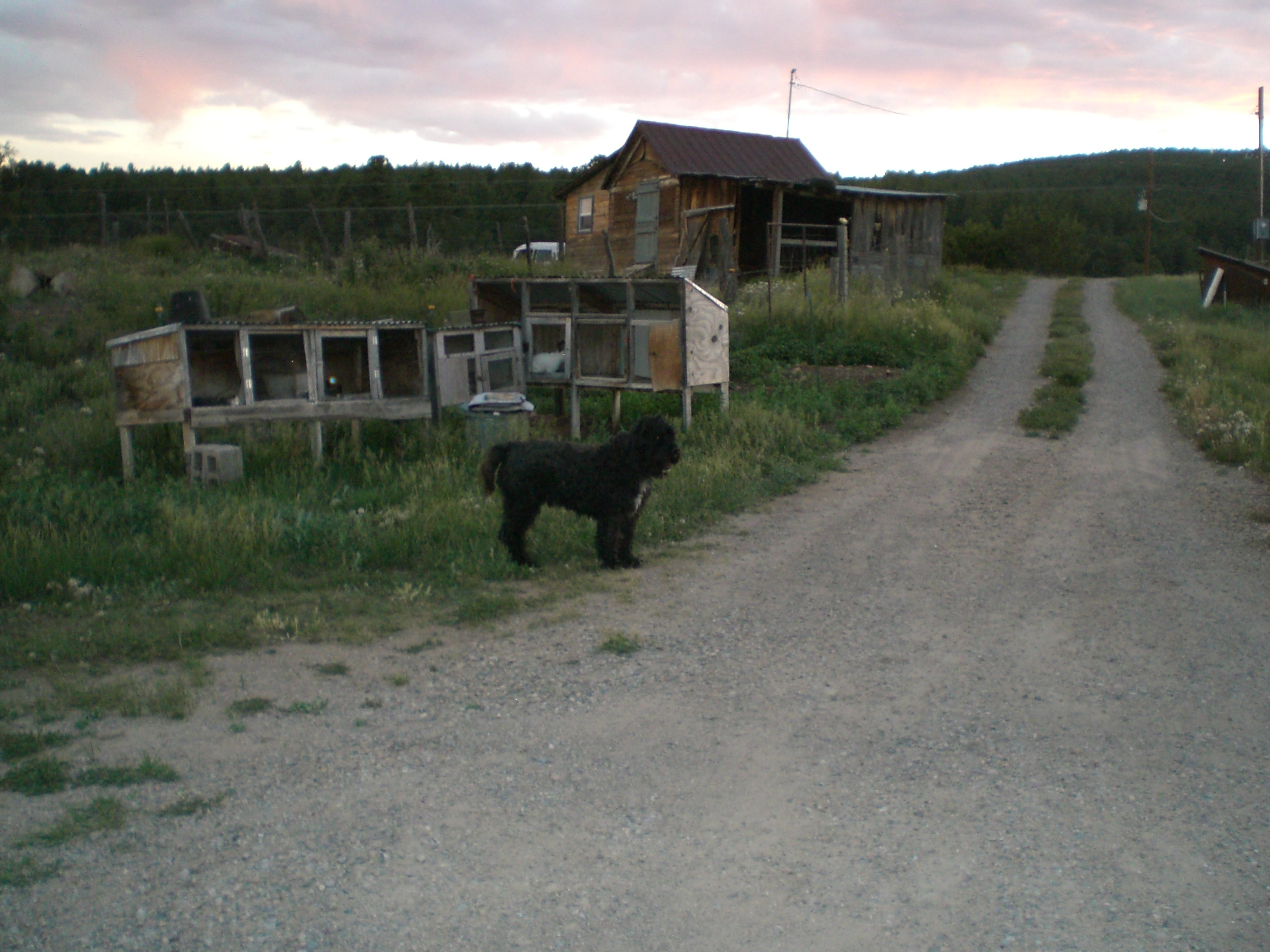
Over the 40 years I’ve lived in rural settings here in northern New Mexico, my one consistent rule for all pets has been that they must get along with one another. Not like, not necessarily interact, but tolerate and make space for all who wind up calling my home theirs. As a result, I’ve had a dog who let newborn kittens nurse on her while their mother took a break from the constant demands of parenting. I have photos of a cat cuddling with a Bouvier de Flandres large enough to squash her if he’d rolled over. That same Bouvier encircled an escaped rabbit and kept it safely between his paws until I got home and returned Mr. Bunny to his cage.

Guarding the rabbit cages

Guarding the rabbit cages

The coincidence of Thanksgiving with the first day of Hanukkah – an event apparently not to reoccur for an enormously long time – allows me to celebrate my two favorite holidays in one. Favorite because both encourage not just thankfulness, but also appreciation of freedom, joy in new beginnings, and the pleasure of connecting across boundaries.

In a heap

In a heap

I am grateful to have observed these same feelings played out amongst my four-legged family members.
I am grateful to be reminded by my furry friends, each time I hunker down to pet and play with them, that I don’t have to wait for Thanksgiving or Hanukkah to participate in a demonstration of tolerance, respect, and appreciation.
They keep me sane, they make me welcome, they direct me back to balance when I start to tilt off center, they define home.
For all this, a lower reflection of the inner beauty being shown me by my spiritual Master, I am thankful.

Sounds of Silence

October 1, 2013

First, I should explain that a different type of silence was imposed on me over the weekend, preventing me from putting up this post when I intended to do so, on Sunday afternoon. The internet link at the motel where I was staying was somehow incompatible with my computer, and the IT people weren’t able to reset it properly. I am back home, and once again connected – able to ‘speak’.

Thank you for patience, for reading, for following, for being there.

Niki
**************


Noise pollution is one of the issues not being adequately discussed in relation to my county’s examination of a proposed fracking ordinance. I brought the topic into the discussion, and I have to keep raising it as others focus insistently on water quality and scarcity, and contamination of the air and soil. By comparison I suppose noise can be considered a less significant negative – but not to me.

I live in the countryside – what most people would consider a truly rural area. My small 900 square foot house is set back from the road, on four acres, abutting a several-hundred-acre ranch. I have three neighbors – houses close to the road with entrance driveways off it, in a cluster with my own entryway. Across the road are two more homes. Most of the time, those neighbors are quiet – so much so that I wonder if they are at home. No loud parties, nor growling outdoor machinery.

I do hear traffic on the highway. My house is situated on a hill toward which the road heads before it veers off, resulting in the longish driveway that snakes from the road up over a hill to my front door. Sitting in my living room, looking out its floor to ceiling windows, I can see a section of the road, and all the vehicles that travel up and down it. I cannot see – but can hear clearly – the heavy trucks and the rattle of gravel excavation that is going on a further 2 miles away, on a section of land that “ought” not to be considered to be in my neighborhood. Something about the lay of the valley funnels that noise straight up to my house.

The gravel operation is new this summer. I don’t know yet if I’ll notice it when my windows are closed, but I am very aware now, with windows wide open, of the days it is running and those, like today, when it is not. Perhaps I’m more sensitive than other people to the ambient noise within which I live?

I do not like to have music playing “in the background” of my days. I work better, think better, live better in silence. I enjoy music, go to concerts, play records (there’s an oldie for you) or CDs with intention to listen to them – emphasis on the intention to listen. If my intention is to work, I prefer to do so in silence.

Undoubtedly, that preference has something to do with my enjoyment of Quaker Meeting, and Buddhist zazen sessions, as well as my own daily spiritual contemplative practice. Undoubtedly it also has something to do with my appreciation of the skill of the young musicians from Curtis Institute who performed Britten’s Quartet #3 for Strings at a recent Music From Angel Fire concert near my home. Two of the piece’s five movements, including the last one, end with a prolonged silence defined by the musicians holding their bows immobile above the strings of their instruments until, as one, they relaxed in their seats, signaling the end of the silence that was part of the movement, and the beginning of the silence into which the audience could inject its noises of appreciation.

Once before, many years ago in Boston, I attended a concert which featured a piano performance that included long silences as part of the piece, and then too I was able to ‘hear’ the difference in quality between the silence that was integral to the music, and the silence of the piece’s end. That time, as I recall, I had no visual cue. I was sitting too far back, in the cheap seats, to see the pianist’s hands. I could only rely on my ears, and the pianist’s flawless sense of timing, to distinguish when musical silence transitioned to an appreciative silence from the audience, which in turn transitioned into loud applause.

A few of my acquaintances seem to understand what I mean when I express my awareness of the difference between the silence of Quaker Meeting, and that in a Zendo. Even the famously silent Meetings (the oldest, historical ones in Philadelphia) which I have attended, have a busy-ness to them, a sense of minds occupied with focused reflection, that is distinctly different from the no-thought silence of a practiced group of Buddhists in meditation. And different again from the life in silence of the Benedictines (and their guests) living at Christ in the Desert Monastery. Different yet again from the experience of many hundreds of chelas (students), attending to the silent communication from our Beloved Teacher at a MasterPath gathering. Dare I say that there are many different sounds of silence?

(Yes I know the Simon and Garfunkle song The Sound of Silence. It doesn’t fit into my narrative because the song is about the negative aspect of silence – silence as a barrier to communication and a symptom of loneliness.)

We seem, in the modern urgency of tuned-in lives, to have forgotten the old adage that silence is golden. We settle for the silver, the copper, even the dross of noisy, busy “I’m somebody, doing something important” daily life and think we are fulfilling ourselves. Just yesterday, I had a Facebook ‘chat’ with a young friend who is torn between his desire to study the classical languages necessary to read ancient Buddhist texts in their original, and the supposedly practical necessity of getting a degree in a subject that can lead to a job. How practical is it, to go against one’s nature, to ignore the still, small, inner voice directing one toward a path of spiritual fulfillment, in favor of a loud, outer, boisterous demand to focus on earning a living?

Inside golden silence, there is much to hear and learn. Whole worlds of perception, of wisdom, exist within our inner silent spaces. Would that we all, individually and collectively, were more insistent on spending time in that beautiful silence within! Would that we all, individually and collectively, could share the golden wealth to be acquired from listening to the songs of the Divine played so beautifully within us. Listen…. and you will hear…

Creativity in a Second Language

September 15, 2013

I’ve started a new class through Coursera – a MOOC – that apparently has close to 125,000 people signed up for it worldwide. Mind boggling to think of that many students going to class together. The topic is Creativity – and in keeping with the course’s intent to promote more creative lives among the students, I’ve joined a subgroup of French speakers enrolled in the class. A challenging way to resurrect my skills with a language which I once spoke and wrote fluently, but which I’ve had little occasion to use in the last thirty years. Since the class is on-line, that means I’m writing French – the most difficult way to use a language skill. Should be an interesting eight weeks!

The first assignment included an option to make a sort of life map – identifying a core value at the center of everything one does, and then listing 3-5 priorities in each area of life, such as family, career, community, etc. I found the exercise relatively easy to do, given that my spiritual path (MasterPath) calls for a consistent effort to examine and process one’s life experiences. But I also attribute some of the ease to age – one doesn’t get to 70 and still engaged with employment, learning and community service, without having examined one’s priorities, and kept tabs on how they evolve over time.

What didn’t get addressed by the Life Ring activity was what I’d call a question of style – how do you, I, we approach daily life? I’m scheduled to facilitate an Alternatives to Violence Project (AVP) workshop with a competent co-leader who is very organized, detail oriented, and most comfortable when every aspect of the workshop is clearly spelled out in advance, including how each activity links to a small number of specific topics. I on the other hand, like to ‘wing it’ for at least part of the weekend. I’ve put together an agenda that includes exercises which can be related to a number of different topics. Part of the challenge – and the learning – that I value in AVP is how it reveals interrelationships that participants have not previously considered. I trust my own skill at helping tie those relationships together, and therefore like to leave room for the unexpected to emerge as the activities are processed.

There’s a lot to be learned co-facilitating with someone whose style differs from mine. Birds of a feather may indeed flock together – but do they learn how to get along with those of a different plumage? We draw reassurance from associating with others like ourselves. We learn and grow when challenged by those with whom we have differences. Which makes the concept of thousands of students from a hundred or more different cultures all joining together to explore creativity a highly innovative concept.

The Francophone subgroup is on LinkedIn, enabling me to check the careers and interests of other members, as they can review mine. Most of those I’ve looked up so far are younger, in business, engineering, industry, very few list teaching, none that I’ve found so far work in social service or health-related careers as I have done. The instructors for the course want the students to find ways to apply the concepts we study to our fields of endeavor, and to work together in teams to develop those projects. I seem to have set myself up to stretch my creativity to the max, finding ways to apply my skills, in a second language, to areas of life with which I have little if any experience! Should be fun…Meanwhile, the course does stress that we all have the capacity to be creative – and that our styles do indeed differ. We have all been asked to take a survey that classifies us along a continuum from adaptively creative to innovatively creative. I come up moderately innovative. I suspect my AVP co-facilitator would land somewhere on the adaptive end of the dimension. I’m realizing, as I write, that by putting on the workshop with her later this month, I will have completed the major assignment of the course – which is to apply the principles of creativity, in conjunction with others, to an aspect of my professional life. Thankfully I don’t have to put on the workshop in French!

Choices

August 18, 2013

For the past year I’ve been living in a way most of us are taught not to… day to day, with no ‘life goals’ and few plans that reach more than a week or two into the future. It’s a natural way to be; children wake each morning to a truly new day, one full of possibilities. They have to be trained to ignore distractions and to stay focused on mandates – good grades, keeping a room picked up, personal cleanliness, helping with household chores, thinking ahead.

Oh yes, thinking ahead. You didn’t make your bed when you should have done, so now you have to do it instead of watching your favorite TV show. You should have thought ahead! You’ve been skimping on your homework, now you’re failing 5th grade, though you’ve been warned over and over. You only have one six week grading period left to bring your work up to acceptable level. You’ll be doing nothing but school work from now until the term ends. No trips, no play, no time for fun… you should have thought ahead!

Sorry, Mom and Dad, but I’ve been determinedly not thinking ahead. There is a point, ahead out there somewhere, when I will run out of savings and, without income, be destitute. I’m not ignoring that fact, but I’m not focused on it. My wise teacher instructs that attention is food – what one attends to grows in one’s life.

Conversely: ”If you want something to leave your life, take your attention off of it.”

I see no benefit from worrying about a maybe some three years off into the future, so I am attending to what is here with me in the present. I have been searching job boards, applying for everything that seems a possibility. Like many older people in the job market, I get few responses. Experience seems not to be valued any longer. Employers want new young minds to train to their special priorities. They want to mimic parents, who know instinctively that training children to think ahead, plan for the future, and learn habits of daily living is easier when the children are young and haven’t yet had enough experience to question the parental dictates.

So how do I communicate, in a standard application and resume submission, that part of my experience has been learning to be open to new ways of doing things, new goals and new achievements? Do I say that I have been living day to day for a year now, proof of my ability to be flexible and adaptable? Do I use, in a cover letter, another image from my spiritual teacher, of riding a horse up a creek and, at a moment’s notice and for no conscious reason, jumping the horse up onto the bank? Knowing when to listen to one’s inner voice (intuition, or spiritual knowing) can indeed be the skill that saves one, in what turns out to be the nick of time, from a tumultuous flash flood gushing down the creek bed.

Asked what I’m looking for in new employment, I could perhaps best answer by saying I seek the employer who will appreciate the depth of meaning in my teacher’s story. Or one who could read Lesley S. King’s recent post entitled Face Your Inner Mischief, about her yapping mind, and understand it for the beautiful parable it is. I seek an employer who has the ability to appreciate the innovative, the creative, the self-directed in others because that is what he/she is also. Someone not threatened by new ideas, not hearing questions as challenges to authority but rather as the positive contributions of an assistant engaged in the process of achieving goals which, themselves, may shift with time and experience.

Living each day for what it offers, as I have done of late, could be considered a rejection of the values my parents, particularly my father, taught – to plan, to delay immediate gratification for a larger achievement; to save and be mindful of expenses, so as to have financial resources when they are needed; to be cautious and consider all possible consequences before acting. Indeed, much of my life could be seen as a rejection of those values; I’ve left higher paying jobs for lower paying ones on a matter of principle; I’ve spoken out about fundamental rights and been blacklisted; I’ve challenged the status quo in large and also in small ways, living as my friend Jane said recently, when she wrote, “I did what the Holy Spirit led me to do, and I can do no other.”

Nonetheless, there is a way in which I still embody the underlying lesson my father – and most parents – try to teach their children. That silent message is about acquiring the ability to choose – i.e. to have an understanding of cause and effect, an ability to be patient long enough to experience outcomes, and a sense of what information comes from within one’s being and what is imposed from ‘outside’. With these three skills, one can choose – to follow outside dictates or respond in opposition to them; to stick with an unsatisfactory job or to leave it without another already in place to go to; to value integrity more than security, or patience more than impulsiveness.

Ultimately, it is our choices – or lack of them – that define our lives. Lucky is the child of a parent who knows to teach how, but not what, to choose. Blessed is the individual who learns from a spiritual teacher that worlds exist beyond the mundane, and that we all have within us the capacity to manifest Truth, to Hear the Word, to be led by the Holy Spirit, in whatever language or manner of Knowing we choose to embrace.

As I continue to practice not knowing, living open to whatever turns out to be my ‘next step’, I am content. I have made my choices and, again like my friend Jane, I have paid a price, but “I would do it all over again.”

It’s good to know that I’m fulfilling my promise to myself, made shortly before my grandfather’s passing, to live my life so that whenever my time of transition arrives, I will have as few regrets as he did on his deathbed. His nearly final words to me were, “I possibly should have remarried – it would have been better for your mother, but I never found a woman I wanted to marry… and I wish I’d learned to play the mandolin.”

May we all make our choices such that we can sum up our lives as contentedly and succinctly!

. . . Was the Word

July 20, 2013

 valley viewI wrote my first poem, in my teens, after standing up to a howling wind blowing across the rim of Les Baux, in southern France. Below me was the Val d’Enfer (Valley of Hell), so named, I was told, because it was the site of attacks on merchant caravans whose masters tried to avoid paying tithe to the lords of Les Baux. My poem sought to express a sense of standing up to challenge.

Now, in my so-called golden years, I live in one of the windiest areas of the USA, the foothills of the Rockies in northeastern New Mexico. As I write, the wind swirls around my home, slamming against the house before fading to a conifer-leached sigh. With my eyes closed, the sounds could be those of the ocean, hitting the Maine coast and splashing me with spray or, from even earlier in my life, the rolling tumult of storm-roiled combers crashing onto Rehoboth Beach, Delaware, below where I stand hanging onto the railing of the boardwalk.

Just last month, the wind lifted tin off the roof of my loafing shed (fortunately no horses were around to be frightened into bolting). I arranged to re-roof the cottage to which the shed is attached, so tonight there is no clatter and rattle, only the almost intelligible language of an ocean of wind, once again attempting to tell me all the truths of the world.

Heavenly Wind

Heavenly Wind

The wind, no matter in what spot in the world I experience it, brings change. Sometimes merely a change in the weather, other times a practical change like the needed, but previously postponed, new roof. The wind, no matter in what spot in the world I experience it, always brings me to inner change.

Awareness of a power beyond my small self, clinging to the boardwalk rail.
Awareness of good and evil across the ages of man’s time on earth as I looked into hell’s valley from the heights where I was sheltered and protected.
Awareness of the power in wind-driven, fragile drops which shattered to spray against mica-rich Maine rocks, before falling back into the sea and rising again to the work of eroding those rocks over eons of time.
Awareness tonight that, living amidst frequent winds, I have placed myself in the perfect outer environment to match the pace of my inner spiritual evolution. Washed by waves of wind-sound, like the Maine rocks, I am inexorably cleansed, my ego eroded to allow the bright mica reflections of Soul to shine forth.

Cleansing started, and will end, with the Word, spoken by the lips of the wind, into the ears of those who wish to hear.

Unlearning

June 30, 2013

For the last twelve months I’ve been taking a Ba Gua class from the wonderfully skilled man who also gives me acupuncture treatments. I’ve used acupuncture as my primary form of medical care for more than 40 years, and have been cared for by a number of able practitioners over that time. Without question, John Mince-Ennis is the best of them all. He’s a gentle and effective teacher as well.

I began my physical-activity life as a dancer, studying both modern and Thai classical styles, with an occasional ballet technique class thrown in for its discipline. I’ve also been a horseback rider, European rather that western-style, and a hiker. In later years, I’ve learned a 27 form Tai Chi pattern, taken a couple years of Tae Kwan Do, and finally found Ba Gua. Also a ‘soft’ martial art, like Tai Chi, Ba Gua works on realigning the fascia, resulting in a suppler yet strengthened body, improved balance, and overall improved health. Used as a fighting form of active martial art, it is both beautiful and effective, with a distinctive circular, coiling and uncoiling movement.
The challenge for me in learning Ba Gua is in fact not learning something new, but unlearning something old. My body has had many decades to practice moving in ways instilled from as long ago as those first dance classes at age 8. Legs turned out from the hips, knees over toes, balance maintained by tight control from the core (abdomen) which is pulled in and up. All movement (including the graceful lifting of an arm) originates from that same central place.

An overlay of how to swing through with a tennis racket, was added during my sojourn in Saigon. I had no language in common with the pro, so he placed himself behind me, reached around and grasped the racket with me, then moved my body through the correct motions. An amazingly effective and enduring type of instruction. I don’t run to meet a ball any longer, but placed where it will bounce, my body still knows the right way to connect with a solid swing.
None of which is of use – indeed all of which must be refuted – as I learn Ba Gua. Instead of pulling my core in and up, I must “hang from the one point” at the crown of my head, sink my lower body into a semi-seated stance and relax the middle, “rotating waist inside of hips”. Toes are slightly pointed inward (a similar slightly pigeon-toed walk is understood to be natural to some Amerindian tribes) in direct contradiction to my ingrained habit of toeing out. A set of twenty-four “gao” – exercises – seem to begin with arm movements, but have the effect of teaching the inner core new ways to move. In other words, where my dance training initiated movement in the belly, from where it moved outward, the beginner’s instruction in Ba Gua initiates movement in the limbs, from where it works inward to retrain the fascia.

My teacher on the MasterPath speaks of a similar, necessary unlearning of all our habits of mind and unconscious ways of believing, thinking, behaving – in order to uncover the truth of Being. Neither process of unlearning the old, to acquire the new, is easy. Both take years of instruction, diligent practice and, above all, the willingness to change. Odd, how persistently we cling to old ways of doing and being, even in the face of ample evidence that our circumstances have changed, and we should change also.

Staying at an acquaintance’s home recently, I looked for silverware in the drawer closest to the sink. Instead I found storage containers. My hostess directed me to a different drawer to find a spoon to stir my tea.
“Why did you look in the drawer by the sink?”
“Because that’s where the silverware would be in my own kitchen.”
After a pause to reflect, I had to add, “That’s where my mother stored the silverware.”
Decades later, I felt disoriented because something as mundane as the location of a silverware drawer was not in accord with my conditioning!

Beliefs about ourselves, about how to relate to others, about what aspects of ourselves we should identify with – these concepts are so ingrained that few of us are required to examine them unless we experience a traumatic shattering of our sense of self from which we must work to find our way back to wholeness. Or perhaps if we start on a path of spiritual exploration.

The challenge, the excitement, the work and the reward of MasterPath lies – for me – in being asked to examine every single assumption, expectation, concept and belief in my life. Most especially, it challenges patterns of being which are buried so far down in the unconscious that I have no recognition of their existence, until some circumstance or life event pushes me to bring the assumption into awareness, to be contemplated and understood for what it is (or is not).

Just as my body is being renewed by the process of unlearning/relearning that is Ba Gua, my essence is being redefined by the unlearning/relearning of what I Am – of what it means to Be, to Know, to See.

On all levels, the unlearning/relearning is hard work, but amazingly rewarding!

What Are The Odds

May 30, 2013

Recently, I received two phone calls within 5 minutes of one another, both from women with whom I had interacted (one closely over several years, the other only briefly) more than 30 years ago – and with whom I had not had contact since! Further, my connection to each of them involves the criminal (in)justice system with which we have all three been involved in some fashion. I taught college level psychology courses in the New Mexico Penitentiary beginning in 1978. One friend was active with me in a major prison reform project arising from the 1980 riot there. The other – acquaintance rather than friend – went on to do research in criminal justice after we had interacted, and wanted now to talk to me about that continuing interest of hers.
What are the odds?

What are the odds that I would date, in college, a guy whose high school girlfriend was the first cousin of one of my schoolmates from junior high? And what are those odds given that the high school was located in White Plains NY, the junior high in Saigon, Vietnam and the college at Swarthmore, in Pennsylvania. Out on a date in New York City, we walked into the Russian Tea Room and encountered my friend’s parents and his girlfriend’s parents having dinner together.
What are the odds?

For that matter, what are the odds that I would receive a call, more than forty years later, from that junior high friend, as a result of her reading an essay I published in the Swarthmore College Alumni Bulletin? Her son had briefly attended Swarthmore before his death. Clearing out his papers, she found the magazine, and my article, and tracked me down through the College alumni office.

Skeptics may try to answer the question of odds with numbers, while reciting the logical statement that co-occurrence says nothing about causality. In other words, the fact that two or more events occur simultaneously, or in close proximity to one another, means nothing whatsoever about their causal relationship. The events may in fact have a common cause, but they may equally well have no connection of any sort to one another. These skeptics (they may think of themselves, rather, as logical or pragmatic) can be heard to pronounce that it is a fallacy of humanity, to ‘need’ to find meaning in random events.

What are the odds, and do they matter? Perhaps only to those fascinated by coincidences, who have not yet taken a position with regard to the importance and role of causality – or serendipity – in our lives. A good friend of mine reminded me, when I mentioned my ‘what are the odds’ question, that I was expressing a cultural bias. Many cultures – the Navajo for example – do not believe in serendipity, or coincidence, but rather believe all events are linked. The purpose of life is to understand those links and find one’s place within them, and thus to be in balance and harmony – to walk in beauty.

Other traditions also teach that the goal of life is to learn to exist in a space of harmonious balance, often expressed as learning to “Be”. Buddhists practice stilling the mind in order to achieve a state of immediate, present, awareness. Quakers seek ‘the Light Within’ to guide them in manifesting the divine in daily life. The Catholic priest Richard Rohr (founder of the Center for Action and Contemplation) encourages us to live from the center instead of from the edges (the edges being where we define ourselves by ego, by the groups we belong to, or the codes we think everyone should adhere to). The ancient Light and Sound teachings (the poet Rumi was an interpreter of this age-old wisdom, MasterPath is a current expression of them) – these teachings guide followers toward direct awareness of Soul, and the ability to Know, Be and See as a manifestation of the Divine.

To resolve apparent either-or tensions, my teacher in MasterPath speaks of the value of finding “what the opposites have in common.” Thus, a middle road between the skeptics and those who see a connection among all events might be found by asking another question on the order of, “Is this seeming coincidence calling my attention to something I should attend to?”

What the two callers reaching out to me had in common, other than a 30 year gap in our interactions, was a connection to the field of corrections. I have taught college courses in prison, been an activist for prison reform, and I currently offer Alternatives to Violence Project workshops in the New Mexico prison system. Should I be looking at that aspect of myself?

Or does the benefit to me of noticing the conjunction of these two calls lie in a consideration of who I was 30 years ago, in contrast to who I have become since? A third possibility is that the value of reflecting on the calls lies outside myself, in my consideration of the science and logic of coincidence versus the range of belief systems which see systematic connection and order between events.

What are the odds that I’ll discover the ‘real reason’ for this apparent coincidence? Is there such a reason? Does it matter? Probably only if I choose to make it matter. And therein lies the kernel, the import of all the questions – the fact that I can choose how I interpret the events in my life. We each can make such choices, though sometimes it feels like the choice is made for us. Coincidence or meaningful plan, noticed or ignored, how our lives unfold and what we make of our experiences is ultimately a matter of choice. Knowing I am responsible for my circumstances, I can more easily “be”, in harmony with them. I like those odds!


Only Fragments

Love Letters to the Tar Pit

KarusaaVerse

Words that Sparkle, Thoughts that Ignite: Fueling Your Imagination

Leaf And Twig

Where observation and imagination meet nature in poetry.

Millarson Diaries

Personal Musings and Thought Experiments

The Beauty Along the Road

Discovering Beauty in the small details of our lives

Flowerwatch Journal

Notes on Traveling with Flowers

1eclecticwriter

Wide-Ranging Commentary

Spirituality Exploration Today

Delving into the cross roads of rationality and intuition

smilecalm

Life through Mindful Media

A Good Blog is Hard to Find

I will shatter a word and scatter the contents into the wind to share it with the world.

Ray Ferrer - Emotion on Canvas

** OFFICIAL Site of Artist Ray Ferrer **

AKA The Versatile

Fashion | Lifestyle | Food & Travel | Beauty | Fitness | Education | Product Reviews | Movies | Doodling | Poetess

Aging Abundantly | Women Over Fifty | Empty Nesters | Caregivers | Aging Gracefully

Finding Joy at Every Age with writer/philosopher Dorothy Sander

ARTZZLE

Helping with the Pieces in Life's Puzzle of Art and Design

Project Light to Life

A bucket list blog: exploring happiness, growth, and the world.

The Daily Post

The Art and Craft of Blogging

Any Shiny Thing

MIDLIFE MAGIC

allmostrelevant

@allmostrelevant

The Irrefutable Opinion

Assaults on the Casually Mundane by K. Jean King