Posts Tagged ‘spiritual development’

Lemon Delight

June 1, 2014

Fixing myself a salad supper using Belgian endive and lemon flavored olive oil, I flashed back to the first time I was offered this salad by the housekeeper employed by my parents, in Paris. Francine had worked in a large hotel most of her life, and had quite a number of stories to tell about life under the German occupation. Some were funny, others distressing, like the one about her desperately hungry coworker who was whipped for eating two bites from the discarded remains of an apple she found on a supper tray set out into the hall.

Francine is also the person who first began to teach me patience, how to mask my reaction to a situation and to bide my time until I could find a safe and effective way to retaliate. In different terms, she taught me to convert reaction into response.

My friend from Cameroon describes the French, who ruled his land for decades – as part of French West Africa – as duplicitous people who mask what they really mean behind polite phrases. He has gently scolded me for being “like the French” when I ask what he would prefer in a situation, rather than state what I think and then ask his opinion of my proposal. At first I was puzzled by this interpretation, since in my own mind I was genuinely neutral, and willing to do whatever he wished. Now, I’ve adapted my communication, to state that I have no preference among several options and would like him to choose for us both.

I’m still learning, in other situations, to feel comfortable openly asking him for what I would like. A lifetime ago, a mentally ill mother who took pleasure in denying me anything I wanted, set me on a path of masking my desires. Francine refined my skills of indirection. Time, experience, life as it happens all combined to instruct me to accept and be happy with what I could get, rather than to demand the fullness of what I wanted.

There is value in patience, in being tactful, in making lemonade from lemons.

Scent of Lemons   by Janet Triplett

Scent of Lemons
by Janet Triplett

But there is also a time for a serving of lemon meringue pie!

I’m savoring my slice just now – a demanding but satisfying job as the (gluten-free) crusty base, a delightfully sweet/tart lemony balance of romance and a social life for the filling, and a meringue topping of frothy happiness and spiritual delight.

There. I’ve said it. That I have what I want.

In the saying, I am confirming my right to this happiness, rather than daring fate to snatch it away from me in the way that, so long ago, my small pleasures were demeaned or destroyed.

How very long it sometimes takes to undo negative conditioning! Especially when that training wears the face of positive qualities like acceptance, patience, diplomacy, tact.

My spiritual teacher, from MasterPath, speaks of iron shackles and golden chains being equally binding. The shackles are clearly negative and therefore easier to identify and shed. The golden chains are so subtle and seemingly so benign. But oh, how constraining they can also be.

I feel blessed, to become able to perceive and free myself from them. I thank Thee, Master, for showing me the way.

Driving into Awareness

April 6, 2014

I am teaching someone to drive – again – no, I am again teaching someone to drive. There, that’s better, more accurate.

The same process of correction, of attention to exact explanation is required of me as the driving teacher (not driving the student hard, but teaching the student the art of driving). And it is as much art as science. Getting the feel of the vehicle, of the wheel, of how the car wants to straighten itself out from a turn so that trying to do the straightening produces an over-correction. Learning to position oneself in the lane, noticing important warnings of the intentions of other drivers, processing what one sees and hears without needing the time to consciously think it all through. Driving, especially in traffic, requires quicker responses than conscious thought permits.

I am, again, teaching someone to drive, and valuing this opportunity to become conscious of what I do instinctively. Valuing, also, this occasion to notice not just what I do right, but what I’ve gotten a bit sloppy about, and don’t want to continue to do, now that I need to be a role model of safe, defensive driving.

My daily spiritual practice is essentially an exercise in shutting down thought, in order to become aware of the subtler levels of my being. Very close to what I must do to teach someone a skill at which I am so practiced that I conduct the activity beneath the level of awareness and thought. When I come out of my daily contemplation, I often bring a new insight with me, into consciousness, then do my best to put into words and actions what I’ve been gifted to perceive. Very much like the way in which I am opening to the subtle habits ingrained by so many years of driving, and attempting to give voice to them in order to instruct my student.

So teaching someone to drive is a spiritual exercise! Or at least it can be, if one chooses to make use of the experience for one’s own growth in understanding. And in patience. And in trust.

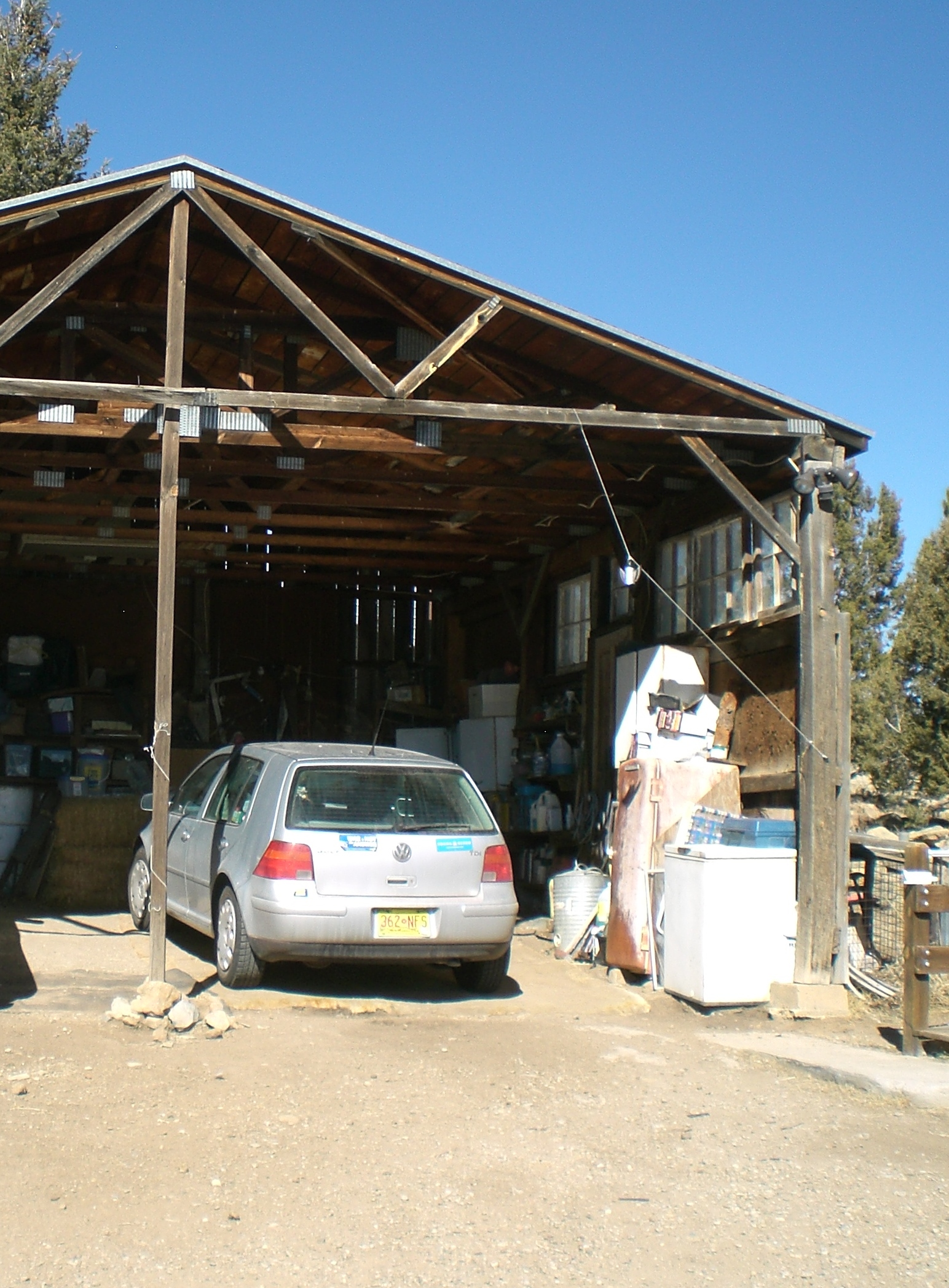
The vehicle being used is my ‘second’ car – the back-up GMC that serves as my guarantee of transport should my trusty and trusted and much loved VW Rabbit ever fail me. (It has not done so, as yet, in ten years and nearly 220,000 miles of mostly solitary driving). I’ve realized already that I would be far more tested were I to be giving the lessons in the Rabbit. Not just because it’s a stick shift whereas the GMC is automatic. I have virtually lived in the VW; it’s packed with all that’s necessary for me to survive through a snow storm, hunker down to wait out a dust storm, take advantage of an unexpected opportunity to camp out overnight, be appropriately dressed for sudden changes in weather, provide roadside first aid in case I come across an accident… you get the idea.

Resting at Home

Resting at Home

My Rabbit has become far more than reliable, reasonably inexpensive transportation. It’s home away from home, an important means of connecting me to the world, a key element of my ability to earn my living and, because Rabbits remain relatively uncommon on our roads, a distinguishing mark of my presence. Not so long ago, I needed to let a mechanic drive the Rabbit so he could feel in the steering what I sensed was a developing problem. Sitting in the passenger seat as we went around the block was one of the harder things I’ve done recently.

Sitting in the passenger seat of the GMC has not been difficult. I don’t have much history with the Envoy, and my student is both a quick learner and a careful driver. The challenge for both of us is that he grew up using public transportation, not riding in cars, so he still has to acquire the non-verbal, body sense of what driving a car is all about. It’s not at all the same as riding a motor cycle, which he has done.

I’m also familiar with riding cycles – not driving them, but happily sitting on the back, free to enjoy the wind in my hair and the scenery flashing past with an immediacy totally lacking when one is shut inside a car or truck. I used to get the same sense of connection with my surroundings when I rode my horse out through the gate of my property and into the extensive acres of my neighbor’s ranch. A brisk canter to the far fence shut down thought and opened up my inner world. Yet another form of spiritual exercise.

Perhaps I should suggest to my student that he do a short contemplation before his next turn behind the wheel? Most physical skills come more easily when one relaxes into them (think of learning to float in order to swim). Those same skills suffer when one over thinks them (tensing up in the water, and sinking). Riding behind on a motorcycle, one has to relax and let one’s body bend with the curves in concert with the driver. Up on a horse, one must become one with the rhythm of the horse’s gait. Behind the wheel of my Rabbit, I feel in tune with every nuance of the vehicle, I know that car as if it were alive.

How does one teach that sort of awareness?

Hearing one’s True Voice in contemplation and then living from one’s Divine Self are, like driving a car well, skills which cannot be mediated through the mind. These skills cannot, therefore, be taught. They must instead be caught by the student, who first observes them being modeled by a teacher and who then, by trial and error experience, learns to shut down the mind and respond from a wise and capable Soul.

Inner commune, connection, inspiration, followed by action – the sequence of a spiritual exercise – is also the sequence many artists describe as their process of creation. Learning dance choreography many years ago, I was told by Miss Widener to stop thinking about my composition and instead to just feel my way through it. Yesterday I asked my student if he could feel how to respond to the impact of wind on the Envoy’s steering. Today I am challenged to create, with words, a feeling of intuitive understanding in my readers.

Do I evoke an “aha, yes, I am aware of that part of me?”
Do you go there, learn, trust, respond, live from that core? Yes? Then I’m happy for you.

If not, or not yet, teach someone to drive – or ride a bicycle, redecorate a room, weave a rug, or work with wood. As your student learns a new skill, you’ll gain a new level of awareness, and enjoy a new way of Being.

Whirlwind

March 30, 2014

My thoughts seem to be coming in song fragments. Some are personal. One asks to be shared.

“Tis a gift to be simple, tis a gift to be free, tis a gift to come down where you ought to be. To turn and to turn shall be my delight, and in turning, turning to come down right.”

My life is being turned upside down, and I’m simultaneously riding on the whirlwind and standing aside, watching the wind (up to 60mph outside my window at the moment) figuratively shred the golden chains that have held me trapped in patterns of thought, belief, behavior that appeared to be good but which were nonetheless ensnaring.

How subtle is our mental training to be “good”, to think in dichotomies, to turn away from what John Eldredge, in Wild at Heart, calls our God-given nature. In order to be “a good Christian” (Eldredge) or to be a responsible partner, or a good family man. Or so as not to be labeled “bossy” as a young girl, or called that other “b” word when, as a mature woman, I speak up, speak out, speak my truth.

“Be a good girl and…” do whatever I’m being asked to do, whether or not that something is good for me.
“Good little boys don’t…” do whatever it is the adult is unhappy at seeing happen.

It’s called socialization, and it’s what good parents do when raising their children to fit into society – and what not such good parents do when projecting their own malformed views onto their children. In both cases – and all the variations in between the two extremes of positive and negative parenting – the resulting imprinting takes a lifetime to understand and clear away, if one is even capable of understanding and clearing it.

What my Master calls iron shackles and golden chains – the imprinted concepts from upbringing and karmic bonds – are what his students work to become aware of, and to release. The shackles are usually obvious – habits like addiction, that limit and restrict opportunity, or behaviors that can be labeled anger, greed, attachment, pride. The golden chains are much more difficult to recognize because they come disguised as positives like responsibility, or being a good ______ (fill in the blank).

Remember What You Are

Remember What You Are

I’m not suggesting one shouldn’t strive to be good at whatever one sets as a goal – developing and using skills is a satisfying and fulfilling effort. Being good at is not the same as being good. Active little boys, expressing their inborn nature, may be good at stirring things up, exploring and challenging and daring to try, all behaviors that can get them labeled as disruptive by a teacher who wants them to sit still for school lessons. A bright little girl with natural leadership skills will hear that she’s being unacceptably bossy when she tries to take over direction of a playground game.

Breaking golden chains, then, can be considered as learning to distinguish being good from being good at, and giving oneself permission to simply Be… good at certain things, not so good at others, but acceptable and accepted and loveable and loved, nonetheless.

Because you are Soul, perfect and beautiful, warts and all.

‘Tis a Gift

March 23, 2014

I have only a little time this evening, set aside for writing, but without any strong motivation regarding a topic. There are four or five essays I’ve started at various points in the past few months – none of them grab me just now, asking to be completed and posted. Too abstractly intellectual; too much social commentary when I don’t feel particularly engaged; too removed from my current state of being… Too, too, too.

The only immediate concern that engages me in this moment of relaxation, is how to keep my present calm acceptance and contentment going when I am bombarded by Saturn’s powerful strictures, or the draining needs of others. I’m sure you’ve encountered people whose sense of deprivation, or overwhelming pain, or just plain exhaustion have turned them into emotional black holes, sucking life force from everything around them. I’m not referring to those who have been diagnosed with borderline personality disorder – the ultimate in black-hole-ness. Working effectively with these fragmented people requires professional training and a great deal of practice.

No, I’m referring to people who mostly manage to make their way in life, but lean extensively on anyone and everyone around them in order to function. They hold jobs, they raise families, and they suck up the energy, the enthusiasm, the very vitality of those around them. I’d forgotten how many such souls draw on our health care system for portions of their support. I’d forgotten to what an extent I have to develop mechanisms to balance myself out, after spending days working with these needy individuals.

Some of the exercises in my weekly Ba Gua class draw energy from the earth and bring it up through the body and out the fingertips. After a particularly challenging work day recently, I rooted myself in the standing tree pose until I felt a resurgence of chi in my body. The technique is effective, but not one I can practice easily in the car, traveling between clients.

Checking in with my Master helps, always.

So does the company of friends, though I feel cautious about relying on the energy of others, not wanting to become, myself, the sort of leech that I am seeking to recover from.

At Upaya, a Buddhist retreat center in Santa Fe, there will soon be a workshop on compassionate caring, subtitled how to be engaged without being entrapped. It sounds like an answer to the challenge of my present situation. I will have to absorb the lessons by osmosis, however – I can’t take that much time off from work just yet.

Nor do I think such a workshop will guide me in dealing with the most serious source of leeching energy – the brutally frustrating, inefficient, too often non-functional data software system with which I must interact on a daily basis at work. I’ve learned that my employer is threatening the computer system contractor with a breach of contract lawsuit – and cancellation of the contract for failure to perform. One part of me is cheering wildly at the thought of becoming free of the monster. Another, though, cringes at the idea of having to redo – in a new data base – all the work already completed since the first of the year.

You’ll get some idea of how awful the data system is, if I say that keeping paper records and duplicating multiple entries by hand would be far more efficient and user friendly than the program we are expected to negotiate, when it works – if it works. I had set today aside for data entry – and couldn’t even get into the system until almost 1PM, effectively losing half my work day. To keep up and not feel totally overwhelmed by unmet obligations, I’ll have to work on Saturday – again.

I can work on Saturday. I’m free to work on Saturday. I have paid work to do on Saturday. I have a good paying, mostly enjoyable job being of service to others, after many long months of being turned down for every sort of work I sought.

No, I’m not practicing affirmations, just reversing a possible spiral into negativity that could begin with today’s frustrating failure, yet again, of a system that is supposed to be an asset in my work my life.

Giving attention to that which uplifts, enjoying the company of friends, sharing a bit of my daily life with these words – these are activities which allow me to regain energy, to move forward into my next day of interaction with whatever sentient or mechanistic black holes cross my path. Outstanding astrologer, Eric Francis of PlanetWaves, urges that we face the coming months of a unique and powerful astrological grand square by daring to trust. For me, that translates to moving forward with confidence that my inner sun is strong enough (provided I remember my Source) to keep shining despite any loss of energy or sapped strength.

To have the opportunity to experience this constant regeneration is a gift for which I am most grateful.
CIMG1281

Dayenu

March 9, 2014

Have you noticed how subtly, but pervasively, some of us become conditioned to be happy with crumbs, accepting far less from the banquet of life than we may want, or even than may be available?

In my case, I recognize that this training began in my earliest childhood, as the result of my mother’s severe psychological problems. Anything I looked forward to, anything I really wanted, she found a way to make unpleasant or to turn into an unhappy experience. You think your birthday should be special, maybe a few playmates over for a small party? Think again. “I don’t choose to accept responsibility for anyone else’s children in my house.”

If I admired some small item in a shop window, wishing someone might think enough of me to buy it for a present, I might very well find it at home – on my mother’s dresser, after she bought it for herself and preened over her lovely new figurine. Primary school graduation, all the girls dressing up in pretty new clothes and patent leather party shoes? “It’s a school day. You wear your sturdy Oxfords, no buts and no arguments, do you hear me!”

I learned to be grateful for a day without being repeatedly slapped, for an hour alone with my grandfather, just going for a walk around the neighborhood (“You haven’t earned the right to go to the zoo with him this week, you’ve been far too much trouble to me”). I learned to accept that only grownups got new clothes from the store; mine were roughly sewn together from one of three basic patterns and handed to me with, “I worked hard to make this for you, don’t you dare complain that it looks like all your others. It’s a different color. That’s more than enough. The children in Africa are lucky if they have any clothes at all!” Those children in Africa were lucky if they had food, or a warm bed, or a place to get out of the rain, or…

I wanted to visit those children in Africa, to see if their lives were really so bad. Somehow, even at only five or six or seven years of age, I suspected that many of them had loving parents and enough to eat and maybe they even got presents sometimes, and hugs and kisses instead of punishments.

If we’re diligent about maturing, about taking responsibility for ourselves and who we become, we grow out of a variety of early conditions to become decent, engaged, thoughtful people. We stop blaming our bad decisions on our parents’ inadequacies, we learn from our mistakes, and we move forward. But underneath, all too often, we retain a fundamental attitude that we must feel satisfied with crumbs.

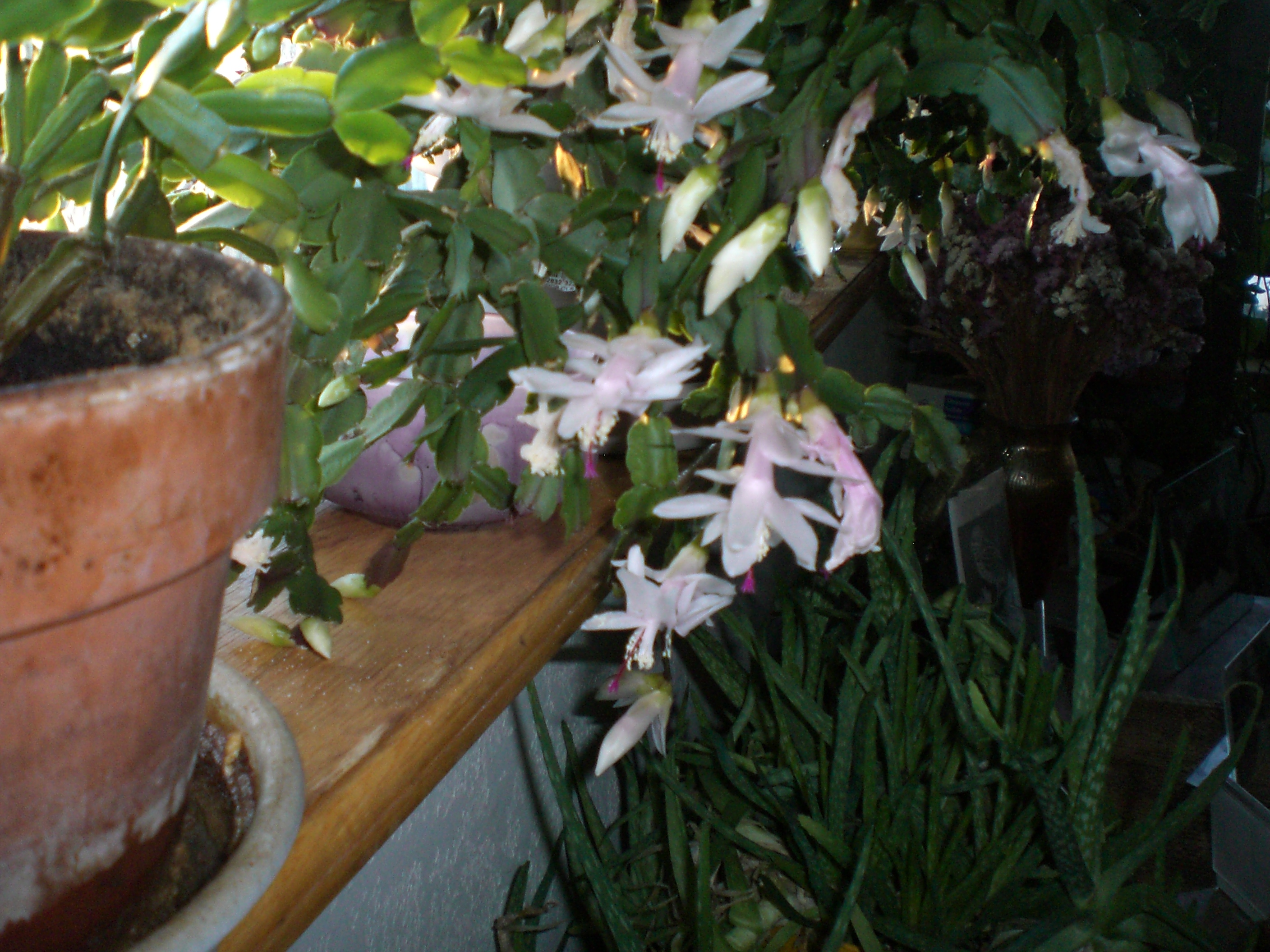
Don’t misunderstand – I fully support approaching each day with “an attitude of gratitude” for the many small positives to be found in it. I’m amused by the antics of the rabbits in the pasture. I smile at my confused (or misnamed?) Christmas cactus which stayed plain at that holiday, but is now flowering for Easter. I’m quietly, inwardly thankful for the opportunity to work once more at a job I enjoy, after years of toil in a less rewarding environment.

At Easter

At Easter

At the same time, I recognize that I spent many more years in that previous, stressful workplace than perhaps I “should have” done, because I was (am still?) conditioned to accept a small salad plate from life’s banquet rather than grabbing a big dinner plate and seeing that it is filled. The latter behavior is so often called greedy, selfish, and thoughtless of the needs of others.

If what one is going after falls in the material world – money, possessions, power – then yes, trying to get as much as possible for oneself may well be greedy and selfish. Lord knows I can’t comprehend how people already making hundreds of thousands of dollars a year can think they are also entitled to bonuses! Some, like Bill Gates or Michael J Fox, turn around and give back a generous portion of what they acquire, and thereby help the rest of us. I am thankful for them, and their charitable foundations. Too many others grab for, demand, and keep outrageous salaries, even insisting they be paid after they’ve been asked to resign. The public face of this activity is labeled “buying out a contract.” I think it is purely obscene. We working folks who don’t perform to standard get fired, not paid to leave. Why should it be any different just because one has an exalted position with an already very generous pay rate?

But I’m not talking about the material world, when I say we’re conditioned to settle for less. I’m not even talking about the emotional world, or the necessity of accepting that very few relationships are perfect, that we cannot count on another to “make me happy.”

I’m reflecting instead on the extent to which we cut ourselves off from fulfilled happiness by telling ourselves we do not need, are not entitled to, don’t have the right to, should not want or expect that fulfillment. In a portion of the Seder, the Jewish celebration of Passover (and the ritual being observed by Jesus at the Last Supper) a litany of blessings is recited, and after each step in the path to freedom the sentiment is expressed “Dayenu = It would have been enough.” If God had done just X, it would have been enough. If God had done just X+Y it would have been enough. If God had done just X+Y+Z it would have been enough.

I learn from this ritual that being grateful for what I have need not prevent me from welcoming more into my life. That I want more does not say I don’t value what I have. Only the subtle, pervasive, underlying conditioning of unworthiness so many of us have absorbed dictates that I should not try for gold, now that I have silver in hand.

I have silver, and rubies, and ambrosia, a wealth of gifts of the spirit. Dayenu. I appreciate how much that means to, is sought after by, people who have less. I happily share my blessings as best I can. And I’m going for more.

Reaching for a full platter does not mean I appreciate my present plate any the less. It does mean I’ve decided not to hang back, not to duck and cover, not to “settle” before I must do so. Maybe I’ll trip. Maybe I’ll fail. Maybe I will, in the end, have neither gold nor silver. But as a former prisoner and student of mine once wrote, “Mighty Casey, he struck out. What does it feel like to get into the game?”

I’m going to find out! And whatever the outcome, it will be enough. Dayenu.

Being Present

February 23, 2014

As I woke this morning, three little puffs of cloud – the only ones in the sky – were framed in the window at the foot of my bed. I lay watching them through the leaves of a night-blooming cereus plant, waiting for the sun to come up above the eastern hill and finish lighting the sky. The clouds seemed immovable, virtually unchanging in what is obviously a windless day. Then, just as the sun began to shine directly into the east window, the puffs merged into one larger pillow, rising up and out of my sight. When I got up to look for what remained of them, the white fluff had thinned and was disappearing against the lighted blue background of a clear morning sky.

I’ve reflected on snow, and last week on the howling wind. This morning of remarkable stillness seems to be a special invitation to stop and consider the hectic pace of my recent weeks, not only of work but in my private and inner life as well. Never one to rush into new situations, new relationships, I have been meeting three to five people (clients) a week, and getting to know them and their family members quite intimately. Drawn into helping them access services which will resolve serious problems they are facing, I am exposed to the challenges and rewards of life in a very personal way that reveals how nothing stands still, even when we feel as though nothing is changing.

First gifts

First gifts

Several small birds have appeared in my long picture widow, flitting around one juniper tree, and two neighbor dogs have just trotted into the pasture, sure to initiate a barking greeting from my ever-vigilant min-pin Doodles and his woolly poodle companion, Warrior. The sun now slants directly into the window at my side, forcing me to lower the shade in order not to be blinded. Small changes – an inch of rise of the sun, a flutter of birds – and the day has shifted. A contrast to the experience of focusing on a single issue – such as finding a job, or getting a driving license – when it can seem as though nothing changes day after day because the single object of focus and desire is not obtained.

One of the greatest gifts from my MasterPath instruction has been an increasing ability to notice the small differences and changes occurring during periods of waiting for some larger event. My Teacher speaks of the need for certain karmas (external situations) to exhaust themselves in our lives, stressing that spiritual growth need not be delayed until after XXX (I get sober, I am able to retire, I find a job). How one views one’s days and the way one approaches the occurrences of each day are both the means and the opportunity for growth. In that light, the AA injunction of “one day at a time” is an important reminder that life is lived, and changes evolve, not in some distant future, but here and now, day by day.

Wisdom of my Teacher

Wisdom of my Teacher

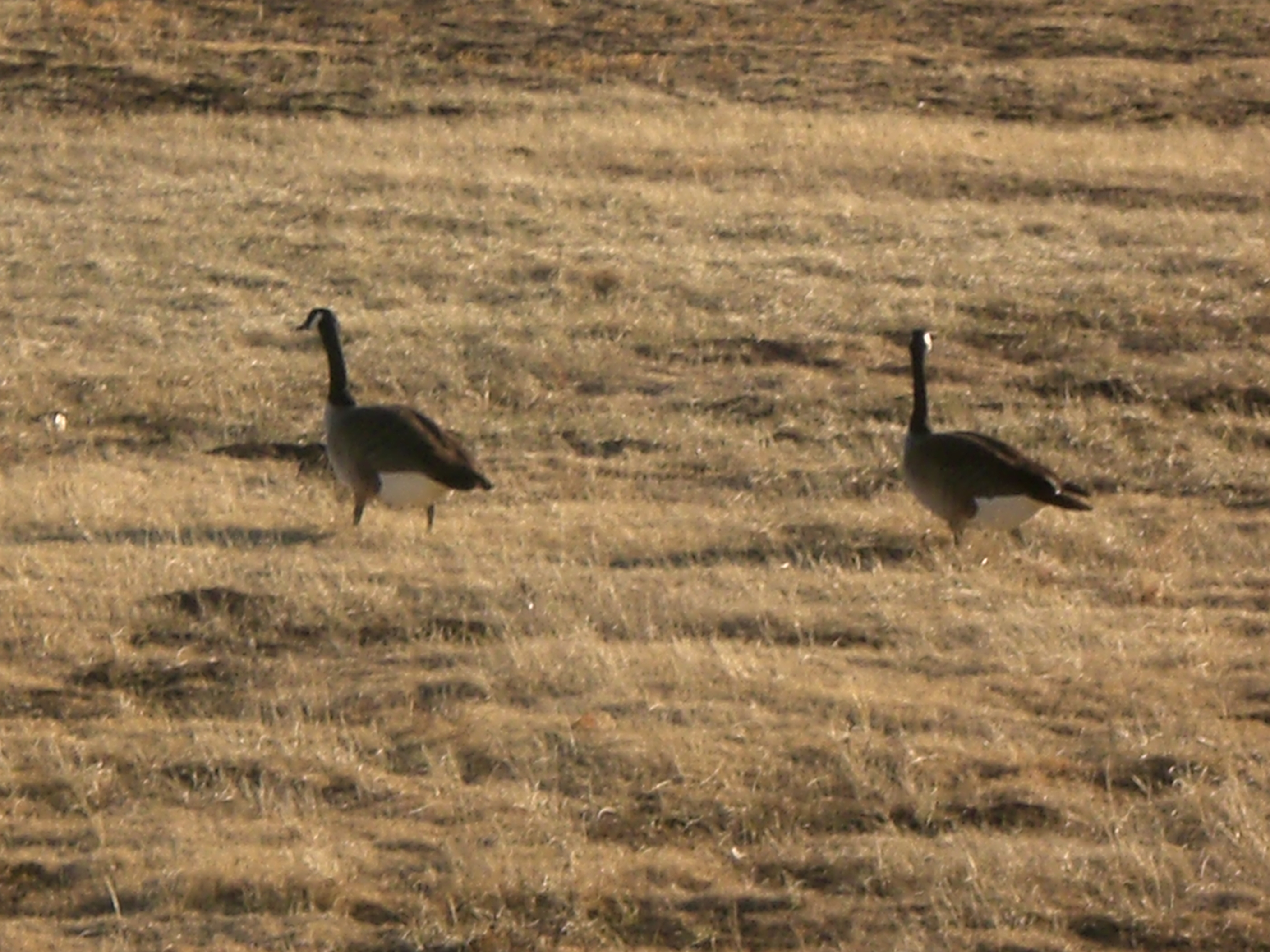
It seems as though my recent spiritual lessons have emphasized not just one day at a time, but one hour, sometimes one minute – bringing out how malleable time, or one’s perception of time – can be. I began with a comment about the hectic pace of my recent weeks, yet that pace only seems hectic when I look at how few days I’ve spent entirely at home, compared to pre-job weeks of days when I didn’t leave the house. If I count how many trips I’ve taken to different communities, how many new clients I’ve met, how much driving around the countryside has filled my recent weeks, I can feel as though there has been no time for me, no time to reflect, to write, to evolve. On the other hand, I remember that I noticed snow geese amongst the Canadians by the pond near town; watched a hawk catch a rabbit on the prairie outside Roy; learned more about Cameroon from stories shared during some of the longer drives; observed the relaxation of a tense body as a harried son who gave up his job last fall, to care full-time for his disabled mother, learned from me that he could have income within a month, being paid to provide that care. I remember these small moments, and time stretches.

Hectic, for me, is when I feel as though events have been rushing at me with no time to consider them, to notice details, to organize and structure experiences or – related to my new work – to prioritize what must be done. From that perspective, my commitment to myself to continue to post weekly is a commitment to limit the hectic pace the job could demand. At least once a week I must stop and reflect, and in this moment’s case, realize that I also stop and reflect frequently throughout each busy day. Noticing the geese, the hawk, the easing of tension are moments of reflection, of being present rather than reaching forward to an as yet non-existent future.

Only Canadians, no Snows

Only Canadians, no Snows

My mind has challenged the idea of being present with the moment when that moment is perceived as difficult, painful, scary or otherwise negative.

Why would one want to be fully present in a recent day of flu-induced aching and nausea? The lesson mind needed to learn was that during that day, other things were also occurring worth noticing, worth being present with. During that day, my one large dog, a retriever-cross named Blackjack, stayed on the porch and insistently close to me rather than spending his time as he usually does, out in the pastures. During that day, cotton tails appeared three separate times in the pasture. During that day one Christmas cactus put forth a single white flower, though the plant had never bloomed before.

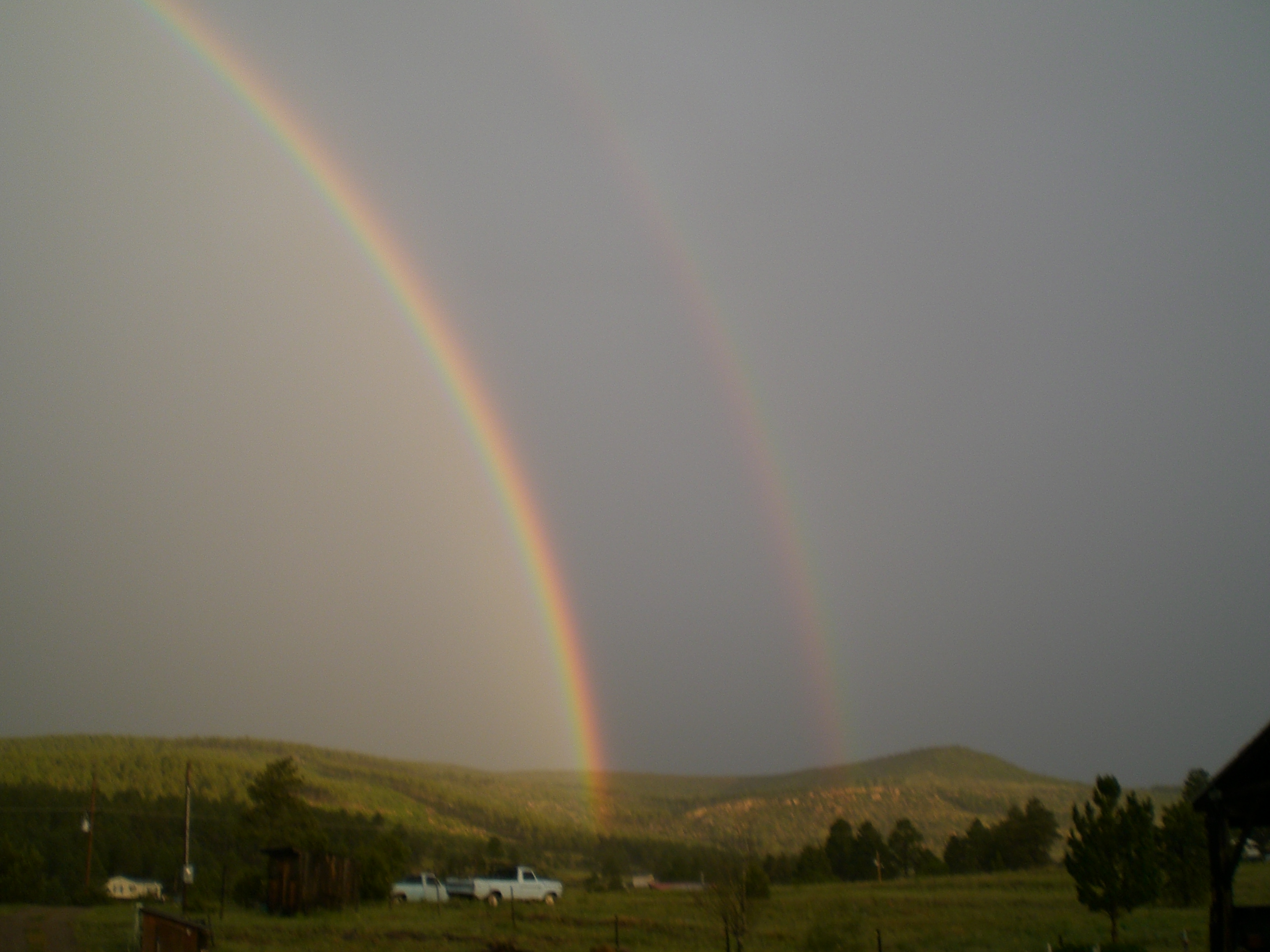
On a recent day when I was physically exhausted but nonetheless had to drive 80 miles of winding roads on an urgent visit to a client, I was gifted to have a companion for the drive, and to receive the encouragement of expressed appreciation for my effort, from both the companion and from the client. I also saw multiple frozen waterfalls glued to rocks in the canyon through which I drove, and remembered and shared the story of a triple rainbow that had filled one field when I traveled that road in the past.

Little things to be present with. Little things which, accumulated, become large, become the frame and the tone and the import of each day. Again, my Teacher instructs that we are always free to choose what we give our attention to. Attention is food – what is fed grows. I choose to feed appreciation, present moments, what is. In such small steps, with present moments of attention, what can be is also fed, given form, and enabled to appear.

Baraka bashad.
Amen.
May the Blessings Be.

A Snowy Contemplation

February 9, 2014

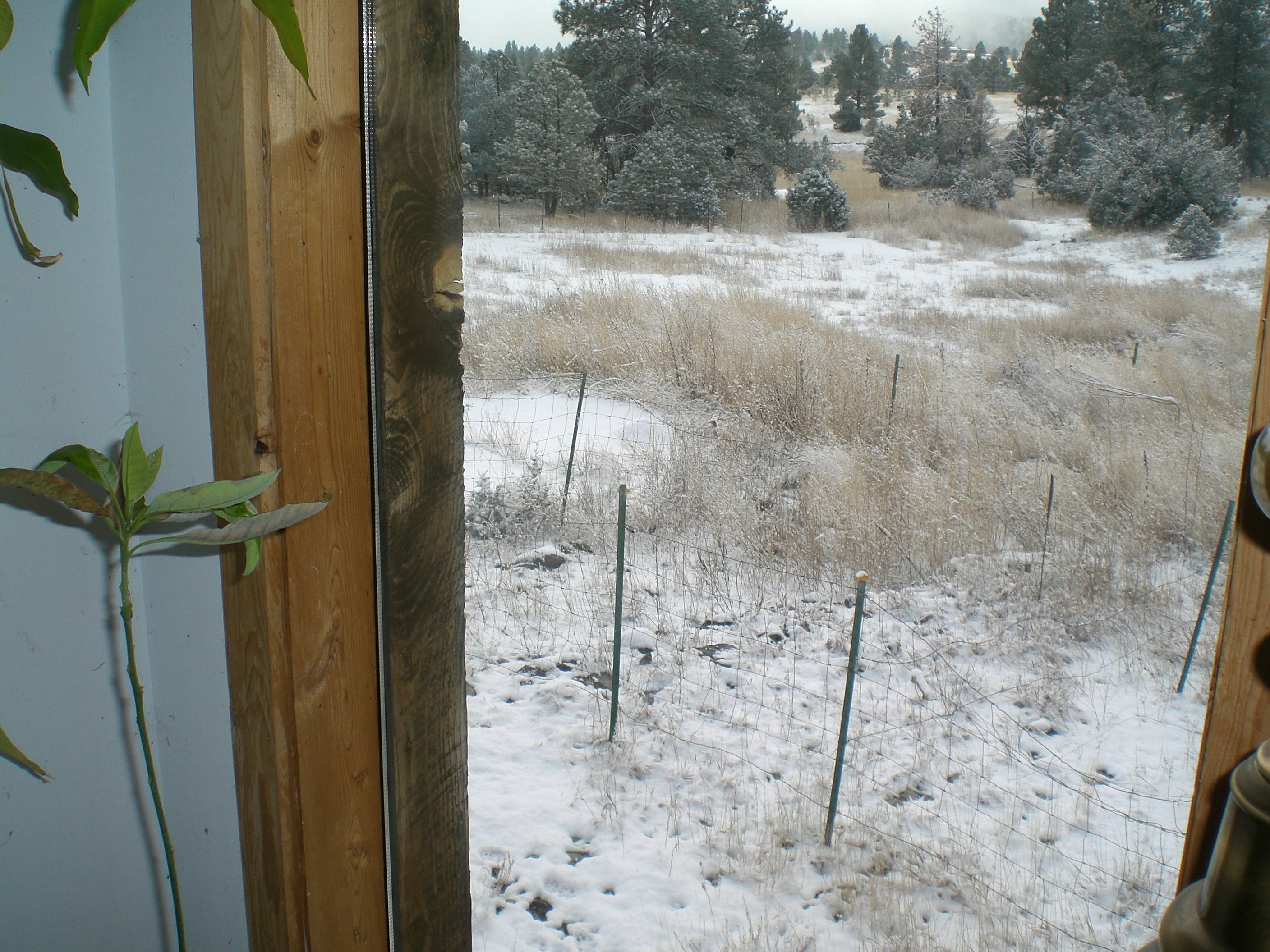
Have you noticed the unique silence that accompanies a fall of snow? The white blanket covering the ground somehow muffles ordinary noises of a country stillness, so that the world is – for a short time – truly quiet. I see birds at the feeder, fluffing themselves to shake dampness off their feathers, but they are not noisily jostling as they were yesterday. Even my dogs lie in, enjoying their heated porch rather than running barking at the rising sun.

From my Window

From my Window

Not much snow fell, not much more than a promise of wetness to our parched land. But the sky is still grey, except where the rising sun has broken through a cloud bank to paint a few slashes of peach and gold. Perhaps a few more drops will bless the earth from the clouds in the west. That is the direction our winter wetness comes in from. In summer it is often the reverse – systems stretch up from the gulf off Texas to give us summer rains. This past year, Texas did not share, and after a good start in late fall, the weather gods have chosen to send all the moisture either north of us into Colorado, or farther east where the blizzards and cold have caused major havoc.

Have you noticed how people’s temperaments are affected by the climates in which they dwell? It is an almost universal truth that cultures in hot, wet environments become gregariously noisy, even in Asian regions that one tends to think of as possessing a pattern of restraint. The silence of traditional Japanese people passing each other in public (it snows in Japan you know) is vastly different from the voluble street harangues of Vietnamese pedestrians in a country where the difference between hottest and coldest weather is less one of temperature than of moisture – monsoon season, or “dry” season when the humidity is perhaps 60% rather than 85%.

I knitted my first sweater in Saigon, when I was fourteen, and wore it twice on “cold” dry season days. Not days really suited to wearing a sweater, but I did so want to show it off. By the time I arrived in a cold enough climate to need a sweater, I’d outgrown it. A pretty dark cherry red pullover, with cap sleeves and a mini-turtleneck, the sweater went with me on to college and to Boston and eventually here to the desert, where I finally gave it to the daughter of a friend to be worn during what used to be our very coldest weeks of January. Used to be – it got down to 30 below at night and not much more than 5 for a daily high over at least a couple of weeks each January, even as recently as 20 years ago when I moved to my present home. For the past ten years, the night time temperature here has not dropped below minus 10, and the sun has warmed us comfortably every day. Pleasanter living than the mid-west’s polar experiences, but dire for our drought.

A snowplow has been by, and the school bus’ flashing lights indicate it has picked up my neighbor’s boys. I see cars making their way down the road that curves toward town, heading into the start of another workday. But still it is silent here around me, in a way only snow produces. It won’t last, neither the silence nor the snow, so I cherish it.

Have you noticed how people’s expressions of temperament change with their circumstances? A man courting a woman asks cautiously will she do this, would she help him to do that. Having won her, he issues orders – we will do this now, you must do that. The woman still has choices. She can simply agree, or she can learn in what way to express her own preferences so that she is heard. It is not significantly different in non-traditional relationships – we learn each other’s ways of being and how to express ourselves to influence the nature of the relationship. We learn how to help one another grow, and sadly, we also often learn how to block or stifle one another in an expression of frustrated, never-outgrown teenage envy.

Have you noticed how, entering a new relationship, there is a tendency to ask oneself, “Should I trust this person? How far? With how much of the truth about myself?” Past personal history of support or betrayal, extent of confidence in one’s self, willingness to risk, curiosity about different life styles, what a friend of mine simply calls open-mindedness, can all blend together into a force that shapes how a relationship develops. That is the common way.

How differently the issues of trust, of exploration and communication and growth of understanding unfold, if one considers a new relationship from the perspective of why the Divine ( God, or Fate, one’s Master, one’s karma, one’s wise inner self, or a Higher Power) “has brought this person and this experience to me at this time.” All the ambiguities of trusting in another person are released to the trust that we are alive for a reason, and that we can understand that reason, learning and thriving in our understanding.

Like the rare silence of a snow-covered early morning landscape, achieving an understanding of ourselves in relationship is a blessing. The moments of silence are brief; I woke early to enjoy them. The opportunities to intuit “what we’re here for” are also brief. I wake early to contemplate them.

The line of cars I see driving to work has warmed the thin snow covering on the road, and it is already turning to splashing slush. My big dog is out and barking to let the world know he has started his new day alertly. His two little companions romp patterns into the snow of my long, curving driveway. Outside, and in, the world is no longer silent. A new day of life has begun. What will I learn? What will I hear? What will I come to understand? What will I teach? What will I give, and what will I receive? Soon enough, I’ll have answers. Soon enough, too, I’ll have another opportunity to practice trusting that what is, is so, for a reason I may or may not be able to fathom. In trusting, I live. To cease trusting would be death – and I’m a long way from ready to die!

Across the Pasture Gate

Across the Pasture Gate

Another wave of snow clouds is sweeping in, flecks of white are drifting across the window. I will delay, just briefly, starting my own work day. Because I can do so, I choose to savor for a few moments more the regained silence (dogs still, birds quiet, no cars passing on the road), the blessing of extra drops of precious water, and another opportunity to consider why I am where I am, and for what inner purpose my outer life has taken on its latest form. Thank Thee, Master, for these gifts!

Not a Christian

December 21, 2013

“I am not a Christian.” A simple, declarative sentence.
My housemate’s aide asked why we do not yet have a tree up, and I answered, “I am not a Christian.”

Why is this the first time I’ve made that statement so openly? In the past, I’ve evaded. “We don’t make a fuss over the holiday, since it’s just the two of us.” Or, “I wasn’t raised to celebrate Christmas.”

It’s true, I wasn’t. My culturally but not religiously Jewish upbringing included commemoration of holidays as a remembrance of history rather than as spiritual practice. I’m old enough to have attended public schools that started the day with both the Pledge of Allegiance and a prayer. For all of my first 6 years in school, I would silently add “Cross that last line out, God” when the teacher ended the prayer “In Jesus name.” Later, at convocations, graduations, other public events in pre-politically-correct times, I didn’t bother with the amendment. Other people could pray as they wished, and assume what they wished about me.

While I lived in Vietnam, in order to participate in a choir, I practiced with the group at a non-denominational Protestant church. My mother did not let me perform with them on Sundays, however. I lit incense at a temple with our Chinese housekeeper, and watched the elaborate funeral parades of some of Saigon’s wealthiest families. The first time I encountered the concept of reincarnation, I knew it to be truth, resolving as it did so many of my questions and doubts.

One of Many

One of Many

In college I took several courses in comparative religion, and sat in silence with the Quakers, drawn both by their lack of ritual and their commitment to social action. The practice of seeing “that of God in every man” enabled me to feel part of a larger whole, in contrast to my life’s lessons of being an outsider. I diligently sought, in the silence, to discern “God’s will for me” and to listen to the “still small voice” giving direction to my life.

I’ve rarely had – or perhaps only rarely remembered having – dreams. The few vivid ones that have occurred have always been crystal clear as to their meaning, and prophetic. My access to inner answers has been simpler, more direct than dream interpretation. If I frame a question before going to sleep, I awake with the answer. If I frame a question before participating in Quaker Meeting, I leave the meditation having received – either from within myself or from a spoken message – a sense of direction. I never conceive of this instruction as God speaking directly to me. Rather, I remember my grandfather’s answer to a question about why one should do right. “Because you know it is the right thing to do.”

I have followed my inner instruction because I know it to be right for me. Living and working these past twenty years amid practicing Christians, primarily Catholics, I’ve kept my views to myself in order not to offend, in order not to disturb their settled beliefs. I’ve been respectful of our differences, not feeling any need to explicate those differences.

For more than twenty years I have been student of MasterPath – a spiritual teaching, an instruction in how to find “one’s way back home” to realization of one’s true nature as Soul. Practitioners number now in the tens of thousands, come from many countries and a wide variety of faith – or no faith – backgrounds. What we have in common is the desire to know our Divine purpose – to know and be our true selves, to manifest wisdom unadulterated by considerations of body, emotions and mind.

Different religions use terms like man’s purest essence, Buddha nature, the Soul self, Christ consciousness to describe the state of pure consciousness to which my Path leads me. Many religions ascribe the capacity to manifest that pure consciousness only to the founder(s) of the religion, as something outside oneself, to be worshiped and admired, but not to be attained.

Regrettably many religions are now adulterated by ego interpretations of what it means to act “as a ______” (fill in the blank with Christian, Muslim, Hindu, Sikh, Jew, Buddhist, Taoist, etc.) so that instead of manifesting the beauty and truth of their faith, they demonstrate violence, intolerance, exclusion and dominance all in the name of religious purity. It should not surprise anyone that atheists point to the history of war waged in the name of religion as proof that belief in God has a negative influence on humanity.

Religious history has little to do with why I reached my seventh decade before stating plainly, “I am not a Christian.” Or maybe it does? Maybe the intolerance of differences reflected in all those wars waged in the name of religion has seeped into my being, quietly persuading me to not make an issue of my difference from my neighbors?

No, I think it has taken me this long to be truly comfortable with who I am and what I know to be Truth; to achieve a genuine indifference to reputation and how others perceive me; to feel certain in my knowledge of my Inner Being. In other words it has taken me this long simply to Be, and hence to be free to speak my own truth. I need not weight myself down with a responsibility not to offend others. If they are discomforted by me, so be it. In a far from cartoonish and Popeye’d way, I am what I am.

In the words of a blessing spoken at the start of a lovely Ba Gua exercise called Swimming Dragon, “I am health, I am beauty, I have enough.” It is enough, that I AM.

Choosing an Attitude

December 14, 2013

One of the elements of my new job that was most appealing – working from home – is also revealing itself to be a challenge in ways I did not experience the last time I had a similar employment. Just a few changes in external circumstances are making a significant difference in how I relate to my obligations.

The first time I worked from home was more than 20 years ago, when I had just moved to Sapello. I lived alone, and was hired to manage and build up the clientele of a home health agency. I enjoyed being able to spread my work over the seven day week, scheduling my leisure activities intermittently with travel to clients’ homes and with the inevitable administrative work required. While I was never “off duty”, I did have a lot of choice about what I did when. I was flexibly able to fit my personal obligations and desires around work demands, rarely feeling pressured because there seemed to be enough time for everything.

Eventually the agency grew to the point that we established an office, and I became subject to a more consistent and common work schedule. I left briefly, for personal reasons, and spent eighteen months self-employed. I completed several contracts and saw clients privately for counselling sessions. When I returned to the agency, again as its branch manager, I was subject to the standard “8-5 in the office” schedule, to which I adhered for fourteen years. Eighteen months of semi-retirement and job search brought me to my present full time, salaried and home-based position.

I do not now live alone. I share my very small house with my disabled former husband, for whom I am guardian and with whom I remain friends. His health is slowly and steadily declining. A sequence of aides come to the house, to help him during the day and to see that he gets supper. The schedule is meant to assure his safety when I am away. In consequence, there are several different people added to our small space, to whom I must accommodate when I am at home. While I am, mostly, relieved of responsibility for my housemate’s care, I do have to step in, unpredictably, when an aide is unavailable. And I am responsible to assure that the schedule of services is established and maintained.

Over time, our home has become divided into “my” room, which is also the living room that contains the day bed where I sleep, and the rest of the space – sleeping area for my housemate, dining area with the table covered with items he uses for his craft projects, kitchen and bath which we share. While I was still employed at the agency, the aides were scheduled during my work hours. In the eighteen months since, I find my necessary privacy and quiet time at night, often writing (as at this moment) or reading. My housemate watches TV with earphones on, allowing me valued silence for contemplation and creation.

Embarked on my new job, I have been away from home for extended periods of orientation and training. Shortly, I expect to be scheduled for long, busy days traveling to clients’ homes, interspersed with long and demanding days at home entering information into the complex computer systems my employer has been training us to use. I’ve had just a few weeks at home, to set up my “office” and establish those systems as functional in my rural, no-cell-service area. The systems are only partially in place so far. I do not yet have a land-based work phone, and I continue to uncover wide areas from within which I have no connection to the Internet. For clients who live in those areas, I will have to take notes and then enter data later at night, after I get back home.

My office is now in a corner of the dining area where my housemate – and his aide – spend most of the day. I’m having to learn to shut out their conversation in order to concentrate on the tasks that come to me by computer. On a recent visit to a building in Albuquerque newly occupied by some of the staff of my company, I walked through a huge room of employees in cubicles, thinking how grateful I am not to be similarly situated. I only have to shut off two voices, not hundreds.

I’m realizing that one of the serious sources of stress over the last years of my former employment came from the lack of doors on offices in the various buildings that agency occupied. As a manager, I relied on knowing (hearing) what was going on throughout the office. As a person, my need for silence around me, for auditory privacy, was consistently challenged. Personal validation and social support, also important to well-being, came from co-workers and from those engaged in the various volunteer activities I’ve pursued. For recuperation, reflection, and privacy I could count on quiet at home.

Changes in my housemate’s health, including recent medical emergencies disrupting my work day plans, new aides requiring instruction that he does not provide, and the expectation from my present employer that I be available on an 8-5 Monday to Friday schedule, have combined to eliminate my control over how and when I do what needs to be done. As a result, work is not staying in balance. It is seeping into my sleep time, rousing me at 5 am to try yet another way to solve a computer problem that proves not to be solvable by me. I begin to feel encroached upon by lack of quiet personal time – and by the necessity of at least temporarily giving up almost all of my volunteer activities.

During a recent two nights alone at home, while my housemate was in hospital, I was jolted to realize that many years have elapsed since the last time I had this space to myself for more than two hours! There is already so much activity filling the house, can I actually bring work here too, without losing the last bits of “me” space?

+++++

Yes, I recognize my issue is a matter of mental attitude. My spiritual Path teaches that “the mind is an excellent servant but a terrible master.” Private, quiet, contemplative space for myself will exist wherever I am, if I make it a priority – and “set my mind”  (no, actually not my mind, but my attention) to assuring it occurs.

I may not be able to go strictly by the clock, dividing work time from private time, especially while I’m still learning how to accomplish work tasks in an efficient manner. I cannot force my work computer to move through its paces more quickly. I cannot fix my situation of intermittent Internet connectivity, which disrupts the intended work flow process and requires me to “do double work” entering data already recorded on paper.

On a Recent Misty Morning

On a Recent Misty Morning

I can teach myself not to be frustrated by the computer’s slowness, and I can line up tasks to do during the waits (like creating a  card file of important numbers and contacts). I can “take time to smell the roses” or, in this winter season watch the birds. I can revel in my ability to look up from my computer to see snow dappled fields inviting to deer, doves perched in a row on the fence beside the feeder, a squirrel gorging himself on seeds, and little birds on the ground waiting to collect what the doves and the squirrel shove over the side of the dish.

Yum!

Yum!

I may need to extend work hours into the evenings and weekends – but I can still define times when I turn off all electronics and soak up the natural sounds of wind, dogs chasing rabbits, birds arguing over priority at their feeder, and snow dripping from the eaves.

Serenity surrounds me. I need only put myself within it. I am blessed.

When It’s Time

December 8, 2013
I Dare You...

I Dare You…

This isn’t the topic I expected to post this weekend. Not because of the passing of Nelson Mandela, but for an even more personal passing that raises almost identical emotions.

+++++

I demonstrated to push my college to rid itself of all investments that supported the South African government during apartheid. I’m proud to say Swarthmore College was one of the early institutions to manifest its (Quaker) values by participating in the economic boycott which the pundits are crediting with bringing an end to the apartheid system.

I rejoiced when it became clear that Nelson Mandela’s emphasis on equality and democracy, and commitment to reconciliation as the path forward, would be carried out with a simultaneous delight in the small pleasures of life. I’ve followed Mandela as I have the Dalai Lama, listening (by reading) to their speeches and appreciating how well they each translate values into action in ways I try to embody in my own life. My venue, as my status, is so much less than that of these two men I admire. Only others can assess to what extent I manifest any similar virtues.

I do attest that my Shih Tzu, named Shian Shung in respect of his status as a Master and Teacher, has shown the Mandela and Dalai Lama traits of persistence, consistency, dedication, joy in living, playfulness, affection, tolerance and respect for the equality of all. I could not know, when I cuddled him for a bit of extra “affection time” this past Monday, that I would never again do so. I cleaned and treated his eye, hugged him, received several doggy kisses in return, and watched him run out to catch up with his mates, chasing a rabbit into the pasture.

Blowing Kisses

Blowing Kisses

I loaded the car for my week of job training away from home and, as I headed down the drive, looked back to see my four dogs sitting on the deck, watching me go. That is my final image of Shian Shung – a furry white bundle of loving energy standing out against the blackness of the other dogs.

+++++

Today everything outside the windows is white. It snowed while I was away, and is snowing again now. Somewhere hidden within the cold wet white, is the body of what was a vibrant, lively personality cloaked in the white fur of a Shih Tzu. Apparently he was hit by a car mid-week. A visitor reports noticing a white dog lying beside the road Wednesday night. Shian Shung has not been seen since Wednesday morning; no body was found near the highway on Thursday. Most likely it was moved, or covered over, by snow plows clearing the road from the storm that day.

In his three short years, Shian Shung endured two traumatic health challenges and lived with a persistent eye irritation that required daily treatment. He was little more than a year old when he ingested meat some neighbor had set out, filled with rat poison. His gums were almost colorless when I got him to the vet. Daily injections with Vitamin K saved his life. He bounced back. He had one surgery to his right eyelid, intended to eliminate irritation to the cornea. It was only partially successful – I still had to clean and treat the eye daily. A follow-up surgery ended abruptly when Shian Shung flat-lined on the operating table. The vet and his assistant performed CPR, intubated him, worked on him for more than half an hour. He survived – again.

Within a week he was running and playing and teasing his pals, warning me of intruders with his assertive bark, tolerating steroid shots to reduce the inflammation to his eye, and lavishing me with his affection and abundant joie de vivre.

Over the 40 years I’ve lived in rural New Mexico, I’ve shared my home with a very large number of dogs and cats. Inevitably, a few stand out… Natasha, Driftwood, Daisy, Haiku, Rowena, Mei Ling and now Shian Shung. Daisy (a beagle/basset cross) extended her life after a serious illness, for just long enough to see me through the loss of my father, before she moved on to join him.

Handsome Haiku

Handsome Haiku

Haiku and Natasha (tiger-striped cats, one ginger the other grey) each taught me how to recognize the difference between choosing to live with sickness and being ready to depart. Rowena (a Scottie) and Mei Ling (another Shih Tzu) offered generous  love while also requiring respect for their independence. Each chose her moment of passing, in ways I could not avoid recognizing and respecting.

Miss Independence x 2

Miss Independence x 2

Various cultures articulate a tradition of animal guides and companions for the spirit world; I’m certain they “have it right”. A cat (my totem) will undoubtedly inform me, and accompany me, when it is my time. For now, I accustom myself to life here without the active presence of Shian Shung, as I adjust to a world now lacking the physical presence of Nelson Mandela.

+++++

We are most fortunate when we find good role models or wise teachers, to help us on our paths through life. I’m blessed to have my spiritual teacher, on MasterPath, still present in the physical, as is the Dalai Lama. Two other role models, one proximate (Shian Shung) and one more distant (Mandela), have shown me how to live fully and well despite imprisonment and life threatening trauma. Both will continue to function as guides, now in my memory.

I wonder – is Shian Shung frolicking at Mandela’s feet as they move to their next stage of being?


Only Fragments

Love Letters to the Tar Pit

KarusaaVerse

Words that Sparkle, Thoughts that Ignite: Fueling Your Imagination

Leaf And Twig

Where observation and imagination meet nature in poetry.

Millarson Diaries

Personal Musings and Thought Experiments

The Beauty Along the Road

Discovering Beauty in the small details of our lives

Flowerwatch Journal

Notes on Traveling with Flowers

1eclecticwriter

Wide-Ranging Commentary

Spirituality Exploration Today

Delving into the cross roads of rationality and intuition

smilecalm

Life through Mindful Media

A Good Blog is Hard to Find

I will shatter a word and scatter the contents into the wind to share it with the world.

Ray Ferrer - Emotion on Canvas

** OFFICIAL Site of Artist Ray Ferrer **

AKA The Versatile

Fashion | Lifestyle | Food & Travel | Beauty | Fitness | Education | Product Reviews | Movies | Doodling | Poetess

Aging Abundantly | Women Over Fifty | Empty Nesters | Caregivers | Aging Gracefully

Finding Joy at Every Age with writer/philosopher Dorothy Sander

ARTZZLE

Helping with the Pieces in Life's Puzzle of Art and Design

Project Light to Life

A bucket list blog: exploring happiness, growth, and the world.

The Daily Post

The Art and Craft of Blogging

Any Shiny Thing

MIDLIFE MAGIC

allmostrelevant

@allmostrelevant

The Irrefutable Opinion

Assaults on the Casually Mundane by K. Jean King