Archive for the ‘Living and Learning’ Category

Not a Christian

December 21, 2013

“I am not a Christian.” A simple, declarative sentence.
My housemate’s aide asked why we do not yet have a tree up, and I answered, “I am not a Christian.”

Why is this the first time I’ve made that statement so openly? In the past, I’ve evaded. “We don’t make a fuss over the holiday, since it’s just the two of us.” Or, “I wasn’t raised to celebrate Christmas.”

It’s true, I wasn’t. My culturally but not religiously Jewish upbringing included commemoration of holidays as a remembrance of history rather than as spiritual practice. I’m old enough to have attended public schools that started the day with both the Pledge of Allegiance and a prayer. For all of my first 6 years in school, I would silently add “Cross that last line out, God” when the teacher ended the prayer “In Jesus name.” Later, at convocations, graduations, other public events in pre-politically-correct times, I didn’t bother with the amendment. Other people could pray as they wished, and assume what they wished about me.

While I lived in Vietnam, in order to participate in a choir, I practiced with the group at a non-denominational Protestant church. My mother did not let me perform with them on Sundays, however. I lit incense at a temple with our Chinese housekeeper, and watched the elaborate funeral parades of some of Saigon’s wealthiest families. The first time I encountered the concept of reincarnation, I knew it to be truth, resolving as it did so many of my questions and doubts.

One of Many

One of Many

In college I took several courses in comparative religion, and sat in silence with the Quakers, drawn both by their lack of ritual and their commitment to social action. The practice of seeing “that of God in every man” enabled me to feel part of a larger whole, in contrast to my life’s lessons of being an outsider. I diligently sought, in the silence, to discern “God’s will for me” and to listen to the “still small voice” giving direction to my life.

I’ve rarely had – or perhaps only rarely remembered having – dreams. The few vivid ones that have occurred have always been crystal clear as to their meaning, and prophetic. My access to inner answers has been simpler, more direct than dream interpretation. If I frame a question before going to sleep, I awake with the answer. If I frame a question before participating in Quaker Meeting, I leave the meditation having received – either from within myself or from a spoken message – a sense of direction. I never conceive of this instruction as God speaking directly to me. Rather, I remember my grandfather’s answer to a question about why one should do right. “Because you know it is the right thing to do.”

I have followed my inner instruction because I know it to be right for me. Living and working these past twenty years amid practicing Christians, primarily Catholics, I’ve kept my views to myself in order not to offend, in order not to disturb their settled beliefs. I’ve been respectful of our differences, not feeling any need to explicate those differences.

For more than twenty years I have been student of MasterPath – a spiritual teaching, an instruction in how to find “one’s way back home” to realization of one’s true nature as Soul. Practitioners number now in the tens of thousands, come from many countries and a wide variety of faith – or no faith – backgrounds. What we have in common is the desire to know our Divine purpose – to know and be our true selves, to manifest wisdom unadulterated by considerations of body, emotions and mind.

Different religions use terms like man’s purest essence, Buddha nature, the Soul self, Christ consciousness to describe the state of pure consciousness to which my Path leads me. Many religions ascribe the capacity to manifest that pure consciousness only to the founder(s) of the religion, as something outside oneself, to be worshiped and admired, but not to be attained.

Regrettably many religions are now adulterated by ego interpretations of what it means to act “as a ______” (fill in the blank with Christian, Muslim, Hindu, Sikh, Jew, Buddhist, Taoist, etc.) so that instead of manifesting the beauty and truth of their faith, they demonstrate violence, intolerance, exclusion and dominance all in the name of religious purity. It should not surprise anyone that atheists point to the history of war waged in the name of religion as proof that belief in God has a negative influence on humanity.

Religious history has little to do with why I reached my seventh decade before stating plainly, “I am not a Christian.” Or maybe it does? Maybe the intolerance of differences reflected in all those wars waged in the name of religion has seeped into my being, quietly persuading me to not make an issue of my difference from my neighbors?

No, I think it has taken me this long to be truly comfortable with who I am and what I know to be Truth; to achieve a genuine indifference to reputation and how others perceive me; to feel certain in my knowledge of my Inner Being. In other words it has taken me this long simply to Be, and hence to be free to speak my own truth. I need not weight myself down with a responsibility not to offend others. If they are discomforted by me, so be it. In a far from cartoonish and Popeye’d way, I am what I am.

In the words of a blessing spoken at the start of a lovely Ba Gua exercise called Swimming Dragon, “I am health, I am beauty, I have enough.” It is enough, that I AM.

When It’s Time

December 8, 2013
I Dare You...

I Dare You…

This isn’t the topic I expected to post this weekend. Not because of the passing of Nelson Mandela, but for an even more personal passing that raises almost identical emotions.

+++++

I demonstrated to push my college to rid itself of all investments that supported the South African government during apartheid. I’m proud to say Swarthmore College was one of the early institutions to manifest its (Quaker) values by participating in the economic boycott which the pundits are crediting with bringing an end to the apartheid system.

I rejoiced when it became clear that Nelson Mandela’s emphasis on equality and democracy, and commitment to reconciliation as the path forward, would be carried out with a simultaneous delight in the small pleasures of life. I’ve followed Mandela as I have the Dalai Lama, listening (by reading) to their speeches and appreciating how well they each translate values into action in ways I try to embody in my own life. My venue, as my status, is so much less than that of these two men I admire. Only others can assess to what extent I manifest any similar virtues.

I do attest that my Shih Tzu, named Shian Shung in respect of his status as a Master and Teacher, has shown the Mandela and Dalai Lama traits of persistence, consistency, dedication, joy in living, playfulness, affection, tolerance and respect for the equality of all. I could not know, when I cuddled him for a bit of extra “affection time” this past Monday, that I would never again do so. I cleaned and treated his eye, hugged him, received several doggy kisses in return, and watched him run out to catch up with his mates, chasing a rabbit into the pasture.

Blowing Kisses

Blowing Kisses

I loaded the car for my week of job training away from home and, as I headed down the drive, looked back to see my four dogs sitting on the deck, watching me go. That is my final image of Shian Shung – a furry white bundle of loving energy standing out against the blackness of the other dogs.

+++++

Today everything outside the windows is white. It snowed while I was away, and is snowing again now. Somewhere hidden within the cold wet white, is the body of what was a vibrant, lively personality cloaked in the white fur of a Shih Tzu. Apparently he was hit by a car mid-week. A visitor reports noticing a white dog lying beside the road Wednesday night. Shian Shung has not been seen since Wednesday morning; no body was found near the highway on Thursday. Most likely it was moved, or covered over, by snow plows clearing the road from the storm that day.

In his three short years, Shian Shung endured two traumatic health challenges and lived with a persistent eye irritation that required daily treatment. He was little more than a year old when he ingested meat some neighbor had set out, filled with rat poison. His gums were almost colorless when I got him to the vet. Daily injections with Vitamin K saved his life. He bounced back. He had one surgery to his right eyelid, intended to eliminate irritation to the cornea. It was only partially successful – I still had to clean and treat the eye daily. A follow-up surgery ended abruptly when Shian Shung flat-lined on the operating table. The vet and his assistant performed CPR, intubated him, worked on him for more than half an hour. He survived – again.

Within a week he was running and playing and teasing his pals, warning me of intruders with his assertive bark, tolerating steroid shots to reduce the inflammation to his eye, and lavishing me with his affection and abundant joie de vivre.

Over the 40 years I’ve lived in rural New Mexico, I’ve shared my home with a very large number of dogs and cats. Inevitably, a few stand out… Natasha, Driftwood, Daisy, Haiku, Rowena, Mei Ling and now Shian Shung. Daisy (a beagle/basset cross) extended her life after a serious illness, for just long enough to see me through the loss of my father, before she moved on to join him.

Handsome Haiku

Handsome Haiku

Haiku and Natasha (tiger-striped cats, one ginger the other grey) each taught me how to recognize the difference between choosing to live with sickness and being ready to depart. Rowena (a Scottie) and Mei Ling (another Shih Tzu) offered generous  love while also requiring respect for their independence. Each chose her moment of passing, in ways I could not avoid recognizing and respecting.

Miss Independence x 2

Miss Independence x 2

Various cultures articulate a tradition of animal guides and companions for the spirit world; I’m certain they “have it right”. A cat (my totem) will undoubtedly inform me, and accompany me, when it is my time. For now, I accustom myself to life here without the active presence of Shian Shung, as I adjust to a world now lacking the physical presence of Nelson Mandela.

+++++

We are most fortunate when we find good role models or wise teachers, to help us on our paths through life. I’m blessed to have my spiritual teacher, on MasterPath, still present in the physical, as is the Dalai Lama. Two other role models, one proximate (Shian Shung) and one more distant (Mandela), have shown me how to live fully and well despite imprisonment and life threatening trauma. Both will continue to function as guides, now in my memory.

I wonder – is Shian Shung frolicking at Mandela’s feet as they move to their next stage of being?

Warm Furries

November 30, 2013

Five doves are fluffily hunched on the gate to the long pasture, seeming to emit waves of discontent because their bird food plate is piled high with snow rather than seed. I will probably succumb to the pressure shortly, and wade around the house with a bowl of feed for them. I doubt that my steps will imitate my Shih Tzu’s curious snow shuffle, though. I’ve been watching Shian Shung coming toward me down the drive, each front paw’s forward motion initiating a wave of snow rippling slightly sideward. It is the strangest looking movement, suggesting he has suddenly acquired the widely feathered feet of a nun pigeon. Or as though he is swimming his front legs through the fluffy white stuff that is belly deep for him.

De-iced

De-iced

My Min-Pin, Doodles, being a short hair, seems able to bounce through the same drifts, almost as though he’s walking on top of the snow instead of wading through it. Not any taller than Shian Shung, he has more of his minimal height in his legs, and an overall springier step. When excited, he can easily bounce to shoulder height on my Lab/Collie cross. And does so frequently, trying to get Blackjack’s attention away from the food bowl, gnawed deer bones, or the treats in my hand.

Aw, please...

Aw, please…

Doodles survived in his earliest life as a dumpster diver – he was about six months old when I collected him from a distant ranch and brought him to live with the rest of my motley crew. Eighteen months of ample and regular food has not yet broken him of the need to be in charge of any edible in the vicinity. Fortunately, Blackjack has a tolerant demeanor, only rarely exerting his considerable might to retain possession of a favored goodie.

Blackjack in Charge

Blackjack in Charge

The fourth member of my canine family is an elderly toy poodle – like Blackjack and Doodles also a rescue – with more serious personality issues. I know nothing about his earlier life, but it cannot have been easy. He was found at death’s door, totally dehydrated, his fur invisible beneath a matting of burrs, his belly distended and sagging to the ground. He growled and snapped at every attempt to care for him, requiring sedation by the vet before medical attention and a total body shave. Damaged intestines, causing the sagging belly, seems likely to be the result of being hit by a car; the injury continues to cause him intermittent constipation.

Warrior newly clipped

Warrior newly clipped

If left by himself, Warrior whimpers ceaselessly, or barks non-stop for an hour or more. Six months after arrival, he began to let me pet or groom him. Diametrically opposite to Doodles, he is reluctant to accept treats, which he requires be set down in front of him, to consider at length, before he will venture a nibble. Consequently, he loses them to Doodles unless they are offered when the other three dogs are off exploring. Which happens reliably enough that Warrior does get treats, but is also unhappily alone for periods of the day.

Blackjack shows remarkable patience with the littles. He lets Doodles and Shian Shung play out attack strategies, his legs and ears the more common targets. He makes sure Warrior has the warmest spot on the porch, and tolerates Doodles’ determination to be first at the food bowls. I remember to give him an extra rub around the head and muzzle, and to tell him he is the senior, and most essential, member of the pack. His calm demeanor, his defining of the boundaries outside which the others should not roam, his lessons about what is and is not fit to eat, and his manner of greeting – or guarding against – visitors to my acres all combine to transmit the expectations I have set about tolerance, respect, and appropriate behavior.

The Littles

The Littles

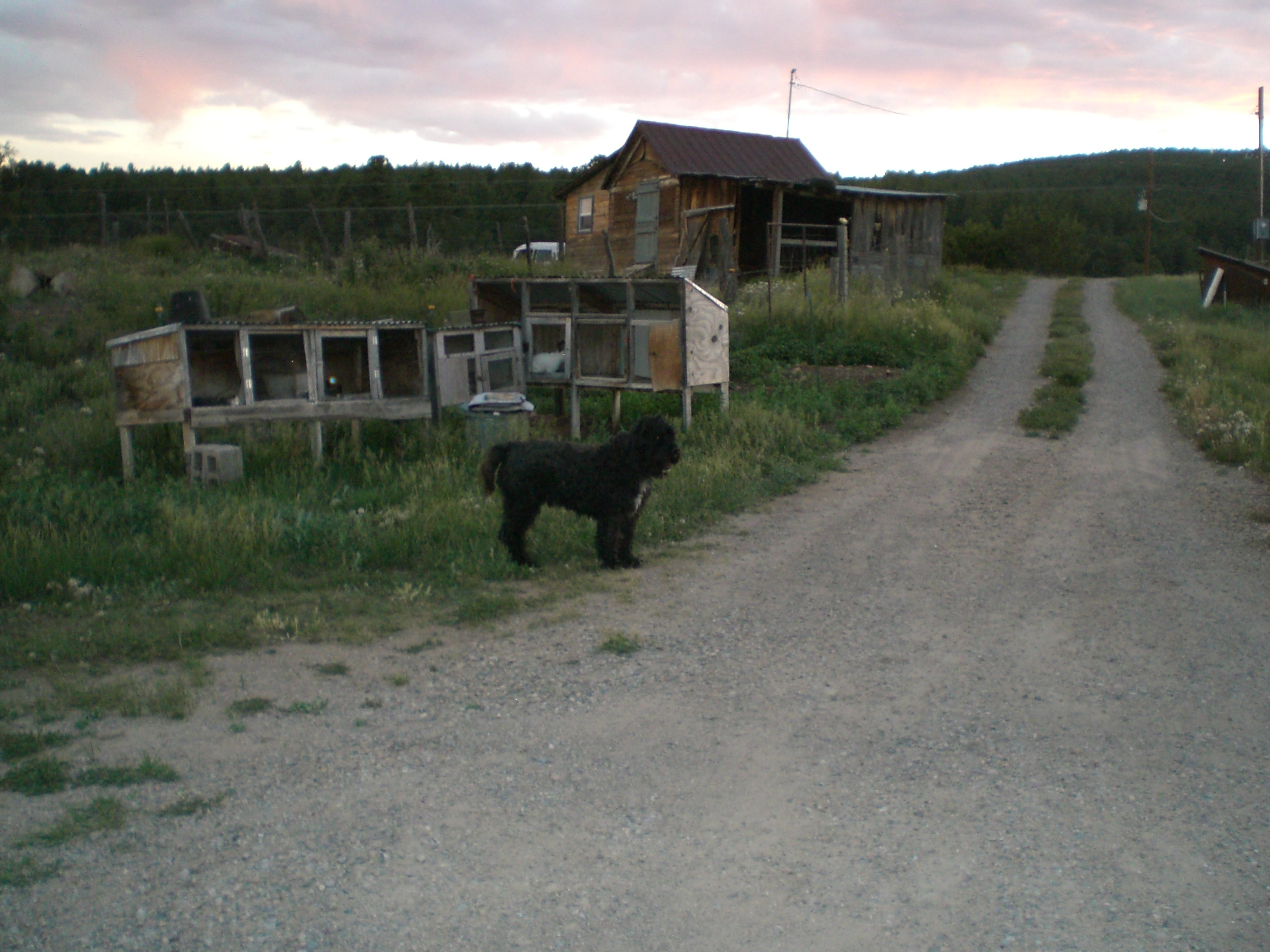
Over the 40 years I’ve lived in rural settings here in northern New Mexico, my one consistent rule for all pets has been that they must get along with one another. Not like, not necessarily interact, but tolerate and make space for all who wind up calling my home theirs. As a result, I’ve had a dog who let newborn kittens nurse on her while their mother took a break from the constant demands of parenting. I have photos of a cat cuddling with a Bouvier de Flandres large enough to squash her if he’d rolled over. That same Bouvier encircled an escaped rabbit and kept it safely between his paws until I got home and returned Mr. Bunny to his cage.

Guarding the rabbit cages

Guarding the rabbit cages

The coincidence of Thanksgiving with the first day of Hanukkah – an event apparently not to reoccur for an enormously long time – allows me to celebrate my two favorite holidays in one. Favorite because both encourage not just thankfulness, but also appreciation of freedom, joy in new beginnings, and the pleasure of connecting across boundaries.

In a heap

In a heap

I am grateful to have observed these same feelings played out amongst my four-legged family members.
I am grateful to be reminded by my furry friends, each time I hunker down to pet and play with them, that I don’t have to wait for Thanksgiving or Hanukkah to participate in a demonstration of tolerance, respect, and appreciation.
They keep me sane, they make me welcome, they direct me back to balance when I start to tilt off center, they define home.
For all this, a lower reflection of the inner beauty being shown me by my spiritual Master, I am thankful.

Small World

November 24, 2013

Have you ever swapped “small world” stories?

Some are simple, like the appearance in the training class for my new job of a woman who lives barely five miles from me in the rural area denoted by a dot on the map called Sapello – a woman I’d met once briefly before, but did not know until we were paired, during the training, for motivational interviewing exercises. Turns out we have a number of common interests, and a shared love of living “on the frontier” as our employer labels the area we serve.

Other small world stories are of more surprising meetings (Coincidences? Fated encounters?)

Two of mine have their roots in my stay in Vietnam, from 1956-1958. I was in my early teens, my father assigned as the economic officer at the U.S. embassy in Saigon.  Ingrid, a few years younger than I, was one of my friends. Both of us were socially awkward, neither of us fully aware to what extent the stresses within our families contributed to that lack of ease. We – in modern parlance – hung out together. After Saigon, Ingrid was sent to a boarding school in Colorado and I moved with my parents moved to Paris. She visited once, briefly, during those three years I lived in France. Then we lost touch.

Blaufarb Family with My Mother and Me Behind Them

Blaufarb Family with My Mother and Me Behind Them

Skip to four years later, my junior year in college, and a trip to New York City.

With my then boyfriend Ray, I was on a date that included a meal at the Russian Tea Room. We walked into the dining area, and saw before us a large family group seated at a round table. Ray started forward to greet one couple and their daughter Pamela, a former girlfriend from his high school days. I started forward to the same table to greet Ingrid’s parents. Ray and I looked at each other. “You know these people?” he quizzed me.

“Yes,” I replied. “Those are the Blaufarbs, parents of my friend Ingrid.”

“Pamela’s aunt and uncle. I’ve been told about them.”

I didn’t share with Ray how immediately I felt transported back to the tropic heat and teenage anxieties of Saigon, where I’d heard too much detail about Ingrid’s socially popular cousin Pamela!

*******

My second Vietnam-based story begins at its end, tying Saigon to Sapello. One of the people working in the office of my vet is a tall, energetic woman a few years older than I, named Susan. She is the sister-in-law of Louie, who trained my younger mare, and with whom I became friends when I first moved to Sapello in 1990. At some point in my on-going  conversations with Louie, it came out that his sister had “run off with a Frenchman” when she was in her late teens, and that the siblings had only reconnected many years later, when they both settled back near their mother. in the Sapello area.

Louie told me that Susan had gone to work for “our” vet when he set up practice about three miles from my home. On my next trip in with an animal in need of care, I met Susan. Remembering what Louie had told me, I mentioned that Susan and I had a connection of both knowing French. The next few sentences revealed that we both learned our French, not in Paris, but in Saigon. We had both spent leisure time at the Cercle Sportif, the “club” where we swam, played tennis, and in my case took classes, and performed the French Can Can at one of their “spectacles” – shows put on for the enjoyment of the members.

Contemplating a Plunge

Contemplating a Plunge

Susan’s time in Saigon preceded mine – she left in the spring before the October that brought me to Vietnam, just in time for my 13th birthday. Susan’s Frenchman, whom she married at seventeen but divorced just a few years later, was the older brother of Marie Claire, with whom I became friends in the dance class, and with whom I performed that Can Can.

******

Ingrid now divides her time between New York and Maine; her son went briefly to Swarthmore, where Ray and I attended college. Looking through a Swarthmore Alumni Bulletin sent to her son, Ingrid found an essay I’d written. Through the college, she obtained the information to once again contact me, some forty years after our last encounter in Paris. I’ve since traveled to the East Coast. We met for an afternoon. Ray recently traveled west, and we also met after a parallel forty year gap, as I recounted in a post this past summer.

Meanwhile, Susan is retiring from the vet’s office for a combination of reasons, including the fact that the vet is introducing a complex new computer system to the practice. Susan “does not get along well with computers” and decided the stress of trying to do so would be an unacceptable strain on her health. I’m feeling vivid kinship with her now, as I try to understand the complexities of the several computer systems I must master in my new job. I don’t share Susan’s aversion to computers, indeed feel fairly comfortable with them – or thought I did – until I encountered the multiple encrypted layers of security that must be understood to navigate around a health provider’s regulation-compliant system. Thank heavens, Presbyterian’s tech support is a seven-days-per-week operation!!!

I expect I’ll still see Susan occasionally, as we live quite near one another and have overlapping interests. I’m in intermittent contact with Ingrid, and with Ray, by email. If the occasion arises for me to introduce them to Susan, will that somehow close a loop that stretches over fifty-five years and around half the world? Linkages through the Internet, which enable me to “chat” simultaneously with a friend in Singapore and one in Norway, have already made the world much smaller, but enjoyable as they are, those conversations don’t have the same feeling of “oh my, how amazing” that accompanied my encounter with the Blaufarbs in New York, or with Susan at the vet.

Is it just me, or is it something to do with the life experiences of my age group, that makes the face-to-face connection of a small world encounter more precious than even the most globe-encompassing Internet link?

Disconnects

November 17, 2013

It’s odd how easily what seems like a simple communication can be misunderstood. I received a spread sheet from one of the higher ups at my new job with a label of “Staffing and Skill Set”. It only listed two of the six areas in which I have skills. I replied with a query regarding why my other four skill areas were not shown. Then from a co-worker I heard that the spread sheet is meant to indicate the areas of specialty to which we are being assigned. OK. Those two are fine with me. I replied to the emailed spread sheet with that acknowledgement, only to learn from my manager that the sheet was indeed meant to cover all our skills. Full circle, confirming a gap in communication.

*********

This morning I tried to complete online registration for the 401(K) I’m eligible to participate in, through my new employment. The managing company’s form kept giving me error messages related to the amount of contribution I wished to make, although the money is already being deducted from my check in accord with a paper application I completed through my employer’s Human Resources office. The online form doesn’t provide options for non-traditional contributors like me, who are not restricted in size of contribution, due to already being over retirement age. Nor is there any way to communicate this information without waiting until next week to call and – presumably after punching lots of irrelevant buttons – hopefully reach a person with whom I can talk through my situation.

*********

Last week, I joined a group of my classmates (all career women, all aged early 40s and up) in the bar area of the hotel where we are housed during orientation. We were taking advantage of the free drink per person, and light snacks, offered by hotel management as a thank you for our extended stay. That evening was our last together, at the end of our five weeks of orientation, before we dispersed back across the state, to work from home.

We progressed from drinks to dinner, and from talk about our training and upcoming new responsibilities to more personal sharing of events in our lives. Unaccustomed to this sort of socializing, I mostly listened – and laughed at some of the wryly told stories. Young teen offspring wanting tattoos led to the revelation that the person we all thought least likely to have one actually had three. She showed them to us, discretely – breast, hip and lower back. Another woman stood to reveal her numerous decorations on legs, arms, neck, lower back – and one that remained hidden because she said she couldn’t reveal it without stripping off her top.

She did not hesitate, however, to offer up her (clothed) chest for “a feel” of her saline implant breasts in response to a query from the woman sitting next to her, who recently underwent a double mastectomy.

At this point, we became aware of the lone male in our vicinity (by that time the only other patron in the area) whose attention was fiercely glued to his smart phone. He appeared to be in his 50s, muscularly well-built and attractive, grimly determined to ignore the behavior of our cheerfully frank and laughing group. We did, briefly, consider inviting him to join us. Embarrassing? To him, or to us? No, just funny – and a reversal of experiences we have all had, being professional women who occasionally go alone into predominantly male environments.

*********

Direct deposit of pay is mandated in my new work environment. I expected to receive a pay stub, or some similar accounting of the allocation of my money, when the disbursement was made, but so far nothing has arrived. Maybe there’s a place within “my” portion of the employer’s website to find this data, but if so I haven’t been introduced to it yet. It is, for me, a singularly uncomfortable feeling that changes are being made to my bank account virtually without my knowledge. A lifetime of instruction on the importance of being in control of my financial status is totally undermined by processes that seem designed to “go behind my back” and wrest that control away from me.

Communication is connection.
A feeling of connection is important to emotional well-being.
Why then is so much of everyday experience so disconnected, misinterpreted, overlooked, or ignored?

ERRor, ErroR, ERroR, ErrOR

Chaplin and Me

November 9, 2013

As I headed toward the employee entrance to Presbyterian Tuesday morning, I flashed on an old movie – a Charlie Chaplin, I’m pretty sure but I don’t recall the title – of flocks of workers pouring into a plant, each showing an ID card and punching in before taking their places on an assembly line. In Albuquerque on Tuesday, we were a smaller clutch of workers, each wearing an ID badge which provides access via a scanned bar code, through multiple levels of security-locked doors, to our classroom, desks, and computers. How did I get to my seventh decade without ever working in such a large, regulated establishment? Even the government programs where I’ve been employed feel relatively small by comparison.

In orientation, we were told that Presbyterian hires about 2000 people per year, employs more than 8000, and receives over 100,000 applications for the annual openings created by turnover or – in the present case – by the expansion of its Medicaid program services. We were congratulated on being “special” because we were part of the select group chosen to be hired. I listened to the numbers in some awe, not in self-congratulation but rather in disbelief. What have I gotten myself into?

These past two days my subgroup (half the class of new Care Coordinators) received training on the still-being-completed-and-tested computer system which will be the primary support of our jobs. We will receive our assignments, create our case files, document our time and our activities, meet State and Federal mandates all within this one system. Given that there are quite a few bugs in the program, and pieces that have not yet been implemented, the training was likened to teaching us “to run the systems that fly the plane that the State still hasn’t finished building.” Take off is set for January 1st. Ready or not, off we go.

What fun!

Assigned to work within the Presbyterian computer system from my hotel room, I spent two hours in frustration at my inability to get through multiple layers of access in order to connect my highly secured work laptop to the hotel’s Internet. A classmate finally figured out the path, based on issues she’d had previously with her connectivity from home. I remember, back in the dark ages when they were new to the workplace, how we were assured that computers would make things easier.

Hah!

My homework included an opportunity to provide feedback on fixes the system needs to make it into a more effective tool of care management. The programmers have had barely seven months to design a system that normally is budgeted for a year or more of development and testing. I do appreciate being given a voice – I just wish there were fewer issues for me to speak up about! And that the changes and improvements could come sooner than the projected six months out from “going live”, which happens in less than two months.

Is any of this beginning to sound like Healthcare.gov?

Remember, Niki, you were hired for your “adaptability, independence, ability to think on your feet” and your implied tolerance for a very unstable and changing work environment. I do have those skills in person, and person to person. I’m not so sure I have them when it’s a matter of interacting with “technology”. I still complete the cards my students earn in their CPR certification classes on a (gasp) typewriter because that is easier for me than trying to create a computer template that will instruct my printer to produce them with all the right info in the correct small spaces.

Call me a Luddite – I’ll wear that badge proudly!

Until now, even the “field” workers for Presbyterian have been based in offices in towns and cities. They speak of those of us who will be working from our homes scattered in rural areas as working on the “frontier” – but still plan for us to use systems that rely on urban technology. I’ve only been able to access DSL at my home within the past year. If I lived a mile farther up the road I would not have it at all, would be dependent on satellite (or dial-up) and couldn’t get my work computer even to boot up due to timing out from the connection. As it is, the DSL flickers enough to pause my work on my fast and lightly loaded personal laptop – it repeatedly froze me out on the work computer which is slow and cumbersome, weighted down with multiple very complicated programs. Yet the concept is that I will take the laptop with me to client homes, to complete interviews and assessments.

I don’t think so.

Not when most of those homes don’t have connectivity at all – isn’t that what’s meant by the frontier? Out where people are living simply, often in the same way as their parents, grandparents, great grandparents, etc.?

We’re told we’ll be given paper copies of all the documents we have to fill in – and that we can then scan and send them to an assistant in the central office who will code them into the computer. That procedure will allow me to get my work done within the established time frames. It is offered as a support strategy – so why do I feel as though it means I will be dumping chunks of my work off onto someone else?

Because in my 20 plus years as regional manager for a home health agency serving that same rural frontier, I had no administrative support? If I needed copies, I made the copies. I typed my own letters, entered all my own work into the computer systems, and was the support for my staff when they got behind, or needed help tracking certification due dates, etc. We were a branch office of 5 with a case load around 300 clients and a field staff of close to 350, for whom I was the top-of-the-chain-of-authority supervisor.

(Now you know why, as I went job-hunting this past year, I determined I wanted a position in which I would only be responsible for my own work product!)

Had all those employees come into the office every day, we would have looked like my experience of this past Tuesday, or the Chaplin film, minus the time clock and swipe cards.  But my field staff were dispersed across a quarter of the large state of New Mexico. I went to them (as I will be doing to member homes in my current position) rather than bringing them to me. In between visits, I communicated with them by phone – either directly, or via their supervisors.

My new supervisor expects me to communicate primarily be email – with phone calls when email isn’t available. The company does recognize that even cell service is spotty “on the frontier” so they are acquiring a few satellite phones to be checked out to staff when they may be needed. I suspect, if I end up covering the same area now as I did for the home health agency, I will have one of those phones permanently in my car. Along with my emergency survival kit, including an extra book (paper, not Nook) to keep me entertained if I’m stranded.

Along the Open Road

Along the Open Road

My new job will definitely be an adventure! I’m curious to see how the blending of futuristic programming and frontier life plays out. I look forward to working in an environment that stresses being part of a team, offering clerical and administrative support I’ve not been used to receiving. I’ll do my best to not be a burden on my support staff, which means I’m committing to becoming as proficient with the computer systems as my connectivity will allow. I’ll need encouragement to resist being tempted by my paper “backup” procedures.

Will you come along on this adventure with me?     

One of a Kind

November 2, 2013

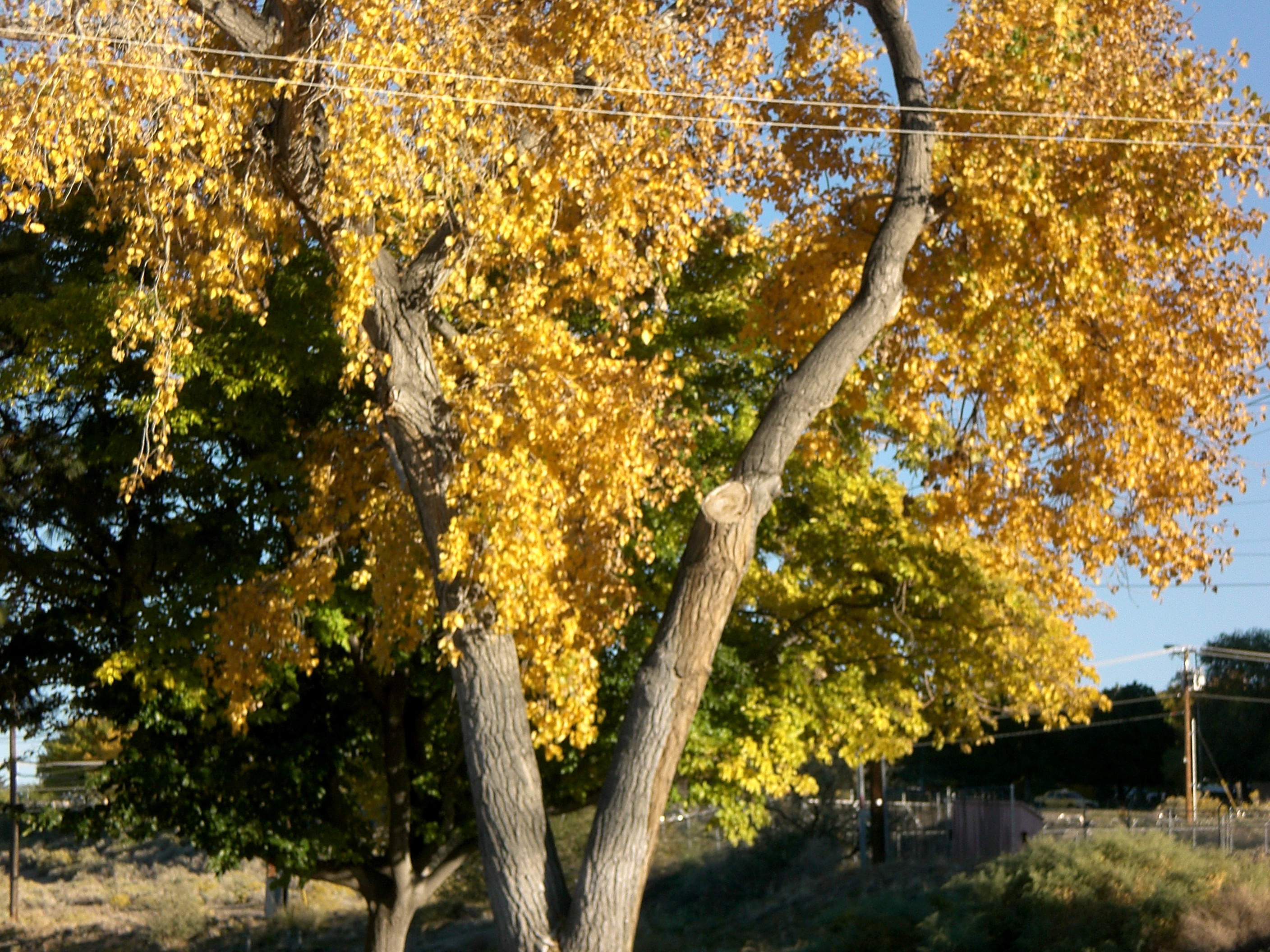
It’s a gorgeous, sunny, crisp yet warm autumn afternoon. I’m driving down from my home at 7500 feet towards Albuquerque. Down as in south, down as in descending to the city’s 5000 foot altitude. I pass from full-color glory of cottonwoods in deep gold, dotted here and there along arroyos which occasionally run but are now dry, to clusters of trees beside small streams which show a mixed blend of yellow tones. Here and there on hillsides I see an occasional, rare in the desert, sprinkling of red leaves where scrub oak is doing its part to show off. Wishing I had time to stop and take pictures at each of the scattered sites, I slow down and drink in the brilliant color enhanced as it is by a bright sun and a postcard-perfect clear blue sky.

An Arc of Gold

An Arc of Gold

Much of the land is once again brown, grasses dried and earth showing little sign of the week of heavy rain that caused flooding in New Mexico as well as Colorado. Oh, you didn’t know that we had floods? Not surprising. When it comes to national reporting, New Mexico doesn’t exist. Our flooding was not mentioned; our drought is equally overlooked, although we have officially been the driest state in the nation. Only when Los Alamos lay in the path of wildfire, and last year when the biggest wildfire raging in the country ate tens of thousands of acres southwest of Santa Fe, did New Mexico make the news. “Listen my children, and you will hear…” stories like those handed out to tourists in a booklet entitled “One of Our Fifty is Missing”  –  but that is the subject of another posting.

On the Prairie

On the Prairie

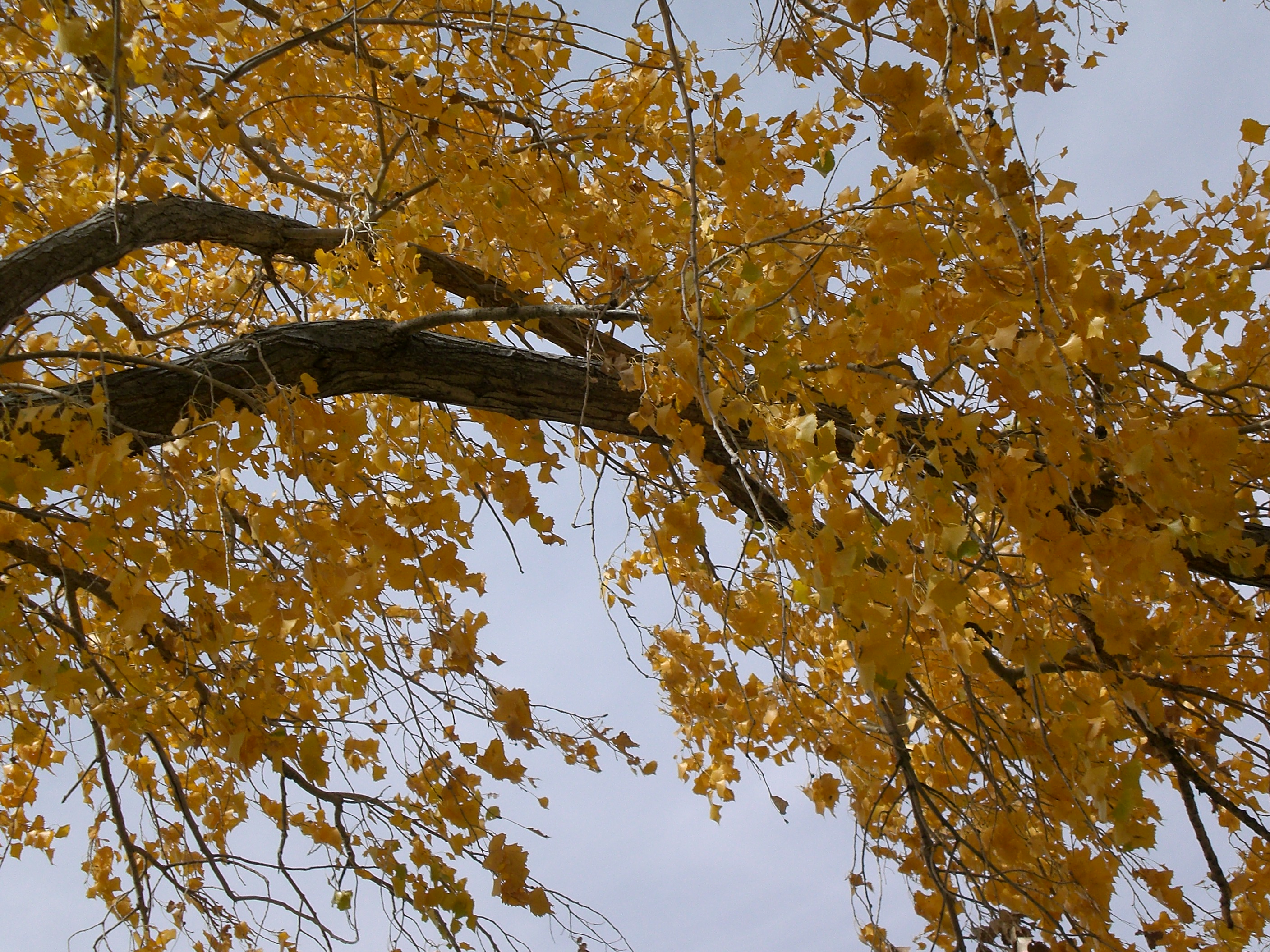
The rain is gone. One week in August, then a torrential week in September that dumped more than the land could absorb – now we’re once again living with drought, seeing long stretches of dun and tan prairie grasses, and encountering bears on the edges of our communities, some even making their way into the center of large cities in search of food. Acres of monochrome are suddenly interrupted by a line of golden cottonwoods. Looking out across the prairie, those trees beckon with the promise of a water course. Many of these small rivulets are dry, their banks eroded by the flash floods which accompanied that week of September rain, sometimes to the point that tree roots are exposed. Tree roots reaching down deeply, to what little is left of moisture; tree roots anchored in brown to give life to riotous gold.

A Survivor

A Survivor

I pass yet another cluster of trees about ten miles south of Santa Fe, and see cars pulled off the side of the road. Looking more closely, I spy a group of artists, easels lined up, some standing, others on camp stools, each of them trying to capture autumn glory. I wish I could stop and join them! Instead I continue down the highway, across dry flat lands, then down one last hill. Spread out before me is the bosque of the Rio Grande, a wide and many-miles-long swath of cottonwoods, in every possible shade of yellow. It is almost too much to take in – acres of dancing golden tones sating the eye to the point that I must look away, watch the highway and the traffic, overfull.

As I enter Albuquerque, I find myself searching out the occasional red of an intentionally-planted maple (they are not native here) and wonder if the householder responsible for the tree is, like me, originally from the East Coast. I delight in the rare splashes of red in equal measure as I responded to the occasional golden cottonwoods earlier in my trip.

Rosy red

Rosy red

I remember autumn in New England, red upon orange upon grape upon wine, each color seeming to stand out and be enhanced by its subtle differences from its neighbors. I never tired of those shades of red in the way that today I ceased to be drawn to the yellows in the bosque.

Neighbors

Neighbors

I perceive that, because there were so many different types of trees producing multi-hued woodlands, autumn in the East, with its continuous experience of changing colors, did not become “too much” in the way that miles of yellow upon yellow have exhausted my ability to be inspired. I ask myself how much variety is enough to keep me from becoming sated? Is it actually variety that is important, or uniqueness? A clump of cottonwoods in a landscape of tan grasses is unique. A brilliant red maple stands out against an orange-toned oak whereas, in an acre of similarly colored trees, each cottonwood loses its distinction.

Do we not all strive to find our own unique color, to stand out from those around us?

Some of us are more strident, others quite subtle, but all of us seem internally driven to find a way to express individuality. Undoubtedly one of you readers will have objected that the acres of yellow in the bosque, the totality of which I found to be ‘too much’, would have delighted you with its abundance. The open, empty plains that I find soothing were frightening to my mother. On her one visit to New Mexico she felt unpleasantly vulnerable, as though naked and exposed. I, by contrast, feel invaded, almost assaulted, by the intensity of human activity in urban areas.

Standing Out

Standing Out

Going out for a walk after orientation class has ended, I find a patch of grass littered with slim, deep red leaves. I don’t know what sort of tree they have dropped from – I’m not an educated botanist. I do know that I’ll keep the handful I collected on my desk in the training room, until they turn brown and brittle. And to have them longer, I’ll photograph them to upload to my screen saver, along with pictures of cottonwood and of maple branches lit by late afternoon sun.

Red Delight

Red Delight

I may feel sated in the bosque; I will delight in retaining reminders of this colorful day, replete with images that speak to my soul while teaching lessons about the value of individual differences.

Words of Communication

October 26, 2013

Driving down I-25 toward I-40 in Albuquerque, I passed through more than one weaving section – those complicated stretches of road where it seems everyone is trying to get into a different lane, coming up from an on-ramp or trying to reach the off-ramp or to position themselves for the upcoming interchange where two major roads meet or diverge. I know the term weaving section courtesy of a transportation planner with whom I had a relationship a very long time ago. He also taught me to drive competently and safely. Thank you, Ray.

Once through the series of weaving sections, I traveled from southbound I-25 to eastbound 1-40 via a flyover – or that’s what my British friends would call it (I know the term courtesy of all the British authors I’ve read over the years). A flyover is the part of the interchange that takes you up and over other lanes of traffic, what we in America call an overpass. As I passed over (flew through at high speed) the interchange, I remembered a number of other lessons in American versus British English, these taught me by my Uncle Eric and Aunt Hilda in Sheffield when I was still a teenager. In (I hope) mock horror Hilda scolded my use of wash cloth (only for cleaning dishes) when what I wanted was to clean my skin (using a face flannel). She was also upset that I called her garden (grassy with flowers) a yard (bare dirt or pavement). And she made it clear that the soil in her garden was earth, not dirt!

My venture into reflection on terminological differences arose following my attendance at an emergency planning conference – more properly the New Mexico Local Emergency Planning Committee Annual Conference – at which a number of intelligent, engaged, caring and thoughtful people tried to convey their knowledge and expertise to a largely receptive audience. My problem with the conference was not in participation, nor content, but in the strange transmogrification which occurred in the speakers – from competent communicators to committed users of stilted government-speak. Several of the presenters tried to include humor in their talks; all had the ubiquitous power point at hand for support; some also added pictures and graphics to illustrate key points. But the bottom – common – line amongst almost all of them was their use of that strange obfuscation which passes for communication within bureaucracies.

Ah, you’ve noticed my inclusion in these paragraphs of big words. It’s fun, sort of, to fall victim to that of which I am complaining. Here, I’m changing my usual form of communication for fun, and with intent. The presenters did not alter their delivery for fun. They seemed, rather, to feel the need to assume a formal persona because they were presenting a talk. As though who they are/how they speak normally was not good enough or important enough to give a conference presentation. One exception was the only attorney to make a presentation – he is so at home in his public delivery that there was no discernible change in him (except voice projection) when he stopped chatting over lunch and stood to give the luncheon address.

I’ve coached students learning to write essays for school, and encountered a similar perceived need to drastically alter their manner of communicating. One teen with an engaging ability to tell stories, when asked to turn the story he’d just told into an assignment for English class, became the written equivalent of tongue-tied (pen-tied, computer-tied?).

“How do I begin?”
“Just start telling your story.”
“I don’t get it. How do I begin?”
“Pretend you’re talking to me and just put the words on paper instead of speaking them.”
“But how do I start? Where do I start? How far back should I go, to get the reader to understand what the story is all about?”
“How far back did you go when you told me the story just now?”
“I didn’t have to go back because you know me.”
“So pretend the reader knows you and start the way you started with me.”
“But the reader doesn’t know me and might misunderstand.”
“Write it like you’re writing a letter to me, then. You know I won’t misunderstand.”
“So do I start with “Dear Ms. Sebastian”?”
“If that lets you get into your story, go for it.”

It would seem that wanting to communicate, for many people, contains within itself the root of lost ability to do so! It is a painful truth for stutterers, that the more urgently they desire to speak, the more inhibited that speech is likely to become. Some stutterers overcome the problem by taking singing lessons. Next, they think of singing their daily speech, and the words come out fluently. I aimed for a similar transfer of skills with my encouragement of my writing student to tell me the story on paper just as he’d told it aloud. He did write me a letter, then transferred the body of the story to essay format, and got a good grade on the paper.

I’m convinced that effective communication – whether in a formal presentation or a chat over tea in a garden – is not about the words one uses, not about the style, but about having a comfortable sense of oneself, and an intent to communicate. The presenters at the conference became ensnared by their efforts to appear as some formalized image of themselves, perhaps labeled “the professional”. The student, a natural story teller, was blocked by replacing his intent to communicate with an intent to “be a writer”. Many people, convinced that they won’t be understood, don’t try to express themselves at all, and become the fulfillment of their perception, going sadly misunderstood through life.

The simplest injunction to give to someone undertaking a new communication task is “be yourself” – yet it is also, often, the hardest one to manifest. How many of us really have “a comfortable sense of ourselves” that we are willing to expose through our written or spoken words? To become a good communicator then, there are in fact four necessary steps:
1) Know yourself
2) Be yourself
3) Trust yourself
4) Express yourself

Just four steps – but ones it often takes a lifetime to learn.

It’s No Coincidence

October 19, 2013

This piece has been written in sections, over time. I began it back in early August, completed it just a few days ago. Gaps in time are indicated by a change in typeface, as well as by subsection dividers.

++++++

It’s no coincidence – I’m certain it’s no coincidence – that I spent time this morning writing out my answer to the question, “What do you fear about moving forward?” and within half an hour of finishing the exercise, received a phone call giving me the opportunity to push into fast forward. I accepted the offer (a well-paid job doing work I generally like) despite my identified reservations. Identifying the reservations let me see that they are not insurmountable challenges, merely conditions which will necessitate new adjustments to my schedule, diet, work habits, writing goals.

++++++

Nor is it coincidence that things come to hand just as you need them. I’ve been having a discussion with writer friends, and reader friends, about how to intermix inner thought with third person narrative in my novel, in a seamless way that will pass muster with editors. (Editors are known to object to the mixing of points of view). Various suggestions have been made, including using italics for the thoughts. I tried the italics and don’t like them – they jar my awareness, as a reader, pulling me out of the flow of the story to register the fact that some change is being made apparent. I also rejected elimination of the self talk/thoughts/inner monologues solely in order to meet a style ‘rule’ that I know has elsewhere already been broken.

Ready to turn my novel rewrite back on itself, and find a way to signal shifts to first person without the jangle of italics, I was forced to turn off my computer and unplug from power to assure protection of the equipment from a fierce thunderstorm raging overhead. Reading lights have been flickering as wild electricity jumps from the sky to disrupt the flow of its domestic kindred through the lines in my house. I picked up the book I’ve been reading – Dorothy Sayers’ Busman’s Honeymoon – and there before me was a chapter of exactly the sort of intermixed action and thought I’ve been considering. It works – it reads smoothly, no italics, only here and there a couple sentences set apart within parentheses, which I find an unnecessary distinction. A separate paragraph would be equally effective and clear.

Posing the question to the LinkedIn group Authors, Writers, Publishers, Editors and Writing Professionals brings more valuable input, including recommendations for good reads which effectively mix first and third person viewpoints. I have my answer – a good writer can pull off the violation of rules. It is up to me to assure that my writing is good enough to do so.

++++++

That I write well is no coincidence.

It is the product of early indoctrination, a great deal of practice, and continuing learning. I finished a blog post (Ba Gua Lessons) in the morning, and then at noon participated in Lesley S. King’s free telephone class on vivid writing. She offered the session, full of helpful guidance, as an example of what one can experience taking a writing workshop she will be producing soon. I hung up from the hour and went back to review what I had written earlier.

Look Ma, I used present tense, active verbs, multiple senses… I hope I engaged my readers, asking questions, encouraging the possibility of dialogue. But I can do it better, as evidenced by my desire to tweak a sentence here, add a challenge there. What I gained from Lesley’s class was a framework for evaluating my writing, a standard against which to stretch myself further. Good writing is fun, it’s my passion, I don’t consider it work… but it does require effort, absence of ego, an open mind, curiosity, and an unfettered willingness to learn.

It is no coincidence that my encounter with Lesley – who encourages writers to build a career from their writing passion – comes at exactly the moment when I am choosing to once more put writing into second place in the prioritizing of how I spend my time. My new job will initially require enough attention that I can meet my commitment to myself and my readers with weekly blog posts, but am unlikely to do much more about building my platform (the latest word for audience), or marketing my novel.

I am not abandoning a writing career; I am accepting that I’ve been offered an opportunity to do something else I care about (assisting others to access services which help them live their fullest potential despite health issues), and to meet an external financial need, while I learn to maintain a balance between competing interests. Not an either/or choice, but an integrative one. Continuing to write is a crucial part of “taking care of myself” – that imperative frequently stated but not so easily implemented. One of my writing projects, a book of creative suggestions for managing the challenges of Parkinson’s, will undoubtedly be furthered through my new job.

Mind likes to create dichotomies. It suggests that just when my focus on writing is beginning to morph into a career, the rewards of my efforts are being taken out from under me. Mind might think so, but I don’t! Instead, I’m being offered the opportunity to meet both outer and inner needs, to manifest balance not only in the activities to which I give my attention, but in the way I blend social interaction with quiet time, and productivity with stillness. I don’t know yet how this balance will manifest; I’m looking forward to discovering the various ways it will express itself. The one thing I do know, with certainty, is that its place in my life at this time is no coincidence.

Ba Gua Lessons

October 12, 2013

As I count down the days until the start of the intense training period for my new job, I find myself in yet another dichotomy. Do I laze about as much as possible, wallowing in the freedom-to-do-nothing that is about to vanish from my life? Or do I begin a disciplined adaptation to going to bed earlier, getting up early, and organizing my days to accomplish tasks that it will be hard to fit into my upcoming schedule? Or, more practically, do I aim to achieve a balance of both tendencies?

My acupuncturist/friend/wise-teacher commented that it is often the case that moving to the extreme of yin (doing nothing) pushes one into yang (activity) so that resting instead of participating in activities can be an excellent preparation for the burst of energy that will be required of me. I liken this approach to the one I’m learning from the same friend and teacher when we practice Ba Gua, wherein movements are designed to “coil” muscles like tightened springs, until the point of release. The force of the release may serve as the attack (the martial part of the art) or may be contained and redirected into intensifying the next coiling movement.

It’s difficult to consider what Western culture calls laziness and idleness as appropriate preparation for a required, new and busy schedule. In that mentality, I definitely should already be adhering to the new (yang) schedule of waking, and filling my days with tasks, accustoming my body to delivering energy and clarity of mind across the ten or so hours of an upcoming busy day. But what happens if I rename the preparation period (the yin) in an Eastern fashion, and say that I am practicing stillness and emptiness? Then I am setting up a powerful contrast, with the potential for sustained energy emerging from the containment being practiced this week.

What a difference a few words make! Try them out. Spend a chunk of time playing solitaire, or just sitting and watching the wind blow the drying grasses of autumn.

Bosque del Apache, New Mexico

Bosque del Apache, New Mexico

Call yourself idle and lazy for failing to do something constructive with your time. Then, rename that time as allowing yourself to be still and mindless, outside your usual sense of yourself. Which set of terms weakens you? Which seems to relax and yet energize you?

To a large extent, even when I’m not engaged in writing, I live my life through words. My grandfather taught me the importance of choosing the right ones, when he talked to me about his poetry. His choices were in Hebrew, and constrained not only by the meter and rhyme of his verse, but by his dedication to purity of the language. (Words created for items that did not exist in ancient culture should, in his opinion, follow the traditional structural frame as to number of consonant sounds).

My experience of parents whose behaviors were often in contradiction with their words led to my dedication to accurate and clear communication. A lonely and isolated childhood built my desire for connection with others, and to the understanding that communication is a two-way street. I do not communicate when I talk (or write); I only communicate when what I say is heard and understood by another.

For others to hear and understand me, I need to understand them – hence my choice of psychology as a major in college, and my continuing interest in neurology now. Also my engagement with the several programs I lead or teach (including Alternatives to Violence Project and Chronic Disease Self- Management), both having to do with learning concepts that help one direct and control behavior.

Which brings me back to Ba Gua, teaching my body new ways of moving, and simultaneously reinforcing flexibility of mind. And back to the importance of just the right words – stillness and emptiness creating a vacuum which attracts energy, to be stored and contained until it explodes into action. So much more sustaining than to label my down time as idle laziness that should be filled with doing.

The first time I attended a feast day dance at one of New Mexico’s Pueblos, I observed a dancer carrying an old-fashioned alarm clock, the sort that is wound with a key, ticks loudly and has a clanging alarm. The dancer teased non-Native observers with the clock, shaking it in our faces, setting off the alarm suddenly and startling visitors with its discordant noise. Eventually, he tossed the clock away and joined the line performing traditional steps in a mesmerizing, repetitive pattern. Time did then disappear, as spectators and participants focused totally on what was happening in the moment.

I suggest that much that we like, whether a good book, a particular hobby, an activity, or a piece of art or music is liked precisely because it has the capacity to capture our attention strongly, and thus to eliminate our sense of time and ego. Being present in the moment with the object of our attention creates a satisfying energetic stillness, and an expanded sense of connection, of capacity, of self.

Those fortunate individuals who are able to combine such likes with their means of employment do not describe what they do as work. They are more apt to describe a career as pursuing a passion. Those less fortunate in the choice or conditions of employment go to work, and then try to find free time for pleasures to balance what they have sacrificed for the earning of income.

You may have noticed in previous posts that I have not called my new job “work”. For the past eighteen months, I’ve been able to live mostly in the present moment, doing what is in front of me to do each day. I really like this way of being. My intention is to continue in this manner, acknowledging that there will be more things in front of me to do, in many of the upcoming days, than there have been in the past ones. I have determined not to change my approach to the doing of them. I will find energy for the doing by assuring that I remain centered in being.

As my body improves its stability and strength through Ba Gua practice, so too my mind – and its use of words – expands its capacity to “hold the tension of opposites” and to achieve balance. For important external reasons, I am starting a new job. For vital internal ones, it will not be work. Activities required of me by the new job will be integrated into the pattern of observing, of writing, of being that has nourished me of late.

Please, if you notice that I’m falling away from center, alert me! If my words seem poorly chosen, my posts less reflective, give me a nudge. I need to know that I’m continuing to communicate with you, not slipping into a stress-driven rant.

Thank you for reading, and for feedback.


Only Fragments

Love Letters to the Tar Pit

KarusaaVerse

Words that Sparkle, Thoughts that Ignite: Fueling Your Imagination

Leaf And Twig

Where observation and imagination meet nature in poetry.

Millarson Diaries

Personal Musings and Thought Experiments

The Beauty Along the Road

Discovering Beauty in the small details of our lives

Flowerwatch Journal

Notes on Traveling with Flowers

1eclecticwriter

Wide-Ranging Commentary

Spirituality Exploration Today

Delving into the cross roads of rationality and intuition

smilecalm

Life through Mindful Media

A Good Blog is Hard to Find

I will shatter a word and scatter the contents into the wind to share it with the world.

Ray Ferrer - Emotion on Canvas

** OFFICIAL Site of Artist Ray Ferrer **

AKA The Versatile

Fashion | Lifestyle | Food & Travel | Beauty | Fitness | Education | Product Reviews | Movies | Doodling | Poetess

Aging Abundantly | Women Over Fifty | Empty Nesters | Caregivers | Aging Gracefully

Finding Joy at Every Age with writer/philosopher Dorothy Sander

ARTZZLE

Helping with the Pieces in Life's Puzzle of Art and Design

Project Light to Life

A bucket list blog: exploring happiness, growth, and the world.

The Daily Post

The Art and Craft of Blogging

Any Shiny Thing

MIDLIFE MAGIC

allmostrelevant

@allmostrelevant

The Irrefutable Opinion

Assaults on the Casually Mundane by K. Jean King