Archive for the ‘Living and Learning’ Category

Theme and Variations

November 22, 2015

After several days of wood-stove heated cold weather, the temperature has soared to cotton shirtsleeve comfort, and an afternoon originally intended for housekeeping has turned into one spent on whatever could be completed outside in the sunlight. For my husband, that has meant washing cars. I, meanwhile, cooked some of his habanero pepper sauce on the outdoor grill (its bite sets everyone sneezing and crying if prepared inside) and re-potted houseplants. Or rather, transferred cuttings that had taken root in water into new pots, and repositioned one jade plant that, for reasons of its own, has chosen to grow so lopsidedly that its pot is highly prone to tip over. Reoriented, the main stem now angles sharply to one side, but seen from a distance the whole plant looks much more balanced.
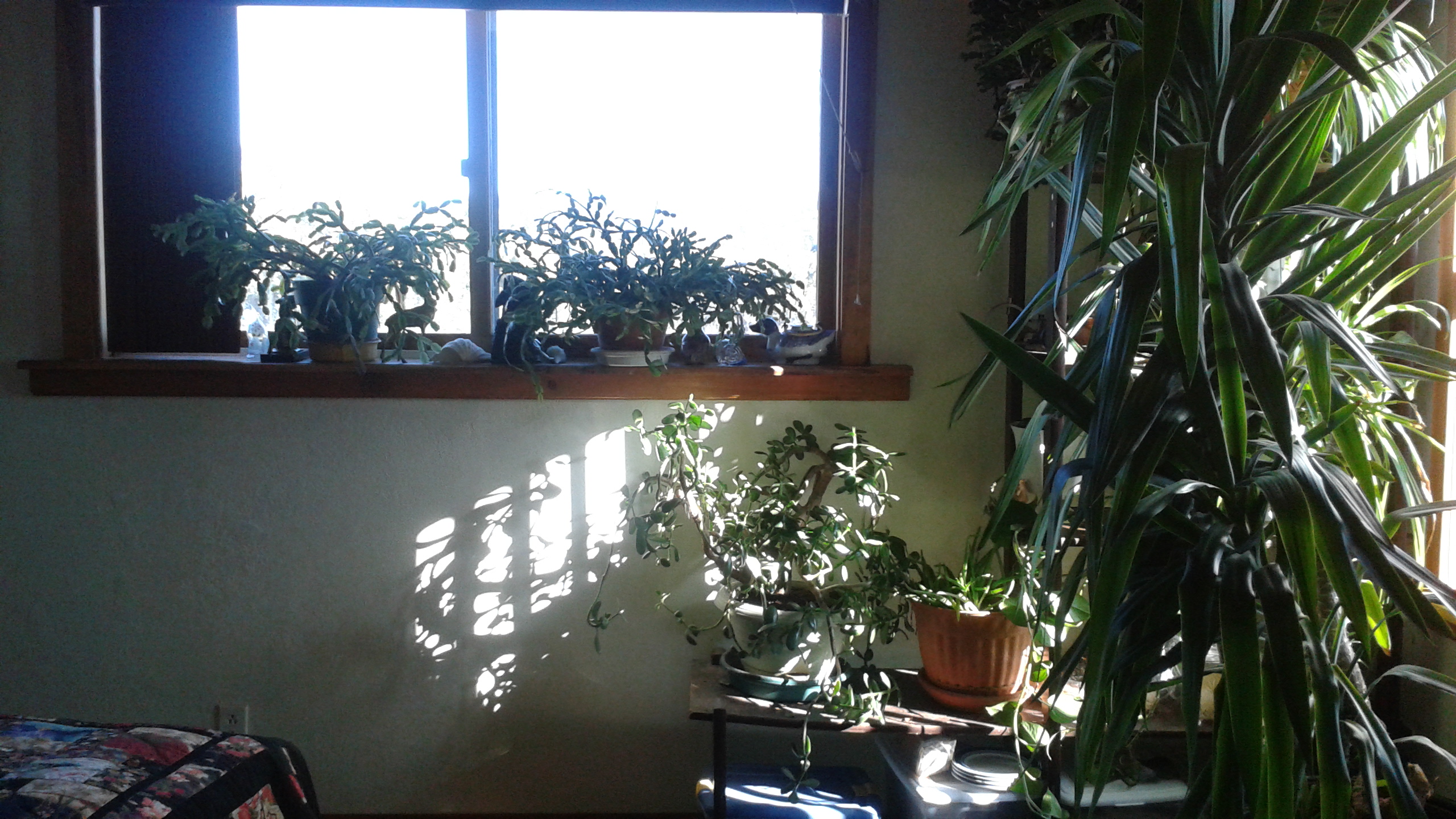
straighter now beneath the window

straighter now
beneath the window

Why do some natures veer off crookedly? How do several children raised in the same supportive environment take such different attitudes forward into their adult life? Why are some people seemingly constitutionally unable to appreciate what is offered and available to them, while others build wondrous achievements out of little more than scraps and string?

My household greenery includes five different Christmas cactus plants, one of which has begun to bloom in anticipation of Advent. If previous years are any indicator, one or two more will flower before the holiday for which they are named, and one – the largest and oldest – will only flower around Easter time. Each is a different color, one white, one pink, and three distinct shades of red. They all get similar light, water and food, and are exposed to the same temperature variations, yet each takes its own turn to blossom.

If it’s true that no two snowflakes are alike (is it so?) then my examples of variation, where similarity might be expected, become rather insignificant and small. But more people seem to be affected by personality differences among siblings than are concerned with verifying the uniqueness of snowflakes or the reasons for oddities in the flowering cycle of plants.

Discussing one of my husband’s English writing assignments brought me up against the debate about how to treat addiction – as a disease that was not chosen any more than one chooses to have cancer, or as an intentional act with moral consequences. The former position is supported by medical evidence showing that when alcohol or drugs cause the release of endorphins in stressed individuals, their brains process this chemical change as life-saving. Future use/misuse of substances becomes, at a purely neurological level, a matter of survival. There is no longer any choice involved, just as a cancer patient does not have a choice about whether his untreated, abnormal cells replicate. Addicts need to seek treatment to recover from their addictions just as cancer patients need to seek treatment to (hopefully) recover from their malignancies.

Choice – and judgement – enter this scenario when the alcoholic refuses to admit he has a problem, or fails to seek treatment. Choice – and judgement – also enter the scenario when a person chooses not to undergo chemotherapy and/or radiation to treat cancer. The same variability that leads us to ask why two siblings should turn out so differently from one another can then lead us to wonder why two similarly situated alcoholics (married, with children, good jobs and reasonably effective support systems) should follow very different paths. Where one recognizes the harm being caused to family, and seeks treatment, the other dives into denial and eventually loses spouse, family and job without ever accepting the many offers of help being extended.

Is it that we need to believe we have free choice, no matter what? Is that why we insist there is a moral standard that is appropriately applied in all life situations? Two children have the benefit of the same loving parenting. One thrives and succeeds and gains our respect. The other struggles and turns to drink and becomes an object of scorn.

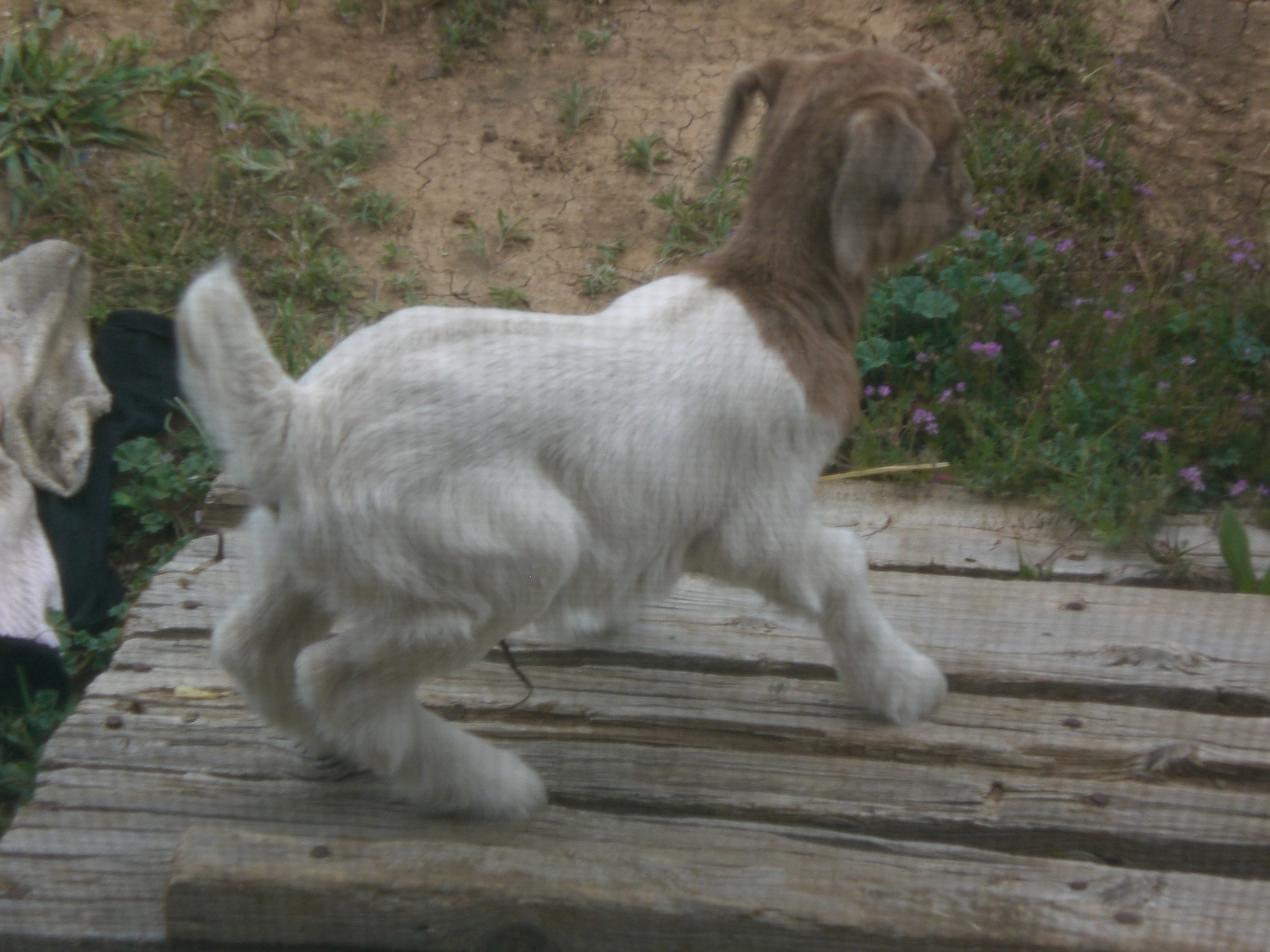
We do not scorn the cactus that fails to flower at Christmas. We are happy to welcome its flowering whenever it chooses to show its colors. I do not blame my goat Storm for persistently worming her way between the bars of the pasture gate; it is just her nature to want to get to that greener grass on the other side of the fence. I can’t imagine anyone blaming a snowflake for not looking identical to its neighbors on the patio. Why, then, are we so hard on ourselves and our fellow humans? Why can’t we simply accept that there is a wide range of individual variation in how people grow and respond and live, that our natures are as different, one from another, as are the many snowflakes that covered my yard four days ago? Then it was icy, snowy and cold while today it’s balmy and delightful outdoors. I don’t hear anyone saying “that’s wrong, that’s bad, Nature shouldn’t be so variable and inconsistent.”

Am I asking too much to wish that people could be as accepting of one another’s variability as we are of flowers, snowflakes, weather and stubbornly determined animals? To do so doesn’t mean abandoning standards of conduct, or being obliged to accept anything and everything as “cool, man” or “whatever.” If I meet someone who doesn’t seem to share my values, I am free to choose not to pursue the relationship. I don’t need to judge them, try to change them, or moralize about how and why they are as they are. And I can hope that they would, reciprocally, let me pass on without being subjected to attempts to change my vibrant red colors to muted pink ones.

Aspiration Accomplished

Returning to Reading

November 15, 2015

I’ve started reading again.
Or, more accurately, I’ve resumed reading for pleasure at what used to be my normal rate of 2-3 books a week. For most of the past two years, until a couple weeks ago, I haven’t achieved more than two books a month. Knowing the why of the drop off did not make the dearth of reading any more acceptable to my impatient mind. It’s certainly mind that is now celebrating evenings spent on the couch with a book as a return to “normal”.

Mind had best not get too comfortable with this normal, as it’s a new one, with frequent interruptions to discuss medical terminology questions with my husband and sister-in-law as they work on their respective anatomy and pharmacology studies. I had better not get too comfortable with this new normal either, since it derives primarily from a lessening of my work caseload, and I don’t trust that this easing will endure. It should – my client list is now, after two years of numbers circling ninety, reduced to where it is “supposed” to be, around sixty-five. That’s a full third reduction, bringing my work week down from 60 hours to 45 and freeing time to read for relaxation.

In this past week I’ve been with Rei Shimura back to Japan, and accompanying an itinerant weaver to solve a string of murders in a Shaker community. It’s pleasant to go traveling again, without the stress of packing, driving (I do so much of that for my daily work) and sleeping away from loved ones, in seldom fully comfortable and always unfamiliar beds.

Being markedly less engaged with books these past eighteen months has made me noticeably more sensitive to them now that I’ve returned my attention to reading. In particular, I’m aware of the too frequent typos, words missed out of sentences and similar flaws of production which seem to be a different type of new normal for print publications. Or is this perhaps the new normal for the comparatively inexpensive, remaindered reprints available from discount supply houses, where I frequently shop?

I wish I could afford the $25-30 per book of a bookstore hard cover, but I can’t. I feed my … I started to say addiction to reading, but maybe it’s no longer an addiction?… pleasant habit of reading with acquisitions from second hand stores, and from remaindered and discount house catalogs. Books from these catalogs, in particular, seem to contain frequent composition errors. Sloppy workmanship? Or the results of computer-based typesetting that doesn’t recognize when a word is missing, or a cognate replaces the word that should be in the sentence.

I don’t read e-books. I spend too much time already in front of a computer screen. So I don’t know if e-books are similarly flawed in composition and construction. And I’m not sure whether to hope they are, or that they are not. If they are, then an entire profession that once prided itself on accuracy has fallen into slackness and error. If e-books are error free, then it would seem that a serious disregard for paper books is being made manifest by compositors who used to be in competition for the most perfect, flawless output.

Is my cranky complainer side showing? Am I sounding like a stereotypical older person ranting that standards are falling and are so far from what they were in my younger days? That complaint has been with us at least as long as the works of Homer and Cicero, and probably longer. I choose not to generalize, merely to observe that in my resumption of reading I am encountering more proof-reader errors than I have noticed before.

I will try not to make my own such errors. Now that reading for pleasure is once again part of my days, perhaps writing posts will also pick up a former pace? Please do call my attention to any proof-reading errors you find. I want to keep my own standards high.

“Pantsing” as a Way of Life

October 22, 2015

A blog on elder issues that I follow, Time Goes By, Time Goes By recently discussed the idea of writing a ”final” post to be put up on a blog when the writer has passed away. Sort of an extension of making one’s funeral preferences known, completing a living will, etc. The stated intent, however is to have a way to say farewell to online followers/friends who may wonder what has happened, when posts cease to appear.

This is NOT my final blog, although my followers may indeed be wondering what has happened to me. I haven’t dared to check how long it’s been since my last post!

Not that I’ve stopped living, nor even stopped reflecting on all the living that is filling my days. I have, however, stopped making time to write out what I’ve been discovering during the rather brief reflective gaps in the hectic pace of my days. Perhaps now that the weather is changing, and more sedentary indoor days loom, I’ll be able to return to writing posts regularly.

Odd, that – I write regularly every day, just not “for pleasure” as is the case with this blog. I write summaries of the needs of my clients, I write persuasive letters to justify insurance coverage of exceptional procedures, I write recommendations to management for procedure changes to simplify my (and my 100 field co-worker) tasks. I even enjoy some of what I write for my “day job” but it is writing from the logical functions of my brain.

What tends to emerge in my essays that become blog posts is much more intuitive and – to me – more pleasurable. I don’t often know, when I start an essay, where it will end because I don’t “know” what it is that I know on the subject about which I have been cogitating. I wait for – and fortunately reliably receive – flashes of inspiration which mold themselves into coherence as I formulate the words to express the ideas and images which rise to awareness.

Should I be admitting in a public forum that I often don’t know what I’m going to say when I start to write? Will an editor at some future point read my manuscript submission and say that it’s obvious I have no idea what I’m writing about and that I’ve admitted as much already?

I hope not, since I do rework, rewrite and thoroughly edit the books and stories I send out (far too rarely now – my submission listing is sparse indeed). And I reread and edit my posts although not with the same degree of critical assessment as I give to works of fiction. It is part of the pleasure, for me, of posting, that I feel free to share what comes to me, rather in the way one speaks freely in a conversation with friends. Having to “watch one’s words” in fact describes a stilted and tense relationship between people, or at best a formal and careful one such as is the case for my day job writing which I mentioned above.

An interview I read recently asked a writer whether he was a “planner or a pantser” in the production of his novels. Like many of us would, I think, he replied that it depended on the circumstances. Some works require planning, others seem to take on life all on their own and – for me at least – write themselves through me. Those are the most fun and happily they quite commonly occur when I’m in the process of completing a post.

Pantsing this essay, I’ve come to a stop without feeling, in the logical part of my brain, that I’ve come to a coherent conclusion. Perhaps I have, however, accurately reflected the incoherent way my days are unfolding, full of unexpected events, and flashes of insight that bear little relationship to what I think of as the pattern of my days. I guess I’m pantsing my life at the moment, when I’ve always been something of a planner in that arena. Hmm… I should expect interesting new insights to accompany the very novel way my days are being filled.

Not a bad gift to self for the birthday in honor of which I’m putting up this post.
Best wishes to all – and thank you to my readers – for my new year ahead.


Autumn Color

Autumn Color

Sleeping Beauty

September 5, 2015

Renovating my home of 25 years has brought out/up a host of subjects for reflection. How have I managed to accumulate so much stuff, when owning things, showing off things is of little importance to me?

Oh, I see… the items have mostly been given to me and the people who gave them are important so I keep the knickknacks, the pictures, the artwork, the books, the music – whether or not I still have use for or interest in them.
“Can’t donate that to the fire department fund raising yard sale – X gave it to me.”
“Can’t pass that book on, though I’ve read it twice and won’t read it again – Y gave it to me for my 50th birthday.”
Et cetera, et cetera, et cetera in Yul Brenner’s inimical voice as the King of Siam.

Well, most of those can’ts have become dones.

The memories of events with the people involved remain fresh, the items by and large past their use-by dates and no longer necessary as reminders. Does that mean I’ve entered the stage of life where more distant memories are much fresher and more real than what I had for lunch yesterday?

What did I have for lunch yesterday?

Oh, that’s right, I didn’t eat lunch yesterday. Phew…

The renewal project included sanding, staining and sealing all the floors, painting almost all the walls, moving some furniture out and several new pieces in, rearranging the use of space, and – still in process – rehanging in new and different arrangements much of the art work that has decorated the walls. The entire house – all 900 square feet of it – feels different. Appropriately so, for the new stage of my life being lived within its walls.

Much of the time since about 2000 I spent in a sort of trance, a marching in place, waiting for I knew not what. I wanted to make changes but every step I took toward a different life hit a wall. It finally became apparent that what was being asked of me, spiritually, was to be patient, to make the most of where I was and what I was doing while waiting for whatever karmic debt was keeping me seemingly stagnant to finally exhaust itself.

In retrospect, I had pricked my finger on the poisoned thorn, and like Sleeping Beauty, was locked into immobility while time passed. Only one prince – or power – knew the secret of what would waken me to the new, active, challenging, loving and amazing life I’m living now. While my Prince Charming came in outer form as an answer to my quest for someone with whom to speak French, the true charm lies in the perfection with which the Inner Spiritual Power knows exactly how and when to wake us up.

Sometimes the wake up is a kiss, at other times it is nothing short of the providential hit upside the head. However we are awakened, there is no going back to sleep. Or rather no going back to sleep without consequences sufficiently negative to preclude all but the most stubbornly self-destructive from ignoring what they are being freshly called toward.

Much easier to accept that the next stage of personal growth is here and now, so just get on with it. In a remarkably short time, one may discover that – while seemingly asleep – an inner cleansing has been done and now what has been accomplished in Soul can vividly reflect itself outwardly. Unnecessary stuff is cleared out, closets are emptied, walls and floors refinished, weight lost and life has a whole new shape.

Beauty’s story ends with that wakening kiss – oh, except for the living happily ever after bit.

Too bad, really – because if my own experience is anything to go by, the best, most vivid and interesting aspects of the tale lie in how the journey unfolds after one’s inner awakening in Soul. Awareness, illumination, enlightenment, realization… all the experiences and adventures to enjoy while traveling the True Path to Being, wherein one achieves the fairy tale ending of “happily ever after.”

May it be so for you, also.


Not One Ding-a-ling

July 26, 2015

One of the blogs I follow, Musings from a Tangled Mind, is occasionally a rant against some stupidity of daily life – usually on a subject I agree deserves a tongue lashing. I’ve not seen, there, my target today.

I am rarely able to nap during the day, no matter how tired I feel. This afternoon, I succeeded to drop off – and scarcely half an hour later my phone rang with an automated call from Walgreen’s Pharmacy, a reminder about refilling a prescription that:
1) doesn’t have refills on it, and
2) I never signed up to have reminders about.

I grew up in an environment which functioned largely without telephones at all. My recollection is that we were on a multi-party line in Washington DC, before my father entered the Foreign Service and we decamped to Vietnam in 1956. There – and later in Paris – there was a phone in our home, but it was solely for my parents and for official use only. I did occasionally use the Paris phone to arrange to meet a friend, but tying up the line to chat was forbidden, the cost considered prohibitive.

Returned to the U.S. for college, I lived in a dorm with one phone for the entire floor, or pay phones in the lobby for calling home. Again no habit of phone conversation developed. By the time I was out of school, married and living in my own space, the telephone had become a tool for necessary contact and nothing more. Thus, when I moved to New Mexico and into an area with no phone lines available, I was not disconcerted. In the one instance when my parents urgently needed to get hold of me, they had me located by the State Police, who came out to my house to deliver the message that I needed to call back East.

With time, I moved to a more developed area and met phone lines in place. I was still on a system that was small enough for us to give out our numbers with only 5 digits (Santa Fe was either 982 or 983 prefix, so my phone number was 33474, although one had to dial the initial 98). By the time I moved to the Las Vegas area, Santa Fe had 988 and 471 also in place, but Las Vegas had only 425 or 454. Five digit numbers remained the norm until the late 1990s.

Over the past 15 years the entire state has “upgraded” its land lines and sprouted a plethora of different cell company connections. In order to have service in my “second” house (the land line only goes to the main dwelling) I’ve signed up for T-Mobile, upgraded to a “smart” phone and now get calls via WiFi.

None of which justifies Walgreen’s disrupting my nap with an automated call to alert me it is time to refill a prescription!

Especially when I did NOT ask for that service. In fact, I’ve opted out of it twice already. Apparently, each time I fill a new prescription, the refill reminder is set for thirty days out, no matter what the content of the prescription says – and each new prescription requires a new opt out.

Lesson learned – no new prescriptions will be filled at Walgreen’s unless/until their system allows me to put a block on unwanted calls.

Which brings me to the true topic of this rant – the presumption that we all want/need to be connected all the time, that if we miss a call we are expected to return it immediately, that it is okay to repeatedly troll for business even after being told not to call again and even when the number dialed is on a national do not call list. We have to opt out of everything we don’t want, rather than being invited in and allowed to not participate unless we request inclusion.

A similar presumption underlies online tracking of preferences, of sites visited, etc. so that “ads can be tailored to meet your needs.” Except that no ad ever meets my needs, because I’ve learned to ignore them. They are an intrusion into my time and space, or into my spam folder. I do not have TV reception and, though I do miss the occasional drama series and a few PBS programs, the amount of advertising I thus avoid more than balances the small amount of worthwhile content that I forgo.

At what point did we cease of be people with brains, worthy of respect and entitled to be asked our preferences? How did I miss the turning point where personal space, rights to solitude and to privacy disappeared from everyday interactions?

I am not so “old fashioned” as to devalue the benefits of having a cell phone. I do appreciate being able to text and to email and reach out to people more quickly and easily than when I had to walk from my home in Lamy to the train depot to make that call to my parents, using the only pay phone in the village. I am so old fashioned as to mind that, with the advent of easy connection, has come a culture of disregard of – nay disrespect for – those who are on the other end of the connection.

Yes I realize there were people, shortly after Mr. Bell made his revolutionary invention, who said then what I’m saying now. They had it right, to some extent. Cultural norms do need to be adapted to changes in technology but not to the point of eliminating basic respect for individuals’ privacy and control of their home environments.

Just because you want to contact me does not mean I am obliged to be available to you!

There is a time and a place for communication. During church service in the morning, and again when I am napping on a Sunday afternoon is neither the time nor the place for Walgreen’s to pester me about a prescription refill for which I am not even eligible!

What’s that old parting line after a job interview? Don’t call us, we’ll call you?

If I want information I’ll seek it out. If I need a refill I’ll ask for it. If I intend to purchase an item, I’ll find the stores or the online sites with the items I’m interested in. I know my own mind, what I want and when I want it.

If you want my business, show me the simple respect of allowing me to initiate the contact, and to choose what reminders or new information I desire.

Downside, Upside

June 21, 2015


Nearly fifteen years of drought in my northeastern corner of NM have not come to an end – but this spring into summer we have had rain, almost daily, steady and hard at times, short and sharp at others. More days have been cloudy, foggy and cool than the dry, windy and sunny we’ve become accustomed to enduring since 2000. Forestry signs indicating level of fire danger are in the lower yellow – moderate – range instead of the screaming fire engine red of extreme.

Ranchers are running larger numbers of cattle, and those herds are lazing about in lush greenery up to their bellies. Horses are grazing fat, and antelope scattered among the domestic herds are too somnolent to come check out, as in their more normally inquisitive fashion, the curiosity of a person walking nearby and waving a hat. I give up waving, and continue my way, remembering the morning I woke from a sleep-out under the stars, a ring of antelope surrounding me. Not this bunch – too lazy.

The rainy dampness and chill have greatly delayed me in initiating my outdoor walking routine. A rural dirt lane a few miles from my house has become my normal exercise site – a mile and a half round trip the standard, easily extended to two miles or executed in every shorter times, according to my increasing stamina. By this time last year I was already well seasoned and doing two miles in half an hour. Today, it took me the half hour to just go a mile and a half.

The delay in getting up to speed is partly due to rain, and partly due to my own reluctance to switch to early morning walking. It’s been my habit to finish my work day and then walk – and that habit had years to become set, as the drought mandated waiting until the cooler temperatures of evening made walking a pleasure. I’ve become accustomed to the evening walk as a way to wind down from work, to quiet my mind and prepare for evening chores and rest.

Back in the 1990s, when last we had wet summers, I practiced a different routine. Then my exercise was riding my horses and I knew the activity had to be completed before midday, if at all. Our then typical summer pattern was bright sun and light breeze until about noon, when huge white cumulus clouds would build up and move in from the west, to collect and darken and dump rain in the afternoon, often lasting into the night.

That pattern has, this year, established itself once more. For several months now, by the time my work day is done, the sky is totally overcast, the air is thick and wet, the ground is sodden and more rain threatens/promises to fill the night. No way to walk outside and unwind from the stresses of the day.

Ronni Bennett, who blogs on elder issues at Time Goes By, Time Goes By recently posted about habits – in her case the habit of ordering her coffee from New York because that is easier than going through the process of trial and error to find a blend, where she now lives in Seattle, that satisfies her as much as her long-enjoyed standard.Ronni makes the important distinction between habit and addiction and reminds readers that, while addiction is a serious problem, habit most certainly is not. Indeed, we cannot survive without habits. How exhausting to have to go through a day thinking out each step of all the cleanliness routines, the household chores, the mechanical skills on which we rely! Habit only becomes a problem (still not as serious as addiction) when we become locked into patterns and resist change.

Like my recognized delay in adapting to the changed weather by switching my walks from evening to morning. I’ve started the process (today was my second morning outing) and expect that by week’s end I will have a new habit pattern in place. I will not, however, have made up for the month’s delay in building my endurance and speed over my usual trekking path.

Even in drought, walking in the evening meant wearing long sleeves and lots of bug repellant. Now, in the wet, walking at night is truly not safe (West Nile Virus is here). Fortunately, I do not seem to need excessive protection in the early morning. Perhaps the mosquitos, so very much more prevalent at night than they were last year, have also not made a change of habit to morning activity?

Walking in the early morning feels self-indulgent, like I’m doing something purely pleasurable BEFORE meeting my obligations to my family or to my employer. Why is it that I feel I’m only entitled to do something for myself after other responsibilities have been met? I work from home, am supposed to put in a “normal” work day/week but the demands of the job do not allow me to take lunch hours, the day never ends before 6 or 7 P.M. and only rarely do I have an entire weekend off. Why, then, am I still pushing myself to start promptly at 8 A.M., as though I were clocking into an office assignment?

Tomorrow, a Monday, I intend to walk as the start to my day. Probably that means I won’t turn on my work computer until 8:30. Almost certainly I’ll feel a bit guilty, but I’m counting on that habit, also, being changed by the end of the week. Morning walks, better energy and also, almost certainly, better concentration are my new habit priorities. This older dog IS learning new tricks.

Right, Just and Good

June 16, 2015

A number of times lately I’ve set out to write a post and instead have spent my time playing solitaire. Forty Thieves occasionally but mostly Free Cell. I have no idea if I have set any sort of record on the latter – 4600 consecutive games without being stymied. I undo and start over when I see one not playing out – and a few times have had to repeat that process four or five times before I succeed. I think maybe that’s “cheating’’ when it comes to setting records, but since I’m not playing for a record I don’t suppose it matters.

What am I playing for? A sort of mindless zone out that lets my attention relax and float free, to be with my spiritual Master on the inner. Oddly, doing something seemingly profoundly mental (a card game) serves me as an avenue out of Mind and into a non-mind status.

Coming back to conscious awareness, I often have new insights, including ideas for posts – but too often have used up my free time that otherwise might have been spent writing. Alas, no matter how elastic time sometimes seems to be (long when I’m tired but obligated to keep working at my primary job, so short when I have a rare day to relax) it simply doesn’t stretch to encompass all that I want to accomplish in my “off work” hours.

Especially not now that I am coaching my husband through his demanding load of summer classes. He’s taking his first psychology course, being exposed to the discipline that was my major in college. I participated in a reunion (I won’t say which one) by Zoom conference last week, the first time I’ve ever attended any such activity. I enjoyed visiting with a few classmates, and seeing how differently we all look. But I realized, also, that I have very little interest in looking backwards to my years at Swarthmore. I greatly value the education I received, which has continuously served me well as I have taken up employment in a series of different fields. My appreciation of my teachers and the learning process is a present condition, however, with very little nostalgia attached.

Apparently one of the undertakings of my classmates on campus was to share personally significant memories about our years at school. I find that almost all of mine arise out of my own achievements, with relatively few memorable events, other than friendships made, involving other people. I was not “social”, although my senior year I captained the archery team, and I regularly performed with the modern dance troupe.

In that capacity, at the start of my senior year, I posted a notice seeking a musician to improvise in response to a dance I’d choreographed. The drummer who answered became one of my best, certainly most long-term and special friends, as we are still in communication close to a lifetime later. The experience of connection when I performed the dance for him to watch, with the next run-through a perfect match of music to movement, is a significant personal memory of Swarthmore.

Another is my feeling of floating over the ground as I left the oral exam for my philosophy courses. I’d spent over an hour with the visiting examiner, analyzing a statement I’d made in one of my written tests, to the effect that good, right and just are coextensive concepts, a core tenet and summary of my personal belief system. At the end of the session, the professor stepped back, looked over the blackboards that we’d filled with examples, and said “I think you have a coherent philosophical system laid out here.” It was not merely a validation of my intellect, but a deeply felt validation of my ethics and spiritual concepts of right conduct, or what I would now call Knowing, Being and Seeing.

Just as I now find value in what could seem to be mindless time wasting, moving cards around on a board, I guess I do also see value in occasionally looking back. If nothing else, when change is incremental and in such small steps as to be easily missed, looking back can provide a signpost marking the fact that change has in fact occurred – or perhaps it has not.

The important thing is not to get stuck with one’s sight turned to the past. Equally important, is to not be so focused on the future that the present is overlooked. I appreciate and value the reminder that “Life is what happens while you’re making other plans.” To be able to reach my end with as few regrets as my grandfather (who wished he’d learned to play the mandolin) I know I need, daily and here and now, to manifest the ethics that covered that classroom board and to Be in my life in each moment of it. When I succeed, I know such happiness 

In Ones and Twos

May 25, 2015

I’m taking my time reading In the Shadow of the Banyon, by Vaddey Ratner. Each section of a chapter is a meditation, a vividly imaged reflection on an aspect of relationships, whether between father and daughter, human and landscape, chaos and sanity, or physical and spiritual realities. Set in the time of the Khmer Rouge takeover of Cambodia, it is a marvelously sensitive and mature child’s view of life. The landscapes are familiar to me – Cambodia as described is much like the Vietnam of my childhood. The recounting of emotions stirred up by violence and turmoil, by loving relationships and by subtle but profound parental education of children is flawless, presenting – again – a familiar landscape. How can a story set in what I know to have been a devastating massacre of more than a third of the country’s population seem so quietly normal?

Maybe I’ll find an answer to that question by the time I finish the novel. Maybe I won’t, and the question will join others that I ponder about humans and our treatment of one another.

A discussion at the supper table recently explored a different aspect of the human condition, this one looking into interpersonal dynamics. The participants were, with the sole exception of me, young and not so young men from Cameroon studying here and trying to improve their lives and those of their families. Each of us has had a similar experience of a few people who are supportive of our efforts to advance, to learn, to become contributing partners in business or family – and each of us has been dismayed at some point by the negative response of a sibling, or cousin, or coworker.

What, we were asking, makes an older brother, working and well established in a good profession, refuse to help pay a school fee to enable his younger sibling to continue studies (and to remain in status vis a vis the US Immigration Service)? What makes an older sister complain to parents that the student struggling to survive in an unfamiliar culture has neglected to call her and inquire how she is doing? Why doesn’t she initiate the call? She is the elder, and yes one owes respect to one’s older siblings, but they in turn owe care and support to those coming behind them (at least in traditional Cameroonian village culture).

I have no siblings, so I can’t comment on how/whether there is a similar implicit set of obligations in western families. I can note that we acknowledge certain rights and corresponding obligations that go with seniority at work – and that there are usually one or more coworkers who object to this tradition. The Cameroonians commented that too often in their society, people fail to see the hard work, perseverance and sacrifice that goes into family advancement. They only look at the outcome and attribute the family’s change in status to graft, or black magic, or some similarly negatively acquired advantage which isn’t earned by merit.

Our discussion included the image of crabs in a barrel, reflecting the way some members of a group will not try to join the one climbing up and out but instead collect together and do their best to pull the leader back down to their failing level. I encountered the latter attitude locally, when I first started my role as director of a home health agency regional office. One of the nurses I hired for “as needed” visits had been employed as a clinic LPN for a number of years, attending school part-time to get her RN. When she did achieve it, the doctor heading her clinic gave her roses and I gave her a happy hug and a pay raise. Her several nurse co-workers scorned her achievement and excluded her from their circle.

At the dinner table, we didn’t talk about competition versus cooperation as a societal dynamic – but we could have done. Instead we stayed on a more individual level and came to the conclusion that people seem to fall into two main categories when it comes to achievement. The first group is of people who are motivated to achieve for the group of which they are members (family, clan, work team). They are generally open minded and flexible, enabling them to see and take advantage of opportunities that present themselves. They grab their chances, work hard and try to make the best of the gifts that come their way, gifts for which they easily express gratitude and thanks.

The second group is made up of those who single-mindedly think of and for themselves and their own advancement. They often seem to believe that the way forward is by finding an edge, an advantage, perhaps the softhearted person who can be persuaded or manipulated into giving them what they want. They work hard also – but their energy is devoted to manipulating others into giving them the preferment, the promotion, the degree or the job. And they disdain those who don’t cater to their sense of entitlement.

One thing we did all agree on, is that parenting and education play a role in which route a growing child decides to take – but neither parenting nor education explains why in a family of five or six siblings, there will always be at least one who falls into each of the two groups. In other words, nature plays a role, not just nurture. We did not digress into beliefs as to what makes for those inherent, nature-based differences. That is a topic for another dinner, or week of dinners, and another post.

Our conversation instead moved on to how we each (believing and being perceived by the rest as members of the first group) have chosen to deal with our relations who are part of the second group. Here, we parted ways. Some continue to try to engage the disdaining other by placating, by continuing to reach out despite the lack of reciprocity, and by “not sinking to their level”. Others have resolutely drawn a line, stating that “he has my number, when he chooses to call me I will talk to him but otherwise I’m functioning as if I don’t have a brother at all.” Neither route is satisfactory – nor were any of the several balancing acts falling between these two end points. However any of us decided to manage the situation, however comforted we felt that we are not alone in our quandary, however clearly we understood the nature of the differences between ourselves and those others, none of us was satisfied, not having a final answer to the question of “why” our opposites were the way they are. The closest we came was “C’est entre les mains de Dieu.” It’s in God’s hands.

As I write now, I’m aware that once again, as so often of late, I feel I have come up against a limit of rationality, a limit to mind’s ability to understand. Trying to reason my way to a course of action regarding the Group Twos in my life is futile. I need instead to let mind go still, and hear the inner voice of spirit directing me on what to do in this moment of this particular relationship. I need to remember that what is appropriate in this moment may be quite different in another moment of the same relationship.

Mind thinks in abstracts and wants answers that will be good for a period of time. Reality only exists in the moment, so there really are no answers to mind’s questions. It is enjoyable – and creates new and positive bonds – to talk things out with others, but the process does not, cannot lead to answers because the questions are by their nature unanswerable in the mental realm.

Which is undoubtedly why I am finding In the Shadow of the Banyon such a rewarding read – it invokes life as a constantly flowing series of moments of now, wherein questions are asked and answers have at least a possibility of arising. It speaks to the spirit within, more than to the mind. It covers births, and deaths, separations and new bonding. It beautifully reflects life. As does the newest member of our household, born just a week ago, on May 18th. Welcome to our world, Storm.


One Week Lively

One Week Lively

Winding Down

April 28, 2015

I seem, finally and despite much inner resistance, to be entering a phase of acceptance that my accumulated years have worn down my endurance to the point that I have to ration my energies.

In the near term this means giving up several of my enjoyable “sideline”’ activities like facilitating Alternatives to Violence Project workshops in the New Mexico prison system. My “day job” is so demanding of time, energy and attention that it exhausts my reserves by week’s end, and I need at least a full day of minimal responsibility to recuperate and regenerate the ability to work another week. Fortunately, I don’t have to remain totally idle for that day of rest; I do have to limit myself to relaxing activities – reading, walking, contemplation, lighthearted conversations – and occasionally also the composition of a blog essay. It’s heartening to realize that writing has become a relaxation exercise for me. I may no longer be able to teach an eight hour workshop after my week of work, but I can probably write for nearly that long if I choose to begin work on another book.

In a recent discussion, I tried to express how different it is, letting go of an activity – or reducing the intensity of one’s participation in it – when one is forty years of age versus when one is in one’s seventies. Somehow, at the younger point, at least for me, there remained a sense of vast opportunity and choice not unduly limited by a reduction in energy or ability. If I could no longer work all day plastering or laying a flagstone floor, without paying a stiff physical penalty – so be it. I would switch to painting or setting tile and carry on earning income in home construction, between professional positions that used my brain more than my back.

Now, however, accepting that I can’t both work full time and also lead workshops or teach, I don’t feel the same ease of adjustment to alternatives. I am being required to give up something, not just switch focus from one type of activity to another. This forced giving up might have come to my attention sooner, if I’d continued to be reliant on my physical strength for my livelihood. It is, after all, an ebbing of strength that is now curtailing my work weeks and reminding me that I can’t go thirteen days at a stretch without a break (two six- day work weeks and the Sunday in between).

Might I be able to continue the workshops and teaching if my work weeks were s more normal forty hours, instead of the fifty plus that they now run? Perhaps… I know for certain that I don’t have the energy to go looking for a different, less intense, job. And I acknowledge that I’m reluctant to give up a position that allows me to work from home several days a week, even though it also involves many miles of weekly travel to see clients, and many evening and weekend hours invested to meet deadlines.

When I consider the adjustments I’m facing, they are minor compared to those some of my clients – and friends – have had to face, due not so much to the wear and tear of life as to illness or accident. One friend who’s pride has been that, the only woman on the county crew, she is as strong and tough as the men, injured her back and is now unable to work, unable to stand for more than a short while, and equally unable to sit for long without severe pain. She has had to give up not only her job but all the housework, animal care and other activities that structured her days. Fortunately she likes to cook and bake, and can manage time in the kitchen by alternately sitting and standing, with breaks to lie down and ease her pain. She has no choice but to develop a new way of defining herself.

Is it easier to accept change if one is confronted with a sudden and total decline of functional level, rather than to feel oneself slowly slipping into loss of abilities? I’m not sure. The question is rather like that discussed in training sessions with nursing staff – whether it’s easier on families to care for a loved one over an extended decline in health, or to lose the family member suddenly from an accident or rapid health crisis, like a fatal stroke or heart attack.

When loss or change comes suddenly and irreversibly, one has no choice but to deal with the consequences. When the loss or change is slow or incremental, it is easier to deny that any adaptation is needed, or at least to insist that it’s “not needed yet”. But it may ultimately become harder to adapt if the needed changes are postponed too long.

I have a good many goals yet to accomplish. If I’m to live long enough, and have the necessary energy to achieve them, I must begin making adjustments now. Fortunately, I now have a partner to help, encourage, nudge, remind and sometimes insist that I give myself down time. It’s easier for me to accede to the change, and not feel guilty about the activities I’m no longer supporting, when I can say I’m doing it a the behest of someone else. Which I recognize is an admission that I still haven’t gotten over the feeling that I must justify myself by my actions. But that’s another topic, for another reflection, on another day. For now, I need only begin the process of finding myself comfortable doing less. Or as a dear friend has said, when we talked about doing versus being, turn the challenge now facing me into the refrain of a song – do be do be do be do.

One of a Kind

April 4, 2015

Standing at the kitchen counter, I lop off each end of a large green plantain, cut a slit down the spine of the fruit, the insert my thumb under the edge of the skin to peel it back. My goal is to undress the plantain without breaking the skin. As I succeed, I give thanks to Susan, the massage therapist who advised me, more than 30 years ago, to base as much as possible of my liquid intake on deionized water. At that time I was already experiencing some arthritis in my fingers and hands. In the decades since, not only has the arthritis not advanced, it seems to have reduced, leaving me with strong fingers and with thumbs able to peel plantains efficiently.

I’m led to reflect on the range of steps I’ve taken over the years to address health concerns in “old folk rather than “modern medicine” ways. Old folkways from many cultures and continents, in that I use acupuncture regularly, Asian herbs to calm an irritated colon and to treat the spring allergy symptoms which many of us are experiencing now. This morning I added a generous dose of new world herbs to my breakfast – notably parsley to be a diuretic since I’ve eaten a bit too much starchy food lately. In my body, starch functions to retain fluid. When I see a three pound weight gain from one day to the next I know I need both parsley and a change in diet.

My reflection moves on to the plethora of different, often conflicting, diets promoted in the popular press. Sober judges of “what is good for you” usually insist that all those that actually work do so because they reduce caloric intake, while they warn against lopsided programs which label certain types of food (carbohydrates for example) as bad. I begin to suspect that the multiplicity of possible diet regimens is an unconscious acknowledgement that we are all, individually, very different in how our metabolisms work. Although each of the diets still presents itself as a one-size-fits-all remedy, the existence of so many conflicting paths to the goal of a healthy weight indicates to me that there is no such thing as one size fits all. Indeed, over the years I’ve come to the conclusion that we each must learn enough about how our own bodies deal with what we put into them, to make reasoned choices and to each ultimately design our own “diet for life.”

An element of that culinary life pattern that is almost never mentioned, so far as I’ve seen, relates to the role of emotion in changing body metabolism. It’s not just that some emotions push us to eat (or to avoid food) in unhealthy ways we need to recognize. I’m recognizing that some emotions change the way in which bodies process different foods. For certain, the recent dramatic increase in my happiness with my life contributed substantially to my successful weight loss, a loss which occurred despite minimal change in my pattern of eating and exercise. I can’t prove, but feel certain, that being happy changed my metabolism from one of “hanging on for dear life” to every calorie, to a more relaxed “easy come easy go” burning off of unneeded fuel. Yes, I hear those of you who are now yelling “Cortisol levels, check your cortisol levels.” I suspect you may be right that stress produces cortisol which has the property of preparing the body for battle, including slowing metabolism to conserve calories and promote endurance. The processes may not be so simple, as I know it is possible to be both happy and stressed at the same time. Undoubtedly I have much to learn about the relationships between endorphins and cortisol and which one outweighs the effects of the other under differing circumstances.

I probably also need to read more deeply into the research on allergens such as that which has recently produced the suggestion that children be exposed to peanuts in order to build up a tolerance, instead of having all potential allergens removed from their diets. The development of drug-resistant infections indicates that too many of us have taken the “ounce of prevention is worth a pound of cure” adage out of context, and thrown several pounds of cure at situations where just the one ounce would have been enough. Similarly, with each discovery of a cause and effect relationship between some aspect of living in this world and a health or sickness outcome, we tend to overreact and generalize and simplify to the point that the parameters of that cause and effect relationship are destroyed.

Desensitization is a technique sometimes used to treat phobias. A person excessively fearful of cats, for example, wanting to overcome this limitation, might use desensitization as a small step by small step process for learning to be calm in the presence of a picture of a cat, then while seeing a cat through a locked window, then in the same room with a cat that is tethered on a leash, etc. Each exposure involves allowing the fears to manifest and then experiencing the fact that none of the feared and fearful outcomes occur. Relaxation and calming follows this perception, and a new connection is made between cat and non-fearful status which can gradually be strengthened to the point that the subject is able to encounter an unrestrained cat with only minimal discomfort.

Exposing children to minimal doses of allergens in order to build up tolerance is an identical desensitization process, carried out on the physical rather than the emotional body. Just as some phobias or compulsive reactions are too strong for desensitization to work, I’m sure some allergies are too immediately life-threatening to try a dietary desensitization process. On the other hand, because a few situations are not appropriate to the technique does not mean parents should avoid trying the process with their children. Again, the fallacy lies in a “one size fits all” assumption that is no more appropriate to eating patterns than it is to latex gloves.

Which brings me back to the challenge facing each of us, to learn the unique and individual ways our bodies and minds function, in order to adjust our diets and our lifestyles to what gives us each the best odds of achieving our goals. I know I can’t hope to succeed in this on-going, lifetime study, without a healthy dose of introspection and an equally strong commitment to listening to the wisdom coming through me from my Divine Teacher. For me, that means slowing down both body and mind with periods of stillness and contemplation every day. Without that sort of reflective space in my life, I am certain I would not have truly heard Susan’s suggestion all those years ago, and would not now be able to peel plantains with ease.

I’m curious what my next contemplation may reveal to me that will show its relevance thirty years hence. And oh, in case you’re wondering, yes I’m making porridge plantains again, and I’m pleased to know that – per the assessment of the six Cameroonians who ate my cooking last weekend – I’ve graduated from neophyte to proficient at doing so.

Which means you can teach an old dog new tricks, as was ably illustrated by scientific research cited in the sermon given recently by Reverend Frank Yates at Las Vegas’ First United Presbyterian Church. But that’s a blog topic for another day.

In Later Years

In Later Years


Still Learning and Teaching

Still Learning and Teaching


Only Fragments

Love Letters to the Tar Pit

KarusaaVerse

Words that Sparkle, Thoughts that Ignite: Fueling Your Imagination

Leaf And Twig

Where observation and imagination meet nature in poetry.

Millarson Diaries

Personal Musings and Thought Experiments

The Beauty Along the Road

Discovering Beauty in the small details of our lives

Flowerwatch Journal

Notes on Traveling with Flowers

1eclecticwriter

Wide-Ranging Commentary

Spirituality Exploration Today

Delving into the cross roads of rationality and intuition

smilecalm

Life through Mindful Media

A Good Blog is Hard to Find

I will shatter a word and scatter the contents into the wind to share it with the world.

Ray Ferrer - Emotion on Canvas

** OFFICIAL Site of Artist Ray Ferrer **

AKA The Versatile

Fashion | Lifestyle | Food & Travel | Beauty | Fitness | Education | Product Reviews | Movies | Doodling | Poetess

Aging Abundantly | Women Over Fifty | Empty Nesters | Caregivers | Aging Gracefully

Finding Joy at Every Age with writer/philosopher Dorothy Sander

ARTZZLE

Helping with the Pieces in Life's Puzzle of Art and Design

Project Light to Life

A bucket list blog: exploring happiness, growth, and the world.

The Daily Post

The Art and Craft of Blogging

Any Shiny Thing

MIDLIFE MAGIC

allmostrelevant

@allmostrelevant

The Irrefutable Opinion

Assaults on the Casually Mundane by K. Jean King