Archive for the ‘the writing experience’ Category

Passing

July 4, 2016

One aspect of the current inter-connectivity of social life that I’ve noticed, without being able to integrate it into my sense of place in the world, is how the absence of someone from that ethereal network can become a prominent feature of daily existence. Over the past 18 months I developed a relationship with Cheryl, following her blog at Artzzle, as she followed mine here. Through comments on postings, we got to know each other a bit – certainly as well as I know some of my coworkers in my day job, given that we all work from our respective home offices and only meet in person on a quarterly basis for training events. Cheryl has been “offline” for several months now; one of her last posts mentioned awaiting the results of pending medical tests, without specifying whether they were her own or for a family member. I can only suppose the news was not good, and that there is now no room for blogging in Cheryl’s life. I don’t know if she still reads my posts – or if she is totally off line and not able to know that I would offer support if I could reach her.

Upon reflection, the tenuousness of this sort of online link is not greater than that I have with face to face (or at least phone call to phone call) friends who live in distant places and whom I only see a few times a year, if that. When we do get together, or have a long phone conversation, the friendship seems not to have suffered any interruption. And I think we take for granted that it will continue as well into the future. Only rarely, as some years ago, have I been brought up short by the discovery, after the fact, that the other person is gone. Not just out of touch, but out of this world, moved on to another plane of existence without my having an opportunity to say goodbye, or even to know that a transition was impending.

It has been the pattern of my life that my closest friends are not usually found in my physical proximity. Partially, perhaps, because for the first half of my life I moved around so often. Although I’ve now lived many years in one location, the majority of my close friendships continue to be with people who live elsewhere. Not sure why, not sure that why matters.

What does matter is that all these relationships – physical or online – have inherent within them the risk of an ending occurring without my knowing about it. My discomfort is not that there is an ending – that is inevitable – but that the other person can cease to be and I not know it for months or even years.

When my father died, some thirty years ago, I knew that – like me – he had friends all around the world with whom he stayed in contact by letter and phone. I didn’t know who those people were, but I projected from my own sense of ‘wanting to know’ that they would also care to be told he had passed away. With no other guide, I turned to his Roladex and sent a death announcement to every address I found there. I received a heart-warming number of replies. The expressions of sympathy were equaled by the appreciations of my effort to inform.

Most of my dearest distant friends have family members whom I trust will inform me if there is a change in status affecting our ability to interact. A few do not. My main communication with these individuals is email. Will anyone trouble to go through a record of email exchanges to send me the sort of notice I mailed out about my father?

With social network links as the primary basis for many friendship interactions (no comment at this time on the “reality” of those friendships), won’t someone please invent – or make me aware of – a mechanism for informing “in the ether” friends of a death or serious restriction on ability to communicate?

Or am I one of too few for whom out of sight is NOT out of mind? No matter – if money can be made out of creating a social network death notification system, someone will set up the site. In the meantime, perhaps I should attempt to develop a sufficient psychic sensitivity to be directly aware when there is a hole in my net of linked relationships.

What I know I can do is assure that someone close to me knows to post an announcement on my blog, should I cease to be able to be here to do so. Do not worry, therefore, if I seem to disappear from sight for a time, as I did when my day job overwhelmed my time. I’m fine, and will be back, unless/until you hear otherwise, here.

And thank you, all, for liking and for following 1eclecticwriter.

Signs of the Times

April 24, 2016

I order books from Daedelus, usually fiction, often mysteries. I enjoy exploring places and time periods unfamiliar to me, via the settings of the stories, and am particularly happy when the writing is really good – vivid, original in its imagery, witty or incisive. I have been especially pleased, recently, with my discovery of Richard Crompton whose lead character is Detective Mollel, a Maasai working in modern Nairobi. Crompton skillfully weaves tribal culture into the present-day narrative.

But the interplay of traditional and modern African culture is the topic of a different essay than this.

Quite by chance the previous two books I read each featured a lesbian protagonist. What stayed with me was not that coincidence, but rather the matter of fact tone of the stories, each of which adhered to the expected blending of investigation into “who/how done it” with development of the character of the investigator. One was a current inhabitant of the U.S; the other an historical figure, a writer herself of “puzzlers”, now cast into the role of investigator of fictional events which might have occurred in her life. Both authors (Ellen Hart and Nicola Upson ) meet my criteria for a good read – they create the backdrop world for their stories with clarity, originality, and a fine use of language. Both present the love relationships of their protagonists in a style appropriate to the time period in which they take place. And both happen to present those relationships as lesbian.

What most struck me, as I read the novels, was both how matter-of-factly the lesbian material was included in the stories, and how matter-of-factly I accepted it as normal and natural to the characters. I think I’ve always been comfortable with the fact of homosexuality, certainly never one to think sexual orientation should be relevant to employment, housing, entertainment or any other aspect of public life.

One of my first (boy) friends shared with me that he enjoyed dressing in women’s clothing and sometimes thought he was born into the wrong gender body. Later in life he began exploring the process of changing gender identity. I lost touch with him about the time he met a woman whom he had come to love deeply, and whom he said he could share his life with as he was, “somewhere in between”. Perhaps for Jan, and many others, the solution to the North Carolina bathroom crisis should be the European model familiar to me from decades ago – unisex bathrooms, with the calm expectation that women would walk past men using the urinals, to reach the stalls at the back of the room.

But I digress from my original point, that mystery novels now include lesbian relationships as a matter of course, are marketed to a general reading public, and are not singled out or “flagged” except perhaps by the intolerant few who still think they have a divine right to judge. With so much strident name-calling and ugly rhetoric usurping public dialog, it’s reassuring to find quiet examples of tolerance and acceptance between the covers of a good book.

Returned

April 3, 2016

I’ve done the one thing I’ve been told is lethal to a blogger’s career – abandoned posting without an explanation. Do I have any followers left? I guess I’ll find out now – or maybe not, since I rarely received comments even when I was posting reliably, although Cheryl at Artzzle always responded and I greatly appreciate her for that.

When I started this blog, I thought I was embarking on a new phase of a sporadic writing career that has spanned decades. I finished a novel and was starting to look seriously at marketing it; a blog with followers was a step toward finding an avenue to get my novel published and read. Then I got a job – a really good job with most of the characteristics I desired: working with people, working from home, good pay and a modestly flexible schedule. The volume of work has, however, been rather overwhelming, stretching to 55 or more hours a week. My limited “free” time has been devoted to a new marriage and other changes in my personal life. As I said in one of the few posts to go out in the past year, I’ve been too busy living to reflect on or write about my experiences.

The demands of my job are finally reducing a bit, to something closer to 40-45 hours a week and the schedule within my personal life has settled as well, giving me two evenings a week, alone, which I can use for interests that have been shorted of late.

One of those interests is reading. Most of my life I’ve buried myself in a book whenever I had an unoccupied moment – even standing in the grocery checkout line, or on occasion when stuck in a traffic jam. I was fortunate to be encouraged to learn to read very young, sitting in my grandfather’s lap and following along as he read me “I Went for a Walk in the Forest”. Fictional worlds soon became my escape from an unpleasant family life. Long before the household was transferred to Asia and then Europe, for my father’s work, I had visited many countries – both real and imaginary – and had great adventures solving crime with Nancy Drew, or uncovering ancient tombs on archeological digs on the plains of Argolis.

What better indicator of just how demanding my job has been, than the realization that over a period of 18 months I read at most 6 books – the number I normally devour in a month. In the past half year, I’m pleased to see, by the size of the pile of books ready to go to the exchange, that I’ve been able to resume reading at something closer to my habitual rate.

And with reading comes reflection, ideas, and the urge to resume writing.

So here I am, probably not with any consistency yet, but back from the deep silence of the past … oh my goodness, nearly a year!

My apologies for the abandonment.

Returning to Reading

November 15, 2015

I’ve started reading again.
Or, more accurately, I’ve resumed reading for pleasure at what used to be my normal rate of 2-3 books a week. For most of the past two years, until a couple weeks ago, I haven’t achieved more than two books a month. Knowing the why of the drop off did not make the dearth of reading any more acceptable to my impatient mind. It’s certainly mind that is now celebrating evenings spent on the couch with a book as a return to “normal”.

Mind had best not get too comfortable with this normal, as it’s a new one, with frequent interruptions to discuss medical terminology questions with my husband and sister-in-law as they work on their respective anatomy and pharmacology studies. I had better not get too comfortable with this new normal either, since it derives primarily from a lessening of my work caseload, and I don’t trust that this easing will endure. It should – my client list is now, after two years of numbers circling ninety, reduced to where it is “supposed” to be, around sixty-five. That’s a full third reduction, bringing my work week down from 60 hours to 45 and freeing time to read for relaxation.

In this past week I’ve been with Rei Shimura back to Japan, and accompanying an itinerant weaver to solve a string of murders in a Shaker community. It’s pleasant to go traveling again, without the stress of packing, driving (I do so much of that for my daily work) and sleeping away from loved ones, in seldom fully comfortable and always unfamiliar beds.

Being markedly less engaged with books these past eighteen months has made me noticeably more sensitive to them now that I’ve returned my attention to reading. In particular, I’m aware of the too frequent typos, words missed out of sentences and similar flaws of production which seem to be a different type of new normal for print publications. Or is this perhaps the new normal for the comparatively inexpensive, remaindered reprints available from discount supply houses, where I frequently shop?

I wish I could afford the $25-30 per book of a bookstore hard cover, but I can’t. I feed my … I started to say addiction to reading, but maybe it’s no longer an addiction?… pleasant habit of reading with acquisitions from second hand stores, and from remaindered and discount house catalogs. Books from these catalogs, in particular, seem to contain frequent composition errors. Sloppy workmanship? Or the results of computer-based typesetting that doesn’t recognize when a word is missing, or a cognate replaces the word that should be in the sentence.

I don’t read e-books. I spend too much time already in front of a computer screen. So I don’t know if e-books are similarly flawed in composition and construction. And I’m not sure whether to hope they are, or that they are not. If they are, then an entire profession that once prided itself on accuracy has fallen into slackness and error. If e-books are error free, then it would seem that a serious disregard for paper books is being made manifest by compositors who used to be in competition for the most perfect, flawless output.

Is my cranky complainer side showing? Am I sounding like a stereotypical older person ranting that standards are falling and are so far from what they were in my younger days? That complaint has been with us at least as long as the works of Homer and Cicero, and probably longer. I choose not to generalize, merely to observe that in my resumption of reading I am encountering more proof-reader errors than I have noticed before.

I will try not to make my own such errors. Now that reading for pleasure is once again part of my days, perhaps writing posts will also pick up a former pace? Please do call my attention to any proof-reading errors you find. I want to keep my own standards high.

“Pantsing” as a Way of Life

October 22, 2015

A blog on elder issues that I follow, Time Goes By, Time Goes By recently discussed the idea of writing a ”final” post to be put up on a blog when the writer has passed away. Sort of an extension of making one’s funeral preferences known, completing a living will, etc. The stated intent, however is to have a way to say farewell to online followers/friends who may wonder what has happened, when posts cease to appear.

This is NOT my final blog, although my followers may indeed be wondering what has happened to me. I haven’t dared to check how long it’s been since my last post!

Not that I’ve stopped living, nor even stopped reflecting on all the living that is filling my days. I have, however, stopped making time to write out what I’ve been discovering during the rather brief reflective gaps in the hectic pace of my days. Perhaps now that the weather is changing, and more sedentary indoor days loom, I’ll be able to return to writing posts regularly.

Odd, that – I write regularly every day, just not “for pleasure” as is the case with this blog. I write summaries of the needs of my clients, I write persuasive letters to justify insurance coverage of exceptional procedures, I write recommendations to management for procedure changes to simplify my (and my 100 field co-worker) tasks. I even enjoy some of what I write for my “day job” but it is writing from the logical functions of my brain.

What tends to emerge in my essays that become blog posts is much more intuitive and – to me – more pleasurable. I don’t often know, when I start an essay, where it will end because I don’t “know” what it is that I know on the subject about which I have been cogitating. I wait for – and fortunately reliably receive – flashes of inspiration which mold themselves into coherence as I formulate the words to express the ideas and images which rise to awareness.

Should I be admitting in a public forum that I often don’t know what I’m going to say when I start to write? Will an editor at some future point read my manuscript submission and say that it’s obvious I have no idea what I’m writing about and that I’ve admitted as much already?

I hope not, since I do rework, rewrite and thoroughly edit the books and stories I send out (far too rarely now – my submission listing is sparse indeed). And I reread and edit my posts although not with the same degree of critical assessment as I give to works of fiction. It is part of the pleasure, for me, of posting, that I feel free to share what comes to me, rather in the way one speaks freely in a conversation with friends. Having to “watch one’s words” in fact describes a stilted and tense relationship between people, or at best a formal and careful one such as is the case for my day job writing which I mentioned above.

An interview I read recently asked a writer whether he was a “planner or a pantser” in the production of his novels. Like many of us would, I think, he replied that it depended on the circumstances. Some works require planning, others seem to take on life all on their own and – for me at least – write themselves through me. Those are the most fun and happily they quite commonly occur when I’m in the process of completing a post.

Pantsing this essay, I’ve come to a stop without feeling, in the logical part of my brain, that I’ve come to a coherent conclusion. Perhaps I have, however, accurately reflected the incoherent way my days are unfolding, full of unexpected events, and flashes of insight that bear little relationship to what I think of as the pattern of my days. I guess I’m pantsing my life at the moment, when I’ve always been something of a planner in that arena. Hmm… I should expect interesting new insights to accompany the very novel way my days are being filled.

Not a bad gift to self for the birthday in honor of which I’m putting up this post.
Best wishes to all – and thank you to my readers – for my new year ahead.


Autumn Color

Autumn Color

What Is…

December 14, 2014

I just spent some time last night and this afternoon checking out and replying to various posts on Facebook – a place I have not visited in weeks. Finding out there’s still a world out there where people have time to watch clips, post pictures, and generally interact for something other than work. Wow.

I hit some sort of end point yesterday shortly after noon. In retrospect I recognize how much I had been counting on having the entire weekend to use on personal interests. Instead, I had to work for much of Saturday to meet demands imposed by an impending state government audit of my employer. It was after 3:00 P.M. before I was able to head into Las Vegas for a walk along Bridge Street and a bit of shopping for the few items I needed to complete my Christmas gift package to a good friend and her family. By that time I’d fallen into a snit – one of those unpleasant moods somewhere between anger and self-pity, feeling unappreciated and generally out of sorts.

Walking and window shopping and finding items for the gift box was not in itself important. Doing something I wanted to do, rather than something expected or required of me, was what mattered. Another friend called, we met for a coffee and talk, and my mood improved. Today I am “back to myself” and readying for another long and demanding week of work.

I wrote – I think in my last, rather distantly past blog post – that I’m so busy living I don’t have time to reflect on, nor write about, what I’m experiencing. I didn’t realize until now that I was actually identifying a problem that needs a solution. I’ve gone from an excess of “me” time to virtually none at all. Neither extreme is healthy.

My Teacher instructs that one cannot outflow effectively if one does not first fill one’s cup, to have something worth pouring out to others. I know this to be true of spiritual matters. My Teacher also reminds us “as above so below”, meaning what one contemplates and envisions manifests eventually in one’s outer life, though perhaps not in the ways the mind and ego imagine or expect. Filling my Soul above with Divine Love, Power and Wisdom through my daily contemplation exercises, I am equipped to pass along encouragement and support to those whom I meet in need.

In the spirit of...

In the spirit of…

Knowing and practicing this Truth, why is it still so hard for me to apply a similar practice below, in my daily allocation of time and energy? How ingrained is the habit of acceding always to the needs of others, rather than speaking up for “me” time!

My new husband is such a loving and generous soul – telling me often that if I want or need something from him, just ask. On those occasions when I’ve broken a lifelong pattern, and asked for what I want, he has responded promptly in the affirmative. But, nonetheless, yesterday happened. I apparently still cannot give myself permission to take what I need, when I need it!

I suspect that this is another manifestation of an uncertainty as to “worthiness”. Have I earned the right to self-care? Have I earned my way into grace?

Grace isn’t earned, it is gifted. Isn’t it about time I left myself open to accept the gift in every moment, so that I automatically provide self-care and don’t reach the stressed out point of needing to demand “me” time? Why is this such a hard lesson to learn?

Yes, I know that each time this lesson of self-acceptance has arisen, it has taken a more subtle form. Each time I get “bent out of shape”, I recognize it sooner and do less harm before calling myself out for my conduct. But that sounds like a mental justification for continuing the behavior, not like an indicator of progress toward eliminating it.

Open Acceptance of Beauty

Open Acceptance of Beauty

In this season of annual review, of winding up things and making new beginnings, I wish for myself the humility and openness to finally release whatever underlying sense of unworthiness causes me still to push myself to prove… I know not what.

++++++

The last few paragraphs were written after what was in their place “erased” with an unintentional sweep of the mouse. Do I get upset at losing my words – or accept that something expressed more effectively was meant to be in their place? The latter, if I am to implement in my lower, outer life the same acceptance of grace that I claim in the higher, inner places of my spirit
What is, is meant to be.
What is, is enough.
What is, is.
Enough.

Unplanned

August 30, 2014

No promises as to resuming a regular posting. As today’s essay reflects, my life is unfolding in such an unplanned way that I know better than to commit yet to any regular writing schedule. I have missed the connection to my readers, however so let’s see…

+++++++

I walked two miles in about 40 minutes, before breakfast this morning. That activity is one of the several things I have been doing with my limited free time, instead of writing blog posts. My walking place is a dirt country lane, straight and well packed, through unfenced plains used for grazing by a herd of black Angus cattle, and occasionally also by a small group of antelope. Heading out – east – the sun is in my eyes so I keep them lowered and shaded by the brim of my hat. I see bugs scuttling across the road, and jeweled colors as the sun glints off shards and stones beaten into the hard clay by the passing of cars. Heading back – west – I can look around to appreciate how incredibly green my surroundings have been painted by our summer rains.

We’ve had as much rain these past three months as in the last 4-5 years of summers combined. Which means before I walk I douse myself in a home concocted mosquito repellant that works quite well. Oils of lemon grass, cedarwood, peppermint, citronella and a bit of lavender added to water and sprayed on. Sounds a bit wild but actually smells rather pleasant to me. I wonder why the mosquitoes don’t agree – but am glad they do not.

My walks – I try to do at least two a week – are about the only unscheduled, reflective time available to me these extremely busy days. Today I contemplated the saying that “life is what happens while you’re making other plans.” In my case, life is what has virtually overwhelmed me when I had no particular plans at all. So much has changed, so radically, from a year ago this time. I had, then, just been hired by Presbyterian, with a start date in October so I engaged with the projects I wanted to have completed before the new job took over my days. I also wrote quite a few blog posts, to have a supply stored up for weeks when it would be challenging to write. As you must realize, I ran out of that supply several months ago.

The job has turned out to be pretty much what I anticipated but far more demanding of my time than I imagined. We’ve had a good bit of turnover among the 70 some of us across the state, mostly people burning out from the constant demands and deadlines, the 60 + hour weeks, and the aggravations of a profoundly user unfriendly computer data system we are obliged to keep updated. There is, now, a bit of light at the end of the tunnel – or enough light to perceive that the tunnel does have an end. Rather like my sighting in on my car, parked at the head of the lane, waiting for me to make my way back the return mile of my walk. I know a cool beverage awaits me there, so I keep up my pace. There IS an end to this madness, really there is!

Meanwhile, I’m busy living each moment, day after day. It’s an interesting change for me – from a good deal of time for reflection to virtually none. I feel stripped down to an essential core, deciding and acting without conscious planning for what will be done when, or how. For someone raised to believe she must organize and plan in order to achieve, living so immediately in the present is a most curious experience. Surprisingly pleasant and freeing. Productive, though not in ways I have previously measured productivity. Most of all, I feel relieved of a weight of responsibility that I’ve carried most of my life.

And that’s perhaps the most novel aspect of this new way of being. Looking back at the past six months, I have behaved responsibly, honestly, as reliably as ever – but I feel as though I’ve been gloriously self-indulgent. I am certain of one thing – I’m not going to analyze that good feeling. I’m simply going to enjoy it, like I enjoy my two mile walks, the people I’ve met through my work, my new marriage and the process of living my life rather than making plans.

Join me? Try it, you might like it as much as I do!

I am the Cat

December 27, 2013

How is it that, as a self-identified cat person, I write so much more often about dogs? True, over the years I’ve shared my home with more dogs than cats, undoubtedly because dogs more easily work out a pack status and accommodate to numbers. For every three dogs, I’ve offered food and shelter to at most one cat. The only time I can recall offering housing to two cats at once, the dominant cat (Natasha) had recently been a mother, her kittens just weaned and off to new homes.

Shifting possessions in a rented storage unit, I heard a frantic mewling coming from behind the building. Huddled under an accumulation of dead leaves blown against the metal siding, was a tiny black handful of fur with a wide open mouth, loudly proclaiming its presence. Chantilly Lace quieted as soon as I picked her up. She dug around against my chest until she found my generously-sized inside jacket pocket, then nestled her way into it and went to sleep.

My chores completed, I returned home uncertain how to introduce Chantilly to Natasha and to the dogs living with me. Isha, a lanky Lab cross, had recently finished her stint as a kitten sitter. She amazed me with her willingness to let Natasha’s brood line up and nurse on her dry tits. Once the last kitten began eating solid food, Isha resumed her role as junior dog in the pack that went daily into nearby fields, to chase rabbits and warn off coyotes. She did not seem disposed to play mother substitute once more. Driftwood (Golden/Collie cross) and Khan (another black Lab cross) showed the normal doggy disdain for felines. No help there.

Not knowing the outcome, I set Chantilly down on the couch between me and Natasha, and waited. My timing must have been perfect; post natal hormones pushed Natasha to wash Chantilly, whose grateful purring response reinforced a bond. The two cats became familiars. I never afterwards saw one without the other. Their preferred sleeping positions were snuggled head to tail (69 position) and belly to belly, Natasha’s grey tiger stripes accented by Chantilly’s glossy black tail, a fur boa draped across Natasha’s neck.

In more recent times, I’ve watched my horses tend to each other’s needs by standing side by side, head to tail, nibbling bugs off hind quarters and those hard-to-reach places that need a scratch or – in the case of the cats – a good wash. Natasha, several years older, nonetheless outlived Chantilly. Alone after years of partnership, Natasha became noticeably more affectionate with me. She would fall asleep against my thigh when I sat reading. Gradually waking from a nap, she was apt to begin licking my leg, her left over habit of grooming Chantilly before and after sleep.

Natasha’s long life ended with a tumor on her jaw that eventually precluded eating. She survived on determination and wet food thinned to drinkable consistency, until the day she climbed onto my lap, looked me over thoroughly, licked my hand and meowed an unmistakable request to be eased on to her next incarnation.

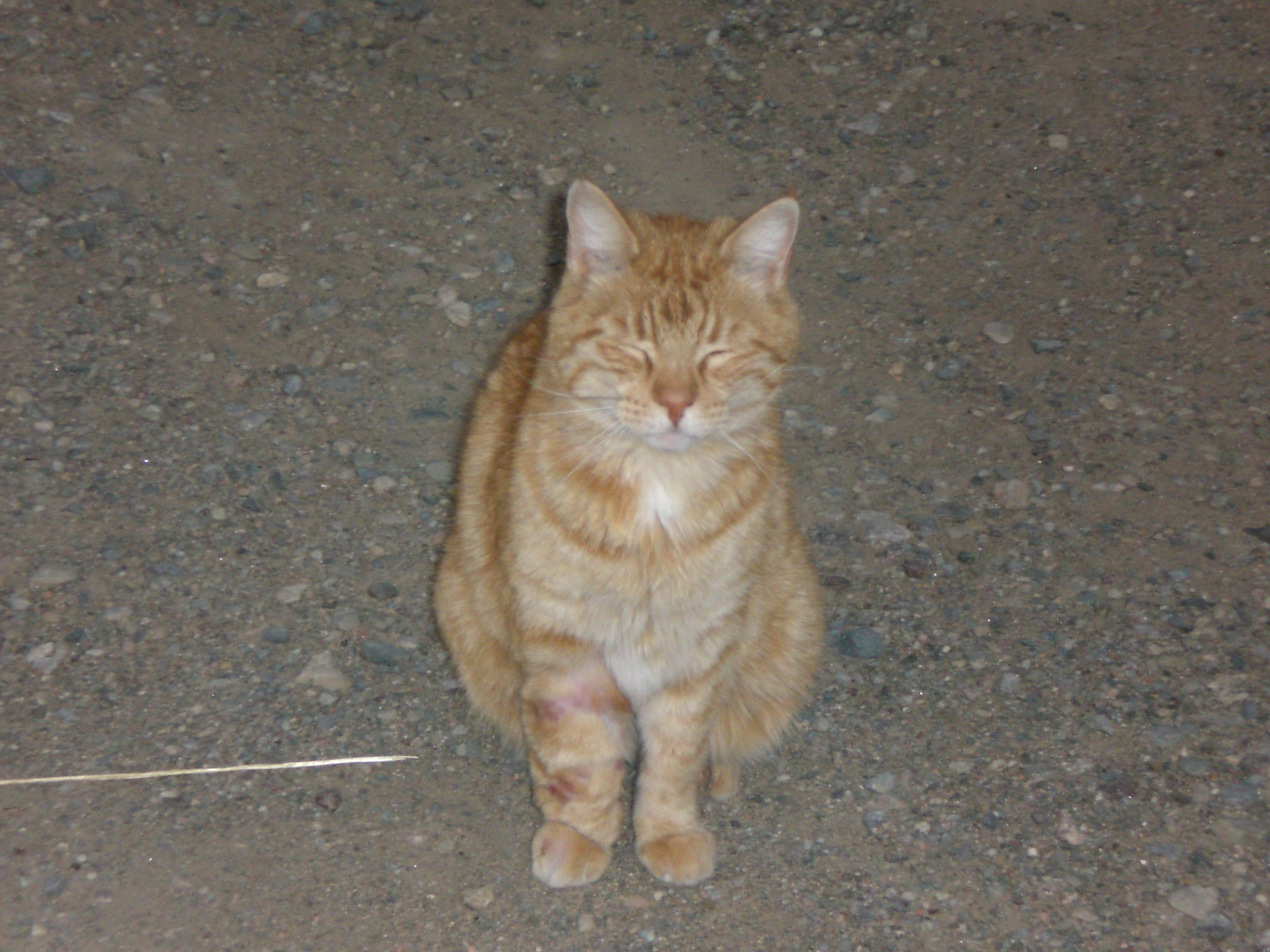
A goodly number of years – and quite a few short-lived cat visitors – later, I was gifted to share space with Haiku, a ginger tom whose disposition was a charming balance of feistiness and affection. He enjoyed the several dogs (a Bouvier, another Lab, a Scottie and my first Shih Tzu) and was not averse to sleeping beside one, or tussling for a bone with another. Indeed, his personality was so like that of Daisy, my departed beagle, that I sometimes wondered if he wasn’t her reincarnated essence.

Handsome Haiku

Handsome Haiku

Haiku was a hunter – solo but also in company with whichever dog felt like going after a rabbit or dove. He would stalk prey, flushing it toward the waiting dog, then join whichever canine (usually the Lab) in pouncing on the heedless rabbit, or jumping into the air to snap at the dove. Together the pair were successful a surprising number of times. Haiku usually left the carcass to his canine teammate – his was indeed the thrill of the chase, more than the achievement of a goal.

Late in his life, Haiku became a test subject for an anti-cancer treatment being developed by a chemist friend of mine, in partnership with a research biologist from Arizona. Haiku grew a tumor on his foreleg which resisted surgical removal, growing back quickly and so deeply that the only further surgery possible would have been an amputation. The anti-cancer medication had, at that point, primarily been tested on mice. Calculating an equivalent dosage for a cat, my friend and I started Haiku on a weekly series of injections to which the tumor responded by softening and growing at a markedly slower rate. My vet followed the experiment with interest – and helped me ease Haiku onward when his system began to shut down as a result of the combined stress of the cancer and older age. He made his mark, not just in my life, but via his test data which went into the pool of information being used in further development of the anti-cancer treatment. A noble contribution from a noble creature.

Miss Socks

Miss Socks

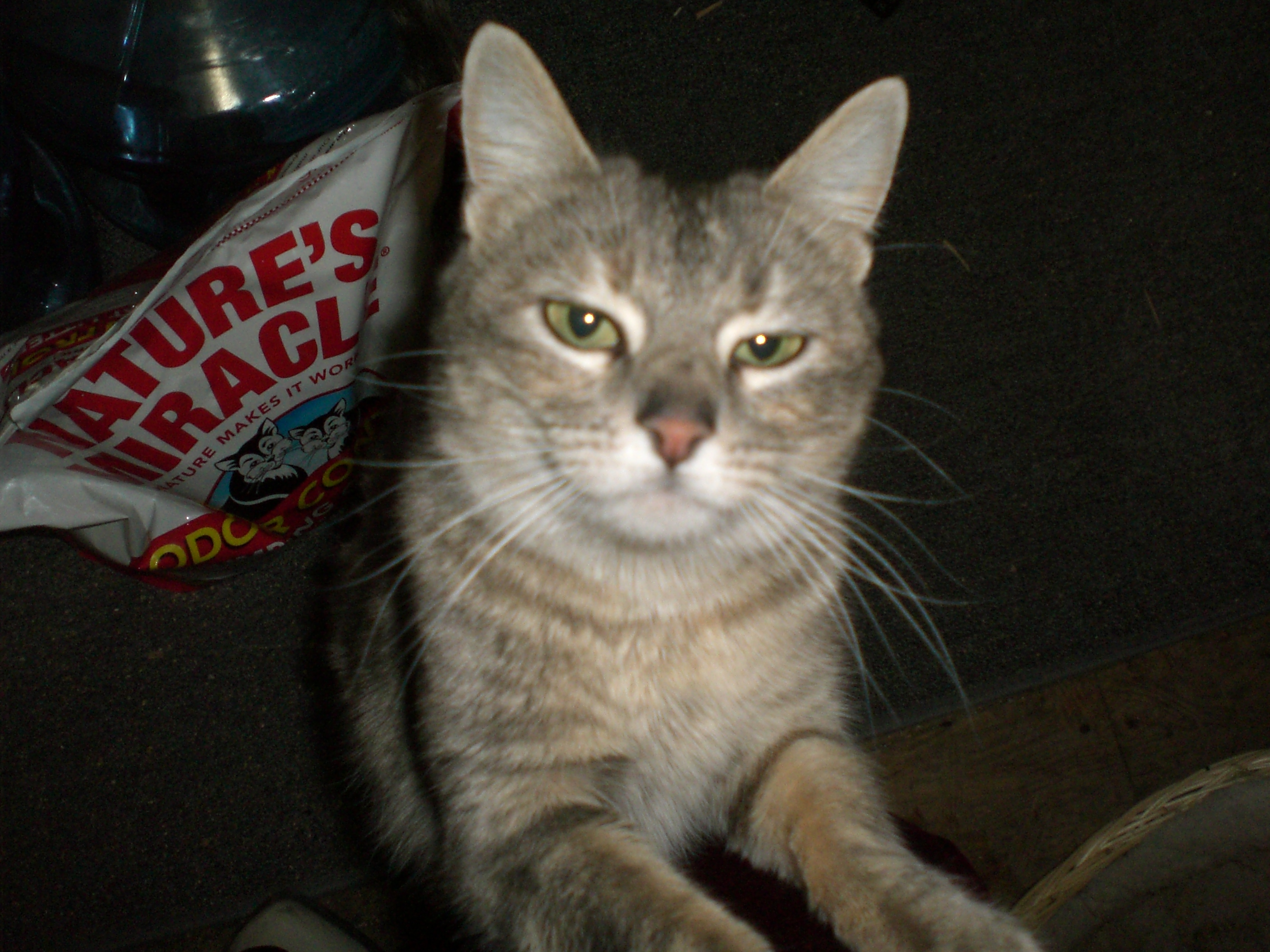
The three most recent cats in my household have been Socks, Limerick and Noelle, all rescues, the first two of whom lived with us for relatively short periods of time. Socks took up with my Bouvier, both of them older and sedate, enjoying sleeping together in the sun. Like a long-married couple, they died only a short time apart. Limerick arrived – and left – by moonlight, spending only a few months with us.

Limerick in the Light

Limerick in the Light

Noelle, now five years old, was a Christmas gift, rescued as a kitten by a neighbor and presented to me “as holiday company.” For an animal born wild, she took to indoor life with alacrity, claiming the utility room as her home and only going out if I carry her to a perch high up under the carport. She hangs out in the rafters, fussing at the dogs and demanding to be transported back to her indoor residence, yet requiring persistent persuasion to come down within my reach. Once back indoors, she hides from just about everyone who has reason to enter the room (she dislikes the noise of the washing machine but hums along with the dryer). Her favorite places to perch are wrapped around the vent pipe for the hot water heater, or atop a box in the room’s south facing window. She has also made herself a hidey hole under a low shelf and it is there she retreats with a flash of tail, if a stranger enters the room.

Noelle

Noelle

Noelle is a talker – but only to me and one aide, who works with my housemate on Sundays. She is affectionate with the two of us, but avoids other people, even those who would lavish affection on her. I don’t know why – she’s not had any negative experience of people in all the years she’s lived with me. Her inscrutable cat reasoning, I guess.

I recently received a cute, animated set of pictures from a friend, illustrating the stereotypical difference between dogs and cats – the dogs generally bouncing in excited response, the cats indifferent to whatever is offered them by their people. What my several cats have taught me is that differences between and within species are more nuanced, closely mirroring the differences between humans.

Or perhaps, what I observe is merely the truism that our pets become mirrors of ourselves? In which case, I guess I defy classification, being sometimes aloof, sometimes affectionate, generally independent, usually friendly, occasionally on guard, rarely wary, never mean, often changeable, my bad moods short-lived. I like to play, love to cuddle, enjoy affection but still, when all is said and done and now that I am in the latter years of my life, I am Kipling’s “cat, who walks by himself.” So be it. Amen.

Words of Communication

October 26, 2013

Driving down I-25 toward I-40 in Albuquerque, I passed through more than one weaving section – those complicated stretches of road where it seems everyone is trying to get into a different lane, coming up from an on-ramp or trying to reach the off-ramp or to position themselves for the upcoming interchange where two major roads meet or diverge. I know the term weaving section courtesy of a transportation planner with whom I had a relationship a very long time ago. He also taught me to drive competently and safely. Thank you, Ray.

Once through the series of weaving sections, I traveled from southbound I-25 to eastbound 1-40 via a flyover – or that’s what my British friends would call it (I know the term courtesy of all the British authors I’ve read over the years). A flyover is the part of the interchange that takes you up and over other lanes of traffic, what we in America call an overpass. As I passed over (flew through at high speed) the interchange, I remembered a number of other lessons in American versus British English, these taught me by my Uncle Eric and Aunt Hilda in Sheffield when I was still a teenager. In (I hope) mock horror Hilda scolded my use of wash cloth (only for cleaning dishes) when what I wanted was to clean my skin (using a face flannel). She was also upset that I called her garden (grassy with flowers) a yard (bare dirt or pavement). And she made it clear that the soil in her garden was earth, not dirt!

My venture into reflection on terminological differences arose following my attendance at an emergency planning conference – more properly the New Mexico Local Emergency Planning Committee Annual Conference – at which a number of intelligent, engaged, caring and thoughtful people tried to convey their knowledge and expertise to a largely receptive audience. My problem with the conference was not in participation, nor content, but in the strange transmogrification which occurred in the speakers – from competent communicators to committed users of stilted government-speak. Several of the presenters tried to include humor in their talks; all had the ubiquitous power point at hand for support; some also added pictures and graphics to illustrate key points. But the bottom – common – line amongst almost all of them was their use of that strange obfuscation which passes for communication within bureaucracies.

Ah, you’ve noticed my inclusion in these paragraphs of big words. It’s fun, sort of, to fall victim to that of which I am complaining. Here, I’m changing my usual form of communication for fun, and with intent. The presenters did not alter their delivery for fun. They seemed, rather, to feel the need to assume a formal persona because they were presenting a talk. As though who they are/how they speak normally was not good enough or important enough to give a conference presentation. One exception was the only attorney to make a presentation – he is so at home in his public delivery that there was no discernible change in him (except voice projection) when he stopped chatting over lunch and stood to give the luncheon address.

I’ve coached students learning to write essays for school, and encountered a similar perceived need to drastically alter their manner of communicating. One teen with an engaging ability to tell stories, when asked to turn the story he’d just told into an assignment for English class, became the written equivalent of tongue-tied (pen-tied, computer-tied?).

“How do I begin?”
“Just start telling your story.”
“I don’t get it. How do I begin?”
“Pretend you’re talking to me and just put the words on paper instead of speaking them.”
“But how do I start? Where do I start? How far back should I go, to get the reader to understand what the story is all about?”
“How far back did you go when you told me the story just now?”
“I didn’t have to go back because you know me.”
“So pretend the reader knows you and start the way you started with me.”
“But the reader doesn’t know me and might misunderstand.”
“Write it like you’re writing a letter to me, then. You know I won’t misunderstand.”
“So do I start with “Dear Ms. Sebastian”?”
“If that lets you get into your story, go for it.”

It would seem that wanting to communicate, for many people, contains within itself the root of lost ability to do so! It is a painful truth for stutterers, that the more urgently they desire to speak, the more inhibited that speech is likely to become. Some stutterers overcome the problem by taking singing lessons. Next, they think of singing their daily speech, and the words come out fluently. I aimed for a similar transfer of skills with my encouragement of my writing student to tell me the story on paper just as he’d told it aloud. He did write me a letter, then transferred the body of the story to essay format, and got a good grade on the paper.

I’m convinced that effective communication – whether in a formal presentation or a chat over tea in a garden – is not about the words one uses, not about the style, but about having a comfortable sense of oneself, and an intent to communicate. The presenters at the conference became ensnared by their efforts to appear as some formalized image of themselves, perhaps labeled “the professional”. The student, a natural story teller, was blocked by replacing his intent to communicate with an intent to “be a writer”. Many people, convinced that they won’t be understood, don’t try to express themselves at all, and become the fulfillment of their perception, going sadly misunderstood through life.

The simplest injunction to give to someone undertaking a new communication task is “be yourself” – yet it is also, often, the hardest one to manifest. How many of us really have “a comfortable sense of ourselves” that we are willing to expose through our written or spoken words? To become a good communicator then, there are in fact four necessary steps:
1) Know yourself
2) Be yourself
3) Trust yourself
4) Express yourself

Just four steps – but ones it often takes a lifetime to learn.

It’s No Coincidence

October 19, 2013

This piece has been written in sections, over time. I began it back in early August, completed it just a few days ago. Gaps in time are indicated by a change in typeface, as well as by subsection dividers.

++++++

It’s no coincidence – I’m certain it’s no coincidence – that I spent time this morning writing out my answer to the question, “What do you fear about moving forward?” and within half an hour of finishing the exercise, received a phone call giving me the opportunity to push into fast forward. I accepted the offer (a well-paid job doing work I generally like) despite my identified reservations. Identifying the reservations let me see that they are not insurmountable challenges, merely conditions which will necessitate new adjustments to my schedule, diet, work habits, writing goals.

++++++

Nor is it coincidence that things come to hand just as you need them. I’ve been having a discussion with writer friends, and reader friends, about how to intermix inner thought with third person narrative in my novel, in a seamless way that will pass muster with editors. (Editors are known to object to the mixing of points of view). Various suggestions have been made, including using italics for the thoughts. I tried the italics and don’t like them – they jar my awareness, as a reader, pulling me out of the flow of the story to register the fact that some change is being made apparent. I also rejected elimination of the self talk/thoughts/inner monologues solely in order to meet a style ‘rule’ that I know has elsewhere already been broken.

Ready to turn my novel rewrite back on itself, and find a way to signal shifts to first person without the jangle of italics, I was forced to turn off my computer and unplug from power to assure protection of the equipment from a fierce thunderstorm raging overhead. Reading lights have been flickering as wild electricity jumps from the sky to disrupt the flow of its domestic kindred through the lines in my house. I picked up the book I’ve been reading – Dorothy Sayers’ Busman’s Honeymoon – and there before me was a chapter of exactly the sort of intermixed action and thought I’ve been considering. It works – it reads smoothly, no italics, only here and there a couple sentences set apart within parentheses, which I find an unnecessary distinction. A separate paragraph would be equally effective and clear.

Posing the question to the LinkedIn group Authors, Writers, Publishers, Editors and Writing Professionals brings more valuable input, including recommendations for good reads which effectively mix first and third person viewpoints. I have my answer – a good writer can pull off the violation of rules. It is up to me to assure that my writing is good enough to do so.

++++++

That I write well is no coincidence.

It is the product of early indoctrination, a great deal of practice, and continuing learning. I finished a blog post (Ba Gua Lessons) in the morning, and then at noon participated in Lesley S. King’s free telephone class on vivid writing. She offered the session, full of helpful guidance, as an example of what one can experience taking a writing workshop she will be producing soon. I hung up from the hour and went back to review what I had written earlier.

Look Ma, I used present tense, active verbs, multiple senses… I hope I engaged my readers, asking questions, encouraging the possibility of dialogue. But I can do it better, as evidenced by my desire to tweak a sentence here, add a challenge there. What I gained from Lesley’s class was a framework for evaluating my writing, a standard against which to stretch myself further. Good writing is fun, it’s my passion, I don’t consider it work… but it does require effort, absence of ego, an open mind, curiosity, and an unfettered willingness to learn.

It is no coincidence that my encounter with Lesley – who encourages writers to build a career from their writing passion – comes at exactly the moment when I am choosing to once more put writing into second place in the prioritizing of how I spend my time. My new job will initially require enough attention that I can meet my commitment to myself and my readers with weekly blog posts, but am unlikely to do much more about building my platform (the latest word for audience), or marketing my novel.

I am not abandoning a writing career; I am accepting that I’ve been offered an opportunity to do something else I care about (assisting others to access services which help them live their fullest potential despite health issues), and to meet an external financial need, while I learn to maintain a balance between competing interests. Not an either/or choice, but an integrative one. Continuing to write is a crucial part of “taking care of myself” – that imperative frequently stated but not so easily implemented. One of my writing projects, a book of creative suggestions for managing the challenges of Parkinson’s, will undoubtedly be furthered through my new job.

Mind likes to create dichotomies. It suggests that just when my focus on writing is beginning to morph into a career, the rewards of my efforts are being taken out from under me. Mind might think so, but I don’t! Instead, I’m being offered the opportunity to meet both outer and inner needs, to manifest balance not only in the activities to which I give my attention, but in the way I blend social interaction with quiet time, and productivity with stillness. I don’t know yet how this balance will manifest; I’m looking forward to discovering the various ways it will express itself. The one thing I do know, with certainty, is that its place in my life at this time is no coincidence.


Only Fragments

Love Letters to the Tar Pit

KarusaaVerse

Words that Sparkle, Thoughts that Ignite: Fueling Your Imagination

Leaf And Twig

Where observation and imagination meet nature in poetry.

Millarson Diaries

Personal Musings and Thought Experiments

The Beauty Along the Road

Discovering Beauty in the small details of our lives

Flowerwatch Journal

Notes on Traveling with Flowers

1eclecticwriter

Wide-Ranging Commentary

Spirituality Exploration Today

Delving into the cross roads of rationality and intuition

smilecalm

Life through Mindful Media

A Good Blog is Hard to Find

I will shatter a word and scatter the contents into the wind to share it with the world.

Ray Ferrer - Emotion on Canvas

** OFFICIAL Site of Artist Ray Ferrer **

AKA The Versatile

Fashion | Lifestyle | Food & Travel | Beauty | Fitness | Education | Product Reviews | Movies | Doodling | Poetess

Aging Abundantly | Women Over Fifty | Empty Nesters | Caregivers | Aging Gracefully

Finding Joy at Every Age with writer/philosopher Dorothy Sander

ARTZZLE

Helping with the Pieces in Life's Puzzle of Art and Design

Project Light to Life

A bucket list blog: exploring happiness, growth, and the world.

The Daily Post

The Art and Craft of Blogging

Any Shiny Thing

MIDLIFE MAGIC

allmostrelevant

@allmostrelevant

The Irrefutable Opinion

Assaults on the Casually Mundane by K. Jean King