Archive for the ‘humor’ Category

O.A.S.?

May 1, 2024

I am woefully ignorant of the texting/social media abbreviations that increasingly occur in the crossword puzzles I used to enjoy as brain stimulation, but now too often toss aside in frustration as unsolvable unless I first take a course in Gen Z culture and textisms. On the other hand I immediately translated my first encounter with OAS – old age syndrome – in an email from a neighbor and friend of my generation even though she used it with minimal context, just saying she was “doing okay other than OAS”.

At about the same time, I interacted with the young woman whose debut website triggered my most recent post. Following from that recently posted reflection has been an extended meditation on the possible benefits of – and my strong inner resistance to – what is now often referred to as Swedish death cleaning.

    (Inserted peeve: the thinks- it- knows- better- than- I- what- I -want- to -say built in grammar monitor is trying to tell me to write “following that reflection” when I do indeed mean following from as in triggered by and derived from, not just coming after in time. I hate the unavoidable, embedded, programmed critics which do not know nuance, nor formal grammar, but try to dictate how I express myself! )

Having undergone the challenge of sorting, selling, discarding or keeping my family belongings after my father’s death many years ago, I fully appreciate the kindness done to survivors by paring down beforehand. Facing the prospect of undertaking such a project myself I equally appreciate how reluctant I am to do so. At first I merely excused myself with the assessment that my energy levels weren’t up to the task (an aspect of OAS). With restricted energy and a goodly number of daily have-to’s, I want what extra energy I have used for more pleasurable activities than sorting and selling or discarding or keeping a lifetime’s accumulations. Having already lost much of what I valued as my personal history to last year’s wildfire, the items remaining seem almost vital to my sense of self.

Yet they are not. Viewed objectively, many of them simply occupy spaces that my eyes are accustomed to seeing them in. Especially the books I have read and will not reread, but keep like old friends, their covers and titles reminding me of the pleasurable time I spent with them in the past.

As I have lived with these conflicting motivations – to simplify and to keep – over the past several days an underlying perspective has emerged. I don’t think the issue is really a tension about things, but rather an inner argument about accepting or refusing to transition from one stage of life to the next. Since retiring something over three years ago, I have not enjoyed the anticipated opportunity to pursue interests that my demanding work life prevented. Covid did not help – nor did the emergence of unrelated health challenges most probably released by my reduction in stress-driven energy. (I relate to the recovering alcoholics who bemoan not being ill until they sober up.)

Looking back over these recent years of retirement, I see a person who achieved (survived) a great deal, coping not just with a health decline but two successive years of wildfire evacuations with extensive losses from the second one, while adding a stepson to my household, overseeing reconstruction of our home, and continuing my role as support to a husband focused on career advancement. Recently several people have described me as courageous. I have not thought that adjective to be descriptive of me – but perhaps they are correct? Is it courageous to push through the demands of each day while trying to be helpful to others whose needs are often urgently disruptive of my planned allocation of time and energy? Or am I just stubbornly refusing to let OAS define me?

I am aware of the often advised benefits to older people that they interact with younger ones to stay engaged and vital. For those with children and grandchildren this sort of interaction often comes naturally, especially when retirement is accompanied by relocation to be nearer to one another (the move usually also producing a paring down of things to the basic essentials). Having no children and hence no grandchildren, my recent acquisition of young step-children feels simultaneously appropriate to following this advice, but also intrusive and an interference with achieving the flexible and free “me” time I had anticipated as a retirement reward. 

“Man proposes, God disposes.”

Now I wait, trying to do so patiently, for inner guidance on how to balance my desire to still be the younger version of myself, physically active and energetic throughout the day, meeting the needs of family – with also taking time for myself and my long postponed travel and new learning interests that were the promise of retirement. Often, so far, it seems that I am that courageous “doing” person from my 6AM rising until about 2 in the afternoon, when I become an exemplar of OAS,  using the description to excuse resting on the couch, reading and extending my Wordle and FreeCell streaks. Not the image of myself I would choose – but apparently the one I need to accept. 

For now, so be it.
The Cruelest Month

March 13, 2024

March is the cruelest month. Despite years of knowing it is full of false promises of spring followed by bitter cold, often heavy wet dumps of snow, and chilling winds, I am unable to find balance as the temperatures swing from highs of mid sixties to lows in the teens and clouds chase away early morning sun even before I get out to feed the chickens. The persistently inconsistent weather has pushed the replacing of my septic system back and back and back again, as four consecutive days of dry weather are needed to do the work – and the delivery driver bringing the new tank has been unavailable twice, in the only weeks when those four days could be predicted. A lesson in patience that I don’t really need, after the past 9 months of being patient with an untimely contractor restoring my home from its damage in last May’s wildfire.

But maybe I should call May the cruelest month, as the Hermit’s Peak/Calf Canyon fire catastrophe of 2022 that smoked but didn’t burn me, and the 2023 Las Tusas fire that destroyed chunks of my property and damaged the house both occurred in early May. This year’s May should not be a threat, as there is not enough vegetation left to feed another wildfire. Not that insurance companies recognize that it is quite safe to insure my neighborhood now… but that’s a topic for another day.

Maybe it’s November that is cruel, forcing us out of daylight saving time and back into darkness at the end of the workday, just when we most need a bit of extra daylight to shop in preparation for the winter holidays?

No, I’ll stay with March. The hope-followed-by-disillusion cycle occurs annually and repetitively throughout the month, aggravating my already unpredictable ability to function on any given day due to an autoimmune triggered depletion of energy. 

Yes, I hear you. Appreciating the immediate present is a way to cope. Detach from planning, go with the flow, all those fine sounding suggestions that do sometimes help. They don’t produce a new homeowner’s insurance policy that depends on completed restoration of the property that depends on consistent enough weather to do the exterior finishing work.

April, please hurry up and get here! Thank you.

The Saint and the Snake

February 1, 2024

The first truly winter snow of the season , earlier in January, caused me to miss an appointment and reschedule several days of plans as I was confronted with yet another after-effect of this year’s wildfire (not the big one that consumed most of northeastern NM last year but the much smaller one that did in about ten of us who had been only slightly singed the first time around) in that my four wheel drive Envoy was crisped and I have not yet been able to replace it. I am grateful to have friends who enabled the rescheduling, and I did appreciate the gift of a quiet couple days at home.

The rebuilding process has been arduous – delay after delay, poor or no communication as to why, piles of building materials blocking the entrance to my house and creating what has felt like a fiercely threatening fall hazard for my achy body. Thankfully the worst of that danger has been removed as some of the materials just went into a new carport – still unfinished but of some partial use protecting my car these winter days.

Taught to look for useful “takeaway” lessons in the challenges life throws at me, I find I am learning to deepen my patience and to become more clear about when to just let things be and when to push against what feels truly wrongful. In that context, I was much taken with a parable I encountered in Forgive for Good, by Dr. Fred Luskin. It is not long, so rather than summarize, I am copying it out here.

“A long time ago a village had a saint living near it. That saint walked among the hills and one day came upon a rattlesnake lying in the grass. The snake lunged with its fangs bared and made to bite the holy man. The saint smiled, and the snake was stopped by his kindness and love. The saint spoke to the rattler and asked the snake to give up biting the village’s children. He said in that way the snake would be better liked and cause less harm.

Because of the power the holy man possessed, the snake agreed to stop biting. The next week the saint walked by the same spot and saw the snake on the ground lying in a pool of its own blood. The snake used what little strength it had to admonish the saint for almost killing him. “Look what happened to me when I took your advice. I am a bloody mess. Look what happened to me when I tried to be nice and not bite, and now everyone is trying to hurt me.” The saint looked at the snake, smiled and said “I never told you not to hiss.”

I would say that the big lesson for me these past 8 months, and ongoing, is knowing when to stay quiet, and when to hiss.

A parallel ongoing lesson has to do with managing one symptom of a recently diagnosed autoimmune disorder. It causes pain but that is fairly well under control. The unpredictable deep fatigue is not. I am still sorting out how much exhaustion comes from overdoing physical activity, how much is my body’s response to weather changes (barometer body), what arises from digestion issues that the new disorder has exacerbated, and what comes from stress. On a truly bad day, I know that all four are contributing. I have learned my physical limitations, and am beginning to understand the digestion dynamics. I can do nothing about the weather – which leaves stress as the main uncontrolled variable. 

Needless to say, managing a major restoration of my home is stressful. No less so is the task of letting go of a lifetime of being a planner and organizer, and instead to “go with the flow” as weather fluctuations dictate my portion of energy for any given day. Slowly I seem to be learning to sort the absolute necessities out from the list of “want to’s”, to recognize when my energy is waning, and to judge if I can take a break and resume, or need to quickly finish the few mandatory items and postpone everything else. Slowly I am learning to hear the wise inner voice that gives flawless directions for how to negotiate each day. And happily I can hear in myself the excellent indicator of impending energy collapse  – nearly constant hissing.

Next step? Hear and follow the flawless directions, obviating the need to hiss.

Et Cetera

August 19, 2019

I haven’t heard if there’s a politically equivalent term for compassion fatigue but if there isn’t there should be one. Or maybe compassion fatigue can be extended to my present state of exhaustion with constant demands to “support this”, “sign if you…”, “tell your Congressman,,,”, “urge your Senators…”, “protest this”, “vote for…”, et cetera, et cetera, et cetera.

(Old enough to hear Yul Brenner’s voice pronouncing those words?)

I recently spent part of a Sunday systematically removing myself from mailing lists of one group after another, clearing out my email inbox and hopefully leaving only a few daily news summary feeds, and requests from the single advocacy group that responded to my demand for assurance that if I sign something on their behalf, they will NOT share my information with any other organization. I actually received a personal response guaranteeing that Issue One does not share its mailing list with any other group, and I am therefore staying connected to that advocacy site, which is a bipartisan focus on restoring integrity to our governing system.

In the process of surviving these past months of ever increasing anger, outrage, brutality, fear-mongering, disgust, determination et cetera, et cetera, et cetera (Didn’t he have a mesmerizing voice?) I have also come to take even greater pride in my home state of New Mexico, felt most keenly on the last (2018) election day. While we too often come out near the bottom in national surveys of graduation rates, maternal health, pregnancy rates of high school students, and similar social measures, my state is decidedly in the very top tier for the integrity (and verification of that integrity) of its elections, as well as for inclusiveness of all social and racial and ethnic groups, et cetera et cetera, et cetera in our state and its political process. No gerrymandering accusations, all inclusive voter registration opportunities (driver’s license and public assistance applications both include an invitation to register to vote if eligible), and accessible voting sites with ample early and absentee voting options.

I felt deep pride as I marked my paper ballot, watched it being scanned into a reader, saw the recorded count indicator tick up one, and noted my individual voting number to use if I should wish to verify that my votes were recorded exactly as I cast them. No races in the state were close enough to require recounts, the gubernatorial transition went smoothly and New Mexico moved forward with its familiar absence of presence on the national news, other than noting that we elected one of the two “first” Native American women to the House. The fact that we were the first state in the nation to have two women competing for governor (back in 2010) did not make the national news. And there was also no coverage on-line of the fact that the most recent transition in the governor’s office was from one Hispanic woman to another Hispanic woman. 

I rarely watch television – don’t have reception in my home – so I cannot confirm that the national news still omits New Mexico when reporting on weather events in the southwest. My father was the one who first commented that the announcers will talk about California, Arizona and Texas skipping New Mexico entirely. I reminded him of the cite in Milagro Beanfield War describing “poor New Mexico, so far from heaven, so close to Texas.” Then I remarked that the quote most probably did NOT originate with a New Mexican, as many of us feel we live pretty darn close to heaven in our beautiful state with its clear star filled skies, amazing sunsets, varied terrain and dramatic weather variations across a single day. I am happy to add to the heavenly aspects the warm reception given to Vietnamese refugees, to a growing Muslim population, to survivors of Katrina who chose to settle and stay after what they had thought would be a temporary evacuation, and even to Californians, New Yorkers and yes, Texans.

The look of the House of Representatives since this past January, was touted as the most diverse ever, and closer than ever to reflecting the diversity of our nation. Would that a little more notice might be taken of New Mexico’s diversity, and the extent to which a singularly poor state manages to balance the differing priorities of that diverse population.

Or maybe it is better that we continue to be overlooked, omitted, frequently thought to not even be part of the U.S.?

Left to ourselves we have been largely spared the uglier aspects of the current national scene, though we have had a couple shooting rampages and quite a number of incidents of cronyism and corruption that have taken too long to be exposed. Left to ourselves, we do expose them – like the President and members of the Board of Directors of Luna Community College who were ousted after nearly costing the school its accreditation. Or the fire chief, his daughter a payroll officer, and his friend who is also an official in the fire department of Mora County who were fired after an investigation into misuse of County funds.

That is the same Mora County, historically the poorest county in our poor state,  which became the first entity in the nation to attempt to pass a local ordinance banning fracking within its borders. They were ultimately unsuccessful at establishing legal precedent, but they did bring the oil and gas exploration effort to a halt for long enough to enact needed strict controls on the exploitation process.

I could identify other positive “firsts” New Mexico has achieved which have also gone largely unnoticed at the national level. But this post isn’t about bragging on my home state. Rather, I set out to write my way toward a less exhausted frame of mind, hoping to find inspiration to remain engaged enough to continue reading the daily news feeds that I will receive from those few sources that give me facts without a deluge of demands for money or petition signing, or other prodding to action that would once again put my email address onto countless other lists.

I’ll let you know in time, whether I’ve succeeded. For now, I can reiterate that I’m proud of how New Mexico handles its diversity, assures the integrity of its voting process, and quietly goes about achieving first in the nation status for choices I think important. Et cetera, et cetera, et cetera.


Shape

April 21, 2018

Something I read recently got me thinking about how deeply embedded early self-concepts can become, and how amazingly difficult they are to reverse. I entered my teens while living abroad, amid Asian women who were generally both shorter and more petite, thin, wiry of build than I. My mother, afraid of my developing sexuality, critiqued my figure and urged that I hide my curves under loose-fitting dresses. One exact statement was that if I cinched my waist in, as was the mid-fifties fashion, it made made my hips look “so big” that I should never wear slacks. I still can feel the discomfort and embarrassment of being out-sized that pursued me through my teens and into my 20’s, although when I look at pictures taken of me in those years I see a very shapely young woman with the hourglass figure that I have since learned men find very desirable. Exactly what my mother was panicked about, undoubtedly.

With an odd sense of shock I was struck earlier today by the realization that I weigh very close to what I did in the last years of high school and through most of my college years. I’ve been significantly heavier between then and now, and take pleasure in the accomplishment of being at present much as I was then. What I am finding difficult to reconcile is my lingering awareness of how unacceptably big and unattractive I felt then, compared to the compliments I receive now on my figure and how I look in my clothes – especially on those still rare occasions that I wear pants rather than a skirt.

An analysis of the challenges associated with keeping lost weight off includes the necessity of becoming comfortable with a new body image. Many women, apparently, continue to see themselves heavy even after they have reached a desired weight goal. Taken to extreme this becomes the illness anorexia. I don’t think it is just one’s own body image that is misperceived, but an amalgam of images from fashion and films that blend with one’s sense of oneself in  a hodge-podge of sticky discomfort. It did not help my teen self to have Twiggy be the height of British fashion. Nor the tall, pencil thin models of French fashion houses. Marilyn Monroe’s curves were presented to me as implicitly “not okay” because of their “blatant sexuality.”

I know that all cultures have standards of beauty against which women are evaluated. Sloping shoulders were highly desirable at one time in Japan. In many African countries it is still considered preferable to be of a warm, light brown color rather than deep black, although that is changing. Ample hips and buttocks are believed to indicate fertility and are therefore positive attributes in many cultures – though not in my adult lifetime in the U.S.

Whatever the norms, sadly and consistently the primary victims of them have always been and still are female. Progress has been made toward acceptance of a wider standard of attractiveness, but from my conversations with young women, the body shaming continues.

My concern in reflecting on this pattern is not particularly about progress – or lack thereof – in the images our society holds up as desirable for girls. Rather I am interested in how tenacious are the often illusory images we hold of ourselves. How can I look at pictures of my young self and see an attractive and shapely woman, while simultaneously still vividly inhabiting the fat and unacceptable body self I experienced at that time? Reason is insufficient to erase emotions.

Hmm, this is the second time in recent weeks that I’ve encountered a situation in which reason and feeling collide – and feeling dominates. Advice given to any professional working with people who are upset or more seriously emotionally disturbed is consistently to not argue with their faulty conclusions but rather to focus on creating an atmosphere of safety and trust. The first step to doing so generally involves acknowledging their feelings. Therapists working with couples usually set parameters for communication during sessions that begin with instructions to listen to the feelings being expressed and refrain from saying any of these are wrong. Feelings are what they are. They tend to gain in power by being denied. To change someone’s feelings about a situation (or past self image) it is useless to reason that the feeling is wrong.

What does seem to have power to alter feelings is new experience perceived from a new framework which can be related back to the earlier events. In my case, the first new experience I recall occurred when I was visiting with relatives of my then husband in Cincinnati. Mel was what is now called “a person of color” with Native American, black and white genetics, whose extended family lived within the culture of Black Americans. As I left the room where we had all been sitting I heard Mel’s aunt remark that I had “big old fine pretty legs” in a tone of appreciative praise. Those “big” legs were then the primary source of my negative body image, in conjunction with the hips to which they were attached. The emotional impact of that statement was so strong that I can, still now, feel myself sitting in the bathroom to which I had headed, trying to connect what I heard with what I felt and totally unable to see myself as Mel’s aunt evidently saw me.

Over the years, feedback from people whom I trust has helped me evolve a rather more positive self image though it is still a work in process, as evidenced by the latest realization – that I am now very much as I was 55 years ago when I felt so unacceptably large. Most days now I can look in the mirror and feel good about myself. That I am a size and shape admired by my husband certainly helps.

So I presently feel good about the same outer physical condition (objective reality) that once made me feel uncomfortable and shamed. Nothing has changed, according to mind; everything has changed according to emotion.

Yet we wonder why, across a wide range of areas, belief based on feelings is so impossible to alter with rational argument!

Instead of “I think therefore I am”, we manifest “I feel therefore I know it to be true.”

So much for the illusion of rational humanity being – because we can reason – at the top of the evolutionary chain.

Practicing Patience

January 13, 2018

The winter storms keep missing us. We get the wind and the cold but not the moisture that is being dumped so plentifully to our north and across the midwest. I remember reading a projection that north would be exceptionally cold and we in the southwest would be noticeably warm across this winter. So far it’s been an accurate forecast.

In some previous similar years, the consequence of this weather pattern has been particularly heavy spring snows, the kind that leave us without power and snowed in for several days, but which then also melt off quickly so that once we can get out, we can drive without the hassles of icy roads. For now, it’s wait and see.

I wouldn’t be concerned at all one way or the other, but my job has me on the road for 50-90 mile one way trips with sufficient frequency that I have to be aware of weather risks – especially in February when the combination of an exceptionally short work month and a markedly heavy workload intersect and make scheduling my travel a critical component of meeting all the deadlines. A day or two unable to get out to my appointments may well mean I don’t get the month’s work completed. Reminding myself I’ll just have to wait and see.

In the meantime, it’s cold enough (or the daylight hours are reduced enough, I’m not sure which is the determinant) that the hens have stopped laying, but not so cold that I have to wear my heavy winter coat. Concerns about renewed drought do not prevent me from enjoying the mild and sunny afternoons that entice me to go walking. For how much longer? Yes, you know the refrain now – we’ll have to wait and see.

Mini-mind

January 6, 2018

It’s another one of those evenings when I find myself playing solitaire, alternating with reading. One of those evenings I have identified as better spent writing (and reading) so that when I look back I will feel I’ve been productive rather than mind-numbed, zoned out, and wasting time.

When the book is particularly engaging, I just read. If I’m not reading steadily, why don’t I just put the book away and find another? Old habit, I suspect, and that internal voice lecturing about finishing what has been started. You’d think I’m old enough to disregard the habit and the voice, but apparently not. Hmm, another pattern to review and see why I am still controlled by it.

That is, in fact, what most of my reflection periods seem to be about these days – reviewing the whys and wherefores of any number of habits of behavior or thought, to consciously decide if they are worth maintaining or if it is time to be freed from them. In many cases, the final outcome is not really either option, but rather a choice to maintain the behavior or way of thinking as a tool to be used at times and ignored at others. In essence I transform the unconscious habit into a chosen action for those situations where it will be truly beneficial.

Follow this lovely road to freedom from the tyranny of mental constructs.

This way to freedom from the tyranny of mental constructs.

Theme and Variations

November 22, 2015

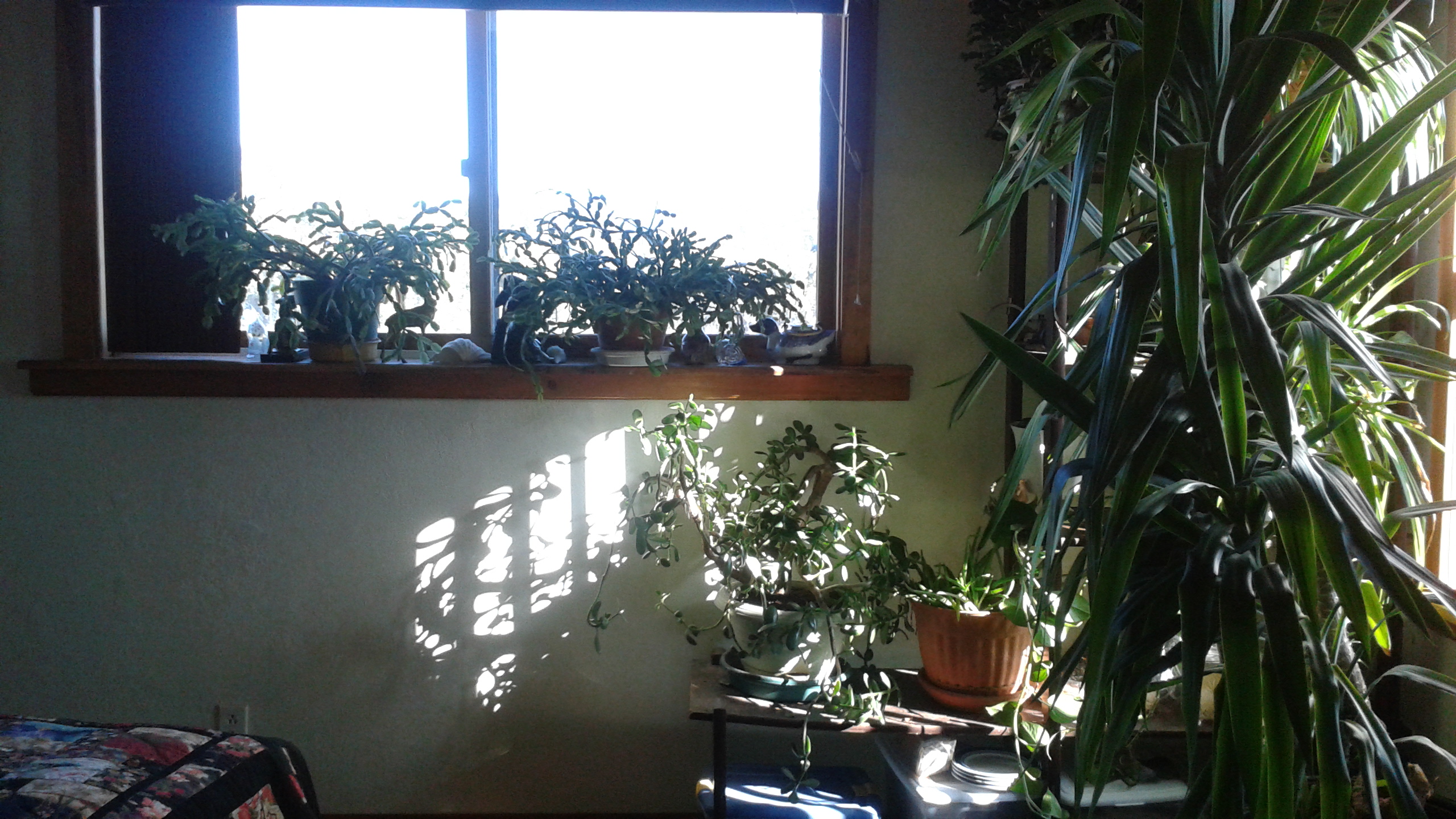
After several days of wood-stove heated cold weather, the temperature has soared to cotton shirtsleeve comfort, and an afternoon originally intended for housekeeping has turned into one spent on whatever could be completed outside in the sunlight. For my husband, that has meant washing cars. I, meanwhile, cooked some of his habanero pepper sauce on the outdoor grill (its bite sets everyone sneezing and crying if prepared inside) and re-potted houseplants. Or rather, transferred cuttings that had taken root in water into new pots, and repositioned one jade plant that, for reasons of its own, has chosen to grow so lopsidedly that its pot is highly prone to tip over. Reoriented, the main stem now angles sharply to one side, but seen from a distance the whole plant looks much more balanced.

straighter now beneath the window

straighter now
beneath the window

Why do some natures veer off crookedly? How do several children raised in the same supportive environment take such different attitudes forward into their adult life? Why are some people seemingly constitutionally unable to appreciate what is offered and available to them, while others build wondrous achievements out of little more than scraps and string?

My household greenery includes five different Christmas cactus plants, one of which has begun to bloom in anticipation of Advent. If previous years are any indicator, one or two more will flower before the holiday for which they are named, and one – the largest and oldest – will only flower around Easter time. Each is a different color, one white, one pink, and three distinct shades of red. They all get similar light, water and food, and are exposed to the same temperature variations, yet each takes its own turn to blossom.

If it’s true that no two snowflakes are alike (is it so?) then my examples of variation, where similarity might be expected, become rather insignificant and small. But more people seem to be affected by personality differences among siblings than are concerned with verifying the uniqueness of snowflakes or the reasons for oddities in the flowering cycle of plants.

Discussing one of my husband’s English writing assignments brought me up against the debate about how to treat addiction – as a disease that was not chosen any more than one chooses to have cancer, or as an intentional act with moral consequences. The former position is supported by medical evidence showing that when alcohol or drugs cause the release of endorphins in stressed individuals, their brains process this chemical change as life-saving. Future use/misuse of substances becomes, at a purely neurological level, a matter of survival. There is no longer any choice involved, just as a cancer patient does not have a choice about whether his untreated, abnormal cells replicate. Addicts need to seek treatment to recover from their addictions just as cancer patients need to seek treatment to (hopefully) recover from their malignancies.

Choice – and judgement – enter this scenario when the alcoholic refuses to admit he has a problem, or fails to seek treatment. Choice – and judgement – also enter the scenario when a person chooses not to undergo chemotherapy and/or radiation to treat cancer. The same variability that leads us to ask why two siblings should turn out so differently from one another can then lead us to wonder why two similarly situated alcoholics (married, with children, good jobs and reasonably effective support systems) should follow very different paths. Where one recognizes the harm being caused to family, and seeks treatment, the other dives into denial and eventually loses spouse, family and job without ever accepting the many offers of help being extended.

Is it that we need to believe we have free choice, no matter what? Is that why we insist there is a moral standard that is appropriately applied in all life situations? Two children have the benefit of the same loving parenting. One thrives and succeeds and gains our respect. The other struggles and turns to drink and becomes an object of scorn.

We do not scorn the cactus that fails to flower at Christmas. We are happy to welcome its flowering whenever it chooses to show its colors. I do not blame my goat Storm for persistently worming her way between the bars of the pasture gate; it is just her nature to want to get to that greener grass on the other side of the fence. I can’t imagine anyone blaming a snowflake for not looking identical to its neighbors on the patio. Why, then, are we so hard on ourselves and our fellow humans? Why can’t we simply accept that there is a wide range of individual variation in how people grow and respond and live, that our natures are as different, one from another, as are the many snowflakes that covered my yard four days ago? Then it was icy, snowy and cold while today it’s balmy and delightful outdoors. I don’t hear anyone saying “that’s wrong, that’s bad, Nature shouldn’t be so variable and inconsistent.”

Am I asking too much to wish that people could be as accepting of one another’s variability as we are of flowers, snowflakes, weather and stubbornly determined animals? To do so doesn’t mean abandoning standards of conduct, or being obliged to accept anything and everything as “cool, man” or “whatever.” If I meet someone who doesn’t seem to share my values, I am free to choose not to pursue the relationship. I don’t need to judge them, try to change them, or moralize about how and why they are as they are. And I can hope that they would, reciprocally, let me pass on without being subjected to attempts to change my vibrant red colors to muted pink ones.

Aspiration Accomplished

“Pantsing” as a Way of Life

October 22, 2015

A blog on elder issues that I follow, Time Goes By, Time Goes By recently discussed the idea of writing a ”final” post to be put up on a blog when the writer has passed away. Sort of an extension of making one’s funeral preferences known, completing a living will, etc. The stated intent, however is to have a way to say farewell to online followers/friends who may wonder what has happened, when posts cease to appear.

This is NOT my final blog, although my followers may indeed be wondering what has happened to me. I haven’t dared to check how long it’s been since my last post!

Not that I’ve stopped living, nor even stopped reflecting on all the living that is filling my days. I have, however, stopped making time to write out what I’ve been discovering during the rather brief reflective gaps in the hectic pace of my days. Perhaps now that the weather is changing, and more sedentary indoor days loom, I’ll be able to return to writing posts regularly.

Odd, that – I write regularly every day, just not “for pleasure” as is the case with this blog. I write summaries of the needs of my clients, I write persuasive letters to justify insurance coverage of exceptional procedures, I write recommendations to management for procedure changes to simplify my (and my 100 field co-worker) tasks. I even enjoy some of what I write for my “day job” but it is writing from the logical functions of my brain.

What tends to emerge in my essays that become blog posts is much more intuitive and – to me – more pleasurable. I don’t often know, when I start an essay, where it will end because I don’t “know” what it is that I know on the subject about which I have been cogitating. I wait for – and fortunately reliably receive – flashes of inspiration which mold themselves into coherence as I formulate the words to express the ideas and images which rise to awareness.

Should I be admitting in a public forum that I often don’t know what I’m going to say when I start to write? Will an editor at some future point read my manuscript submission and say that it’s obvious I have no idea what I’m writing about and that I’ve admitted as much already?

I hope not, since I do rework, rewrite and thoroughly edit the books and stories I send out (far too rarely now – my submission listing is sparse indeed). And I reread and edit my posts although not with the same degree of critical assessment as I give to works of fiction. It is part of the pleasure, for me, of posting, that I feel free to share what comes to me, rather in the way one speaks freely in a conversation with friends. Having to “watch one’s words” in fact describes a stilted and tense relationship between people, or at best a formal and careful one such as is the case for my day job writing which I mentioned above.

An interview I read recently asked a writer whether he was a “planner or a pantser” in the production of his novels. Like many of us would, I think, he replied that it depended on the circumstances. Some works require planning, others seem to take on life all on their own and – for me at least – write themselves through me. Those are the most fun and happily they quite commonly occur when I’m in the process of completing a post.

Pantsing this essay, I’ve come to a stop without feeling, in the logical part of my brain, that I’ve come to a coherent conclusion. Perhaps I have, however, accurately reflected the incoherent way my days are unfolding, full of unexpected events, and flashes of insight that bear little relationship to what I think of as the pattern of my days. I guess I’m pantsing my life at the moment, when I’ve always been something of a planner in that arena. Hmm… I should expect interesting new insights to accompany the very novel way my days are being filled.

Not a bad gift to self for the birthday in honor of which I’m putting up this post.
Best wishes to all – and thank you to my readers – for my new year ahead.


Autumn Color

Autumn Color

Not One Ding-a-ling

July 26, 2015

One of the blogs I follow, Musings from a Tangled Mind, is occasionally a rant against some stupidity of daily life – usually on a subject I agree deserves a tongue lashing. I’ve not seen, there, my target today.

I am rarely able to nap during the day, no matter how tired I feel. This afternoon, I succeeded to drop off – and scarcely half an hour later my phone rang with an automated call from Walgreen’s Pharmacy, a reminder about refilling a prescription that:
1) doesn’t have refills on it, and
2) I never signed up to have reminders about.

I grew up in an environment which functioned largely without telephones at all. My recollection is that we were on a multi-party line in Washington DC, before my father entered the Foreign Service and we decamped to Vietnam in 1956. There – and later in Paris – there was a phone in our home, but it was solely for my parents and for official use only. I did occasionally use the Paris phone to arrange to meet a friend, but tying up the line to chat was forbidden, the cost considered prohibitive.

Returned to the U.S. for college, I lived in a dorm with one phone for the entire floor, or pay phones in the lobby for calling home. Again no habit of phone conversation developed. By the time I was out of school, married and living in my own space, the telephone had become a tool for necessary contact and nothing more. Thus, when I moved to New Mexico and into an area with no phone lines available, I was not disconcerted. In the one instance when my parents urgently needed to get hold of me, they had me located by the State Police, who came out to my house to deliver the message that I needed to call back East.

With time, I moved to a more developed area and met phone lines in place. I was still on a system that was small enough for us to give out our numbers with only 5 digits (Santa Fe was either 982 or 983 prefix, so my phone number was 33474, although one had to dial the initial 98). By the time I moved to the Las Vegas area, Santa Fe had 988 and 471 also in place, but Las Vegas had only 425 or 454. Five digit numbers remained the norm until the late 1990s.

Over the past 15 years the entire state has “upgraded” its land lines and sprouted a plethora of different cell company connections. In order to have service in my “second” house (the land line only goes to the main dwelling) I’ve signed up for T-Mobile, upgraded to a “smart” phone and now get calls via WiFi.

None of which justifies Walgreen’s disrupting my nap with an automated call to alert me it is time to refill a prescription!

Especially when I did NOT ask for that service. In fact, I’ve opted out of it twice already. Apparently, each time I fill a new prescription, the refill reminder is set for thirty days out, no matter what the content of the prescription says – and each new prescription requires a new opt out.

Lesson learned – no new prescriptions will be filled at Walgreen’s unless/until their system allows me to put a block on unwanted calls.

Which brings me to the true topic of this rant – the presumption that we all want/need to be connected all the time, that if we miss a call we are expected to return it immediately, that it is okay to repeatedly troll for business even after being told not to call again and even when the number dialed is on a national do not call list. We have to opt out of everything we don’t want, rather than being invited in and allowed to not participate unless we request inclusion.

A similar presumption underlies online tracking of preferences, of sites visited, etc. so that “ads can be tailored to meet your needs.” Except that no ad ever meets my needs, because I’ve learned to ignore them. They are an intrusion into my time and space, or into my spam folder. I do not have TV reception and, though I do miss the occasional drama series and a few PBS programs, the amount of advertising I thus avoid more than balances the small amount of worthwhile content that I forgo.

At what point did we cease of be people with brains, worthy of respect and entitled to be asked our preferences? How did I miss the turning point where personal space, rights to solitude and to privacy disappeared from everyday interactions?

I am not so “old fashioned” as to devalue the benefits of having a cell phone. I do appreciate being able to text and to email and reach out to people more quickly and easily than when I had to walk from my home in Lamy to the train depot to make that call to my parents, using the only pay phone in the village. I am so old fashioned as to mind that, with the advent of easy connection, has come a culture of disregard of – nay disrespect for – those who are on the other end of the connection.

Yes I realize there were people, shortly after Mr. Bell made his revolutionary invention, who said then what I’m saying now. They had it right, to some extent. Cultural norms do need to be adapted to changes in technology but not to the point of eliminating basic respect for individuals’ privacy and control of their home environments.

Just because you want to contact me does not mean I am obliged to be available to you!

There is a time and a place for communication. During church service in the morning, and again when I am napping on a Sunday afternoon is neither the time nor the place for Walgreen’s to pester me about a prescription refill for which I am not even eligible!

What’s that old parting line after a job interview? Don’t call us, we’ll call you?

If I want information I’ll seek it out. If I need a refill I’ll ask for it. If I intend to purchase an item, I’ll find the stores or the online sites with the items I’m interested in. I know my own mind, what I want and when I want it.

If you want my business, show me the simple respect of allowing me to initiate the contact, and to choose what reminders or new information I desire.


Only Fragments

Love Letters to the Tar Pit

KarusaaVerse

Words that Sparkle, Thoughts that Ignite: Fueling Your Imagination

Leaf And Twig

Where observation and imagination meet nature in poetry.

Millarson Diaries

Personal Musings and Thought Experiments

The Beauty Along the Road

Discovering Beauty in the small details of our lives

Flowerwatch Journal

Notes on Traveling with Flowers

1eclecticwriter

Wide-Ranging Commentary

Spirituality Exploration Today

Delving into the cross roads of rationality and intuition

smilecalm

Life through Mindful Media

A Good Blog is Hard to Find

I will shatter a word and scatter the contents into the wind to share it with the world.

Ray Ferrer - Emotion on Canvas

** OFFICIAL Site of Artist Ray Ferrer **

AKA The Versatile

Fashion | Lifestyle | Food & Travel | Beauty | Fitness | Education | Product Reviews | Movies | Doodling | Poetess

Aging Abundantly | Women Over Fifty | Empty Nesters | Caregivers | Aging Gracefully

Finding Joy at Every Age with writer/philosopher Dorothy Sander

ARTZZLE

Helping with the Pieces in Life's Puzzle of Art and Design

Project Light to Life

A bucket list blog: exploring happiness, growth, and the world.

The Daily Post

The Art and Craft of Blogging

Any Shiny Thing

MIDLIFE MAGIC

allmostrelevant

@allmostrelevant

The Irrefutable Opinion

Assaults on the Casually Mundane by K. Jean King